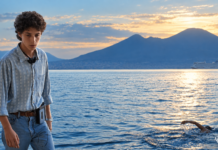
 Happy as Lazzaro (Lazzaro felice) asks a deceptively simple question: what happens to a person who treats everyone with kindness in a world built around advantage?
Written and directed by Alice Rohrwacher, this 2018 Italian film combines rural drama, social criticism, and the strange logic of a fairy tale. At its center stands Lazzaro, a young farmworker whose generosity unsettles the people around him. Adriano Tardiolo plays him with a quiet, attentive presence that gives the film its emotional force.
The story begins in an isolated farming community. However, its concerns reach far beyond the countryside. Through Lazzaro, Rohrwacher examines work, friendship, inequality, and the promises of progress.
For readers exploring the best Italian movies of all time, this is a distinctive example of cinema that finds room for both social observation and wonder.
The Story
Spoiler notice: This section discusses the opening story and its major change of setting, but leaves the ending undisclosed.
Lazzaro lives at Inviolata, an isolated estate controlled by Marchesa Alfonsina de Luna. The community grows tobacco and works within a system that keeps its members dependent on the landowner.
Daily life revolves around physical labor, crowded rooms, and instructions from others. Lazzaro accepts almost every request. When someone needs help, he responds without bargaining or asking what he might receive in return.
Then Tancredi, the Marchesa’s son, draws him into a plan to stage his own kidnapping. Their unlikely friendship opens a door in Lazzaro’s restricted world. For the first time, someone seems to offer him a special place in their life.
Yet the relationship carries a deep imbalance. Tancredi can treat rebellion as an adventure because privilege gives him choices. Lazzaro approaches their bond with a sincerity that Tancredi does not always match.
The film later moves into an urban world through an extraordinary break in ordinary time. Rohrwacher presents this shift with the calm confidence of a storyteller recounting a familiar legend. She gives viewers space to accept the mystery rather than explaining every detail.
That change also reshapes the film’s central question. Leaving an exploitative rural order should promise a better life. But does a new setting necessarily bring greater dignity?
The countryside offers beauty without freedom. The city offers movement without belonging. Between them, Lazzaro remains a point of emotional continuity.
His kindness exposes what other people have learned to accept. Through his eyes, familiar arrangements begin to look deeply strange.
Cast and Characters
Adriano Tardiolo as Lazzaro
Tardiolo makes Lazzaro compelling through small gestures and sustained attention. He listens, waits, and looks directly at the people speaking to him. His performance rarely asks the audience for sympathy.
The role marked his acting debut. The production discovered him at a school in Orvieto during an extensive casting search.
Crucially, Lazzaro’s trusting behavior does not require a medical label. The film invites us to consider his way of relating to others, including the ease with which people exploit it.
Luca Chikovani and Tommaso Ragno as Tancredi
Chikovani plays the younger Tancredi, while Ragno takes the role later in life. Tancredi brings excitement and possibility into Lazzaro’s experience. However, charm does not erase the unequal terms of their friendship.
Agnese Graziani and Alba Rohrwacher as Antonia
Graziani portrays the younger Antonia, and Alba Rohrwacher plays her adult counterpart. Antonia provides an essential emotional connection between the film’s different worlds.
Her presence gives the story a sense of remembered experience. Through her, the past remains something people have lived, carried, and struggled to understand.
Nicoletta Braschi as Marchesa Alfonsina de Luna
Braschi makes the Marchesa’s authority feel habitual. She does not need constant outbursts to establish control. Her power rests on the assumption that other people’s labor belongs at her disposal.
Sergi López as Ultimo
López adds a further human presence to the ensemble as Ultimo. Around these central figures, the larger cast creates a community with its own routines, tensions, and ways of surviving.
Awards and Recognition
Happy as Lazzaro competed at the 2018 Cannes Film Festival, where Alice Rohrwacher received the Best Screenplay award. She shared the prize with 3 Faces, written by Jafar Panahi and Nader Saeivar.
The screenplay award recognizes an especially striking achievement. This is a film that changes its setting and relationship to time while maintaining a clear emotional center.
Its structure encourages viewers to reconsider what they have already seen. Early details acquire new meaning, and the apparent distance between the rural and urban worlds begins to shrink.
The Cannes recognition also continued Rohrwacher’s established relationship with the festival. Her previous feature, The Wonders, had won the Grand Prix in 2014.
Nevertheless, Happy as Lazzaro has an identity of its own. Its mix of tenderness, humor, and unease gives the social argument an unusual shape. The film can feel intimate in one moment and almost mythic in the next.
How the Film Was Made
Rohrwacher has explained that a real account helped inspire the story. It concerned a landowner who kept isolated agricultural workers unaware of changes affecting their working arrangements.
The film develops that starting point into a fable. It explores how people can remain outside social change, even while others announce the arrival of a new era.
Filming took place during summer and winter in 2017. Rural locations included the area around Vetriolo and Bagnoregio, as well as Castel Giorgio. The urban sequences used Milan, Turin, and Civitavecchia.
The production shot on Super 16mm film. Rohrwacher described this choice in terms of the attention and preparation that working with film demands, rather than nostalgia alone.
Cinematographer Hélène Louvart gives the images a tactile quality. Faces, stone, leaves, and worn interiors seem to belong to the same physical world. Meanwhile, editor Nelly Quettier helps the story move between everyday observation and startling changes of rhythm.
The visual texture supports the film’s uncertainty about time. Inviolata can initially seem remote from modern life, but small details complicate that impression. Viewers must gradually revise their assumptions.
Just as effectively, Rohrwacher avoids presenting the countryside as an uncomplicated refuge. Beautiful surroundings do not make the workers’ conditions acceptable.
The result is a film in which realism and fantasy support each other. Physical detail makes the world convincing. Mystery then allows the story to ask questions that a strictly realistic account might approach differently.
Why It Still Matters
The strongest idea in Happy as Lazzaro is that progress should be judged through people’s lives.
A change of address, employer, or economic system can look impressive from a distance. Up close, however, the same people may still face insecurity and exclusion. Rohrwacher gives that gap an emotional form.
The film also considers how exploitation travels through a community. People who suffer under authority can still pass demands down to someone with even less power. Lazzaro repeatedly occupies that lowest position.
Consequently, the story asks more of viewers than simply identifying a cruel landowner. It encourages us to notice ordinary habits: who performs the extra work, who receives thanks, and whose time seems endlessly available.
Friendship provides another demanding theme. Lazzaro’s loyalty is moving because it does not depend on reward. Yet that same loyalty leaves him vulnerable to people who enjoy affection without accepting responsibility.
The film allows tenderness and discomfort to exist together. We can feel the beauty of a bond while questioning whether both people understand it in the same way.
Religious associations also shape the viewing experience. Lazzaro’s name invites thoughts of Lazarus, while the story’s imagery suggests innocence, renewal, and sacrifice. These connections enrich the film without requiring viewers to share a particular faith.
For me, its most powerful question is practical: would we recognize goodness if it appeared without status, confidence, or social power?
Rohrwacher does not turn that question into an easy lesson. Instead, she lets it remain troubling.
The title itself contributes to this tension. Lazzaro’s openness can look like happiness, but the world around him is often painful. His presence does not excuse that pain or make hardship admirable.
That balance gives Happy as Lazzaro its lasting force. It asks us to value kindness while paying close attention to the conditions in which people must live.
Where to Watch or Buy
Availability checked on October 5, 2026. Catalogs and purchasing options can change.
United States: subscription streaming
Current U.S. listings show Happy as Lazzaro on Netflix, including its plan with advertisements. You can check the film’s Netflix page or consult JustWatch’s U.S. listing.
The checked U.S. listing did not show separate digital rental or purchase options. Netflix access is subscription viewing, rather than ownership of a digital copy.
Italy: free streaming and digital rental
In Italy, current listings show the film on RaiPlay, free with advertisements. Visit the official Lazzaro felice page on RaiPlay.
Italian rental options are also listed through Apple TV Store, Rakuten TV, and Amazon Video. These are separate transactions; an Amazon rental does not mean the film is included with Prime.
Check JustWatch Italy for the current offers. Confirm whether you are selecting rental or purchase before paying.
DVD and Blu-ray
Italian DVD and Blu-ray editions have been released. For current sellers and editions, use these searches:
- Find Happy as Lazzaro DVD and Blu-ray editions on Amazon.com.
- Find Lazzaro felice DVD and Blu-ray editions on Amazon.it.
These links lead to search results, rather than a verified in-stock edition. Before ordering, check the disc region, subtitle languages, and compatibility with your player. This is especially useful when buying an imported copy.
Watching while traveling
RaiPlay titles may carry geographic restrictions. If you use NordVPN for privacy while traveling, remember that a VPN does not guarantee access to any particular film. Availability still depends on the service’s licensing and terms.
Affiliate disclosure: Italia Mia may earn a commission from qualifying purchases through the Amazon and NordVPN links, at no additional cost to you.
External Sources
- Festival de Cannes: Happy as Lazzaro, credits and award
- Official press kit: director’s notes and production background
- The Match Factory: film information
- RaiPlay: Lazzaro felice
- JustWatch: United States availability
- JustWatch: Italian availability