 Some films tell a family’s story so powerfully that an entire country seems to emerge through it. Luchino Visconti’s Rocco and His Brothers, released in 1960 as Rocco e i suoi fratelli, is one of them.
Its setting is Milan, where the Parondi family arrives from southern Italy hoping to build a better life. Work, housing, love and ambition pull the brothers in different directions. What begins as a story of opportunity becomes a painful examination of loyalty and the damage people can cause in the name of family.
For me, its central question is what makes it so compelling: when does protecting someone you love become a way of protecting them from responsibility?
The Story
Content notice: the film contains sexual assault, domestic abuse and murder. The following synopsis includes a significant mid-film spoiler but leaves the ending undisclosed.
After her husband’s death, Rosaria Parondi leaves Lucania, the historic name associated with present-day Basilicata, for Milan with four of her sons. Her eldest, Vincenzo, has already established himself there. Their arrival disrupts his engagement celebrations and quickly exposes the difficulties of fitting a large, impoverished family into a new life.
The brothers gradually find separate paths. Simone sees boxing as a route to money and recognition. Rocco, gentler and more self-sacrificing, works and later completes military service. Ciro moves toward industrial employment, while young Luca watches the family change around him.
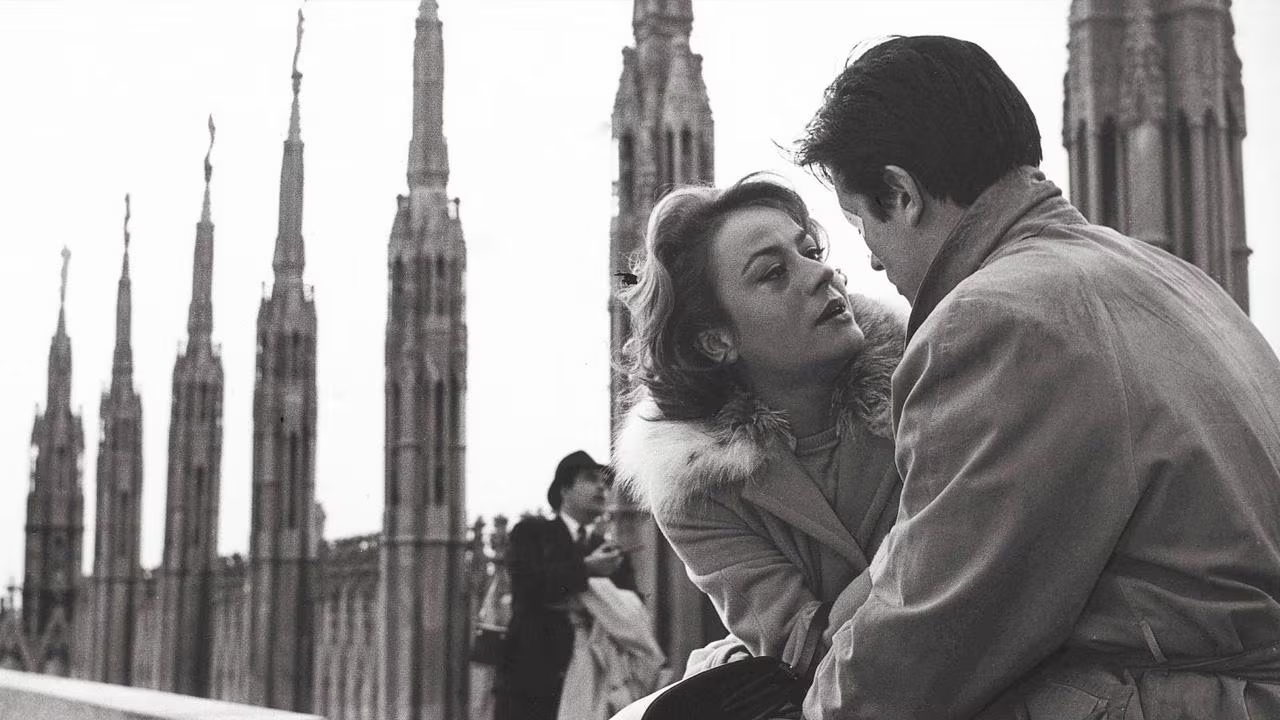
The emotional conflict develops through Nadia, a sex worker who first becomes involved with Simone and later falls in love with Rocco. Simone’s jealousy turns violent: he assaults Nadia in front of his brother. Rocco’s subsequent attempt to repair the family by relinquishing their relationship becomes one of the film’s most disturbing moral decisions.
I find Rocco’s compassion increasingly difficult to separate from his refusal to confront what Simone has done. Visconti makes that discomfort essential to the drama. Good intentions offer little protection when they require another person to suffer.
Cast and Characters
Alain Delon as Rocco Parondi
Delon gives Rocco a quiet, sorrowful presence. His gentleness makes him sympathetic, but his determination to forgive raises difficult questions about judgment and responsibility.
Renato Salvatori as Simone Parondi
Simone is physically imposing, ambitious and increasingly destructive. Salvatori makes his decline frightening without reducing him to a simple villain.
Annie Girardot as Nadia
Girardot supplies much of the film’s emotional force. Nadia’s hope for a different life deserves attention in its own right, beyond her place in the brothers’ conflict.
Katina Paxinou as Rosaria Parondi
The family matriarch sees unity as a necessity. Her fierce attachment to her sons helps explain both the family’s resilience and its resistance to change.
Spiros Focas as Vincenzo, Max Cartier as Ciro, and Rocco Vidolazzi as Luca
The other brothers widen the story beyond Rocco and Simone. Each represents a different relationship with work, independence and the family’s southern origins.
Claudia Cardinale as Ginetta
As Vincenzo’s fiancée, Ginetta belongs to the life he is trying to establish in Milan. Her presence helps reveal the competing demands of marriage and family obligation.
Awards and Recognition
Rocco and His Brothers received the Special Jury Prize at the 1960 Venice Film Festival. Producer Goffredo Lombardo subsequently received the 1961 David di Donatello award for Best Producer.
Its standing also extends beyond its original awards. The film was included in the selection of “100 Italian films to be saved,” assembled in 2008 with support from Italy’s Ministry of Cultural Heritage.
That recognition makes sense to me because the film preserves more than a memorable drama. It captures the uncertainty of people entering a rapidly changing society while carrying expectations formed somewhere else.
Readers following Italia Mia’s Italian movies series will find it a particularly rewarding companion to Visconti’s The Leopard: both examine historical change through intimate relationships.
How the Film Was Made
Visconti developed the screenplay with Suso Cecchi d’Amico, Pasquale Festa Campanile, Massimo Franciosa and Enrico Medioli. Its sources included Giovanni Testori’s Il ponte della Ghisolfa, alongside wider literary influences.
Much of the filming took place in and around Milan. The production encountered controversy and censorship over its violence, and shortened versions circulated after release.
Giuseppe Rotunno’s black-and-white cinematography and Nino Rota’s score give the film its distinctive mixture of physical immediacy and operatic emotion. Streets, rooms and boxing venues feel tangible, while the music allows private suffering to expand across the drama.
A later 4K restoration by the Film Foundation and Cineteca di Bologna became the basis of Milestone’s restored home-video editions. These offer a valuable way to appreciate the photography’s detail and tonal range. A restoration completed in 4K does not, by itself, mean that every disc or stream is presented in 4K.
For a first viewing, I would choose a restored edition running approximately three hours and check its language and subtitle specifications.
Why It Still Matters
The film’s portrayal of migration feels particularly important. The Parondis move within Italy, yet the distance between their old and new lives is enormous. Finding employment is only part of the adjustment. They must also reconsider how they live together and what they owe one another.
I find Ciro especially interesting because he offers another way of understanding responsibility. His position invites us to ask whether caring for a family sometimes requires challenging its rules.
Nadia also changes how the film should be discussed today. Describing her simply as the woman who comes between two brothers misses the seriousness of what happens to her. Her wishes are repeatedly subordinated to male jealousy and family reconciliation. A sympathetic reading of Rocco should still confront the consequences of his decisions.
Visconti’s style gives these questions unusual force. The heightened emotions can feel overwhelming, but that intensity makes the family’s contradictions impossible to ignore. Love, sacrifice and forgiveness acquire a frightening ambiguity.
Where to Watch or Buy
Availability checked on September 30, 2026. Catalogs, prices and viewing rights can change; confirm the offer for your country before subscribing or paying.
United States: subscription streaming
The Criterion Channel has a film page with a viewing option. Current U.S. listings also identify OVID, Kino Film Collection and Darkroom. Kanopy and Hoopla are listed as additional options, subject to access through participating libraries or institutions.
United States: digital rental or purchase
U.S. listings identify Amazon Video, Apple TV Store and Fandango at Home for rental and digital purchase. These are separate transactions from subscription streaming. Use the U.S. availability guide to compare current offers.
Italy: free and subscription streaming
Italian listings identify RaiPlay as a free option with advertising, alongside MUBI, MUBI Amazon Channel and Novecento Amazon Channel. Channel subscriptions may require payment beyond an ordinary Prime membership.
Italy: digital rental or purchase
Amazon Video, Apple TV Store and Rakuten TV are listed for rental and purchase. Check the Italian availability guide for current offers and language information.
DVD and Blu-ray editions
Milestone documents restored U.S. DVD and Blu-ray editions. Rai Home Video documents an Italian restored DVD with Italian audio and English subtitles. These publisher pages establish the editions’ specifications; retailer stock and individual listings still need checking.
To compare current marketplace listings, use these affiliate searches:
Search Amazon.com for Rocco and His Brothers DVD and Blu-ray editions
Search Amazon.it for Rocco e i suoi fratelli DVD and Blu-ray editions
These links open search results rather than a verified individual product. Before ordering, check the restoration, subtitles, disc region and compatibility with your player.
Watching Italian services while traveling
If you use Italian television services while abroad, NordVPN is an option to consider for your connection. Access to a particular film is not guaranteed: geographic restrictions and each platform’s terms still apply.
Affiliate disclosure: Italia Mia may earn a commission from qualifying purchases through the Amazon and NordVPN links above. As an Amazon Associate, I earn from qualifying purchases.
External Sources
Turner Classic Movies: film history, production and cast
Treccani: Rocco e i suoi fratelli
Milestone Films: restoration and home-video editions
Rai Home Video: Italian restored DVD
JustWatch: United States viewing options
JustWatch: Italian viewing options