
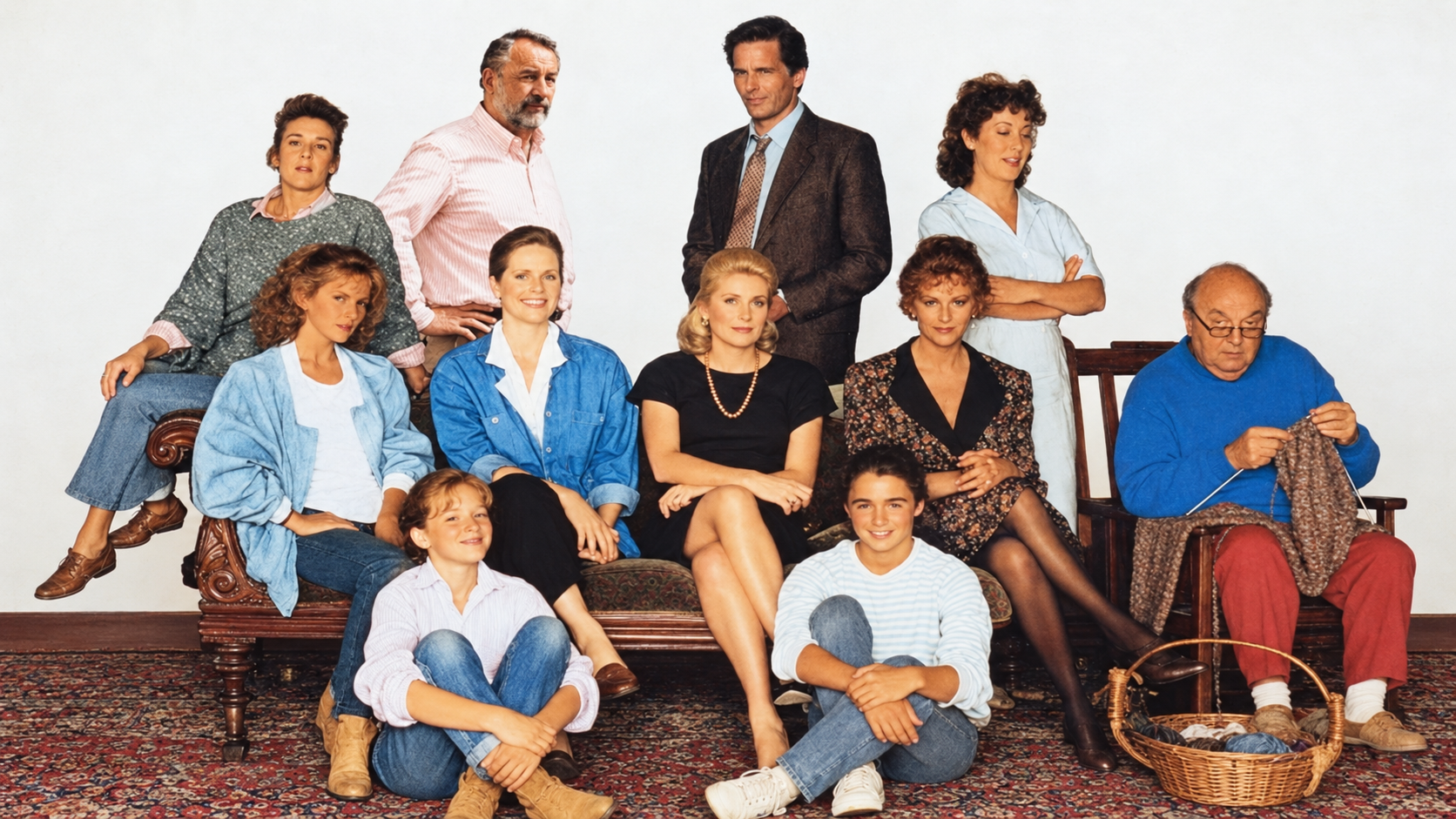
 Let’s Hope It’s a Girl (Speriamo che sia femmina, 1986) brings together a remarkable cast for a story about family, money, and the work of keeping a household together. Directed by Mario Monicelli, this Italian-French comedy-drama stars Liv Ullmann, Catherine Deneuve, Giuliana De Sio, and Stefania Sandrelli.
Its country setting promises peace. Yet behind the farmhouse doors lie unpaid bills, difficult relationships, and plans that rarely survive contact with everyday life. The women must decide what they can expect from others—and what they can build together.
For readers exploring our guide to the best Italian movies, this film offers a rewarding change of pace. Its drama grows through conversations, practical decisions, and the slow recognition that affection alone cannot pay the bills.
The Story
Spoiler notice: This section discusses major developments and the ending.
Elena lives on a Tuscan estate after separating from her husband, Leonardo. She manages the property while Fosca, the housekeeper, helps sustain a household that includes children and elderly Uncle Gugo.
Leonardo returns with a proposal to revive thermal baths on the estate. However, Elena already faces financial strain. His scheme adds pressure instead of offering a dependable solution.
After Leonardo dies in an accident, the household approaches a crossroads. Selling the property seems possible, and several residents consider leaving. Meanwhile, disappointments elsewhere draw the women back toward the home they had imagined abandoning.
Elena ultimately chooses to keep the estate. Her older daughter’s pregnancy gives the title its immediate meaning, while the family’s decision gives it a broader one.
The ending leaves the practical difficulties unresolved. Staying together requires work, compromise, and shared responsibility. That makes the hopeful final movement more persuasive: these women choose solidarity with a clear view of the problems ahead.
Cast and Characters
The cast gives Let’s Hope It’s a Girl its richness. Characters belong to the same household without sharing the same expectations, resources, or needs.
| Actor | Character | Place in the story |
|---|---|---|
| Liv Ullmann | Elena | The separated wife who manages the estate |
| Catherine Deneuve | Claudia | Elena’s sister, an actress with a life in Rome |
| Giuliana De Sio | Franca | Elena’s older daughter |
| Lucrezia Lante della Rovere | Malvina | Elena’s younger daughter |
| Athina Cenci | Fosca | The housekeeper whose care sustains daily life |
| Stefania Sandrelli | Lolli | Leonardo’s partner |
| Philippe Noiret | Leonardo | Elena’s estranged husband |
| Bernard Blier | Uncle Gugo | The older relative who lives with the family |
| Giuliano Gemma | Nardoni | The estate manager |
| Paolo Hendel | Giovannini | The academic involved with Franca |
Ullmann’s role provides a useful way into the ensemble. Elena must think beyond her immediate feelings because decisions about the property affect everyone. Her authority comes with a burden: other people can imagine leaving, but she must consider what happens to the home itself.
Fosca brings a different kind of authority. Her position invites us to notice how much a household depends on the person who attends to daily needs. Giving that work dramatic weight is one of the film’s strongest choices.
Meanwhile, Claudia, Franca, Malvina, and Lolli prevent the story from presenting one model of womanhood. Their relationships and ambitions differ. Sharing a home does not erase those differences.
Awards and Recognition
Speriamo che sia femmina won seven David di Donatello awards in 1986:
- Best Film.
- Best Director — Mario Monicelli.
- Best Producer — Giovanni Di Clemente.
- Best Screenplay — Leo Benvenuti, Suso Cecchi d’Amico, Piero De Bernardi, Mario Monicelli, and Tullio Pinelli.
- Best Supporting Actress — Athina Cenci.
- Best Supporting Actor — Bernard Blier.
- Best Editing — Ruggero Mastroianni.
The range of awards matters. Recognition extended across writing, performance, direction, production, and editing, reflecting the film’s strength as an ensemble work.
It also received three Nastri d’Argento honors. The official 1986 archive names Monicelli as director of the best film and recognizes the screenplay. It lists Mastroianni’s editing under “exceptional technical qualities,” a distinction often shortened to Best Editing in film summaries.
The film’s life continued beyond its original release. Bologna’s Il Cinema Ritrovato screened it in 2023 within its program devoted to Suso Cecchi d’Amico. That context encourages viewers to appreciate the writing as much as the famous faces.
How the Film Was Made
The film began with a story by Tullio Pinelli. Five writers shaped the screenplay: Pinelli, Monicelli, Suso Cecchi d’Amico, Leo Benvenuti, and Piero De Bernardi. Giovanni Di Clemente produced the film through Clemi Cinematografica, with France’s Les Producteurs Associés.
The principal creative credits include Camillo Bazzoni for cinematography, Ruggero Mastroianni for editing, and Nicola Piovani for music.
The screenplay’s central challenge is easy to underestimate. It must introduce a large household, explain several relationships, and make a financial crisis emotionally meaningful. Each person needs enough space to become more than a supporting detail in Elena’s life.
The estate helps give those stories a common focus. It is a workplace, an asset, and a home. Consequently, the question of selling it carries several meanings at once. One decision can offer financial relief while threatening a child’s security or an adult’s sense of belonging.
The setting also complicates the appeal of rural life. A beautiful property demands maintenance and income. Through that tension, the film gives its family story a material foundation.
Its ensemble structure rewards attention to how people affect one another. A romantic disappointment can change household plans. A proposal about money can expose an imbalance of power. Comedy and discomfort grow from the same relationships.
Why It Still Matters
Let’s Hope It’s a Girl remains compelling as a story about who takes responsibility when other people’s plans fall apart.
The most useful way to approach its gender politics is through the characters’ actions. The women increasingly rely on one another because experience has tested the alternatives. Their solidarity develops through choices, frustration, and necessity.
That reading leaves room for their flaws. Elena can make difficult decisions without becoming an ideal leader. Claudia can want independence while placing demands on others. Affection and selfishness can exist within the same relationship.
The household also raises a question about class. Elena and Fosca share daily problems, but they occupy different positions. Ownership and domestic employment carry different forms of power. A generous reading of their bond should still recognize that distinction.
Another lasting theme is the value of care. Feeding children, organizing a home, and supporting an older relative may seem like background activities. Here, they help explain how a family functions. The story asks us to notice the labor that allows everyone else to pursue their plans.
There is also room to question the title. Hoping for a girl reverses a familiar preference for a male heir. As a dramatic gesture, it expresses hope that the next generation might inherit different expectations. It need not become a claim that character or competence depends on gender.
Finally, the ending gives togetherness a practical meaning. A shared home requires people to keep showing up. Its hope rests on that continuing effort, which makes the film relevant far beyond its 1980s setting.
Where to Watch or Buy
Listings reviewed on October 5, 2026. Some guides show earlier update dates; availability, prices, and language options should be checked on the provider before payment.
United States: streaming, rental, and purchase
JustWatch’s U.S. guide lists Amazon Video rental and digital purchase. It does not list an included subscription option or free streaming. An Amazon Video listing does not mean the film is included with Prime membership.
Use this Amazon.com search for Let’s Hope It’s a Girl to locate the digital edition. Confirm English subtitles on the exact version offered to your account.
Italy: free streaming and rental
JustWatch’s Italian guide lists free streaming with advertisements on Rakuten TV. It also lists rental options through Amazon Video, Apple TV Store, Rakuten TV, CHILI, and TIMVISION.
You can check the Italian Apple TV film page or search Amazon.it for the film. Apple’s page lists Italian audio; check subtitles separately. Store rentals are distinct from subscription access.
DVD and Blu-ray
JustWatch lists a Blu-ray offer through Amazon in the United States, while Italian retailers list DVD editions. Compare the exact release before ordering:
The Italian Amazon link is a search link, not a verified in-stock edition. For imported discs, check region compatibility, audio, and English subtitles.
Watching while traveling
If you use a VPN while traveling, you can explore NordVPN through Italia Mia’s affiliate link. A VPN does not guarantee access to this film or any particular catalog. Follow the streaming service’s terms and territorial rules.
Affiliate disclosure: Italia Mia may earn a commission from qualifying purchases through the Amazon and NordVPN links above, at no additional cost to you.
External Sources
- Cinematografo — synopsis, production credits, and awards.
- Il Cinema Ritrovato — credits and 2023 screening.
- Nastri d’Argento — official 1986 awards.
- Minerva Pictures International — film catalog.
- Apple TV Italy — cast and language listing.
- JustWatch — United States.
- JustWatch — Italy.
- IBS — Italian DVD edition.