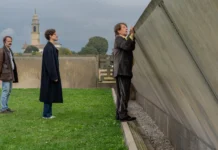

Gomorrah (2008), released in Italy as Gomorra, examines organized crime through the people who work within its reach. Directed by Matteo Garrone and adapted from Roberto Saviano’s investigative book, it follows five stories connected by the Camorra in Campania.
There is no comforting distance between criminal business and ordinary life. Money passes through apartment corridors, skilled workers face threats, and industrial waste becomes a source of profit. Meanwhile, young people learn that belonging can carry a terrible price.
The result is a demanding and powerful Italian film. For readers exploring our guide to the best Italian movies of all time, Gomorrah offers an essential perspective on contemporary cinema and its ability to confront uncomfortable realities.
The Story
Spoiler notice: This section discusses the main situations and themes but avoids revealing the central characters’ final outcomes.
Gomorrah moves between five storylines in Naples and the surrounding area. Instead of following a single criminal leader, Garrone shows how the Camorra affects people at different levels of power.
Totò is a boy who delivers groceries and watches the local drug trade with growing interest. He wants acceptance from the older people around him. However, joining their world means facing demands that steadily erode the boundary between childhood and violence.
Don Ciro occupies another vulnerable position. He distributes payments to families connected to imprisoned clan members. His work requires him to enter homes, hear complaints, and maintain a routine. When rival factions fight, that routine becomes dangerous.
Elsewhere, Marco and Ciro imagine themselves as independent gangsters. They imitate the swagger of movie criminals and believe that weapons will make them powerful. Yet their confidence rests on a serious misunderstanding of the people who control their surroundings.
The other stories widen the film’s view of criminal enterprise. Pasquale is a gifted tailor whose work connects small workshops with the fashion industry. When he secretly teaches workers at a competing Chinese-run workshop, he risks upsetting the interests that govern his livelihood.
Meanwhile, Roberto begins working with Franco, a businessman involved in illegal waste disposal. The job exposes him to an economy in which cutting costs matters more than protecting workers or the land.
These stories share a question: how much freedom does a person have when someone else controls their income, safety, or future?
Garrone rarely pauses to explain the entire structure. Instead, viewers discover it through transactions, threats, and small decisions. This approach can feel disorienting at first. Gradually, however, the connections become clear.
Cast and Characters
The cast gives Gomorrah much of its force. Garrone combines experienced performers with local nonprofessional actors, creating a world in which familiar faces never overwhelm the setting.
Toni Servillo plays Franco, the waste-disposal broker. His calm manner is crucial. Franco treats damaging decisions as routine business, which makes his confidence especially disturbing. Servillo suggests a man who has become fluent in explaining away the consequences of his work.
Gianfelice Imparato plays Don Ciro, the payment courier. His tense movements and cautious conversations communicate someone trying to attract as little attention as possible. Fear shapes the performance without requiring grand speeches.
Salvatore Cantalupo plays Pasquale, the tailor. He brings warmth and quiet pride to a character whose skill deserves more recognition than his working conditions allow. His scenes make the loss of professional dignity feel personal.
Maria Nazionale plays Maria, a woman caught in the conflict surrounding the clans. Her presence gives emotional weight to the pressures reaching into domestic life.
Salvatore Abruzzese plays Totò, while Marco Macor and Ciro Petrone play Marco and Ciro. These young characters approach the criminal world with different expectations. Together, they reveal how the desire for status and belonging can become a means of exploitation.
Carmine Paternoster plays Roberto, whose work alongside Franco raises questions about personal responsibility. Watching him observe his employer creates a tension between professional opportunity and moral judgment.
Awards and Recognition
Gomorrah won the Grand Prix at the 2008 Cannes Film Festival. This was a major international achievement for Garrone. It should not be confused with the Palme d’Or, a separate award.
The film also dominated the 2008 European Film Awards, winning five prizes:
- European Film.
- European Director for Matteo Garrone.
- European Actor for Toni Servillo, recognized for both Gomorrah and Il Divo.
- European Screenwriter for the writing team.
- European Cinematographer for Marco Onorato.
In Italy, it received seven David di Donatello awards in 2009, including Best Film, Best Director, and Best Screenplay. These honors recognized both its overall achievement and the craft behind its seemingly immediate style.
The international response helped establish Gomorrah as a central film in discussions of modern Italian cinema. Its impact came from more than its subject. Garrone found a dramatic form that made a complex criminal economy visible through individual lives.
How the Film Was Made
The starting point was Roberto Saviano’s 2006 book Gomorra. Although its storytelling has literary qualities, the source is a work of investigative nonfiction. The film adapts selected material into five dramatic strands rather than attempting to reproduce the entire book.
Six writers share the screenplay credit: Maurizio Braucci, Ugo Chiti, Gianni Di Gregorio, Matteo Garrone, Massimo Gaudioso, and Roberto Saviano. Domenico Procacci produced the film, with Fandango and Rai Cinema involved in the production.
The locations contribute directly to the storytelling. Housing complexes, workshops, roads, and disposal sites show how people move through spaces shaped by money and power. Doors and corridors often seem to offer little privacy or protection.
At the Cannes press conference, Garrone explained that war reporting influenced his approach. He wanted the filmmaking to feel unobtrusive and to place viewers inside the environment. He also described local residents watching the shoot, offering advice, and taking part.
Cinematographer Marco Onorato and editor Marco Spoletini helped shape this effect. The camera stays close to everyday activity, while the editing moves between stories without forcing them into a single conventional plot.
Much of the dialogue uses Neapolitan and local speech. This gives conversations a particular rhythm and makes language part of the setting. For viewers who do not understand it, good subtitles are especially valuable.
Despite its documentary-like texture, Gomorrah remains a carefully constructed drama. Its framing, performances, and shifts in perspective guide our attention. The apparent simplicity takes considerable control.
Why It Still Matters
The enduring strength of Gomorrah lies in its understanding of power as something people encounter during ordinary activities.
A payment, a job offer, or a chance to earn more money can create dependence. Violence supports that dependence, but it does not need to appear in every scene. Often, the possibility of violence is enough.
The film also connects street-level intimidation with wider economic interests. Pasquale’s story raises questions about the distance between skilled labor and the prestige attached to finished products. Franco’s business exposes the human and environmental costs hidden behind cheap disposal.
Together, these strands invite viewers to look beyond the person holding a weapon. Who benefits from the arrangement? Who absorbs the damage? Who can afford to walk away?
Marco and Ciro introduce another troubling idea: cinema itself can supply the gestures through which young people imagine power. They mistake a screen image for a practical understanding of danger. Their behavior makes the gap between fantasy and control painfully clear.
At the same time, the film’s setting requires careful interpretation. The Camorra does not represent everyone in Naples or Campania. These communities contain lives, work, and experiences far beyond the criminal structures shown here. Treating the film as a complete portrait of southern Italy would erase that complexity.
Its attention to exploitation should instead encourage empathy for people living under pressure. Characters make different choices, but those choices do not occur under equal conditions.
For me, the most important critical question raised by Gomorrah is how to show criminal power without making it attractive. Garrone’s answer lies in vulnerability, routine, and consequence. Even moments of bravado reveal how little security the characters possess.
This is why the film remains worth watching. It asks for attention and offers few easy reassurances. In return, it expands what a crime drama can examine.
Where to Watch or Buy
Availability checked on October 5, 2026. Catalogs, prices, and subtitle options can change. Select Matteo Garrone’s 2008 film when searching; the later television series is a separate production.
United States: subscription streaming
The current JustWatch U.S. listing for Gomorrah lists Amazon Prime Video, including its advertising-supported subscription option. Confirm that the film is included with your account before watching.
United States: digital rental or purchase
The same listing identifies Amazon Video, Apple TV Store, and Fandango at Home for rental and digital purchase. These transactions are separate from subscription access.
Italy: subscription streaming
The JustWatch Italy listing for Gomorra did not show an included subscription option when checked.
Italy: digital rental or purchase
It lists Amazon Video, Apple TV Store, Rakuten TV, and TIMVISION for rental or purchase. A store listing does not mean the film is included in a monthly subscription.
DVD and Blu-ray
The Criterion Collection edition offers DVD and Blu-ray options. Its extras include a making-of documentary, interviews, deleted scenes, and an English subtitle translation.
You can also compare physical editions through these Amazon searches:
Check the director, release year, disc region, and subtitle languages before ordering. Imported editions can have different playback requirements.
Watching while traveling
If you use Italian services while abroad, check their travel and account rules. NordVPN is an option for protecting your connection on shared networks. A VPN does not guarantee access to a particular film or replace a required subscription or rental.
Affiliate disclosure: Italia Mia may earn a commission from qualifying purchases through the Amazon and NordVPN links, at no additional cost to you.
External Sources
- Festival de Cannes: Gomorra and its Grand Prix
- Festival de Cannes: 2008 press conference
- European Film Academy: 2008 awards
- David di Donatello: Gomorra awards
- Criterion Collection: Gomorrah
- JustWatch: United States availability
- JustWatch: Italian availability