
 Few Italian films have reached an international audience as broad as Life Is Beautiful, Roberto Benigni’s 1997 film known in Italian as La vita è bella. Its combination of romance, comedy and devastating loss earned extraordinary recognition, including three Academy Awards. It also prompted a serious debate about how cinema should represent the Holocaust.
Benigni directs, co-writes and stars as Guido Orefice, a Jewish Italian man whose imagination becomes a means of protecting his young son. The film’s emotional appeal rests on that relationship, but its place in cinema history also requires us to consider what its fable reveals—and what it leaves outside the frame.
Within Italia Mia’s selection of Italian movies, Life Is Beautiful deserves attention for both its artistic achievement and the difficult questions it raises.
The Story
Spoiler notice: This section describes the premise and the transition into the film’s wartime story, without revealing the ending.
The film opens in Tuscany during the late 1930s. Guido arrives with his friend Ferruccio, finds work as a waiter and falls in love with Dora, a schoolteacher already promised to another man. His courtship unfolds through improbable encounters, elaborate improvisations and an apparently inexhaustible appetite for life.
These early scenes establish the film’s comic language. Guido seems able to turn ordinary inconveniences into little theatrical performances. His greeting to Dora, “Buongiorno, principessa!”, becomes an expression of the private world he creates around their relationship.
Yet the romance takes place within Fascist Italy. Antisemitism intrudes through insults, exclusion and the growing restrictions imposed on Jewish life. The warmth of the central love story never entirely removes that threat.
Several years later, Guido and Dora have a son, Giosuè. Guido and the boy are deported to a Nazi concentration camp. Dora, who is not Jewish, insists on joining the transport rather than abandoning her family. At the camp, she is separated from them.
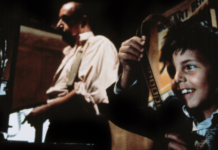
Guido invents an elaborate game to conceal the camp’s purpose from Giosuè. He tells him that obeying certain rules will earn points toward a spectacular prize: a real tank. Hunger, silence and hiding are recast as challenges within this imaginary competition.
The audience understands the danger that the child cannot fully grasp. Much of the film’s force comes from this gap between Guido’s performance and the reality surrounding it. His comic energy becomes exhausting work: a father constantly improvising to keep his son alive and shield him from terror.
Cast and Characters
Roberto Benigni as Guido Orefice: The film’s central performance moves from exuberant physical comedy to the strain of maintaining reassurance under unimaginable pressure.
Nicoletta Braschi as Dora: Her quiet presence gives the romance emotional weight, while her decision to follow her family establishes her courage.
Giorgio Cantarini as Giosuè: His directness and watchful expressions make the child’s dependence on Guido convincing.
Giustino Durano as Uncle Eliseo: Guido’s uncle connects the younger man to an older Jewish generation.
Horst Buchholz as Dr. Lessing: His fascination with riddles becomes an unsettling expression of moral blindness.
Sergio Bustric as Ferruccio and Marisa Paredes as Dora’s mother complete the principal supporting cast.
Awards and Recognition
Life Is Beautiful received seven nominations at the 1999 Academy Awards and won three:
Best Actor — Roberto Benigni.
Best Foreign Language Film — Italy, using the category’s name at the time.
Best Original Dramatic Score — Nicola Piovani.
Its other nominations were for Best Picture, Directing, Film Editing and Original Screenplay. Recognition across these categories placed an Italian-language production at the center of that year’s Oscar competition.
The film also won the Grand Prix at the 1998 Cannes Film Festival. This was the festival’s Grand Prix, rather than the Palme d’Or. Its international reception included the People’s Choice Award at the 1998 Toronto International Film Festival.
Those awards help explain its prominence, although acclaim did not produce agreement about its approach to history. Its popular success and the controversy surrounding it are both part of its legacy.
How the Film Was Made
Benigni wrote the screenplay with Vincenzo Cerami. Elda Ferri and Gianluigi Braschi produced the film for Melampo, with cinematography by Tonino Delli Colli, editing by Simona Paggi, production design and costumes by Danilo Donati, and music by Nicola Piovani.
The film’s structure depends on two contrasting movements. The first builds a romantic world of chance meetings, jokes and apparent miracles. The second transfers Guido’s capacity for invention into circumstances where maintaining that world becomes a desperate act of protection.
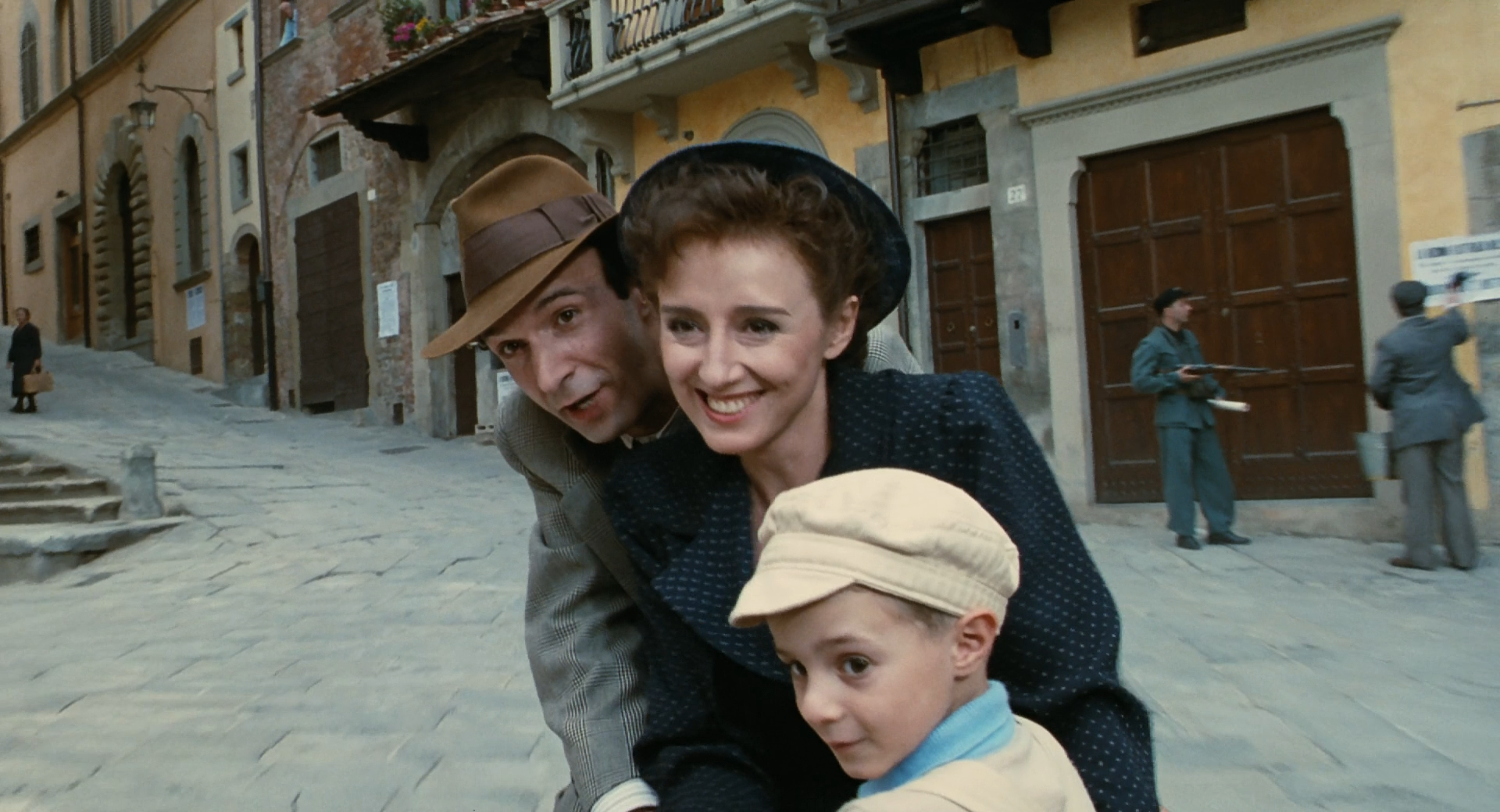
Several recognizable locations in Arezzo appear in the early scenes. Piazza Grande provides the setting for the family’s bicycle ride, while the Logge Vasari and streets around Via Cavour contribute to the courtship sequences. Tuscany’s official tourism website offers a guide to the film’s locations in Arezzo.
These attractive surroundings serve a narrative purpose. They give the family’s ordinary happiness a tangible setting before deportation destroys it.
Piovani’s music supplies another connection between the two halves. Its tenderness reinforces the memory of the family’s earlier life, giving familiar emotional themes a different weight as the story progresses.
Benigni’s treatment is deliberately shaped as a fable. That choice explains the film’s heightened situations, but it also lies at the heart of the debate about its representation of the camps.
Why It Still Matters
Life Is Beautiful remains powerful because it makes parental protection visible as a sustained effort. Guido has to keep finding words, gestures and explanations while facing circumstances he cannot control.
The humor changes meaning as the film develops. What begins as a way of winning Dora’s affection becomes a way of reassuring Giosuè. The same imaginative personality links the lover and the father.
But the film’s emotional effectiveness does not settle the question of historical representation. Scholars and critics have challenged its plausibility and asked whether its sentimental framework softens the Holocaust’s reality. Others have examined its use of allegory and the possibilities—and limits—of humor in representing catastrophe.
A particular concern involves Italy’s role in persecution. Historian Shira Klein argues that the film contributes to the comforting myth of the “good Italian,” obscuring the extent of Italian responsibility for antisemitism and the persecution of Jews. This is a substantive historical criticism, rather than simply a disagreement over whether the film is moving.
The historical context matters. Mussolini’s regime introduced antisemitic legislation in 1938. After the German occupation of northern and central Italy in 1943, persecution escalated into roundups and deportations; Italian Fascist authorities also participated. The United States Holocaust Memorial Museum’s account of Italy provides essential background.
The film should therefore be approached as a fictional work with a particular emotional perspective, alongside historical evidence and survivor testimony. Its exceptional survival story cannot explain who survived the Holocaust or why. Survival did not depend on possessing sufficient optimism, ingenuity or parental love.
For me, the most useful discussion holds the film’s compassion and its limitations together. We can recognize the force of Guido’s love while questioning the way the story translates genocide into a personal fable. That tension helps explain why Life Is Beautiful continues to generate discussion.
Where to Watch or Buy
Availability checked on September 29, 2026, for Italy and the United States. Catalogues, prices and subscription requirements can change.
Affiliate disclosure: Italia Mia may earn a commission from qualifying Amazon purchases and purchases made through the NordVPN link below.
Subscription streaming in Italy
JustWatch’s Italian listing currently identifies Netflix, Sky Go and NOW. NOW also has a direct Life Is Beautiful streaming page, confirming the film within its cinema offering. Sky Go access depends on the relevant Sky subscription. Check your account’s catalogue before subscribing specifically for this film.
Subscription streaming in the United States
The U.S. listing currently includes Paramount+ and MGM+, both directly and through selected channel subscriptions, as well as fuboTV and Philo. A Paramount+ or MGM+ channel within Amazon requires its own subscription; it should not be confused with inclusion in a standard Prime membership.
Digital rental and purchase
In the United States, JustWatch lists rental and digital purchase options through Amazon Video, Apple TV Store and Fandango at Home. The distributor links to this Amazon.com digital edition of Life Is Beautiful. Confirm the audio language, subtitles and transaction type before paying.
For Italy, the checked listing does not establish a current separate rental or purchase option. Consult the Italian availability page for updates rather than assuming the U.S. offer applies.
DVD and Blu-ray editions
A Life Is Beautiful DVD listing on Amazon.com was identified through the U.S. availability page. Confirm the selected format and seller at checkout, since Amazon can group several editions together.
For Italian editions, use this Amazon.it search for La vita è bella on DVD and Blu-ray. This is a search link; a specific Italian Amazon edition and its stock were not verified.
Before buying a disc, check its region compatibility, Italian soundtrack and English subtitles. An imported edition may have different language options, and a Blu-ray player does not automatically support every region.
Watching Italian services while abroad
If you use Italian streaming or television services while traveling, NordVPN offers a VPN option to consider. Access still depends on the service’s terms, your subscription and its location checks. A VPN does not guarantee access to this film or any particular Italian catalogue.
External Sources
Academy Awards: 1999 winners and nominees
Festival de Cannes: La vita è bella
Visit Tuscany: Life Is Beautiful in Arezzo
Shira Klein: Life Is Beautiful, or Not—The Myth of the Good Italian
United States Holocaust Memorial Museum: Italy
JustWatch: United States availability