
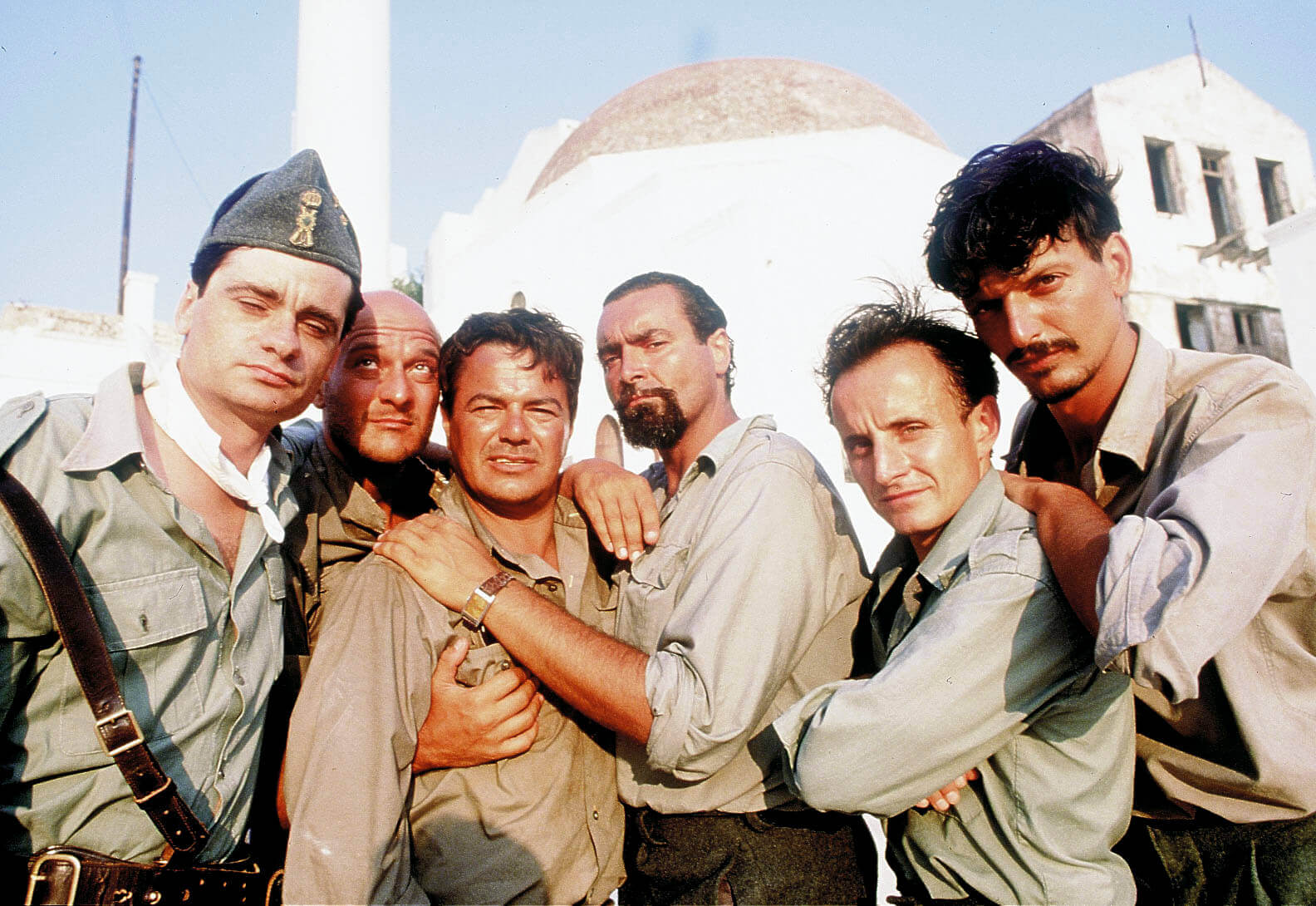
 Mediterraneo begins with a military assignment and gradually becomes a story about wanting a different life. Released in 1991, Gabriele Salvatores’ film follows eight Italian soldiers on a remote Greek island during the Second World War. Isolation gives them something their orders never promised: time to question what they want.
What interests me most is the sadness beneath its easygoing humor. The sea, village streets and friendships create an inviting world. Yet the film also asks an uncomfortable question: what happens when the place where you belong is somewhere you were never meant to stay?
Among the films in our Italian movies collection, Mediterraneo offers a particularly approachable blend of comedy, romance and reflection.
The Story
In 1941, eight Italian soldiers arrive on a small Greek island with orders to guard it. At first, the village appears deserted. However, its residents have been hiding, and they gradually emerge as they assess the newcomers.
After the soldiers lose their transport and radio contact, their assignment becomes an isolated existence. Orders no longer arrive. Meanwhile, the routines of island life begin to replace military discipline.
Each man responds differently. Lieutenant Montini finds an outlet for his artistic interests. Sergeant Lorusso struggles to maintain a sense of purpose. Farina develops a bond with Vassilissa, a local woman who works as a sex worker.
Football, conversation and romance fill the days. Nevertheless, the soldiers do not all share the same dream. For some, the island offers freedom. For others, separation from home remains painful.
Salvatores allows these differences to develop through small encounters rather than constant action. As a result, the question changes. We stop asking when the soldiers will leave and start wondering whether they still want to.
This is a wartime fable rather than a detailed account of the campaign in Greece. Its focus is the fragile community that forms when the men’s official mission loses its hold on them.
Cast and Characters
The ensemble gives Mediterraneo much of its warmth. Although several characters begin as familiar comic types, their contrasting needs make the group feel less predictable.
Diego Abatantuono plays Sergeant Nicola Lorusso. His authority, impatience and humor make him the most forceful presence among the soldiers. Beneath that confidence, however, lies a need to believe that returning home will mean something.
Claudio Bigagli plays Lieutenant Raffaele Montini, whose thoughtful manner provides a quieter center. His interest in art suggests an identity that military service has pushed aside.
Giuseppe Cederna brings tenderness to Antonio Farina. His relationship with Vassilissa, played by Vana Barba, gives the story its clearest possibility of building a new life.
Claudio Bisio plays Corrado Noventa, whose determination to return home challenges the others’ growing attachment to the island. Gigio Alberti appears as Eliseo Strazzabosco, while Ugo Conti plays Luciano Colasanti. Memo Dini and Vasco Mirandola complete the patrol as the Munaron brothers.
For me, the performances work best when the men simply spend time together. Their teasing, arguments and silences reveal how companionship can become a substitute for certainty.
Awards and Recognition
Mediterraneo won the Academy Award for Best Foreign Language Film at the 1992 Oscars. That was the category’s name at the time; it is now called International Feature Film. The award recognized Italy’s entry and remains the film’s best-known international achievement.
Its Italian recognition was also substantial. At the 1991 David di Donatello Awards, Mediterraneo won Best Film, sharing the prize with Francesca Archibugi’s Verso sera. It also received awards for Nino Baragli’s editing and Tiziano Crotti’s sound.
In addition, Salvatores won the 1992 Nastro d’Argento for Best Director. These honors recognized both the film’s broad appeal and the craft supporting its relaxed surface.
The Oscar offers a useful introduction, but it does not explain everything people find in Mediterraneo. Its enduring attraction also comes from an ordinary feeling: the wish to step away from a life that no longer seems to fit.
How the Film Was Made
Gabriele Salvatores directed Mediterraneo from a screenplay by Enzo Monteleone. Italo Petriccione handled the cinematography, while Giancarlo Bigazzi and Marco Falagiani composed the music. Nino Baragli edited the film.
The production filmed on Kastellorizo, a Greek island in the Dodecanese near the Turkish coast. Although Mediterraneo belongs to Italian cinema, its unforgettable landscape is Greek. The Hellenic Film Commission confirms Kastellorizo as the filming location.
That setting shapes the storytelling. The harbor and village create a close world in which people repeatedly cross paths. Meanwhile, the surrounding sea makes the soldiers’ separation from events elsewhere feel almost complete.
Petriccione’s images invite us to understand why the men become attached to the place. However, the beauty also supports the film’s central tension. A refuge can offer genuine happiness while allowing difficult questions to remain unanswered.
The music adds another layer. Its reflective passages give the comedy a sense of passing time, even when the characters seem content to ignore it.
Mediterraneo also shares themes with Salvatores’ earlier Marrakech Express and Turné. Across these films, travel and friendship give characters room to reconsider their lives. Here, that search unfolds within a group whose journey began as an order.
Why It Still Matters
Mediterraneo remains appealing because its central desire is easy to recognize. Many people have imagined leaving behind demands, disappointments or expectations. The soldiers receive that chance almost by accident.
However, the film becomes more interesting when escape stops looking simple. The men do not agree about where happiness lies. Some want to return to familiar lives. Others discover possibilities they could not have imagined at home.
I also find its treatment of friendship affecting. These relationships grow through shared routines rather than grand declarations. Spending time together becomes a source of stability when everything beyond the island feels uncertain.
At the same time, the film deserves a critical eye. Its affectionate portrait of the soldiers can soften the reality that they arrive as part of an occupying army. The islanders often serve the visitors’ emotional journeys, while the women receive less room to develop independent stories.
Recognizing those limits makes for a fuller reading. We can appreciate the film’s warmth while questioning whose experiences it places at the center.
Ultimately, Mediterraneo leaves me thinking about belonging. A beautiful place can change how we see our lives. Yet the deeper question is whether we can carry that understanding with us when circumstances change.
Where to Watch or Buy
Availability checked on October 2, 2026. Streaming catalogs, subtitle options and physical stock can change.
Italy: subscription streaming
Mediterraneo is listed on Netflix Italy and NOW. JustWatch also lists Sky Go for viewers with the relevant Sky access.
These are subscription options. Netflix’s Italian page currently lists Italian audio and Italian subtitles, so English-speaking viewers should check the language menu before subscribing specifically for this film.
Italy: digital rental or purchase
I could not verify a separate Italian rental or digital-purchase offer during this check. The current JustWatch Italy listing shows subscription services rather than a confirmed pay-per-film option.
United States: streaming and digital rental
I could not reliably confirm a current U.S. subscription, rental or digital-purchase option for Salvatores’ 1991 film. Some search results refer instead to Mediterráneo, the unrelated 2021 film.
Check the year, director and cast before paying. A catalog page alone does not confirm that a film is playable in your country.
Physical editions: DVD and Blu-ray
DVD editions exist, including Italian releases and imported editions offered through U.S. retailers. These are physical purchases, separate from streaming subscriptions.
You can check Mediterraneo DVD and Blu-ray listings on Amazon.com or browse Mediterraneo editions on Amazon.it. These links open searches so you can compare the editions currently offered.
Before ordering, confirm the disc format, region code and subtitle languages. In particular, some U.S. listings are imported Region 2 PAL DVDs. A listing on Amazon.com does not automatically mean compatibility with a standard U.S. player. Blu-ray availability was not independently confirmed in this check.
Watching while traveling
If you use a VPN while traveling, NordVPN is an option to consider. However, it does not guarantee access to Mediterraneo or a particular country’s catalog. Streaming services can restrict VPN connections, and their subscription and access terms still apply.
Affiliate disclosure: This article contains Amazon and NordVPN affiliate links. As an Amazon Associate, I earn from qualifying purchases. I may also receive a commission through the NordVPN link, at no extra cost to you.
External Sources
Academy Awards: 1992 ceremony and winners
Archivio del Cinema Italiano: Mediterraneo credits and synopsis
Hellenic Film Commission: Mediterraneo filming location
JustWatch: Italian streaming availability