
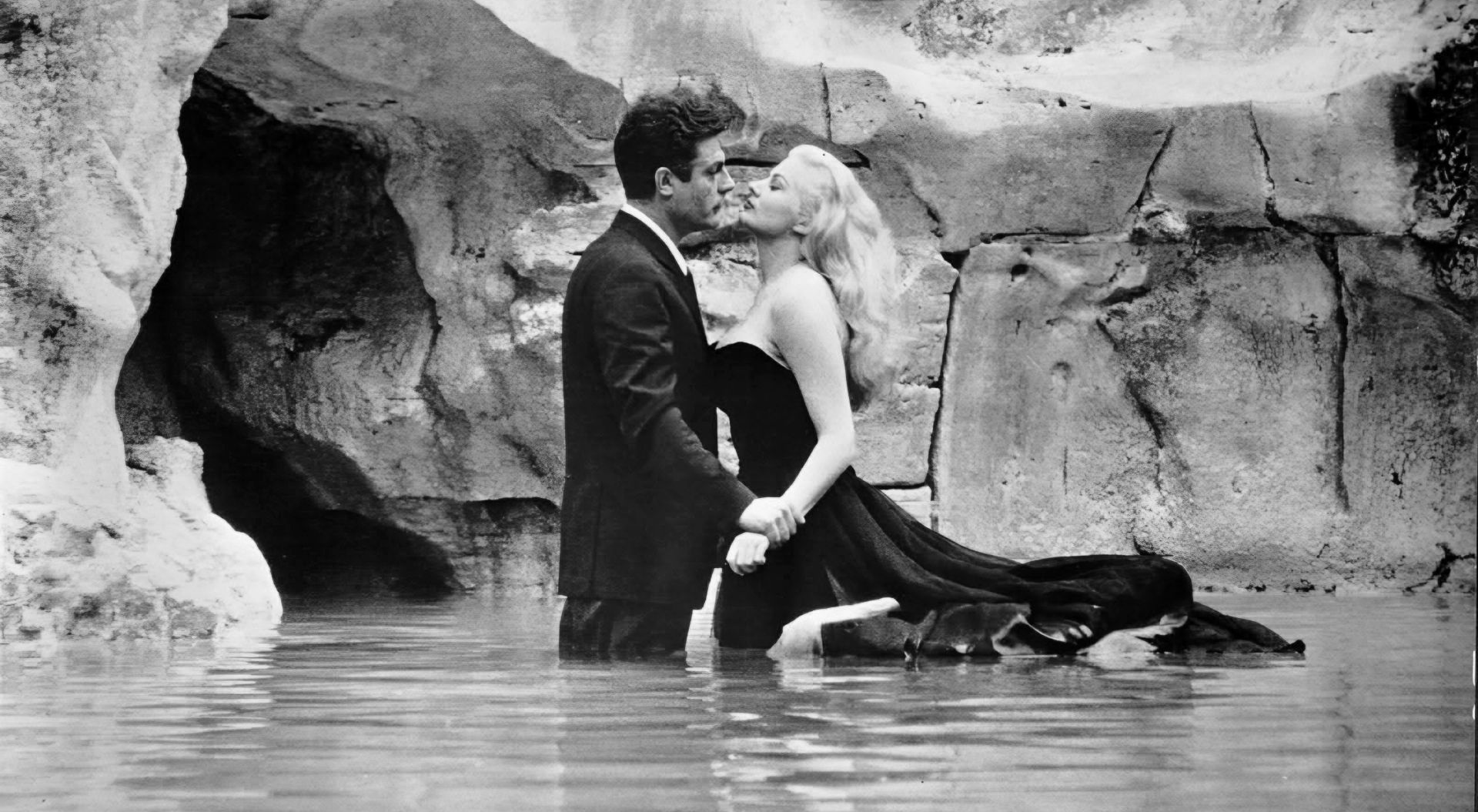
 Federico Fellini’s La dolce vita (1960) contains one of cinema’s most recognizable images: Anita Ekberg standing in Rome’s Trevi Fountain, calling Marcello Mastroianni into the water. It is a beautiful moment. It is also a poor guide to the film’s mood. Behind the parties, elegant clothes and celebrity encounters, Fellini follows a man who can no longer tell whether the life he is chasing makes him happy.
The Story
Marcello Rubini is a journalist who covers Rome’s famous and wealthy. He moves easily through nightclubs, aristocratic homes and crowded streets, usually with a photographer close behind. He once hoped to become a serious writer, but scandal stories pay for the life he now leads.
The film follows Marcello through a series of encounters rather than one tightly plotted adventure. There is Maddalena, an heiress whose freedom seems as lonely as his own; Emma, his devoted and increasingly distressed partner; Sylvia, a visiting American film star who turns a night in Rome into a spectacle; and Steiner, an intellectual friend whose home appears to offer the stability Marcello lacks. Each meeting invites Marcello to imagine a different future. Each ends with him returning to the same restless circuit.
Spoiler notice: the following paragraph discusses a major late development and the final scene.
A tragedy involving Steiner destroys Marcello’s belief that education and domestic life guarantee peace. After another exhausting party, Marcello reaches the beach at dawn. Across the water he sees Paola, a young woman he met earlier, but cannot make out what she is saying. Fellini leaves us with that failed connection: a small, human possibility that Marcello cannot quite reach.
Cast and Characters
Marcello Mastroianni — Marcello Rubini. Mastroianni makes Marcello charming without hiding his evasions. He is comfortable in a crowd and much less certain when someone asks him to commit to a person or a purpose.
Anita Ekberg — Sylvia. The American star arrives surrounded by cameras and admirers. Her exuberance powers the Trevi Fountain sequence, though the fascination she inspires tells us as much about Marcello and the press as it does about Sylvia.
Anouk Aimée — Maddalena. Wealth gives Maddalena access to almost anything, yet her scenes with Marcello expose a shared difficulty with intimacy.
Yvonne Furneaux — Emma. Marcello’s partner wants a settled life with him. Her anguish is real, even when their arguments make clear why the relationship is failing.
Alain Cuny — Steiner. A cultivated friend whom Marcello admires, Steiner seems to have built a life around family, books and music.
Walter Santesso — Paparazzo. Marcello’s photographer colleague is always ready for the next image. The character’s name became inseparable from the language of celebrity photography.
The ensemble also includes Annibale Ninchi as Marcello’s father and Valeria Ciangottini as Paola. Fellini gives even brief encounters enough weight to linger after Marcello moves on.
Awards and Recognition
La dolce vita won the Palme d’Or at the 1960 Cannes Film Festival, awarded unanimously according to the festival’s record. At the 1962 Academy Awards, it received four nominations: directing, original screenplay, black and white art direction, and black and white costume design. Piero Gherardi won for costume design.
Its lasting recognition goes beyond prizes. The Trevi Fountain scene remains a familiar image of Rome, while the film itself has become a touchstone for stories about fame, publicity and the emptiness that can hide inside an enviable life.
How the Film Was Made
Fellini developed the project with writers Ennio Flaiano and Tullio Pinelli; Brunello Rondi also worked on the screenplay. The production brought together cinematographer Otello Martelli, composer Nino Rota, editor Leo Cattozzo, and Gherardi, who designed both sets and costumes. Their work gives the film its distinctive movement between crowded public spectacle and moments of private unease.
The film grew out of an earlier idea about a young man’s experiences in Rome. Producer Dino De Laurentiis left the project, and Giuseppe Amato and Angelo Rizzoli became involved before filming began in March 1959. What emerged was an ambitious, expensive production that let Fellini turn contemporary Rome into a sequence of vivid episodes rather than a conventional rise or fall story.
That choice matters when watching it today. The helicopter carrying a statue of Christ over the city, Sylvia’s night at the fountain, the gatherings of the rich and the dawn on the beach feel like separate short stories. Marcello links them, and his gradual exhaustion gives them their shape.
Why It Still Matters
I return to La dolce vita for the distance between its appearance and its feeling. Fellini understands why Marcello wants to stay out all night: Rome looks magnificent, the next invitation is tempting, and the next person might have an answer. He also lets us see the cost of never going home to a life Marcello has chosen for himself.
The film belongs to a particular moment in Italy, when postwar prosperity, international cinema and a growing celebrity press were changing the image of Rome. Yet Marcello’s work feels remarkably familiar. He turns other people’s lives into stories while neglecting his own, and he is surrounded by people without finding much companionship.
Allow time for its episodic rhythm. At nearly three hours, it rewards attention to the quieter scenes as much as the famous fountain. Watch the way Marcello listens, changes the subject or fails to answer. The film’s deepest drama often happens while everyone around him is celebrating.
Where to Watch or Buy
Availability checked September 29, 2026. Streaming rights and store listings vary by country and can change. Confirm the title, language options and price in your own account before paying.
Streaming in Italy: Mediaset Infinity lists La dolce vita. JustWatch Italy also lists it through Mediaset Infinity and the Infinity Selection and CineAutore Amazon Channels. Check the subscription or channel terms that apply to you.
Streaming in the United States: JustWatch’s U.S. listing shows no current online streaming option for this title. An advertisement for similar films on Prime Video does not mean La dolce vita is included.
Digital rental: I could not verify a current rental listing in either the U.S. or Italy, so I am not linking to one. Check a local film store if you prefer a one-time rental.
Physical editions: Criterion confirms that La dolce vita is included in its Essential Fellini Blu-ray set. Its standalone Criterion DVD and Blu-ray editions are marked out of print; copies offered elsewhere may be used or priced for collectors.
You can compare current listings through Amazon.com’s La dolce vita disc search or Amazon.it’s La dolce vita disc search. These links lead to search results rather than a specific edition. Check the seller, disc region, subtitles and format before ordering.
Affiliate disclosure: If you buy through either Amazon link, Italia Mia may earn a commission at no extra cost to you.
External Sources
Festival de Cannes — La dolce vita · Academy Awards — 1962 ceremony · The Criterion Collection — La dolce vita · Treccani — La dolce vita · JustWatch U.S. · JustWatch Italy