

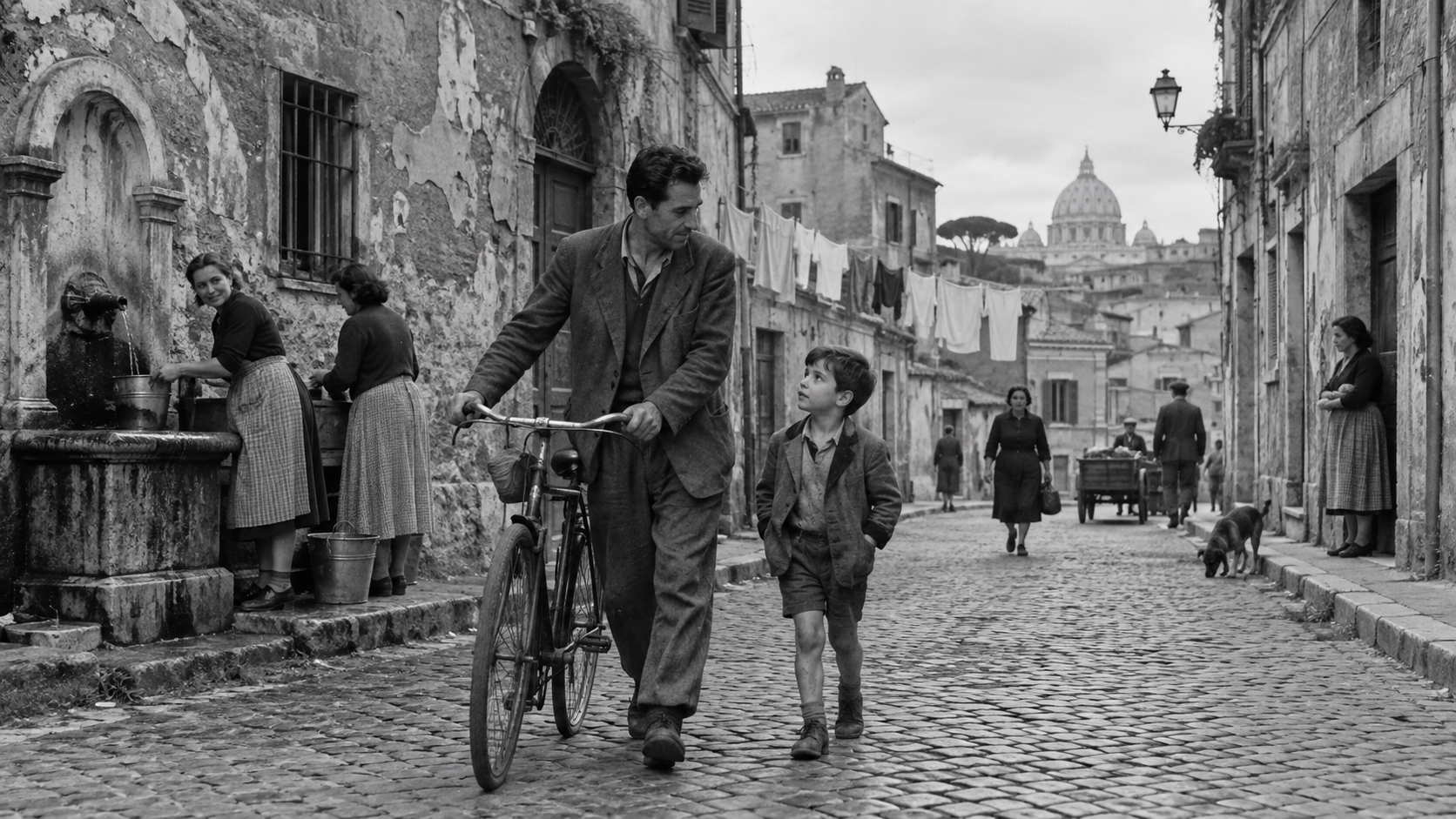
 Italian Neorealism emerged during the final years of the Second World War and transformed the way filmmakers portrayed ordinary life. Instead of offering glamorous stars, elaborate studio sets and escapist stories, directors turned their cameras toward bomb-damaged streets, crowded apartments, unemployed workers, displaced children and families struggling to survive.
The movement’s most influential period lasted from approximately 1943 to the mid-1950s. Its boundaries, however, were never precise. Neorealism was not an organized school with a manifesto that every director followed. It was a loose, constantly evolving approach shared by filmmakers who wanted to confront the reality of Fascism, war and postwar reconstruction.
Roberto Rossellini, Vittorio De Sica, Luchino Visconti, Giuseppe De Santis, Alberto Lattuada and Pietro Germi created very different films, but they were united by an interest in people who had rarely occupied the center of Italian cinema.
To understand how revolutionary these films were, it helps to place them within the broader history of Italian cinema.
Italy Before Neorealism
During the Fascist period, the Italian government invested heavily in cinema. The Cinecittà studios opened in Rome in 1937, helping Italy develop a technically sophisticated film industry.
Many popular productions of the period were comedies and romances set in elegant interiors. These became associated with the expression telefoni bianchi, or “white telephone films,” because luxurious white telephones appeared as symbols of wealth and modernity.
Not every film made under Fascism was propaganda, and not every studio production ignored social reality. Nevertheless, the carefully controlled world shown in mainstream cinema rarely reflected the poverty, regional differences and political tensions experienced by much of the population.
Young critics writing for magazines such as Cinema began arguing for a more truthful national cinema. Among them were future directors and screenwriters who would become important to neorealism.
The influence of literature was also crucial. Verismo writers such as Giovanni Verga had portrayed the lives of workers, fishermen and rural communities without romanticizing poverty. American and French films, documentary traditions and the political experience of anti-Fascism also contributed to the emerging aesthetic.
Ossessione and the Birth of a New Cinema
Luchino Visconti’s Ossessione (1943) is frequently described as the first major neorealist film. Loosely adapted without authorization from James M. Cain’s novel The Postman Always Rings Twice, it follows the destructive relationship between a drifter and the wife of a roadside restaurant owner.
Visconti filmed along roads, riverbanks and provincial landscapes that looked strikingly different from the polished environments of contemporary studio productions. His characters are driven by sexuality, economic frustration and the desire to escape.
Although Ossessione retained elements of melodrama and film noir, its physical settings and attention to social conditions anticipated neorealism. Fascist authorities objected to its bleak portrayal of Italian life, and the film encountered censorship and distribution difficulties.
Vittorio De Sica’s I bambini ci guardano (The Children Are Watching Us, 1943) offered another important transition. The film was made largely within established commercial cinema, but its depiction of a family’s collapse through the eyes of a child anticipated the emotional directness of De Sica’s postwar work.
Rome, Open City and the International Breakthrough
The decisive breakthrough arrived with Roberto Rossellini’s Roma città aperta (Rome, Open City, 1945).
Conceived while the memory of the Nazi occupation was still immediate, the film follows Resistance members, civilians and a Catholic priest confronting brutality in occupied Rome. Limited resources forced Rossellini to use available locations, inconsistent film stock and improvised production methods. Those limitations contributed to the film’s extraordinary sense of urgency.
The cast was not entirely non-professional. Aldo Fabrizi was already a popular performer, while Anna Magnani had extensive experience in theater and cinema. Her performance as Pina, particularly in one of the film’s most devastating sequences, made her an international symbol of Italian Neorealism.
Rome, Open City did not simply reproduce events as documentary evidence. It used melodrama, suspense, humor and carefully constructed performances. Its achievement was to combine those elements with locations and experiences that felt inseparable from recent history.
The film received the Grand Prix at the 1946 Cannes Film Festival and helped introduce postwar Italian cinema to international audiences. The BFI describes its success as central to establishing neorealism as a recognizable cinematic movement.
Rossellini’s War Trilogy
Rossellini continued his examination of Europe during and immediately after the war with Paisà (Paisan, 1946) and Germania anno zero (Germany Year Zero, 1948).
Paisà consists of six episodes following the Allied advance through Italy, from Sicily to the Po Valley. Encounters between Italians and American soldiers are complicated by language barriers, cultural misunderstandings and the chaos of war. Rather than presenting a single heroic narrative, Rossellini shows history through brief meetings between people who may never completely understand one another.
Germany Year Zero shifts the setting to the ruins of Berlin. Its central character is a young boy trying to support his family in a devastated society. The film expands neorealism beyond Italy and asks what happens to morality when political institutions, families and communities have collapsed.
Together, the three films established Rossellini as one of the central figures in modern cinema.
De Sica and Zavattini: Drama Hidden in Everyday Life
The partnership between director Vittorio De Sica and screenwriter Cesare Zavattini produced some of the movement’s most emotionally powerful films.
Zavattini believed that cinema did not always require extraordinary plots. Everyday experiences—looking for work, paying rent, caring for a child or trying to preserve one’s dignity—could reveal the structure of an entire society.
In Sciuscià (Shoeshine, 1946), two boys saving money to buy a horse become involved in a crime and are sent to a juvenile detention center. Their friendship is gradually destroyed by poverty, institutional violence and adult manipulation.
The Academy presented Shoeshine with a Special Award, praising a film created in a country still scarred by war. This recognition preceded the establishment of the competitive Academy Award for Best International Feature Film.
De Sica and Zavattini achieved their greatest international success with Ladri di biciclette (Bicycle Thieves, 1948).
Antonio Ricci finally finds work putting up posters across Rome, but the job requires a bicycle. When it is stolen on his first day, Antonio and his young son Bruno search through markets, churches, streets and working-class neighborhoods.
The plot is deliberately simple, but the stolen bicycle represents employment, survival and social identity. Antonio’s desperation eventually forces him into the same moral territory as the person who robbed him.
The leading actors, Lamberto Maggiorani and Enzo Staiola, were not established film stars. Their performances, combined with extensive location shooting, give the story its celebrated immediacy. Yet the film is far from unplanned: its emotional effects depend on precise framing, editing, crowd movement and the evolving relationship between father and son.
Bicycle Thieves received an Honorary Academy Award as the most outstanding foreign-language film released in the United States in 1949. It remains one of the essential works included in Italia Mia’s guide to the greatest Italian movies.
De Sica and Zavattini continued their collaboration with Miracolo a Milano (Miracle in Milan, 1951), which combines social criticism with fantasy, and Umberto D. (1952), an intimate portrait of an elderly pensioner facing eviction, isolation and poverty.
You can read more about De Sica’s parallel careers as an actor and filmmaker in the biography of Vittorio De Sica.
Visconti, Sicily and Class Conflict
Visconti developed a more visibly composed and politically analytical form of neorealism.
In La terra trema (The Earth Trembles, 1948), he worked with residents of Aci Trezza, a fishing community in Sicily. The performers speak in Sicilian dialect, and the story concerns a family attempting to escape exploitation by fish wholesalers.
The film is deeply rooted in real economic conditions, but its images are carefully arranged and often monumental. Visconti’s visual sophistication demonstrates why neorealism should not be confused with simply pointing a camera at reality.
His Bellissima (1951) turns its attention toward Cinecittà and the promises manufactured by the film industry. Anna Magnani plays Maddalena, a working-class Roman mother convinced that a film role will create a better future for her young daughter. The result is both a compassionate family drama and a sharp examination of how cinema exploits dreams of fame.
Beyond the Three Famous Directors
Rossellini, De Sica and Visconti dominate most accounts of neorealism, but the movement was considerably broader.
Giuseppe De Santis brought political commitment, dramatic energy and a strong awareness of popular genres to films such as Caccia tragica (Tragic Hunt, 1947) and Riso amaro (Bitter Rice, 1949). The latter follows seasonal female rice workers in northern Italy and combines labor conflict with crime, romance and melodrama.
De Santis also directed Roma ore 11 (Rome 11:00, 1952), inspired by a real incident in which hundreds of women arrived to apply for a single secretarial position. When a staircase collapsed beneath them, the accident exposed the scale of female unemployment in postwar Rome.
Alberto Lattuada explored displacement and poverty in Il bandito (The Bandit, 1946) and later helped develop the lighter neorealismo rosa. Pietro Germi applied neorealist techniques to crime, regional inequality and migration in films including In nome della legge (In the Name of the Law, 1949) and Il cammino della speranza (The Path of Hope, 1950).
These directors show that neorealism was never a single formula. It could incorporate melodrama, crime, comedy, regional storytelling and political argument.
The Characteristics of Italian Neorealism
Neorealist films are commonly associated with several techniques:
- Stories about workers, children, pensioners, women and impoverished families
- Filming in streets, villages and damaged urban neighborhoods
- A mixture of professional and non-professional performers
- Attention to unemployment, housing, migration and social inequality
- Regional speech, dialects and communication difficulties
- Open or unresolved endings
- A visual style influenced by documentary filmmaking
- An emphasis on moral choices rather than conventional heroes and villains
These features were tendencies rather than strict rules. Rome, Open City used celebrated performers. Bitter Rice drew heavily on popular melodrama. Miracle in Milan introduced fantasy, while La terra trema presented real Sicilian locations through highly controlled compositions.
The filmmakers did not abandon artistic construction. They used it to direct attention toward lives and environments that commercial cinema had often excluded.
Women in Neorealist Cinema
Women occupy a complex position within neorealism.
Pina in Rome, Open City, the rice workers of Bitter Rice, the jobseekers in Rome 11:00 and Maddalena in Bellissima reveal how war and economic insecurity affected women differently from men. Their lives involve paid labor, domestic responsibilities, motherhood, sexual judgment and restricted opportunities.
Anna Magnani became the movement’s most recognizable actress because she could communicate defiance, humor, exhaustion and vulnerability without making her characters appear symbolic or idealized.
At the same time, most canonical neorealist films were written and directed by men. Modern viewers and scholars have therefore reconsidered how women’s experiences were represented, whose perspectives were excluded and how the films sometimes reproduced the gender assumptions of their period.
From Social Realism to Psychological Cinema
During the early 1950s, the movement began moving in several directions.
Rossellini’s films with Ingrid Bergman—Stromboli (1950), Europa ’51 (1952) and Viaggio in Italia (Journey to Italy, 1954)—shifted attention from collective wartime experience toward alienation, marriage, faith and psychological crisis.
Federico Fellini, who had worked as a screenwriter on Rome, Open City and Paisà, gradually transformed neorealist observation into a more personal and poetic cinema. I vitelloni (1953) studies a group of aimless young men in a provincial town, while La strada (1954) combines poor itinerant performers and rural landscapes with fable, symbolism and spiritual longing.
Fellini’s subsequent work moved still further toward memory, dreams and spectacle. His journey beyond neorealism is explored in Italia Mia’s biography of Federico Fellini.
Why Neorealism Declined
There was no single moment when Italian Neorealism ended.
As economic conditions improved, audiences increasingly sought comedy, romance and entertainment. Producers favored films with recognizable stars, while the restored Cinecittà studios again offered sophisticated production facilities.
Political conditions also changed. Films emphasizing poverty and social conflict did not always fit the image of a stable, modernizing Italy that public officials wished to promote.
Some neorealist ideas survived in neorealismo rosa, or “pink neorealism.” Films such as Due soldi di speranza (Two Cents Worth of Hope, 1952) and Pane, amore e fantasia (Bread, Love and Dreams, 1953) retained village settings and ordinary characters while introducing greater romance, optimism and comedy.
This transition helped prepare the way for commedia all’italiana, the socially observant comedies that flourished during the 1950s and 1960s.
Essential Italian Neorealist Films
| Film | Director | Year | Why It Matters |
|---|---|---|---|
| Ossessione | Luchino Visconti | 1943 | A dark provincial drama widely regarded as a precursor or starting point of neorealism |
| I bambini ci guardano | Vittorio De Sica | 1943 | Anticipates De Sica’s concern with children and family breakdown |
| Rome, Open City | Roberto Rossellini | 1945 | Brought the movement to international attention |
| Paisà | Roberto Rossellini | 1946 | Portrays the liberation of Italy through six regional episodes |
| Shoeshine | Vittorio De Sica | 1946 | Examines childhood, poverty and institutional cruelty |
| Tragic Hunt | Giuseppe De Santis | 1947 | Combines political conflict with the energy of popular genre cinema |
| Germany Year Zero | Roberto Rossellini | 1948 | Extends neorealist moral inquiry to ruined postwar Berlin |
| The Earth Trembles | Luchino Visconti | 1948 | A powerful study of Sicilian fishermen and economic exploitation |
| Bicycle Thieves | Vittorio De Sica | 1948 | The movement’s most universally recognized story of work, family and dignity |
| Bitter Rice | Giuseppe De Santis | 1949 | Focuses on female agricultural labor while embracing melodrama |
| Stromboli | Roberto Rossellini | 1950 | Moves neorealism toward psychological and spiritual conflict |
| Miracle in Milan | Vittorio De Sica | 1951 | Combines postwar social criticism with fantasy |
| Bellissima | Luchino Visconti | 1951 | Examines working-class ambition and the illusions created by cinema |
| Rome 11:00 | Giuseppe De Santis | 1952 | Dramatizes women’s unemployment through an actual Roman tragedy |
| Umberto D. | Vittorio De Sica | 1952 | A restrained portrait of old age, poverty and isolation |
| I vitelloni | Federico Fellini | 1953 | Bridges social observation and Fellini’s increasingly personal cinema |
| Journey to Italy | Roberto Rossellini | 1954 | Transforms location realism into an examination of marriage and alienation |
| La strada | Federico Fellini | 1954 | Blends neorealist settings with poetry, symbolism and fable |
Neorealism’s Influence Around the World
Italian Neorealism changed international cinema because it demonstrated that important films could be made outside the traditional studio system and centered on people without wealth, power or social prestige.
Its influence can be seen in the French New Wave, British social realism, Indian Parallel Cinema, Brazilian Cinema Novo and the work of filmmakers such as Satyajit Ray, Ken Loach, Martin Scorsese and the Dardenne brothers.
The movement’s techniques also became central to independent filmmaking: real locations, small crews, available light, unknown performers and stories drawn from everyday experience.
Its influence continues in films concerned with migration, precarious employment, housing, social exclusion and communities rarely represented by mainstream entertainment. Contemporary directors may use digital cameras rather than wartime film stock, but the central neorealist question remains recognizable: how can cinema make us see another person’s reality?
Italia Mia’s guide to Italian social and political films traces how later filmmakers continued this commitment.
Why Italian Neorealism Still Matters
The lasting importance of neorealism lies not in a checklist of stylistic techniques but in its moral attention.
These films ask viewers to observe people who might otherwise disappear into statistics: an unemployed father, a lonely pensioner, a frightened child, an exploited laborer or a woman competing with hundreds of others for one poorly paid job.
The stories rarely provide simple solutions. A bicycle may never be recovered. Poverty may remain unresolved. A family may continue walking into an uncertain future.
Yet the films insist that these lives are worthy of sustained attention. That principle transformed Italian cinema and continues to influence filmmakers throughout the world.
External Resources
- BFI: 10 Great Italian Neorealist Films
- BFI: The Roots of Neorealism
- BFI: Rome, Open City and the Leap Toward Realism
- The Criterion Collection: Italian Neorealism
- Academy Awards Database