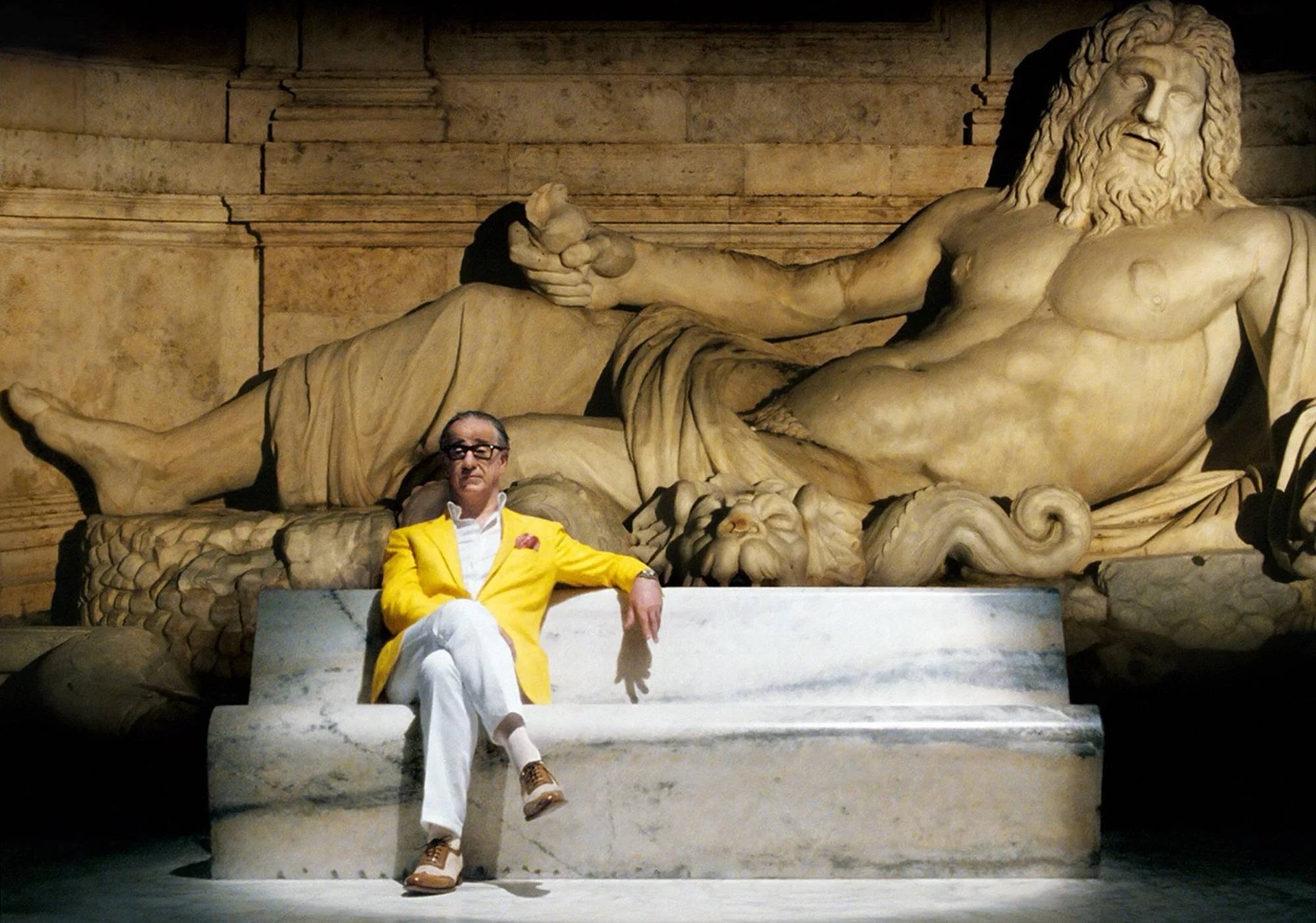
 The Great Beauty (La grande bellezza), directed by Paolo Sorrentino in 2013, follows a man who knows how to enjoy Rome but has begun to question what he has done with his life. Toni Servillo plays Jep Gambardella, a writer whose elegance and sharp wit conceal a growing sense of loss.
The film moves between extravagant parties, quiet streets and encounters that unsettle Jep’s comfortable routine. Rome provides an extraordinary setting, yet its beauty also raises an uncomfortable question: how much can we overlook while surrounded by so much to admire?
The Story
Jep Gambardella once wrote a successful novel. Decades later, he makes his living as a journalist and spends his nights among Rome’s wealthy, artistic and socially ambitious circles. His reputation opens doors, while his conversation ensures that people notice when he enters.
His sixty-fifth birthday brings another lavish celebration. However, news connected to his first love soon interrupts the familiar rhythm of parties and late mornings. Jep starts looking back at the life he imagined and the one he actually built.
Sorrentino tells this story through encounters rather than a tightly plotted sequence of events. Friends discuss their achievements. Performers demand attention. Religious figures offer unexpected responses to serious questions. Meanwhile, Jep wanders through a city that seems capable of revealing something new whenever the noise subsides.
The film’s emotional movement comes from the gap between Jep’s public confidence and private uncertainty. He can expose another person’s pretensions with a few sentences. Understanding his own disappointments proves more difficult.
Viewers who expect a conventional drama may need time to settle into its rhythm. The Great Beauty rewards attention to faces, music and small changes of mood. Its apparent detours gradually become the story.
Cast and Characters
Toni Servillo as Jep Gambardella gives the film its center. His measured voice and restrained gestures allow amusement, cruelty and tenderness to exist within the same scene. Jep’s charm is persuasive, but Servillo also reveals the effort behind it.
Carlo Verdone plays Romano, a friend with literary ambitions and a less secure place in Rome’s social world. His vulnerability provides a revealing contrast to Jep’s practiced ease.
Sabrina Ferilli plays Ramona, a performer whose relationship with Jep brings warmth and emotional directness. Their scenes give the film room to breathe beyond its crowded gatherings.
Galatea Ranzi appears as Stefania, whose confident account of her own accomplishments prompts one of Jep’s most cutting interventions. Roberto Herlitzka plays Cardinal Bellucci, a religious figure whose enthusiasm for food complicates Jep’s search for spiritual guidance.
The supporting cast also includes Isabella Ferrari as Orietta, Carlo Buccirosso as Lello Cava and Iaia Forte as Trumeau. Together, they create a social world full of competing desires, practiced manners and carefully maintained appearances.
Awards and Recognition
The Great Beauty competed for the Palme d’Or at the 2013 Cannes Film Festival. Its international success continued during the following awards season.
In 2014, it won the Academy Award for Foreign Language Film, the category now called International Feature Film. The award represented Italy at the Oscars and marked a major achievement for Sorrentino’s career.
The film also won the Golden Globe for Best Foreign Language Film and the BAFTA for Film Not in the English Language. These honors helped bring its distinctly Italian setting and sensibility to a much wider audience.
Its recognition is especially striking because Sorrentino asks viewers to accept an unusual rhythm. The film shifts freely between satire, grief, spectacle and moments that approach a dream.
How the Film Was Made
Sorrentino wrote the screenplay with Umberto Contarello. The film was an Italian-French coproduction, with cinematography by Luca Bigazzi, editing by Cristiano Travaglioli and original music by Lele Marchitelli.
Bigazzi’s photography makes Rome feel both accessible and remote. The camera glides through gatherings, observes imposing architecture and pauses in spaces where human activity briefly falls away. Those movements help express Jep’s changing relationship with the city.
Locations include the Acqua Paola fountain on the Janiculum and the Baths of Caracalla. These places contribute more than recognizable scenery. Their scale and history make the concerns of Jep’s social circle seem temporary, sometimes even absurd. Rome’s official tourism guide also notes how Sorrentino plays with the identities of locations, creating a city shaped by imagination as well as geography.
Music gives the film another way to change direction. Dance tracks drive its crowded celebrations, while quieter and sacred pieces encourage reflection. The shift can be sudden, echoing the distance between public excitement and private feeling.
Comparisons with Federico Fellini’s La dolce vita are natural. Both films follow a journalist through Roman society and examine the promises of pleasure and prestige. Sorrentino, however, places the experience of aging at the heart of Jep’s journey. His protagonist has already spent decades inside the world he now questions.
Why It Still Matters
The Great Beauty understands how easily a busy life can conceal a sense of emptiness. Jep always has somewhere to go and someone to meet. Nevertheless, constant activity offers little protection from regret.
That tension remains relevant in a culture where visibility can resemble achievement. The film’s parties could belong to an earlier social age, yet the desire to appear successful feels familiar. Its characters work hard to maintain an image that may no longer reflect their inner lives.
Sorrentino also leaves room for tenderness. Jep’s intelligence sometimes becomes a defense against disappointment, but genuine affection can still reach him. These moments prevent the satire from reducing everyone to a target.
Rome deepens this tension. The city offers extraordinary beauty without promising that its inhabitants will become wiser or happier. Art survives. Buildings endure. People still struggle to decide what deserves their attention.
The film invites several readings, and its final movements resist a single explanation. One persuasive interpretation is that Jep’s creative life depends on learning to notice again: a memory, an honest encounter or an emotion he cannot dismiss with a clever remark.
For more films that approach Italian life from different perspectives, browse Italia Mia’s Italian movie articles.
Where to Watch or Buy
Availability checked on October 1, 2026. Catalogs, subscription requirements and language options can change.
United States: subscription streaming
The current JustWatch U.S. listing for The Great Beauty shows HBO Max and the HBO Max Amazon Channel. The Amazon channel requires the relevant subscription; its presence does not mean the film is included with a standard Prime membership.
Criterion also maintains a Criterion Channel page for the film. Check playback availability before subscribing specifically to watch it.
United States: rental and digital purchase
Amazon Video, Apple TV Store and Fandango at Home currently appear as rental and digital purchase options. Check the selected edition for Italian audio and English subtitles before paying.
Italy: subscription streaming
The Italian availability listing currently includes Sky Go, NOW, Mediaset Infinity and Infinity Selection through Amazon Channels. Access depends on the service and package. NOW also provides a dedicated La grande bellezza viewing page.
Italy: rental and digital purchase
Apple TV Store, Amazon Video and Rakuten TV currently list rental and purchase options. English subtitles may vary between editions, so international viewers should check the language details.
DVD and Blu-ray
The Criterion Collection edition includes a director-approved transfer, English subtitles, interviews and deleted scenes. It is a useful option for viewers interested in the film’s production as well as the feature itself.
Compare The Great Beauty DVD and Blu-ray listings on Amazon.com or La grande bellezza editions on Amazon.it. These links lead to search results, where stock and sellers can vary. Confirm the disc region, subtitle languages and version before ordering.
Watching while traveling
NordVPN is an option for protecting your connection on shared Wi-Fi while traveling. It does not guarantee access to a particular streaming catalog. Regional licensing and each platform’s terms still apply.
Affiliate disclosure: This article contains affiliate links. As an Amazon Associate, I earn from qualifying purchases. I may also earn a commission through the NordVPN link, at no additional cost to you.
External Sources
Festival de Cannes: official film entry and credits
The Academy: 2014 Oscar winners
BAFTA: Film Not in the English Language
The Criterion Collection: film and home-video edition
Turismo Roma: locations from The Great Beauty
JustWatch: United States availability
JustWatch: Italian availability