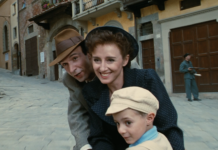

 Some films make us remember the story. Cinema Paradiso makes us remember the place where we first watched a film: the seats, the darkness, the people beside us, and the feeling of stepping back outside afterward.
Giuseppe Tornatore’s Cinema Paradiso, originally titled Nuovo Cinema Paradiso, was released in 1988. Set largely in a fictional Sicilian town, it follows a boy whose friendship with a projectionist shapes his future. Its warmth makes it an inviting introduction to Italian movies, but beneath the humor lies a difficult question: what do we lose when we leave home to become ourselves?
The Story
──────────
Spoiler notice: this section describes the premise and early developments. The final sequence and the director’s cut’s major revelations are left undisclosed.
Salvatore Di Vita is a successful filmmaker living in Rome when he learns that Alfredo, the projectionist from his hometown, has died. The news brings back memories of his childhood in Giancaldo, Sicily, and of the local cinema that became the center of his world.
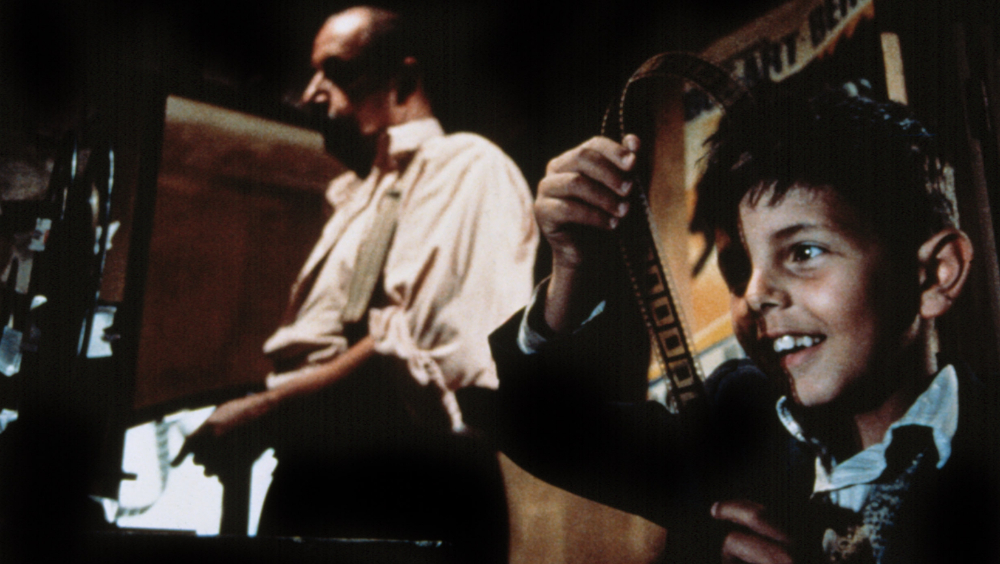
As a boy, Salvatore—known as Totò—is fascinated by everything about the Cinema Paradiso. Watching films is only part of the attraction. He wants to understand the machinery, the light, and the work that makes the images appear.
Alfredo initially finds the boy’s persistence exhausting. The projection booth is a workplace with dangerous equipment, not a playground. Gradually, irritation gives way to affection, and Alfredo becomes both teacher and a father figure.
Outside the booth, the audience supplies another kind of entertainment. People call out, argue, laugh, and conduct their lives in the darkness. The parish priest previews films and demands that kisses be removed, leaving regular customers to complain about what they never get to see. Tornatore turns these screenings into a portrait of a community: the audience matters almost as much as the film.
As Totò grows older, his attachment to cinema shares space with his love for Elena. His ambitions also raise a painful choice. Giancaldo has given him his vocation, but staying there may prevent him from pursuing it.
The adult Salvatore’s return brings the film’s central tension into focus. A place can remain vivid in memory while changing beyond recognition in real life. Success has carried him far from Sicily; it has not settled his relationship with home.
Cast and Characters
──────────
Philippe Noiret as Alfredo
Noiret gives the projectionist patience, gruff humor, and authority. Alfredo’s affection rarely becomes sentimental speechmaking. It emerges through practical help, teasing, and advice that is sometimes difficult to accept.
Salvatore Cascio as the young Totò
Cascio supplies the childhood scenes with restless energy. His Totò is curious, mischievous, and determined to get closer to the projector, regardless of how often adults tell him to go away.
Marco Leonardi as the teenage Salvatore
Leonardi carries the story into adolescence, when the boy’s enthusiasm becomes tangled with romantic longing and uncertainty about the future.
Jacques Perrin as the adult Salvatore
Perrin’s restrained performance gives the framing story its melancholy. His face suggests a man who has achieved a great deal while leaving important feelings unresolved.
Agnese Nano as the young Elena
Elena represents Salvatore’s first great romantic attachment. Their relationship receives substantially more development in the longer version.
Antonella Attili and Pupella Maggio as Maria
Attili plays Salvatore’s mother in the earlier years; Maggio portrays her later in life. Their performances give the story a family perspective beyond the bond between Totò and Alfredo.
Leopoldo Trieste as Father Adelfio
The priest’s supervision of the cinema produces some of its funniest moments while revealing the authority that religious institutions exercised over public entertainment.
Brigitte Fossey as the adult Elena
Fossey appears in the extended director’s cut. Her role is one reason viewers should check which version they are choosing.
Awards and Recognition
──────────
Cinema Paradiso’s major international honors arrived after its original Italian release.
At the 1989 Cannes Film Festival, it shared the Jury’s Special Grand Prix. It subsequently won the 1990 Academy Award for Foreign Language Film, representing Italy, and the 1990 Golden Globe for Best Foreign Language Film.
At the 1991 BAFTA Film Awards, it won five awards: Film Not in the English Language, Leading Actor for Philippe Noiret, Supporting Actor for Salvatore Cascio, Original Screenplay for Giuseppe Tornatore, and Original Film Score.
The acting awards are particularly fitting. Although the film follows Salvatore across several decades, the relationship between Cascio’s inquisitive child and Noiret’s seasoned projectionist gives it its emotional foundation.
How the Film Was Made
──────────
Tornatore’s inspiration came from his own experience of cinemas in Sicily. He recalled helping clear out an old theater after it closed in 1977. The abandoned building’s atmosphere suggested a story, and he spent years gathering ideas and projectionists’ recollections before making the film. Producer Franco Cristaldi encouraged him to pursue it as his second feature.
Giancaldo is fictional, but one of its principal locations is real: Palazzo Adriano, inland from Palermo. Piazza Umberto I became the film’s familiar town square. Visitors can also find a local Cinema Paradiso museum with photographs and material connected to the production.
The score is central to the film’s emotional language. Ennio Morricone composed its music, while his son Andrea composed the celebrated Love Theme. That distinction deserves attention because the melody is often attributed entirely to Ennio.
The different cuts explained
Cinema Paradiso has a more complicated release history than the phrase “the original version” suggests.
The initial Italian theatrical release ran approximately 155 minutes. The shorter international theatrical version runs approximately 124 minutes. The extended director’s cut commonly available on modern editions runs approximately 174 minutes.
The 124-minute version concentrates on childhood, Alfredo’s influence, departure, and memory. Its relatively compact structure gives the return to Giancaldo particular force.
The director’s cut adds substantial material involving Elena and Salvatore’s adult life. It also changes how viewers may understand Alfredo’s involvement in Salvatore’s future. These additions reshape the story rather than simply providing more scenes.
For a first viewing, my recommendation is the 124-minute theatrical cut. Afterward, the director’s cut offers a revealing comparison, especially for anyone interested in the unresolved romance.
Why It Still Matters
──────────
Cinema Paradiso understands that a cinema can be part of a town’s social life. People gather there to escape their troubles, but they bring those troubles—and their personalities—with them. The room becomes a shared space in which a community recognizes itself.
That gives the film an appeal beyond film enthusiasts. Its subject is also the ordinary places that acquire extraordinary importance: a workplace, a square, a shop, or a room where someone encouraged us.
Alfredo’s mentorship remains especially moving because it involves letting go. Helping a younger person may mean encouraging them to leave, even when their departure makes your own life lonelier.
The film also treats nostalgia with more complexity than its reputation for warmth might suggest. Salvatore’s memories are beautiful, but returning cannot restore his childhood. The people and buildings that formed him have continued through time without him.
For viewers with family roots in Italy, that distance may feel familiar. A remembered town can become an emotional homeland even when daily life has moved elsewhere.
Its place among the best Italian films rests on this ability to make a specific Sicilian story widely recognizable. You do not need to have grown up near Palermo, or to know anything about projection equipment, to understand the pull of home.
Where to Watch or Buy
──────────
Availability checked on September 29, 2026, for the United States and Italy. Catalogs can change; confirm the runtime, audio, subtitles, and final terms on the provider’s page.
Streaming in the United States
The U.S. listings currently include MGM+, MGM+ through Amazon Channels and Roku Premium Channels, fuboTV, and Philo. An MGM+ channel subscription is separate from a standard Amazon Prime subscription.
Use the Cinema Paradiso U.S. availability guide to compare current options. Its film-level runtime should not be treated as confirmation that every provider carries the director’s cut.
Streaming in Italy
The Italian listing currently identifies RaiPlay as a free, advertising-supported option. Visit Nuovo Cinema Paradiso on RaiPlay and check the version offered before watching.
For readers interested in using a VPN while accessing Italian TV, see NordVPN plans and offers. RaiPlay’s territorial restrictions and service terms still apply, and a VPN does not guarantee playback.
Digital rental and purchase
In the United States, current listings show rental and digital purchase through Amazon Video, Apple TV Store, and Fandango at Home. These are paid transactions rather than automatically included subscription streams.
The Italian availability listing checked for this article did not show a rental or digital purchase offer. Check the Italian availability guide for changes.
DVD, Blu-ray, and 4K editions
For U.S. shoppers, a verified product listing is the Miramax Cinema Paradiso Blu-ray on Amazon.com. Its listed runtime differs from the standard 124-minute theatrical specification, so check the packaging and seller details rather than assuming it includes the director’s cut.
For an edition containing both main cuts, Arrow’s verified 4K UHD plus Blu-ray release includes the 124-minute theatrical version on UHD and the 174-minute director’s cut on Blu-ray, with optional English subtitles. Check the companion Blu-ray’s region compatibility when importing.
In Italy, CG Entertainment lists a 124-minute Blu-ray with English subtitles, while its 4K UHD plus Blu-ray edition lists Italian subtitles. Its DVD has a different listed runtime, so the formats should not be treated as interchangeable. See the publisher’s edition specifications.
You can also search Amazon.it for Nuovo Cinema Paradiso editions. This is a shopping search, not a recommendation for a verified individual Amazon.it edition.
Affiliate disclosure: As an Amazon Associate, I earn from qualifying purchases. I may also earn a commission through the NordVPN link.
External Sources
──────────
Festival de Cannes: Nuovo Cinema Paradiso
Santa Barbara International Film Festival: Cinema Paradiso
Arrow Films: 4K UHD and Blu-ray specifications
CG Entertainment: Italian home-video editions