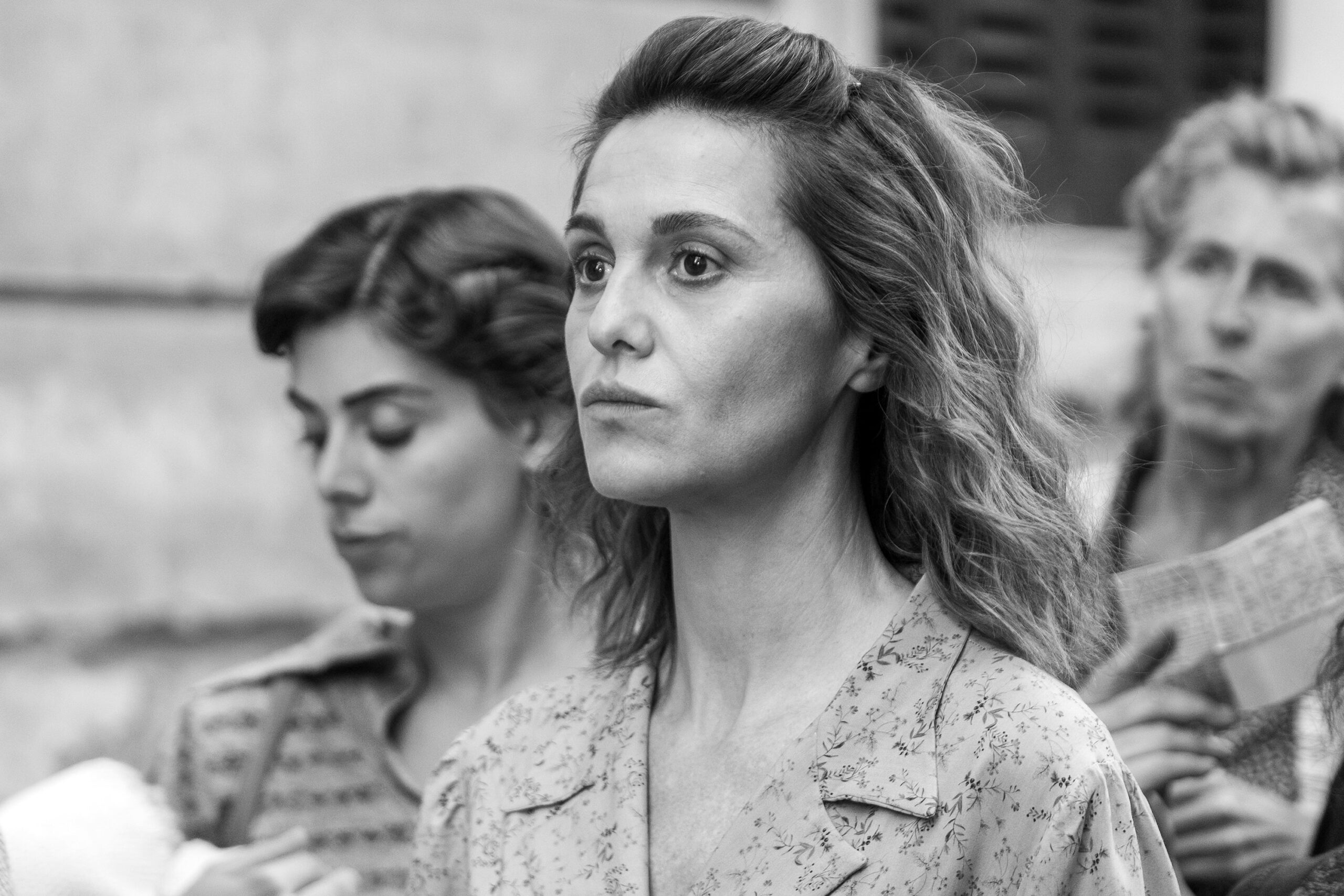
 There’s Still Tomorrow (C’è ancora domani) brings the struggles of one woman in postwar Rome into sharp focus. Released in 2023, Paola Cortellesi’s directing debut combines family drama, social criticism, and humor. Its black-and-white images suggest an older Italian cinema, yet its questions about dignity and freedom remain immediate.
Cortellesi also plays Delia, a mother whose daily work keeps her family going. At home, however, her husband treats her labor as an obligation and her independence as a threat. The film asks us to notice everything that others take for granted: her resourcefulness, her friendships, and her capacity to imagine change.
For readers exploring Italian cinema through Italia Mia, this is an essential recent title. It connects the country’s screen traditions with a story that reached a remarkably broad audience.
The Story
Spoiler notice: This section discusses the premise and early developments but does not reveal the ending. Content note: The film includes domestic violence and emotional abuse.
The story takes place in Rome in 1946. The war has ended, but poverty and unequal power still shape daily life. Delia shares a crowded home with her husband, Ivano, their three children, and his father.
She works, cares for the household, and tries to meet demands that rarely leave room for her own needs. Ivano controls family life through intimidation and violence. His behavior is his responsibility, even when the people around him excuse or normalize it.
Meanwhile, their daughter Marcella sees marriage as a possible route to a different future. Her boyfriend, Giulio, comes from a family with greater financial security. Delia hopes this relationship will give her daughter opportunities she never had. The arrival of a mysterious letter then opens another possibility in Delia’s own life.
The film builds suspense around what she might do next. Small choices begin to matter: where she goes, what she keeps private, and which hopes she allows herself to entertain.
That attention to ordinary decisions gives the story much of its force. Delia does not need to become a different person to deserve freedom. The audience must learn to see the person already there.
The relationship between mother and daughter also complicates the drama. Marcella’s frustration reflects her fear of repeating her mother’s life. Yet frustration can make another person’s circumstances difficult to understand. Their relationship invites us to consider the difference between judging someone’s choices and recognizing the limits imposed on them.
Knowing little about the conclusion makes a first viewing more rewarding. Cortellesi carefully shapes our expectations, so it is worth letting the film reveal its destination.
Cast and Characters
Paola Cortellesi as Delia
Delia is the film’s center. Cortellesi gives her humor, intelligence, and an inner life that extends beyond the abuse she experiences. Her performance asks viewers to pay attention to pauses and expressions as much as dialogue.
That balance matters. Delia is neither a symbol without personality nor a collection of hardships. She remains a person with relationships, wishes, and practical concerns.
Valerio Mastandrea as Ivano
Mastandrea plays Delia’s controlling husband. The character shows how authority within a household can become a means of intimidation. His everyday presence makes the violence especially disturbing: the danger belongs to the place where Delia should feel secure.
Romana Maggiora Vergano as Marcella
Marcella brings a younger generation’s impatience into the story. Her hopes for marriage raise an uncomfortable question: does greater comfort necessarily mean greater freedom?
Emanuela Fanelli as Marisa
Marisa, Delia’s friend, gives the film an important space for companionship and humor. Their friendship helps keep Delia’s identity visible outside her family duties.
Giorgio Colangeli as Ottorino
Ivano’s father adds another layer to the household’s hierarchy. His presence places the family’s treatment of women within a pattern that extends across generations.
Francesco Centorame as Giulio and Vinicio Marchioni as Nino
Giulio is Marcella’s boyfriend, while Nino belongs to Delia’s wider emotional world. Both characters contribute to the film’s questions about affection, expectation, and the possibilities people attach to relationships. The European Film Academy confirms these principal cast and character credits.
Together, the cast makes the family and neighborhood feel socially connected. Delia’s circumstances exist within a community, where attitudes can reinforce control but friendship can also create support.
Awards and Recognition
There’s Still Tomorrow won six David di Donatello awards in 2024:
- Best Directorial Debut: Paola Cortellesi.
- Best Actress: Paola Cortellesi.
- Best Supporting Actress: Emanuela Fanelli.
- Best Original Screenplay: Furio Andreotti, Giulia Calenda, and Paola Cortellesi.
- David Giovani: the youth award.
- David dello Spettatore: the audience award linked to theatrical admissions.
Its reception had already gathered momentum at the 2023 Rome Film Fest. There, the film received a Special Jury Award, the Audience Award, and a special mention for Best First Feature.
The commercial success was equally striking. It became Italy’s highest-grossing theatrical release of 2023, ahead of Barbie. This was a major achievement for a directing debut filmed in black and white and centered on domestic abuse.
Those results help explain its place in recent Italian film history. The movie reached viewers well beyond a specialist audience while asking them to engage with a difficult subject.
Awards cannot determine how every viewer will respond. Still, the combination of industry recognition and public enthusiasm shows how widely the film connected.
How the Film Was Made
Cortellesi wrote the screenplay with Furio Andreotti and Giulia Calenda. The principal creative team included cinematographer Davide Leone, editor Valentina Mariani, production designer Paola Comencini, and composer Lele Marchitelli.
Filming combined locations in Rome’s Testaccio district with sets at Cinecittà. The neighborhood’s courtyards and shared spaces helped establish a world where private lives are often visible to others.
The black-and-white photography immediately connects the story with memories of postwar Italian cinema. However, the filmmaking also includes modern music and deliberately stylized passages.
One of its most discussed choices is the choreography of an assault. Movement turns the scene into an unsettling repeated pattern. Cortellesi has explained that this approach conveys the recurring nature of the violence.
It is a demanding artistic choice. Some viewers may find the distance created by choreography revealing; others may find it uncomfortable. Either response can lead to a useful question about how cinema represents harm without making suffering a spectacle.
The humor creates another tension. It offers moments of recognition and relief within a painful story. As a result, the film can move between warmth and fear without requiring its characters to exist in only one emotional register.
Why It Still Matters
There’s Still Tomorrow examines the gap between being needed and being respected.
Delia’s family depends on her work. That dependence does not bring equal authority or consideration. The film makes this imbalance visible through daily routines, which can reveal power as clearly as a confrontation.
Its mother-and-daughter relationship also deserves attention. Wanting a better future for someone does not guarantee agreement about how to reach it. Love can coexist with anger, misunderstanding, and impatience.
This makes the film a useful starting point for discussions about independence. Financial comfort, romantic attention, and social approval can all appear to promise security. The more difficult question is whether a person can make choices without fear.
The story also resists the idea that someone experiencing abuse must behave in a particular way to deserve understanding. Delia’s moments of humor do not cancel her suffering. Her caution does not make her responsible for Ivano’s actions.
There is room to debate the film’s methods. Its emotional direction is clear, and its contrasts can be broad. Viewers who prefer understated drama may find some passages emphatic. However, that directness also makes its central questions accessible.
Most of all, the film asks us to reconsider whom we recognize as important. A woman performing ordinary work can carry a story about freedom, belonging, and the future. Cortellesi gives those daily efforts the attention they deserve.
Where to Watch or Buy
Availability checked on October 2, 2026, using the accessible regional listings below. Catalogs, access conditions, and prices can change.
Affiliate disclosure: Italia Mia may earn a commission from qualifying purchases through the Amazon and NordVPN links below. As an Amazon Associate, I earn from qualifying purchases.
United States
Streaming through a participating library
The U.S. listing includes Kanopy. Access depends on whether your participating library or institution offers the film.
Digital rental or purchase
The film is listed for rental and purchase through Amazon Video, Apple TV Store, and Fandango at Home. An Amazon rental is separate from inclusion with a Prime subscription.
Use the U.S. viewing-options page to open the current offers.
Physical editions
U.S. listings include DVD options through Amazon and Barnes & Noble. You can search Amazon.com for There’s Still Tomorrow on DVD. This is a retailer search link, so check the selected edition before ordering.
Italy
Subscription streaming
Italian listings currently include Netflix, Prime Video, NOW, and TIMVISION, among other subscription options.
Free viewing
The regional guide also lists RaiPlay as a free, advertising-supported option. Check the current playback window and account requirements.
Digital rental or purchase
Rental and purchase listings include Amazon Video, Apple TV Store, Rakuten TV, and CHILI. CG TV Streaming also appears among rental options.
See the Italian viewing-options page for current provider links.
DVD and Blu-ray
CG Entertainment lists Italian DVD and Blu-ray editions. You can search Amazon.it for C’è ancora domani on DVD and Blu-ray.
Check subtitle information carefully. The Italian DVD specifications list Italian subtitles for deaf and hard-of-hearing viewers; they do not establish English-subtitle availability. For imported discs, also confirm compatibility with your player.
Watching while traveling
Italian services may apply location restrictions. If you use a VPN while traveling, NordVPN is available through Italia Mia’s affiliate link. A VPN does not guarantee playback or replace a required subscription; check the streaming service’s terms and access conditions.
External Sources
- Vision Distribution: official film page
- European Film Academy: synopsis and production credits
- BFI: production background and interview material
- Accademia del Cinema Italiano: Paola Cortellesi’s awards
- Rome Film Fest: official 2023 winners
- CG Entertainment: home-video editions and specifications
- JustWatch: United States availability
- JustWatch: Italian availability