
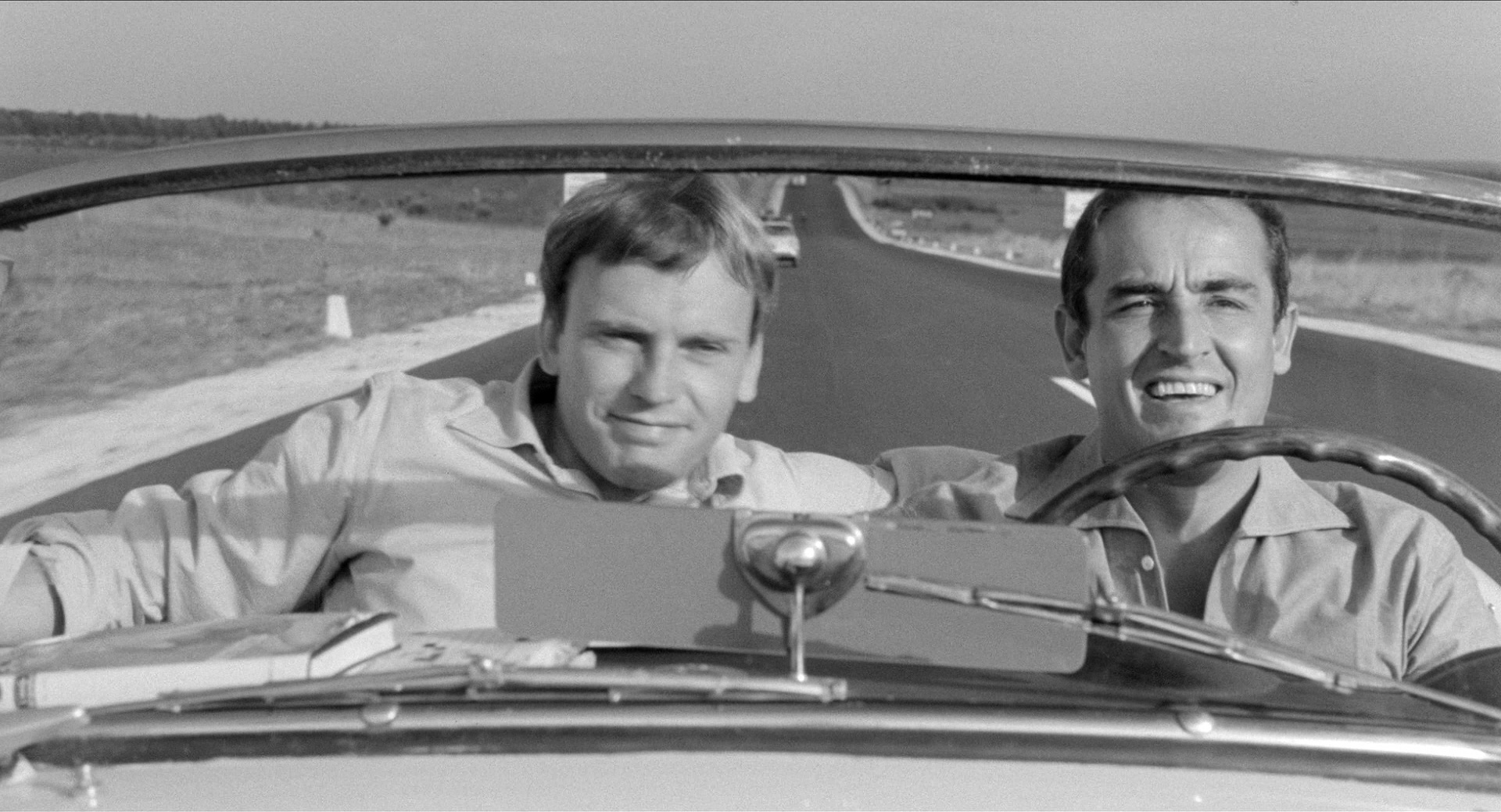
 A deserted Rome, a noisy convertible, and an invitation that is difficult to refuse: Il sorpasso begins with the promise of an unexpected summer adventure. Released in 1962 and directed by Dino Risi, the film pairs Vittorio Gassman with Jean-Louis Trintignant in a journey that moves effortlessly between comedy, discomfort, and disillusionment.
Known in English as The Easy Life, it captures the excitement and contradictions of an Italy discovering new prosperity. Beneath its lively conversations and holiday atmosphere lies a searching question: what happens when charm and confidence become substitutes for responsibility?
Quick Film Facts
Original title: Il sorpasso
English title: The Easy Life
Director: Dino Risi
Year: 1962
Screenplay: Dino Risi, Ettore Scola, and Ruggero Maccari
Principal cast: Vittorio Gassman, Jean-Louis Trintignant, Catherine Spaak
Cinematography: Alfio Contini
Music: Riz Ortolani
Country: Italy
Language: Italian
Photography: Black and white
Running time: Approximately 105 minutes in the Criterion edition; published runtimes vary by release.
A Summer Road Trip with an Uncertain Destination
The story begins during Ferragosto, Italy’s August 15 holiday. Roberto Mariani, a shy law student, is spending the day studying when Bruno Cortona enters his life.
Bruno is older, outspoken, and apparently untouched by embarrassment. A chance encounter becomes an invitation to leave the apartment, find something to eat, and enjoy the holiday. Soon Roberto is sitting beside him in an open-top Lancia, traveling from Rome toward the Tuscan coast.
Their journey unfolds through roadside stops, encounters with strangers, and visits to relatives. Roberto repeatedly considers leaving, yet Bruno’s energy keeps drawing him back. What initially looks like an escape from routine gradually becomes an encounter with a way of living that Roberto finds both troubling and seductive.
The synopsis is best left there. The ending deserves to be experienced without advance explanation.
Vittorio Gassman and Jean-Louis Trintignant
Gassman makes Bruno the center of almost every encounter. His voice, gestures, teasing, and effortless familiarity fill the space around him. He can turn an ordinary conversation into a performance, often before the other person has decided whether to participate.
The fascination of the character lies in how easily his behavior wins people over. His confidence can feel generous when it releases Roberto from hesitation, then become oppressive when it leaves no room for another person’s wishes.
Trintignant gives Roberto a quieter presence. His pauses and uncertain expressions make the student’s shifting reactions readable without turning him into a comic caricature. Watching them together means watching two different rhythms: Bruno constantly pushes forward, while Roberto needs time to understand what is happening.
Catherine Spaak plays Lilli, Bruno’s daughter. Their scenes introduce a family perspective on a man whom Roberto has encountered chiefly as an entertaining stranger. Claudio Gora plays Bibi, and Luciana Angiolillo plays Gianna.
Dino Risi and Commedia all’Italiana
Il sorpasso belongs to the tradition examined in Italia Mia’s guide to Commedia all’Italiana: films that use humor to expose social habits, moral compromises, and uncomfortable truths.
Risi’s achievement is the balance between amusement and unease. The journey remains entertaining even as the behavior driving it becomes increasingly questionable. The audience has time to feel Bruno’s appeal before considering its consequences.
Working with Ettore Scola and Ruggero Maccari, Risi creates an episodic structure in which apparently casual encounters gradually develop the film’s social portrait. Treccani identifies its combination of irony, emotional involvement, and disillusionment as central to its enduring reputation.
Speed, Freedom, and the Economic Boom
The road gives the film its organizing image. A car promises independence, movement, and access to new pleasures; it also allows its occupants to leave difficult situations before confronting them.
Within this setting, the Italian economic boom becomes visible through travel, leisure, and consumption. Antonio Monda’s Criterion essay connects the film’s appeal to a growing middle class eager to experience the country and enjoy the mobility that prosperity offered.
The title means “the overtaking” or “the passing maneuver.” Read as a metaphor, it suggests the pressure to get ahead: to move faster, seize opportunities, and avoid being the person left behind.
That interpretation gives Bruno and Roberto’s relationship a wider significance. Bruno appears to know how to live because he rarely hesitates. Roberto’s caution seems limiting beside such assurance. The film invites viewers to question how confidently they make the same judgment.
Black-and-White Photography and the Sound of Summer
Alfio Contini’s photography gives the summer setting a bright, exposed quality. The daylight leaves little room to hide, yet the holiday atmosphere makes uncomfortable encounters seem temporarily easy to dismiss.
Riz Ortolani’s music shares the soundtrack with popular songs heard during the journey. These sounds help establish a world of passing pleasures, busy leisure spaces, and constant stimulation. Treccani highlights both the sunlit photography and the summer songs as essential to the film’s atmosphere.
The car’s horn and the interruptions of roadside life also give the journey an insistent rhythm. Even moments of reflection seem vulnerable to the next departure.
Awards and Lasting Influence
Vittorio Gassman received both the David di Donatello and the Nastro d’Argento for Best Actor for Il sorpasso in 1963. These awards recognized a performance that remains central to the film’s reputation.
Its influence extends beyond Italian cinema. Alexander Payne has acknowledged Il sorpasso as an inspiration for Sideways, another film built around a journey and a revealing relationship between two contrasting men.
For more celebrated films and their achievements, see Italia Mia’s Italian Movie Award Winners.
Where to Watch or Buy Il sorpasso
Criterion lists Il sorpasso with a viewing link to the Criterion Channel. Access depends on your country and the service’s current catalog.
For a physical copy, the Criterion Blu-ray and DVD edition on Amazon.com includes a restored presentation, Italian audio, English subtitles, and substantial supplementary material. The Blu-ray is Region A, so buyers using European equipment should check player compatibility.
Criterion’s extras include interviews, documentaries, and an introduction by Alexander Payne. A separate DVD edition is also listed by the distributor. Check the selected format, disc region, subtitle languages, seller, and current availability before ordering; specifications can differ between editions.
Affiliate disclosure: Italia Mia may earn a commission from qualifying purchases made through the Amazon link, at no additional cost to you.
Why Il sorpasso Still Matters
The film’s lasting power comes from the uneasy relationship between pleasure and judgment. Bruno is entertaining enough to make his company attractive, and Roberto’s hesitation is familiar enough to make his surrender understandable.
Risi gives that relationship room to develop through laughter, irritation, curiosity, and fleeting affection. By the end, an apparently simple holiday journey has become a film that asks viewers to reconsider the people they trust—and the qualities they mistake for wisdom.
External Sources
The Criterion Collection: Film Credits and Edition Details
Treccani: Il sorpasso — Enciclopedia del Cinema
Cinematografo: Film Record and Awards
Antonio Monda: Il sorpasso — Italy, Dark and Light