

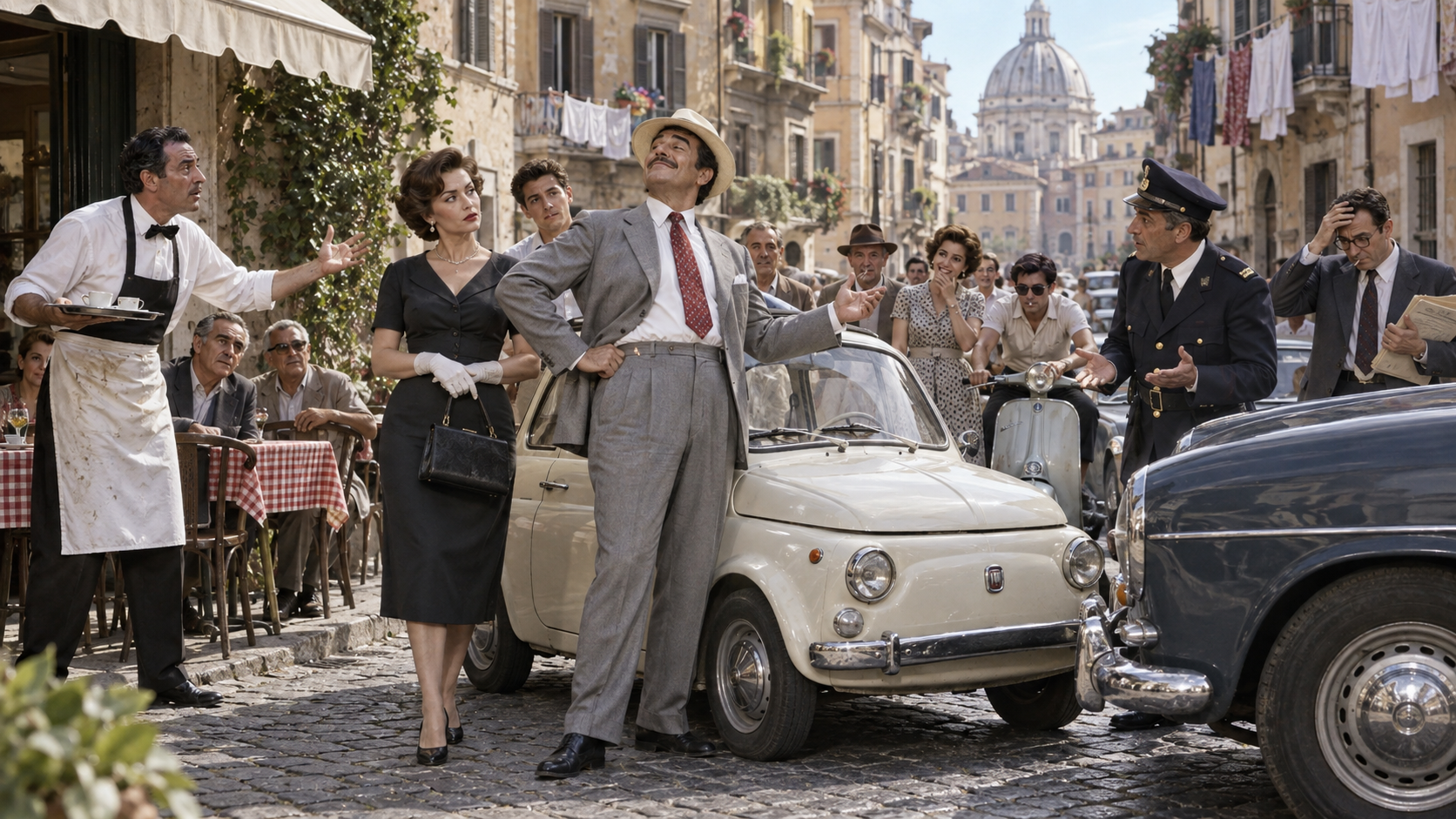
 Commedia all’Italiana was far more than Italian cinema designed to make audiences laugh. Emerging during the late 1950s and flourishing throughout the 1960s and 1970s, the movement used comedy to expose the contradictions of a country undergoing extraordinarily rapid change.
Its films examined the economic boom, consumerism, class divisions, political corruption, changing sexual attitudes, marriage, religion and the persistent divide between Italy’s modern ambitions and its traditional social structures. The laughter could be irresistible, but it was rarely innocent. Behind the jokes were loneliness, humiliation, opportunism and, quite often, tragedy.
This distinction matters because not every comedy produced in Italy belongs to Commedia all’Italiana. It was a recognizable historical movement with particular themes, filmmakers, screenwriters and performers. Understanding it provides an essential chapter in the broader history of Italian cinema.
What Does Commedia all’Italiana Mean?
The expression is usually translated as “Comedy Italian Style.” It became associated with the movement partly through the international success of Pietro Germi’s Divorzio all’italiana, released in 1961 and known in English as Divorce Italian Style.
The label describes a type of comic and satirical filmmaking rooted in postwar Italian life. Unlike a conventional comedy, it did not necessarily reward decent characters, restore social order or conclude happily. Its protagonists were frequently selfish, cowardly, dishonest or hopelessly unprepared for the world around them.
Audiences were invited to laugh at these characters while recognizing the society that produced them. A corrupt doctor, an arrogant motorist or an opportunistic businessman was not simply an isolated villain. He represented a broader weakness in the country’s institutions, values or national character.
The movement’s special quality came from this mixture of humor and discomfort. A film could be enormously entertaining while addressing poverty, war, divorce, unemployment, sexism, political extremism or death.
From Neorealism to Satirical Comedy
Commedia all’Italiana developed partly from the legacy of Italian Neorealism. Neorealist filmmakers had brought working-class lives, economic hardship and contemporary social problems onto the screen. The new comedy retained that interest in recognizable Italian life but approached it through satire, irony and popular entertainment.
During the 1950s, Italy was leaving behind the devastation of the Second World War. Industrial production expanded, cities grew, families bought cars and household appliances, and mass tourism began transforming the country. This “economic miracle” created new opportunities, but prosperity was distributed unevenly.
Traditional morality survived alongside consumerism and modernization. Divorce remained illegal until 1970, regional and class inequalities persisted, and public respectability often concealed private misconduct. These contradictions supplied Commedia all’Italiana with an almost inexhaustible source of stories.
The movement transformed social observation into accessible cinema. Instead of idealized heroes, it presented boastful businessmen, unsuccessful thieves, compromised professionals, frustrated wives, provincial dreamers and ordinary people attempting to survive through cunning.
I Soliti Ignoti and the Birth of the Movement
Mario Monicelli’s I soliti ignoti, released in 1958 and internationally known as Big Deal on Madonna Street, is widely considered one of the first fully developed examples of Commedia all’Italiana.
The film parodies the sophisticated heist movie. Its group of impoverished Roman criminals spends considerable time planning a robbery, but its members lack the discipline, intelligence and equipment necessary to carry it out. The result is comic, yet the characters’ poverty and desperation remain visible beneath the farce.
The cast united several performers who would become central to Italian cinema, including Vittorio Gassman, Marcello Mastroianni, Renato Salvatori and Claudia Cardinale, with Totò appearing as an experienced safecracker.
Monicelli proved that a commercially successful comedy could retain the social awareness of postwar cinema. His characters were ridiculous but human, and their failure said something about the unequal society in which they lived.
The Defining Characteristics
Commedia all’Italiana films varied greatly in setting and tone, but many shared several characteristics.
Their protagonists were usually flawed antiheroes rather than admirable role models. They lied, cheated, exaggerated their importance and adjusted their principles whenever personal advantage appeared possible.
The films also treated Italy itself as a central character. Regional identities, dialects, family expectations, Catholic morality, bureaucracy and political instability shaped the lives of the protagonists.
Many stories included abrupt changes in tone. A lighthearted sequence could be followed by betrayal, humiliation or death. The ending of a film such as Il sorpasso demonstrates how quickly carefree comedy could turn into tragedy.
Another defining feature was the refusal to offer simple moral solutions. The filmmakers exposed social problems but rarely suggested that they could be easily corrected. Their humor was based on observation rather than optimism.
Mario Monicelli: Comedy with Historical and Social Depth
Mario Monicelli was one of the movement’s most important architects. His films combined precise comic timing with a sympathetic but unsentimental understanding of human weakness.
After I soliti ignoti, he directed La grande guerra in 1959. Starring Alberto Sordi and Vittorio Gassman, the film challenged heroic representations of the First World War by following two reluctant soldiers more interested in avoiding danger than achieving military glory.
L’armata Brancaleone, released in 1966, used a chaotic medieval adventure to ridicule heroic myths, social ambition and military incompetence. Its inventive language and unforgettable performance by Gassman made it one of the most distinctive Italian comedies of its period. Read more in Italia Mia’s guide to L’armata Brancaleone.
Monicelli continued to darken the movement’s tone with Amici miei and Un borghese piccolo piccolo. The latter begins with comic observations of bureaucracy and middle-class aspiration before becoming a disturbing story of grief and revenge.
Dino Risi and the Monsters of Modern Italy
Dino Risi became one of the sharpest observers of Italy during the economic boom. His characters frequently confused speed, money and social mobility with genuine progress.
Il sorpasso, released in 1962, follows the confident and irresponsible Bruno as he draws the reserved law student Roberto into a road trip during the Ferragosto holiday. Vittorio Gassman’s Bruno initially appears energetic and liberating, but his charm gradually reveals recklessness, emptiness and an inability to consider the consequences of his actions.
The film’s roads, beaches, cars and new consumer culture form a portrait of a rapidly modernizing Italy. Its famous conclusion transforms the apparently carefree journey into one of the movement’s most devastating moral statements.
In I mostri, Risi used a series of short episodes to present an entire gallery of “monsters”: hypocrites, opportunists, neglectful parents, dishonest professionals and self-satisfied members of respectable society.
Profumo di donna, released in 1974, offered Vittorio Gassman another complex role, balancing sharp comedy with anger, vulnerability and emotional pain.
Pietro Germi and the Satire of Marriage and Honor
Pietro Germi’s Divorzio all’italiana gave the movement its internationally recognized name. Marcello Mastroianni plays a Sicilian aristocrat who wants to escape his marriage but cannot legally obtain a divorce. He therefore plans to manipulate Italy’s attitudes toward adultery and “honor” to eliminate his wife.
The film attacks both archaic traditions and the hypocrisy of respectable society. Its elegant style and comic narration make the protagonist’s scheme amusing, even as the story reveals the dangerous consequences of laws and customs created largely by men.
Germi returned to related territory in Sedotta e abbandonata, which exposes the pressure placed on women by family honor, social appearances and sexual double standards. Signore & signori later turned its attention to adultery and hypocrisy in a prosperous provincial town.
Ettore Scola and the Movement’s Later Years
Ettore Scola began as a screenwriter before becoming one of the major directors associated with the later phase of Commedia all’Italiana.
In C’eravamo tanto amati, three former Resistance fighters follow different paths during the decades after the war. Their friendships, compromises and disappointments become a reflection on Italy’s political and cultural transformation.
Brutti, sporchi e cattivi presents a grotesque vision of poverty on the outskirts of Rome, with Nino Manfredi leading a family divided by greed and resentment. The film deliberately rejects sentimental depictions of the poor.
Scola also showed how the movement’s actors and methods could support more intimate historical drama. Una giornata particolare, starring Sophia Loren and Marcello Mastroianni, is quieter than a typical Commedia all’Italiana film but retains the movement’s concern with Fascism, social conformity, gender and exclusion.
Other Essential Directors and Screenwriters
The movement cannot be understood through Monicelli, Risi, Germi and Scola alone.
Luigi Comencini brought sensitivity and social observation to films such as Tutti a casa and Lo scopone scientifico. Antonio Pietrangeli examined women’s changing place in Italian society, most powerfully in Io la conoscevo bene. Luigi Zampa used comedy to criticize institutions, while Luciano Salce explored conformity, work and political opportunism.
Marco Ferreri occupied a more radical and unsettling position. Films such as La donna scimmia and La grande abbuffata pushed satire toward the grotesque, exposing exploitation, consumption and self-destruction.
Screenwriters were equally important. Agenore Incrocci and Furio Scarpelli, known professionally as Age and Scarpelli, helped define the movement through their work on I soliti ignoti, La grande guerra and numerous other films. Rodolfo Sonego, Ruggero Maccari, Suso Cecchi D’Amico and Bernardino Zapponi were among the writers who gave these stories their sharp dialogue, social detail and carefully controlled shifts between comedy and drama.
The Great Actors of Commedia all’Italiana
The movement depended on performers capable of making morally questionable characters compelling.
Alberto Sordi specialized in exposing vanity, cowardice and self-interest beneath the surface of the respectable Italian citizen. His characters could be infuriating, pathetic and extremely funny, often within the same scene.
Vittorio Gassman used his commanding voice and theatrical presence to portray braggarts, seducers, failed intellectuals and men whose confidence concealed weakness. Ugo Tognazzi brought a more restrained and sometimes melancholy quality to stories about masculinity, marriage and social conformity.
Nino Manfredi was especially effective at portraying ordinary Italians caught between survival and compromise, while Marcello Mastroianni could turn elegance and charm into instruments of satire. Totò, whose career extended beyond the movement, supplied an important connection between traditional Italian popular comedy and the new postwar cinema.
Women were not merely supporting figures, although the stories frequently revealed the restrictions imposed on them. Monica Vitti reinvented herself as a brilliant comic performer. Stefania Sandrelli, Franca Valeri, Claudia Cardinale, Sophia Loren, Mariangela Melato and Catherine Spaak portrayed women negotiating marriage, sexuality, work and unequal social expectations.
Essential Commedia all’Italiana Films
For readers approaching the movement for the first time, these films provide a strong introduction:
- I soliti ignoti (1958), Mario Monicelli — An unsuccessful robbery becomes a compassionate satire of poverty, ambition and criminal incompetence.
- La grande guerra (1959), Mario Monicelli — Two reluctant soldiers challenge romantic ideas about courage and wartime heroism.
- Divorzio all’italiana (1961), Pietro Germi — A darkly elegant attack on marriage law, masculine privilege and the culture of honor.
- Il sorpasso (1962), Dino Risi — A summer road trip becomes a defining portrait of the Italian economic boom and its moral emptiness.
- I mostri (1963), Dino Risi — A succession of comic episodes reveals the everyday selfishness hidden inside respectable society.
- Sedotta e abbandonata (1964), Pietro Germi — A fierce satire of family honor and the unequal treatment of women.
- Io la conoscevo bene (1965), Antonio Pietrangeli — The dreams of a young woman in Rome expose the cruelty of celebrity culture and social ambition.
- Signore & signori (1966), Pietro Germi — Provincial respectability collapses under the weight of adultery, gossip and hypocrisy.
- L’armata Brancaleone (1966), Mario Monicelli — A medieval parody that dismantles heroism through language, chaos and failure.
- La ragazza con la pistola (1968), Mario Monicelli — Monica Vitti’s Sicilian protagonist travels to Britain, transforming a revenge story into a comedy of emancipation.
- Lo scopone scientifico (1972), Luigi Comencini — A card game between a wealthy American and a poor Roman couple becomes a cruel allegory of class inequality.
- C’eravamo tanto amati (1974), Ettore Scola — Friendship and lost ideals reflect three decades of postwar Italian history.
- Profumo di donna (1974), Dino Risi — Vittorio Gassman gives one of his greatest performances as an embittered former officer.
- Amici miei (1975), Mario Monicelli — Practical jokes and male friendship conceal aging, dissatisfaction and fear of loneliness.
- Un borghese piccolo piccolo (1977), Mario Monicelli — One of the movement’s darkest films turns bureaucratic satire into personal tragedy.
Several of these titles also appear among Italia Mia’s selection of the top Italian movies of all time.
Why the Movement Declined
By the late 1970s, the social conditions that had produced Commedia all’Italiana were changing. Italy had entered a period marked by economic uncertainty, political violence and declining cinema attendance. Television was becoming increasingly important, while the film industry relied more heavily on easily marketed genres.
The movement also became progressively darker. In films such as Un borghese piccolo piccolo, comic energy gave way to anger, alienation and despair. The familiar antihero no longer seemed merely ridiculous; he could become frightening.
Commedia all’Italiana should not be confused with the commedia sexy all’italiana that became popular during the 1970s. Although the two sometimes shared performers and social settings, the latter generally emphasized sexual farce and voyeuristic situations rather than the sustained political and social criticism associated with the earlier movement.
Its Influence and Continuing Legacy
The original cycle belongs primarily to the late 1950s through the 1970s, but its influence never disappeared. Later Italian filmmakers continued to combine humor with criticism of politics, family life, corruption and social inequality.
Directors such as Nanni Moretti, Paolo Virzì and Carlo Verdone inherited aspects of its tradition without simply reproducing it. Contemporary Italian comedies may feature flawed protagonists and sharp social observation, but they should not automatically be classified as Commedia all’Italiana. The term is most useful when it identifies the particular movement created by the social conditions, filmmakers and performers of postwar Italy.
At its best, Commedia all’Italiana achieved something difficult: it entertained mass audiences while confronting them with an unflattering reflection of their own society. Its heroes were compromised, its happy endings were uncertain and its laughter carried the uncomfortable recognition that the “monsters” on screen were not so different from the people watching them.
Books and Films
For a deeper study of the genre, browse books about Commedia all’Italiana on Amazon.com. Availability of individual films varies by country, but classic titles can also be found by searching Commedia all’Italiana DVDs and Blu-rays.
Related Italia Mia Guides
Italian Cinema: 100 Years of Masterpieces That Shaped World Film
Top Italian Movies of All Time
External Sources
Treccani — Commedia all’Italiana
BFI — Mario Monicelli and the Origins of Commedia all’Italiana
Austrian Film Museum — Dino Risi and Commedia all’Italiana