 The Best of Youth (La meglio gioventù) follows two brothers through almost four decades of Italian life. Directed by Marco Tullio Giordana and released in 2003, this sweeping drama brings together family, love, political conflict, and the choices that shape adulthood.
Its running time of roughly six hours may seem daunting. Yet the appeal lies in having time to know these people. Relationships develop, old arguments return, and small decisions reveal their consequences years later.
For readers interested in Italy beyond its familiar landmarks, the film offers a powerful starting point. It shows a country changing through the lives of people who hope to change it themselves.
The Story
The story begins in 1966, when Nicola and Matteo Carati are young men with a future full of possibilities. They share books, friends, and plans. However, an encounter with Giorgia, a young woman experiencing mental health difficulties, sends their lives in different directions.
Nicola becomes a psychiatrist. Matteo leaves his studies and eventually joins the police. Both care deeply about injustice, but they struggle with it in different ways. Nicola seeks understanding through contact with others. Matteo finds it harder to reconcile his sensitivity with the world around him.
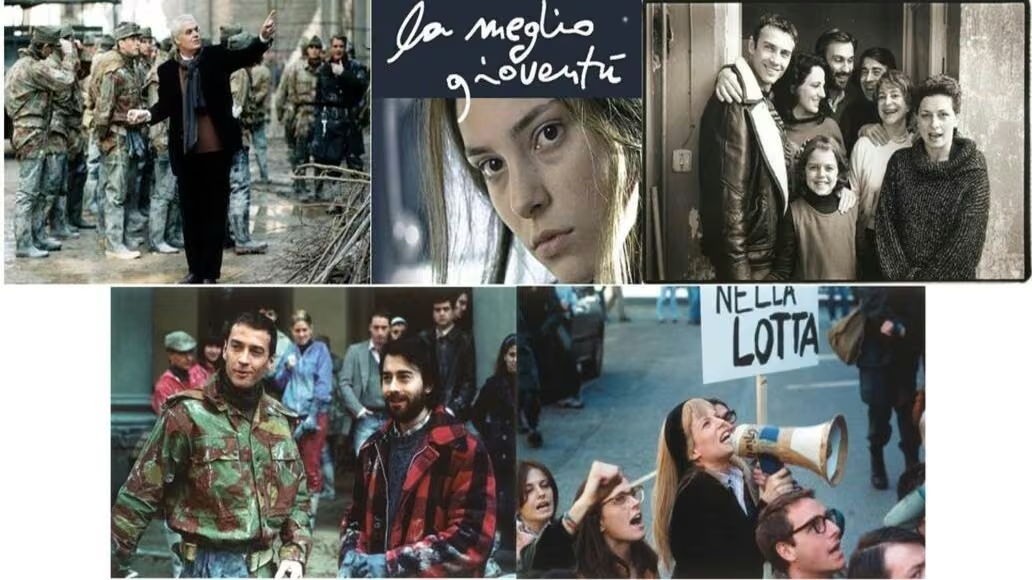
Their story unfolds against major events in modern Italy. These include the Florence flood, student protests, industrial conflict, political violence, and changes in psychiatric care. Later chapters reach the upheavals of the early 1990s and the beginning of a new century.
Nevertheless, the film remains rooted in everyday relationships. Parents grow older. Children develop their own ideas. Friends take unexpected paths, while love creates both comfort and conflict.
You do not need a detailed knowledge of Italian history to follow the story. The family provides the emotional thread. Historical context adds depth, but the central questions are familiar: how do we live with our choices, and how much can we help those we love?
Cast and Characters
Luigi Lo Cascio plays Nicola Carati, whose warmth gives the film much of its emotional continuity. Nicola listens closely to other people, although understanding those nearest to him can prove more difficult.
Alessio Boni plays Matteo Carati. His performance conveys a man whose outward discipline offers little protection from inner distress. The contrast between the brothers creates tension without reducing either one to a simple symbol.
Sonia Bergamasco plays Giulia, a pianist whose relationship with Nicola becomes entangled with her political commitments. Meanwhile, Maya Sansa plays Mirella, an important presence in the brothers’ wider story.
Jasmine Trinca plays Giorgia, whose experiences connect the family narrative with questions about dignity and psychiatric treatment. Adriana Asti and Andrea Tidona play the brothers’ parents, Adriana and Angelo. Fabrizio Gifuni appears as Carlo, a friend whose life remains connected to the family.
The ensemble is essential to the film’s impact. Supporting characters have their own concerns and contradictions. As a result, the world feels larger than the story of its two central figures.
Awards and Recognition
The Best of Youth won the Un Certain Regard prize at the 2003 Cannes Film Festival. This was the award for that festival section, distinct from the Palme d’Or.
At the 2004 David di Donatello Awards, it received six prizes: Best Film, Best Director, Best Screenplay, Best Producer, Best Editing, and Best Sound.
The film also earned seven Nastri d’Argento. Its acting honors recognized groups of performers from the ensemble, reflecting the importance of the cast as a whole.
These achievements underline the range of its strengths. The writing holds together decades of events, while the performances give those events a personal cost. Editing, in turn, allows a very long narrative to retain its momentum.
How the Film Was Made
Giordana directed a screenplay by Sandro Petraglia and Stefano Rulli. Angelo Barbagallo produced the film through BiBi Film with Rai Fiction. Roberto Forza handled cinematography, and Roberto Missiroli edited the film.
The project crossed the boundary between cinema and television. Italian cinemas presented it in two parts in June 2003. Rai Uno later broadcast it across four evenings in December of the same year.
That structure helps explain its unusual length. The story has room for separations, reunions, and long periods of change. Instead of showing only decisive events, it also follows the quieter stretches between them.
The title carries a literary connection. La meglio gioventù is also the title of a collection of poetry in Friulian by Pier Paolo Pasolini. Cannes’ description additionally notes its connection with an Alpini song.
Within the film, the phrase invites reflection. Youth brings hope and energy, but neither guarantees wisdom. The characters must discover what remains of their ideals when life becomes more complicated.
Why It Still Matters
The Best of Youth asks a lasting question: what happens when the future we imagined becomes the life we actually lead?
Its answer emerges through relationships. Some people revise their beliefs. Others hold tightly to them. Meanwhile, family bonds survive changes that once seemed impossible to overcome.
The film’s concern with mental health is especially significant. Giorgia’s story encourages us to consider the person behind an institutional label. Nicola’s work also raises questions about listening, care, and the limits of good intentions.
Similarly, the political story gains force through its personal consequences. Beliefs affect partnerships, careers, friendships, and children. Public events enter private homes, where their effects can last for decades.
The film sometimes relies on coincidence and heightened emotion. Viewers who prefer restrained drama may find certain turns too emphatic. Even so, its generous attention to its characters gives those moments weight.
It also makes an interesting companion to Cinema Paradiso. Both films explore memory and the passing of time, although Giordana builds his story around a much broader family and social history.
I would approach The Best of Youth across two or more evenings. Give its characters time to become familiar. The length then becomes part of the pleasure: people who first seem distant gradually feel close.
Where to Watch or Buy
Availability checked October 1, 2026. Catalogs, prices, subtitles, and editions can change.
United States: streaming subscriptions
The U.S. listings checked did not show an included subscription option for the complete film. A title appearing on Amazon or Apple does not necessarily mean it comes with a subscription.
United States: digital rental and purchase
JustWatch currently lists rental and digital purchase options through Amazon Video, Apple TV Store, and Fandango at Home. Check the current U.S. viewing options or the Amazon U.S. digital listing.
Check the running time before paying. The Apple TV listing displays 2 hours and 55 minutes, while the complete work runs roughly six hours. Confirm whether an offer includes both parts, and verify English subtitles.
Italy: free and subscription streaming
RaiPlay has an official page for La meglio gioventù, and JustWatch lists free viewing with advertising in Italy. This is the clearest starting point for Italian viewers.
The separate television listing also reports availability through Prime Video. However, its episode information is inconsistent, so check that the offer contains Giordana’s complete work before subscribing.
Italy: digital rental and purchase
The Italian film listing checked did not confirm a standalone rental offer. The television listing reports an Amazon Video purchase option, but the package and included episodes need checking. Consult the Italian availability page before paying.
DVD and other physical editions
For a physical copy, browse The Best of Youth DVDs on Amazon.com or La meglio gioventù DVDs on Amazon.it. These links lead to search results, where editions and sellers may vary.
Look for the complete film or all four television episodes. Also check the disc region, player compatibility, and subtitle languages. An Italian edition may not include English subtitles.
Watching while traveling
RaiPlay access can depend on location and viewing rights. If you are considering NordVPN, read our guide to VPNs and Italian television. A VPN does not guarantee access or replace a subscription, and you should follow the streaming provider’s terms.
Affiliate disclosure: As an Amazon Associate, I earn from qualifying purchases. Italia Mia may also earn a commission through the NordVPN link, at no additional cost to you.
External Sources
Festival de Cannes: La meglio gioventù
Cinematografo: credits, production details, and awards
Rai Cultura: the film’s twentieth anniversary
JustWatch: United States availability
JustWatch: Italian availability