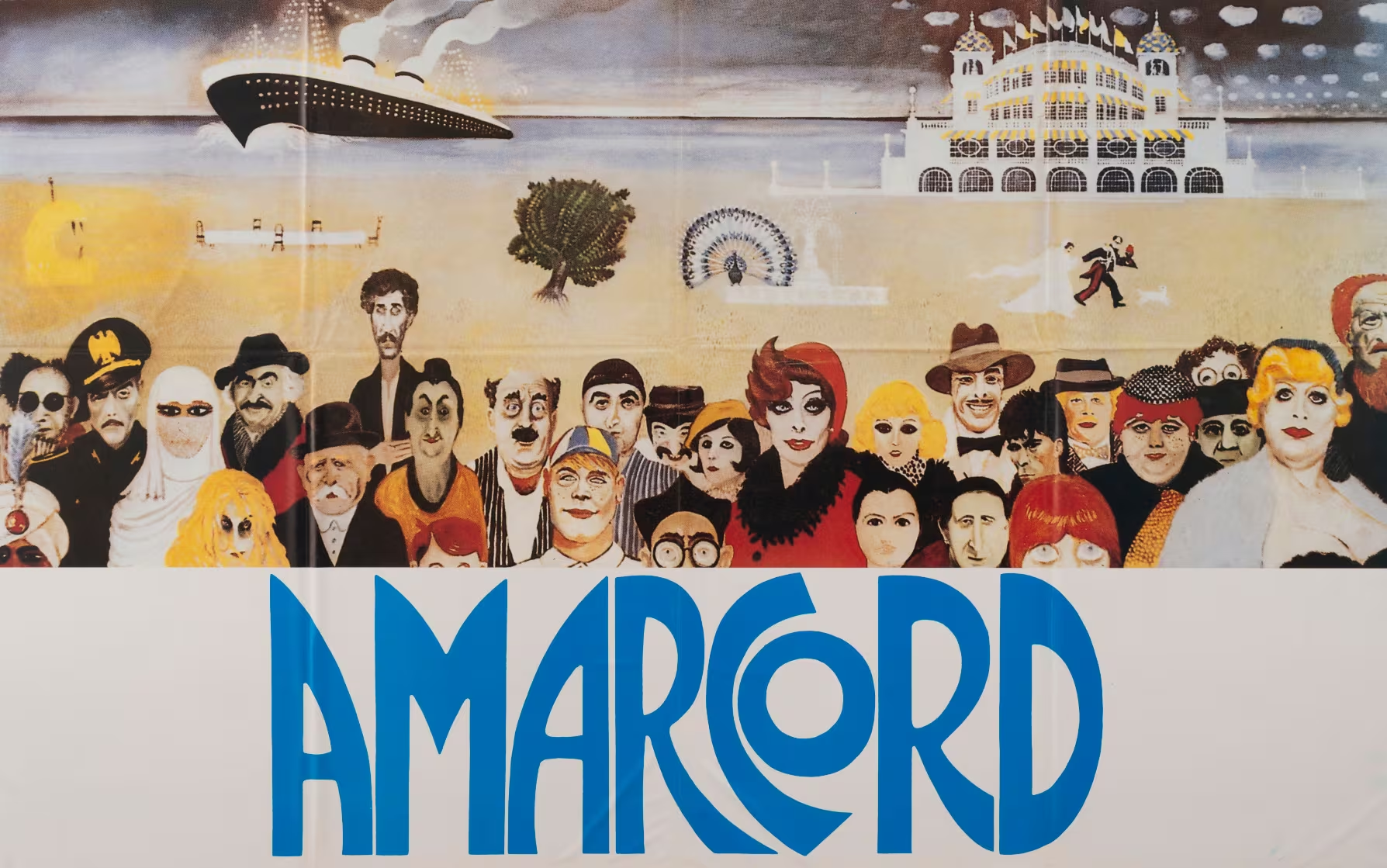
 Some films tell a story; Amarcord makes you feel that you have lived somewhere. Federico Fellini’s 1973 film brings together unruly schoolboys, family arguments, local gossip and extraordinary visions in a seaside town shaped by Fascism.
What draws me to it is the uneasy relationship between affection and criticism. Fellini remembers the pleasures of provincial life, but also its cruelty, conformity and foolishness. The title comes from a Romagnol expression meaning “I remember,” yet memory here constantly spills into fantasy.
The Story
Amarcord unfolds through the changing seasons in a fictionalized version of 1930s Rimini. Its central adolescent, Titta, spends his days misbehaving with friends, enduring school and navigating a household where arguments can erupt over almost anything.
Around him, the town becomes the film’s collective protagonist. Spring arrives with a bonfire. A motor race briefly transforms the streets. Residents venture out in boats to witness the nighttime passage of the ocean liner Rex, whose illuminated silhouette seems almost too magnificent to belong to their world.
Fellini moves between public celebrations and private embarrassment, between adolescent desire and the loneliness of adults. There is little sense of a conventional plot marching toward a single resolution. Instead, individual episodes accumulate into the experience of a community passing through a year.
The Fascist setting gives those episodes a disturbing undertow. Uniforms, rituals and collective enthusiasm coexist with intimidation and violence. For me, that tension prevents Amarcord from becoming a comfortable scrapbook of the past.
Cast and Characters
Bruno Zanin plays Titta with the restless energy of a boy who wants adult freedom while understanding very little about adulthood.
Pupella Maggio, as his mother Miranda, gives the family scenes their emotional weight. Her exasperation and protectiveness make her feel immediately recognizable. Armando Brancia plays Aurelio, Titta’s father, whose explosive temper and antifascist convictions complicate the household’s comic disorder.
Magali Noël’s Gradisca is one of the film’s defining figures. The town sees her through layers of desire and gossip, but her longing for romance gives her a vulnerability beyond that public image.
Ciccio Ingrassia plays Uncle Teo, whose tree-climbing episode turns a family outing into a scene of both comedy and distress. Giuseppe Ianigro appears as Titta’s grandfather, while Maria Antonietta Beluzzi plays the tobacconist at the center of one of the boy’s most overwhelming encounters.
Together, these performers create the sense of a town populated by people who have known one another for far too long. Their gestures, grudges and repeated stories matter as much as the dialogue.
Awards and Recognition
Amarcord won the Academy Award for Best Foreign Language Film, representing Italy, at the 1975 ceremony. At the 1976 Oscars, Fellini received a directing nomination, while Fellini and Tonino Guerra were nominated for Original Screenplay. The nominations therefore belong to two different ceremonies, despite the film’s Italian release in 1973.
Italian recognition included the 1974 David di Donatello awards for Best Film and Best Director, alongside several Nastri d’Argento honors.
Its place among Italian movie award winners is secure, but the awards explain only part of its enduring appeal. The images and characters remain memorable long after the details of individual episodes have faded.
How the Film Was Made
Fellini wrote Amarcord with Tonino Guerra, drawing on their shared roots in Romagna. Their collaboration transformed remembered people and incidents into a deliberately invented world.
Much of the town was constructed at Cinecittà in Rome. Production and costume designer Danilo Donati combined recognizable elements of Rimini with imaginative architecture and theatrical exaggeration. The film also used locations in Lazio, including Ostia Antica, Fiumicino and Anzio; it was not filmed entirely inside the studios.
The Rex sequence demonstrates the ingenuity behind that approach. The liner was represented by an elaborate constructed silhouette in Cinecittà’s pool, with illuminated windows, smoke and carefully arranged movement creating its dreamlike passage. Fellini wanted the emotion of the spectacle rather than a perfectly realistic ship.
Giuseppe Rotunno’s cinematography, Nino Rota’s music and Ruggero Mastroianni’s editing complete the film’s distinctive texture. Rota’s recurring melody is especially effective: it can make a comic scene feel wistful without asking the viewer to forget its absurdity.
Why It Still Matters
I find Amarcord most rewarding when watched as an examination of how people remember their communities. Familiar places grow larger, embarrassing incidents become legends, and individuals are reduced to nicknames that never quite capture who they were.
Fellini allows affection to survive without making the past innocent. His town can be generous and festive, but it can also humiliate outsiders and surrender to authoritarian spectacle. The comedy makes those weaknesses visible.
The treatment of women deserves attention, too. Much of the film looks at them through adolescent male fantasy. A contemporary viewer can enjoy the exuberance while questioning that perspective—and noticing the loneliness beneath some of its most extravagant portraits.
Above all, Amarcord understands that growing up means seeing familiar people differently. The adults who once seemed ridiculous become vulnerable; the town that once appeared permanent begins to change. That recognition gives the film its lasting emotional force.
Where to Watch or Buy
Availability checked on October 1, 2026. Streaming catalogs, rental options and disc stock can change.
United States — subscription streaming
Current U.S. listings include HBO Max and its Amazon channel, with additional access listed through TCM and YouTube TV. Access through television services depends on the channels included in your package. Criterion’s own film page also links to Amarcord on the Criterion Channel. Check the title page before subscribing.
United States — digital rental or purchase
U.S. listings show rental and digital purchase options through Amazon Video, Apple TV Store and Fandango at Home. These are separate from subscription streaming. See current U.S. viewing options and check the language and subtitles before paying.
United States — physical editions
Criterion offers Amarcord on Blu-ray and DVD, with supplements including a commentary, an interview with Magali Noël and material about Fellini’s relationship with Rimini. You can search Amazon.com for the Criterion edition. Confirm the format and region compatibility on the selected listing.
Italy — streaming and digital rental
At the time of checking, JustWatch’s Italian listing showed no local streaming, rental or digital purchase offer. An Apple TV information page alone does not establish that a film is available to rent. Consult current Italian viewing options for updates.
Italy — physical editions
For a disc, search Amazon.it for Amarcord on DVD or Blu-ray. This is a retailer search link: verify stock, the distributor, audio, subtitles and region compatibility on the individual product page.
For a first viewing, I would choose the original Italian soundtrack with English subtitles if needed. The voices and regional flavor are part of the film’s pleasure.
Affiliate disclosure: As an Amazon Associate, Italia Mia earns from qualifying purchases made through the Amazon links above.
External Sources
The Criterion Collection: film and editions
Cineteca di Bologna: making Amarcord
Italy for Movies: filming locations