
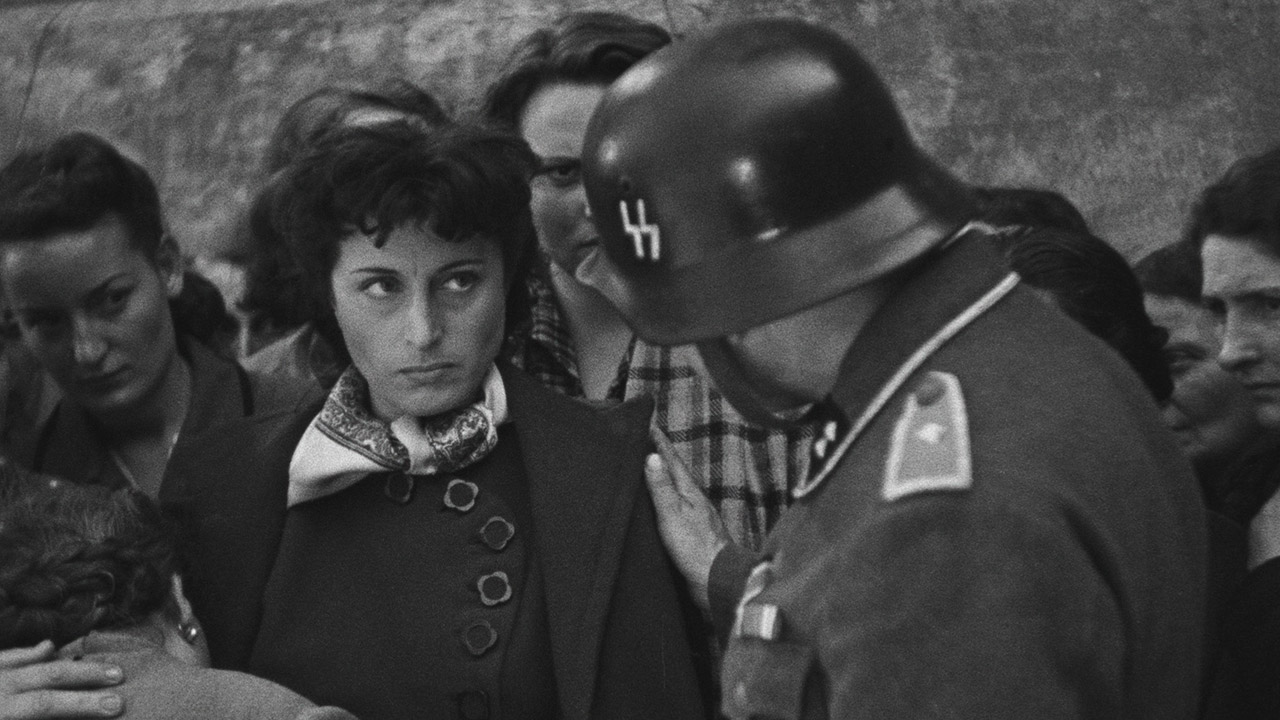
 Roberto Rossellini’s Rome, Open City (1945) takes us into a city where an ordinary apartment can become a hiding place and a familiar street can turn dangerous in seconds. Set during the Nazi occupation of Rome, it follows people who help the Resistance while trying to protect their families and survive the day. The film brought Italian neorealism to international attention, but its power begins with those personal choices.
The Story
Spoiler notice: This section introduces the characters and their predicament but does not reveal their fates.
Giorgio Manfredi, a Resistance leader pursued by the occupying forces, seeks refuge with Francesco, a printer who is due to marry Pina. Pina has a young son, Marcello, and a life to hold together even as danger closes in. Don Pietro Pellegrini, a parish priest, helps the partisans despite the risks to himself.
The story moves between homes, streets and gathering places where people must decide whom to trust. Rossellini gives the pursuit urgency, but he also lets us see what is at stake beyond the Resistance operation: a wedding, a child’s future, a neighbour’s safety.
Cast and Characters
- Anna Magnani as Pina: Francesco’s fiancée and Marcello’s mother. Magnani makes her forceful, affectionate and impossible to forget.
- Aldo Fabrizi as Don Pietro Pellegrini: A priest who puts his convictions into action by helping the Resistance.
- Marcello Pagliero as Giorgio Manfredi: The hunted Resistance leader whose need for shelter draws the characters together.
- Francesco Grandjacquet as Francesco: A printer, partisan supporter and Pina’s husband-to-be.
- Vito Annicchiarico as Marcello: Pina’s son, who sees more of the occupation than any child should.
- Maria Michi as Marina Mari: A performer whose connection to Giorgio becomes part of the film’s tense web of loyalties.
Magnani and Fabrizi were established performers. Their presence is a reminder that neorealism did not require every actor to be an amateur; here, their performances share the screen with faces and streets that make occupied Rome feel close at hand.
Awards and Recognition
Rome, Open City received one of the Grand Prix awards at the 1946 Cannes Film Festival. Calling it the Palme d’Or would use the later name for Cannes’s top prize. At the 1947 Academy Awards, Sergio Amidei and Federico Fellini received a nomination for Writing (Screenplay); the film did not win an Oscar. RaiPlay also records two Nastri d’argento.
Its lasting recognition is larger than its awards. Alongside Rossellini’s Paisan and Germany Year Zero, it became part of the body of work through which audiences around the world encountered postwar Italian cinema.
How the Film Was Made
Rome had been liberated in June 1944, but the war elsewhere in Italy was still underway when filming began on January 18, 1945. The production faced scarce money and film stock. Rossellini’s team used whatever stock it could obtain and could not routinely inspect the footage it had shot. The damaged city was the setting in which the filmmakers worked.
The screenplay grew from ideas connected to the Resistance. A project about the Resistance priest Don Giuseppe Morosini became part of a broader story; Pina’s most famous scene drew on the killing of Teresa Gullace in occupied Rome. Amidei and Fellini both contributed to the script, although accounts of exactly how it was written differ. Those real events informed a fictional drama, not a scene-by-scene reconstruction.
Why It Still Matters
I would begin with Rome, Open City for its people, rather than approach it as a lesson in film history. Pina’s concern for her family, Don Pietro’s courage and the uncertainty surrounding Giorgio make the occupation feel immediate. Rossellini places acts of resistance inside everyday life, where helping someone may mean putting everyone near you at risk.
The film also shows why neorealism changed what cinema could look and feel like. Its streets, postwar conditions and urgent performances gave audiences an image of Italy far removed from polished studio spectacle. It remains a gripping drama even if you know nothing about the movement it helped make famous.
Where to Watch or Buy
Availability check: September 29, 2026. Services and editions vary by country and can change. Check the film’s language and subtitle options before paying.
United States — streaming: Criterion Channel lists the film. The U.S. availability guide also lists HBO Max and other options; it is useful for checking which subscription currently includes it.
United States — rental or digital purchase: The U.S. listing shows rental and purchase options through services including Amazon Video, Apple TV Store and Fandango at Home. Compare the current offers on the U.S. availability page. A digital rental or purchase is separate from a streaming subscription.
United States — physical edition: Criterion identifies Rome, Open City in its Roberto Rossellini’s War Trilogy Blu-ray set, with a restoration and substantial extras. To compare current Amazon listings, search Amazon.com for the Criterion Blu-ray. The Amazon link opens search results; verify the seller, region compatibility and included discs before ordering.
Italy — streaming: RaiPlay has a page for Roma città aperta, and the Italian availability guide lists RaiPlay as a free option with advertising and Artiflix as a subscription option. Open the service in Italy to confirm playback and any account requirements.
Italy — rental or digital purchase: The Italian listing identifies CHILI for rental or purchase. Check the current offer through the Italian availability page.
Italy — physical edition: Search Amazon.it for Roma città aperta on DVD or Blu-ray. This is a search link, not a recommendation of an unverified edition. Confirm the format, subtitles and disc region on the individual listing.
Affiliate disclosure: If you buy through an Amazon link above, Italia Mia may earn a commission at no additional cost to you.
External Sources
Cannes: 1946 awards · Academy Awards: 1947 ceremony · The Criterion Collection: film and edition details · Criterion: the making of Rome Open City