
An Interview with Michelangelo: The Life, Genius and Secrets of a Renaissance Master
What if we could sit down with Michelangelo Buonarroti and ask him about his extraordinary life? We might ask why he became a sculptor, what he really thought about Leonardo da Vinci, how he survived the enormous task of painting the Sistine Chapel, why he fought with popes, or whether he truly believed that a figure was already hidden inside a block of marble.
The interview that follows is, of course, an imaginative reconstruction. Michelangelo cannot literally answer our questions today. His responses are literary interpretations based on documented episodes, letters, biographies, works of art, and historical accounts. The questions are fictional, while the historical framework is grounded in what is known about the artist.
Michelangelo di Lodovico Buonarroti Simoni was born in 1475 and died in 1564, living almost ninety years during one of the most extraordinary periods in European cultural history. He was a sculptor, painter, architect and poet whose career stretched across the transition from the High Renaissance into the beginnings of the Mannerist period.
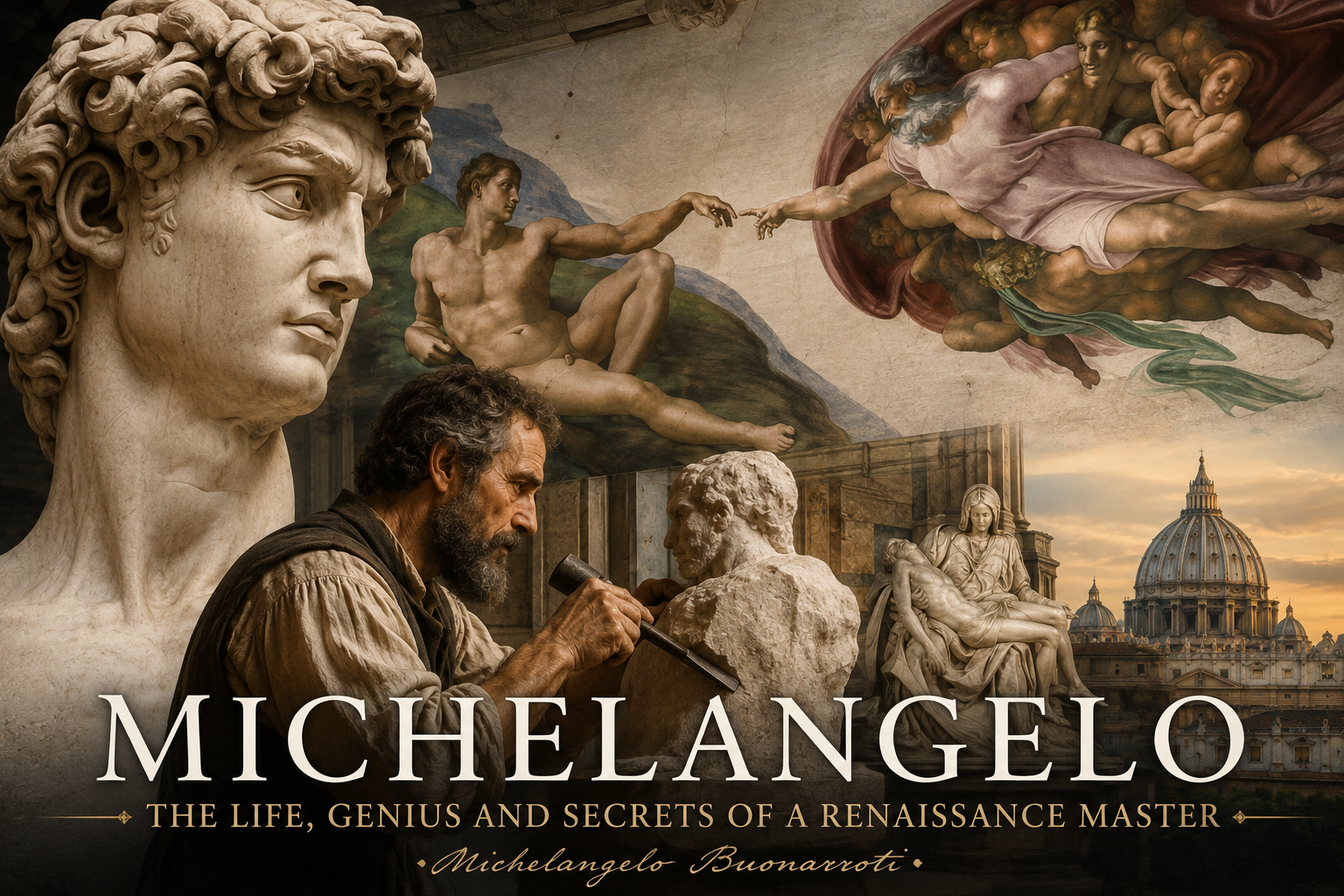
Few artists have left such an enormous mark on Western culture. His David, Pietà, Sistine Chapel ceiling, Last Judgment, Moses and architectural projects in Rome and Florence remain among the defining achievements of Italian art.
Yet the man behind these masterpieces was far more complicated than the image of the serene Renaissance genius suggests.
“Master Michelangelo, where does your story begin?”
Michelangelo: My story begins in Caprese, in Tuscany, on March 6, 1475.
I was born into the Buonarroti family, which belonged to the Florentine world of civic and minor aristocratic families. My father, Ludovico, held government positions, and he did not initially consider artistic work a suitable profession for someone of our social standing.
The family soon returned to Florence, however, and that city became the real setting of my childhood and youth.
My mother, Francesca, died when I was still very young. Art would eventually become the force that shaped my entire existence, although my father did not immediately accept that destiny.
“Why did your father object to your becoming an artist?”
Michelangelo: In our society, manual artistic work could carry a lower social status than the professions associated with education, administration or government.
My father wanted a respectable future for me. He could not initially understand why I would want to spend my life handling stone, paint and tools.
I understood something he did not: I had to become an artist.
At around thirteen, I entered the workshop of Domenico Ghirlandaio in Florence. There I learned the practical discipline of drawing, painting and workshop production. Ghirlandaio was among the most respected painters in Florence, and his workshop gave me an extraordinary education.
My time there was relatively short, but its influence was profound.
“Was Florence the secret behind your development?”
Michelangelo: Florence was not simply my birthplace of artistic ambition. It was an extraordinary laboratory of ideas.
The city still lived in the shadow of earlier masters such as Brunelleschi, Donatello and Masaccio. Artists, architects, scholars and philosophers were constantly discussing the nature of beauty, antiquity, religion and the human body.
Then there was the Medici family.
I entered the circle associated with Lorenzo de’ Medici, known as Lorenzo the Magnificent. At the Medici household and garden I encountered classical sculpture and intellectuals who treated ancient Greece and Rome not as dead history but as a living source of inspiration.
That experience changed everything.
I began to see sculpture not merely as craft but as a form of intellectual and spiritual expression.
“Did Lorenzo the Magnificent recognize your talent?”
Michelangelo: Lorenzo certainly recognized something in me.
The Medici environment gave me access to people and ideas that would otherwise have been difficult for a young artist to encounter. I saw ancient sculptures and listened to discussions about philosophy, poetry and classical culture.
Such experiences taught me that an artist needed more than technical ability.
The human figure became my great obsession. I wanted to understand anatomy, movement, tension, balance and emotion. A body could communicate an entire story without speaking a word.
“You later became famous for sculpture. Why was marble so important to you?”
Michelangelo: Marble has a character.
It is not simply a material waiting to be shaped. Every block presents a problem, and every problem contains a possibility.
I often spoke of sculpture as the process of releasing the figure from the stone. That idea has become associated with me because it captures something fundamental about how I approached carving.
The sculptor removes what does not belong.
What remains must appear inevitable.
“Your early career took you to Rome. What happened there?”
Michelangelo: Rome opened another world.
During my first major Roman period, I encountered an enormous concentration of ancient monuments and sculpture. The city offered an education impossible to reproduce anywhere else.
I also received commissions.
Among the most important was the Pietà, created between approximately 1497 and 1500 for St. Peter’s. It depicts the Virgin Mary holding the dead Christ, yet the figures are treated with remarkable calm and idealized beauty.
The work established my reputation at an international level.
“There is a famous story about your signature on the Pietà. Is it true?”
Michelangelo: That story has been told for centuries.
According to the traditional account recorded by Giorgio Vasari, I overheard visitors attributing the sculpture to another artist. I became angry enough to return to the church and carve my name into the sash across the Virgin’s chest.
Whether every detail of the story happened exactly as later generations told it is impossible to establish with certainty.
The signature itself is real.
It is the only known work that I signed so prominently.
“Then came David. How important was that commission?”
Michelangelo: David changed everything.
The sculpture was commissioned in Florence in 1501. The marble block was enormous and had already been worked unsuccessfully by other sculptors. It was considered difficult and perhaps unsuitable for a major statue.
I saw another possibility.
The completed David stood approximately 5.17 meters high. Rather than portraying David after his victory over Goliath, I chose the moment of psychological tension immediately before the confrontation.
His body is calm, but the face and posture reveal concentration.
The sculpture became a symbol of Florence itself: alert, powerful and prepared to defend its independence.
The official Galleria dell’Accademia records the commission of August 1501 and the extraordinary dimensions of the finished marble.
“Is it true that you rescued a useless block of marble?”
Michelangelo: The story is somewhat more complicated than the popular version.
The marble had already been roughly worked and abandoned. That made it difficult because the possibilities were constrained by what had already been removed.
Yet limitations can sometimes force an artist to become more inventive.
I did not simply find a perfect block waiting for me. I confronted a damaged and problematic piece of stone and transformed it into something Florence considered extraordinary.
That transformation became part of the legend of David.
“You were sometimes described as arrogant. Were you?”
Michelangelo: Perhaps I was difficult.
I had little patience for incompetence, interference or people who pretended to understand art when they did not.
Artists depend on patrons, however. Popes, governments, princes and wealthy families paid for my work. Their demands could be frustrating, and my temper was not always diplomatic.
Yet I was equally demanding of myself.
I could spend enormous amounts of time worrying about details that other people considered finished.
“What about your relationship with Leonardo da Vinci?”
Michelangelo: Leonardo and I represented very different artistic temperaments.
Leonardo was older, immensely curious and fascinated by nature, science, engineering and observation. I was more intensely focused on sculpture, the human figure and the physical structure of form.
Florence became the setting for a famous artistic rivalry between us.
The two of us were involved in ambitious projects for the Palazzo Vecchio. Leonardo worked on the Battle of Anghiari, while I was commissioned to work on the Battle of Cascina.
Neither project survives as a completed monumental fresco.
Nevertheless, the rivalry became part of the mythology of Renaissance Florence.
“Did you actually dislike Leonardo?”
Michelangelo: Rivalry does not necessarily mean hatred.
Artists compete because reputation matters. We were both ambitious and proud. Naturally, comparisons were unavoidable.
History has simplified the relationship into a dramatic rivalry, but the Renaissance artistic world was full of competition, collaboration, patronage and shifting alliances.
The legend is entertaining.
Reality was more complicated.
“Then Pope Julius II summoned you to Rome. What happened?”
Michelangelo: Julius II was one of the most formidable patrons I ever encountered.
He wanted a monumental tomb that would proclaim his power and importance. I became deeply involved in the project, which changed repeatedly over the years.
The tomb consumed an extraordinary amount of my time and energy.
The famous Moses eventually became one of the surviving masterpieces associated with the project. Other sculptures connected with the changing plans include the figures known as the Slaves or Prisoners.
The relationship between Julius and me was often turbulent.
He wanted results quickly.
I wanted to control the artistic process.
Neither of us was particularly easy to deal with.
“And then came the Sistine Chapel.”
Michelangelo: Yes.
That commission became one of the greatest challenges of my life.
In 1508 Julius II assigned me the decoration of the ceiling of the Sistine Chapel. I was primarily known as a sculptor, and I did not consider myself primarily a painter.
The task nevertheless became unavoidable.
I worked for approximately four years, completing the ceiling in 1512. The central scenes narrate episodes from Genesis, surrounded by prophets, sibyls, ancestors of Christ and monumental architectural illusions.
The Vatican Museums confirm that the ceiling commission began in 1508 and that the work was completed in October 1512, with Julius II inaugurating it on All Saints’ Day.
“Did you really paint the ceiling lying on your back?”
Michelangelo: That image has become one of the most persistent myths about the project.
The physical reality was different.
I worked from scaffolding beneath the vault, constantly looking upward. The position was exhausting and damaging to the body. My neck, back and eyes suffered.
Imagine spending years painting above your head while standing on a platform high above the floor.
The work demanded extraordinary physical endurance as well as artistic concentration.
“What is the most famous scene?”
Michelangelo: Perhaps The Creation of Adam.
The image of God reaching toward Adam has become one of the most recognizable compositions in the history of Western art.
The hands are separated by a tiny space.
That space is important.
The entire drama of creation seems concentrated in the distance between the two fingers.
“Did you work completely alone?”
Michelangelo: No artist working on a project of that scale exists entirely in isolation.
I was the dominant creative force, but assistants were involved in practical aspects of the enormous undertaking. Fresco painting requires preparation, plaster work, transferring designs and other tasks.
The popular image of Michelangelo alone on the scaffolding is powerful, but it simplifies the reality of Renaissance workshops.
“You also returned to Florence. What did you build there?”
Michelangelo: Florence remained deeply important to me.
Among my major Florentine architectural projects were the Medici Chapel and the Laurentian Library. I also worked on projects associated with the Basilica of San Lorenzo.
Architecture increasingly became another way to express ideas about movement, space and the human body.
My interest in architecture was not separate from sculpture.
I thought about buildings almost as enormous sculptures.
“You even became involved in military fortifications?”
Michelangelo: For a period, yes.
Florence entered a dangerous political period after the Medici were expelled and the republic was restored. I became involved with the city’s defensive works.
The experience may surprise people who think of me only as a sculptor.
Yet Renaissance artists were often expected to be versatile. Architecture, engineering, mathematics and military design could overlap.
The Florentine artist and engineer was not an unusual combination.
“Why did you eventually settle permanently in Rome?”
Michelangelo: By 1534, Rome had become my permanent home.
Florence remained emotionally important, but my major responsibilities increasingly lay in Rome.
There I returned to the Sistine Chapel, this time to paint the Last Judgment on the altar wall.
The commission was initially associated with Pope Clement VII and was carried out under Pope Paul III.
“How different was the Last Judgment from the ceiling?”
Michelangelo: Very different.
The ceiling presents an immense narrative world. The Last Judgment is more concentrated and dramatic.
Christ dominates the center. Around him, the dead rise, saints appear, angels move through the composition and the damned descend.
The human body once again became my principal language.
This time, however, the mood was darker.
The work was completed between 1536 and 1541. The Vatican Museums describe it as Michelangelo’s monumental representation of the return of Christ, with the artist using the human figure to express theological ideas.
“People were shocked by the nudity in the Last Judgment, weren’t they?”
Michelangelo: There was criticism.
The naked bodies were considered inappropriate by some observers, especially as attitudes changed during the Counter-Reformation.
After my death, alterations were made to cover some figures with painted drapery.
Daniele da Volterra became associated with this work of alteration and was later given the nickname “Braghettone.”
The episode illustrates how the meaning of an artwork can change according to the religious and political climate surrounding it.
“Did you intend to shock people?”
Michelangelo: My intention was not simply to shock.
The naked human body had enormous significance in Renaissance art. For me, the body could express vulnerability, beauty, suffering, strength and spiritual transformation.
In the Last Judgment, bodies are caught between salvation and damnation.
The drama depends upon movement.
“There is a fascinating theory that you hid self-portraits in your works. Is that true?”
Michelangelo: Several interpretations have been proposed.
One of the best-known theories concerns the face of St. Bartholomew in the Last Judgment. The saint holds his flayed skin, and some scholars have interpreted the distorted face as a possible self-portrait.
Another frequently discussed possibility appears in representations associated with the artist’s own features.
But caution is necessary.
Renaissance artists sometimes incorporated self-representations into their work, yet not every face resembling an artist should automatically be identified as a portrait.
“What was your relationship with marble from Carrara?”
Michelangelo: Carrara was fundamental.
The marble from the Carrara quarries was among the finest available, and I personally cared deeply about the selection of stone.
Choosing marble was itself an artistic decision.
A poor block could limit what was possible. A magnificent block could inspire an entirely different idea.
The stone had to possess the qualities necessary for the intended sculpture.
“Did you really believe that the figure already existed inside the marble?”
Michelangelo: That idea is associated strongly with me, and it expresses my philosophy well.
The sculptor does not create life from nothing.
He removes excess stone.
The challenge is knowing what must remain.
In a sense, every sculpture is an argument between the artist and the material.
“You were also a poet. Why is that side of you less famous?”
Michelangelo: Because my sculptures are difficult to ignore.
My poetry reveals another side of me: introspective, spiritual, emotional and sometimes troubled.
I wrote poems throughout my life, especially in my later years. They explore beauty, mortality, faith, love and the difficulty of reconciling earthly existence with spiritual aspiration.
My relationship with Tommaso dei Cavalieri also occupies an important place in this story.
Cavalieri was a younger Roman nobleman with whom I developed a profound intellectual and emotional attachment. Michelangelo dedicated poetry and drawings to him.
Modern readers sometimes attempt to force the relationship into contemporary categories.
The historical evidence is better understood in the context of Renaissance ideas about friendship, beauty, devotion and affection.
“Were you lonely?”
Michelangelo: I spent much of my life working.
That leaves little room for an ordinary existence.
I never married and had no conventional family life of my own. My work was demanding, and I often lived in circumstances that others might have considered austere.
Money did not interest me as much as independence.
I wanted the freedom to work.
Perhaps that made me difficult.
Perhaps it also made the work possible.
“What did you think about fame?”
Michelangelo: Fame is useful while you are alive and irrelevant when you are dead.
Artists naturally want recognition, but reputation is unstable.
One generation praises you.
Another criticizes you.
A third may rediscover you.
The important question is whether the work survives.
“You lived almost ninety years. Did you ever think about death?”
Michelangelo: Constantly.
My later works became increasingly spiritual.
The Pietà Rondanini, which I worked on during my final years, is radically different from the polished perfection of the youthful Pietà. The figures appear fragile, elongated and unfinished.
Some people see incompleteness.
I saw another kind of truth.
The older I became, the less interested I was in physical perfection for its own sake.
“Why did your late sculptures look so different?”
Michelangelo: Age changes the way an artist sees.
Youth is fascinated by strength.
Old age becomes more conscious of mortality.
The Pietà Rondanini does not celebrate the body in the same way as David. Instead, the figures seem almost to dissolve into one another.
It is a work about suffering, death and spiritual transformation.
Its unfinished state is not merely a technical accident. It forms part of the emotional power of the sculpture.
“You also became an architect of St. Peter’s. Was that your greatest architectural responsibility?”
Michelangelo: It was certainly one of the greatest.
In 1546 I became chief architect of St. Peter’s Basilica at an advanced age. I inherited a project that had already involved several architects and decades of changes.
My contribution included a major rethinking of the central design and the great dome.
The challenge was enormous.
The building had to be both structurally convincing and visually overwhelming.
“Did you expect to finish St. Peter’s?”
Michelangelo: No.
I knew my age.
Architecture moves slowly.
The responsibility was to establish a design capable of being continued after my death.
That is often the fate of architecture.
An architect must accept that the building may outlive him by centuries.
“What was your relationship with the popes?”
Michelangelo: Complicated.
Some were patrons.
Some were difficult employers.
Several were both.
Julius II was forceful and impatient. Clement VII gave me major responsibilities. Paul III supported my later Roman work and entrusted me with important projects.
Popes could make extraordinary opportunities possible, but they could also change their minds, impose deadlines and redirect commissions.
An artist working for a pope was never completely free.
“What did you want more than anything?”
Michelangelo: Freedom to work.
I wanted to decide how the work should be done.
I wanted sufficient time.
I wanted good marble.
And I wanted the finished work to possess integrity.
“What do you think is your greatest masterpiece?”
Michelangelo: That is a question I would avoid.
David represents the extraordinary possibilities of sculpture.
The Pietà represents youth, beauty and controlled emotion.
The Sistine ceiling represents an entire universe.
The Last Judgment confronts humanity with eternity.
St. Peter’s represents architecture on an almost unimaginable scale.
Perhaps the answer depends upon the question.
If you ask what changed sculpture, perhaps David.
If you ask what changed painting, the Sistine ceiling.
If you ask what reveals the anxieties of an aging artist, perhaps the Pietà Rondanini.
“What is one thing people misunderstand about you?”
Michelangelo: They imagine genius as effortless.
Nothing was effortless.
Behind every finished figure were years of drawing, observation, mistakes, arguments, physical labor and doubt.
People see the David.
They do not see the thousands of decisions required to make it.
People see the Sistine ceiling.
They do not feel the exhaustion of years spent working above their heads.
The finished masterpiece hides the struggle that created it.
“You died in Rome in 1564. What happened to your body?”
Michelangelo: I died on February 18, 1564, in Rome.
Initially I was buried there, but my remains were later secretly transferred to Florence.
I was eventually buried in the Basilica of Santa Croce, where my monumental tomb can still be seen.
The Florentines wanted their great artist back.
And Florence had always remained part of me.
“What should visitors see today if they want to follow your life?”
Michelangelo: Begin in Florence.
See the David at the Galleria dell’Accademia.
Visit the Medici Chapel and the Laurentian Library.
Walk through the streets where I grew up and worked.
Then go to Rome.
See the Pietà in St. Peter’s and the Moses at San Pietro in Vincoli.
Finally, enter the Sistine Chapel and look upward.
Do not rush.
Some things require time.
Michelangelo’s Florence
A journey through Michelangelo’s life is also a journey through Tuscany.
Florence contains an extraordinary concentration of places associated with his career. The city itself became one of the great centers of Renaissance culture, and Michelangelo’s development cannot be separated from that environment.
Visitors interested in following his story can combine the major museums with a broader exploration of Florence’s architecture, churches, sculpture and Renaissance heritage.
Italia Mia’s guide to [Italy’s great art cities] and its [Florence travel resources] provide useful starting points for exploring this wider artistic landscape.
The city is especially rewarding when explored on foot. Streets, piazzas and churches often reveal details that disappear when Florence is treated simply as a list of famous attractions.
Michelangelo’s Rome
Rome tells another chapter of the story.
Here Michelangelo encountered ancient sculpture, powerful papal patrons and some of the largest architectural challenges of his career.
The Sistine Chapel remains the essential destination.
The Vatican Museums explain that the chapel was originally restored under Pope Sixtus IV between 1477 and 1480. Its first Renaissance decoration was created by a team that included Perugino, Botticelli, Ghirlandaio and Cosimo Rosselli before Michelangelo transformed the ceiling beginning in 1508.
Two decades later, Michelangelo returned to paint the Last Judgment. The project began in 1536 and was completed in 1541.
Rome therefore preserves both the young sculptor’s ambitions and the mature artist’s increasingly spiritual vision.
Ten fascinating facts about Michelangelo
1. He lived to almost 90.
For a man born in 1475, reaching 88 was remarkable. His extraordinarily long career allowed him to work across several generations of artists.
2. He was more than a sculptor.
Michelangelo was a painter, architect, sculptor and poet. His reputation as a sculptor sometimes overshadows his architectural and literary achievements.
3. David is enormous.
The statue stands approximately 5.17 meters high. Its scale was essential to its original political and visual impact.
4. He was reluctant to paint the Sistine ceiling.
Michelangelo’s reputation rested heavily on sculpture, yet the ceiling became one of the defining achievements of Western painting.
5. His relationship with Julius II was turbulent.
The pope and artist frequently disagreed, particularly over commissions, deadlines and priorities.
6. He was deeply interested in anatomy.
Understanding the human body was central to his art. His figures possess an extraordinary sense of musculature, movement and tension.
7. He wrote poetry throughout his life.
His poems provide insight into subjects that are less obvious in his monumental sculptures, including spirituality, love, aging and mortality.
8. He worked on St. Peter’s at an advanced age.
His architectural responsibilities continued well into his seventies.
9. Not all his major projects were completed.
The history of Michelangelo’s work contains unfinished sculptures, abandoned projects and repeatedly redesigned commissions.
10. His unfinished works can be as powerful as his finished ones.
The unfinished figures known as the Prisoners and the late Pietà Rondanini demonstrate how incompleteness can become part of artistic expression.
Michelangelo: truth versus legend
Michelangelo’s life has been surrounded by stories for centuries.
Some originated with Giorgio Vasari, whose Lives of the Artists helped establish the modern idea of the Renaissance genius. Others developed through later biographies, art history and popular culture.
The challenge is separating documented evidence from attractive anecdotes.
The story of the abandoned marble block for David contains a substantial historical foundation, although later retellings sometimes make the stone sound even more worthless than it was.
The story of Michelangelo painting the Sistine Chapel flat on his back is a popular misconception. He worked on scaffolding beneath the ceiling rather than lying directly on his back throughout the project.
Claims concerning hidden self-portraits are intriguing but remain interpretations rather than indisputable facts.
Even the famous image of Michelangelo as a solitary genius should be treated carefully. Renaissance masterpieces were produced within complex networks of patrons, assistants, craftsmen, suppliers and political institutions.
The real Michelangelo is arguably more interesting than the myth.
Why Michelangelo still matters
More than four centuries after his death, Michelangelo remains one of the clearest symbols of Italian artistic genius.
His influence is not limited to museums.
Images of David appear everywhere. The hands of God and Adam from the Sistine ceiling have become part of global visual culture. The Pietà remains one of the most recognizable representations of grief and compassion ever created.
Yet popularity has not diminished the intellectual complexity of the work.
Michelangelo’s art continues to raise difficult questions about the body, beauty, religion, ambition, mortality and the relationship between human beings and the divine.
His sculptures appear extraordinarily complete, but many were born from uncertainty.
His paintings appear effortless, but they required years of physical and intellectual struggle.
His architecture appears permanent, yet much of it was completed or modified after his death.
Perhaps that contradiction explains part of his enduring fascination.
Michelangelo wanted to make things that could survive him.
He succeeded.
Visiting the Michelangelo trail in Italy
For travelers interested in experiencing Michelangelo’s world, Florence and Rome should form the core of the itinerary.
In Florence, the Galleria dell’Accademia provides the essential encounter with David. The Medici Chapel, the Laurentian Library and the Basilica of Santa Croce add further dimensions to his story.
Rome offers an entirely different experience. St. Peter’s contains the Pietà, while the Sistine Chapel preserves the ceiling and Last Judgment. The Moses can be seen at San Pietro in Vincoli.
Beyond those destinations, Michelangelo’s relationship with Tuscany connects his biography to the wider cultural landscape of central Italy.
Italia Mia’s guides to [the art and artists of Italy], [the most beautiful Italian cathedrals and churches], and [the region of Tuscany] can help place his work within the broader history of Italian culture.
Internal Italia Mia Links
- Michelangelo Buonarroti: Biography and Major Works
- Famous Italian Artists
- Italian Art and Artists
- Italy and Its Art Cities
- Italian Art Movements and Periods
- Where to See Italy’s Best Artworks: 15 Must-Visit Places for Art Lovers
- Biography and Art Works of Raphael
- Biography and Art Works of Sandro Botticelli
- Biography and Art Works of Leonardo da Vinci
- The Vatican Museums in Rome
External Links
- Vatican Museums – Sistine Chapel
- Vatican Museums – History of the Sistine Chapel
- Galleria dell’Accademia di Firenze
- Museo Galileo – Michelangelo Buonarroti
- Vatican – Sistine Chapel