Italian Fashion Trends for Fall–Winter 2026–2027: What to Wear in Italy This Season
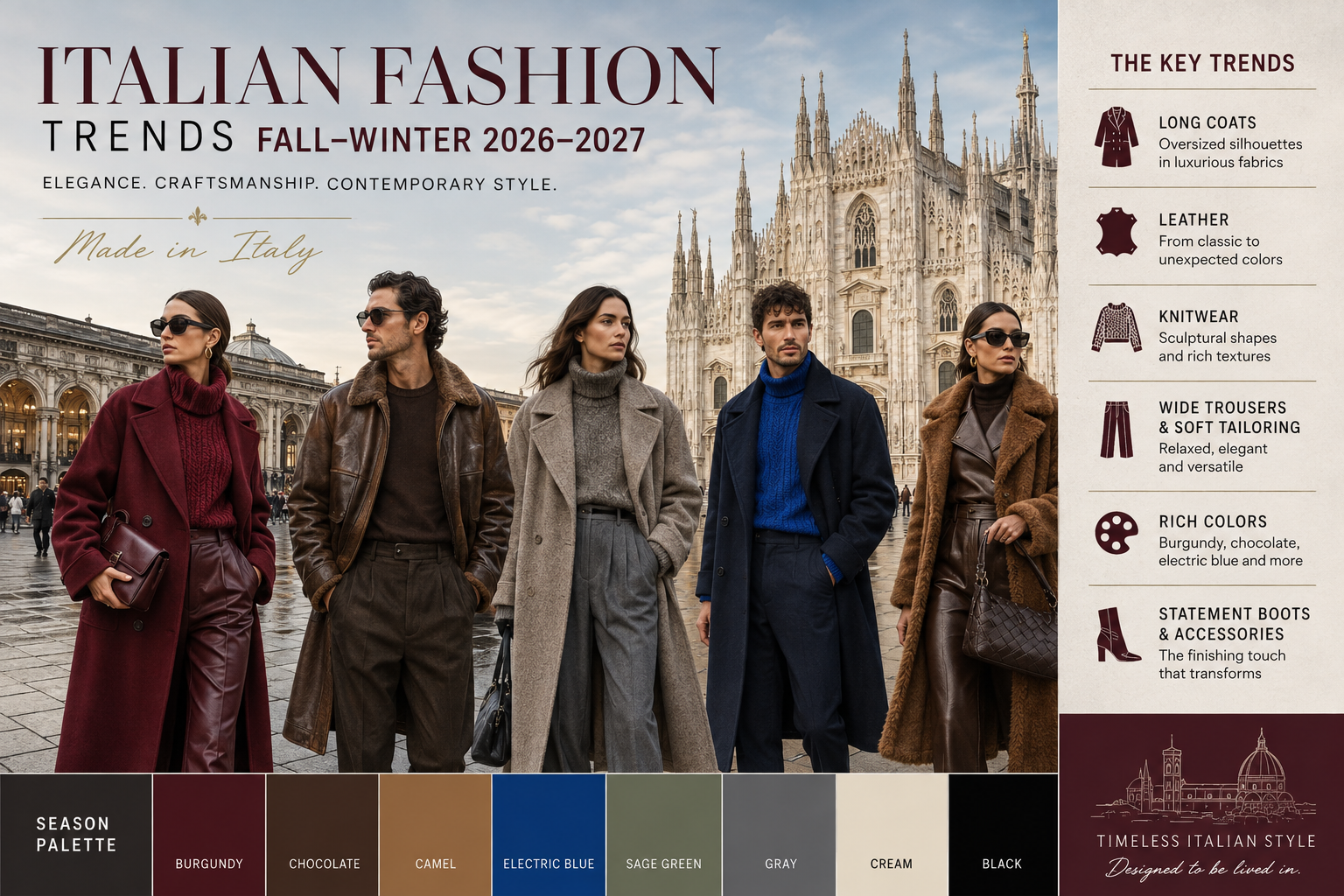
Italy enters the Fall–Winter 2026–2027 fashion season with a distinctly confident point of view. The mood is neither minimalist nor extravagantly theatrical. Instead, Italian fashion is moving toward elegance with substance: excellent materials, sophisticated color, relaxed tailoring, expressive outerwear, and pieces that can actually be worn in everyday life.
From Milan to Florence, Rome to Turin, the new season combines traditional Italian craftsmanship with contemporary proportions. The result is a wardrobe that feels luxurious without necessarily being flashy.
The major Fall–Winter 2026–2027 trends emerging from Milan and the international fashion circuit emphasize layering, rich textures, oversized coats, leather, soft tailoring, strong colors, knitwear, historical references, and carefully chosen accessories. Vogue Italia describes the season as one of “concrete elegance,” layering and reinterpretations of the past, with a stronger emphasis on a purposeful wardrobe rather than disposable trends.
For anyone interested in Italian fashion, this is an especially interesting season because the traditional strengths of Made in Italy—tailoring, leather, knitwear, footwear and fine fabrics—are not being abandoned. They are being reinvented.
The New Italian Fashion Philosophy for 2026–2027
One of the most important changes this season is philosophical rather than purely visual.
Italian fashion is increasingly rejecting the idea that every season requires an entirely new wardrobe. Instead, designers are concentrating on quality, versatility and personality.
A beautiful wool coat can be worn for years. A good leather jacket becomes better with age. A cashmere sweater can move between casual and formal outfits. A well-cut pair of trousers can work with sneakers during the day and loafers or boots in the evening.
This approach is particularly compatible with the traditional Italian attitude toward clothing: buy fewer things, but make them count.
The principles discussed in our Italian Fashion: An Introduction remain highly relevant. Italian fashion has historically combined craftsmanship, quality fabrics and strong design with an ability to adapt classic ideas to contemporary life.
The Fall–Winter 2026–2027 season takes that philosophy one step further.
1. Burgundy Becomes One of the Season’s Defining Colors
Burgundy continues its extraordinary run as one of the dominant colors of the Italian fashion palette.
The shade works particularly well in Italy because it combines the sophistication of traditional winter dressing with enough warmth to make an outfit distinctive.
Expect to see burgundy in:
- Wool coats
- Leather jackets
- Knitwear
- Trousers
- Handbags
- Shoes
- Scarves
- Evening dresses
- Tailored suits
Giorgio Armani’s Fall–Winter 2026–2027 collection used burgundy as an important thread running from daytime clothing to evening looks, alongside gray, sage, blue and white.
Burgundy is also particularly versatile. It can be paired with black for a dramatic Milanese look, camel for traditional Italian elegance, gray for understated sophistication, or cream for a softer combination.
For men, a burgundy sweater or scarf can introduce color without abandoning a conservative wardrobe.
For women, burgundy leather or a burgundy coat can become the defining element of an otherwise neutral outfit.
2. Brown, Chocolate and Cognac Replace Some of the Black
Black will never disappear from Italian fashion, particularly in Milan. But Fall–Winter 2026–2027 sees an increasing emphasis on brown and warm earth tones.
Chocolate, tobacco, cognac, chestnut, caramel and warm beige are appearing across clothing and accessories.
These colors are particularly effective in leather.
Think:
- Chocolate leather coats
- Cognac boots
- Tobacco suede jackets
- Brown handbags
- Camel wool coats
- Dark-brown tailoring
- Chocolate-colored gloves
The effect is luxurious without appearing overly formal.
Several Milan collections used palettes incorporating brown, tobacco, cognac, ochre and milk tones. Missoni, for example, combined these colors with intense blue and its characteristic vertical stripes.
For an authentic Italian look, brown can also be used tonally. A chocolate coat over a caramel sweater with dark-brown trousers and cognac shoes creates an extremely sophisticated winter combination.
3. Electric and Unexpected Colors Break Up the Neutrals
Although Italian winter fashion remains strongly connected to neutrals, Fall–Winter 2026–2027 is not afraid of color.
Current fashion forecasts identify electric blue, vibrant red, royal purple, butter yellow, juicy peach, turquoise and burgundy among the important colors of the season.
The important point is that these colors don’t necessarily have to dominate an entire outfit.
Italian styling often works better when one strong color is allowed to become the focal point.
For example:
Electric blue coat + black trousers + black boots
or:
Burgundy sweater + gray trousers + black loafers
or:
Butter-yellow knitwear + camel coat + brown leather accessories
The result is expressive without becoming chaotic.
4. The Long Coat Is the Ultimate Italian Winter Investment
If there is one item worth prioritizing for Fall–Winter 2026–2027, it is a great coat.
Long coats remain one of the strongest trends of the season, with designers exploring oversized proportions, dramatic collars, soft construction and luxurious fabrics.
Laura Biagiotti’s Fall–Winter 2026–2027 collection included extra-long coats and theatrical capes alongside midi dresses and oversized cardigans.
The modern Italian coat is not necessarily rigid.
Instead, it can be:
- Oversized
- Double-breasted
- Softly tailored
- Belted
- Extremely long
- Made from cashmere or wool
- Constructed with dramatic collars
- Inspired by men’s tailoring
A camel or gray long wool coat is perhaps the safest investment.
For something more dramatic, choose burgundy, chocolate, forest green or deep blue.
5. Leather Is Back as a Major Outerwear Statement
Leather is one of the clearest trends for the new season.
But Fall–Winter 2026–2027 is moving beyond the traditional black leather biker jacket.
The important piece is increasingly the leather coat.
Vogue Italia identified the leather coat as one of the major winter runway trends, with designs ranging from classic silhouettes to oversized models, trenches and versions featuring furry or shearling collars.
This is particularly appropriate for Italian fashion because leather has always been one of the country’s great areas of craftsmanship.
Brown, burgundy, black and dark green leather are especially versatile.
A long brown leather coat worn over a cream cashmere sweater and wide trousers is one of the season’s most convincing Italian-inspired looks.
6. Shearling and Furry Details Add Texture
Winter 2026–2027 is also about touch.
Shearling, furry collars and textured fabrics add depth to outfits that might otherwise appear monochromatic.
The trend can be subtle.
You don’t need a full shearling coat.
A leather coat with a shearling collar, a shearling-lined jacket, or a bag with a textured finish can provide the same effect.
The important Italian principle is restraint.
Instead of combining several dramatic textures, choose one dominant material and allow it to define the outfit.
7. Knitwear Becomes Architecture
Knitwear has moved far beyond the basic sweater.
For Fall–Winter 2026–2027, knitwear can be the structure of the entire outfit.
Italian designers are particularly well positioned for this trend because Italy has an extraordinary tradition of knitwear production.
Missoni continues to demonstrate the expressive possibilities of knitwear, while other Milan collections have emphasized oversized sweaters, sculptural shapes and sophisticated layering.
The new knitwear wardrobe includes:
- Oversized turtlenecks
- Long cardigans
- Sculptural sweaters
- Knitted skirts
- Cape-like pieces
- Heavy ribbed knitwear
- Fine cashmere
- Layered knitwear
- Knitted dresses
Vogue’s reporting on the broader 2026 knitwear movement points to increasing interest in tactile, high-quality and experimental knitwear, with craftsmanship and technology working together.
For Italy, this is an ideal marriage of tradition and innovation.
8. Layering Is Essential
Layering is not simply a practical response to cold weather. It has become one of the defining styling techniques of the season.
A typical Italian winter outfit might include:
Base layer: shirt or fine knit
Second layer: cardigan, sweater or vest
Third layer: blazer or jacket
Outer layer: long coat
Accessories: scarf, gloves and leather bag
The secret is controlling proportions.
If the coat is oversized, the inner layers should not necessarily be oversized as well. Conversely, a slim coat can work with more generous knitwear underneath.
Missoni’s Fall–Winter collection specifically emphasized layering, combining large coats, blazers, pleated trousers, long dresses and long scarves.
Layering also makes Italian winter dressing practical because temperatures can vary dramatically between morning and afternoon.
9. Soft Tailoring Continues to Redefine Italian Elegance
The traditional Italian suit is changing.
The stiff, highly structured suit is increasingly being replaced by soft tailoring.
Jackets are more relaxed. Trousers are wider. Shoulders are less rigid. Fabrics are softer. The distinction between formal and casual is becoming less important.
Boglioli’s Fall–Winter 2026–2027 collection, for example, emphasizes soft tailoring, relaxed silhouettes and luxurious materials such as cashmere.
This is particularly significant for men’s fashion.
A modern Italian man can wear:
- A soft unstructured jacket
- Wide-leg trousers
- Fine-gauge knitwear
- A polo shirt
- Loafers or minimalist sneakers
- A long coat
The result is elegant without looking as though the wearer is going to a corporate meeting.
10. Wide and Fluid Trousers Are Here to Stay
Skinny trousers have lost much of their dominance.
Fall–Winter 2026–2027 favors fuller, more fluid trousers, particularly when combined with relaxed tailoring.
For men, look for:
- Pleated trousers
- Wide-leg trousers
- Soft wool trousers
- Relaxed suit trousers
- High-waisted trousers
For women, wide trousers can be paired with a fitted knit, tailored jacket or oversized coat.
The key is balance.
Wide trousers with an oversized coat create a deliberately dramatic silhouette. Wide trousers with a fitted top create a more traditional Italian proportion.
11. The Return of Heritage Patterns
Traditional patterns are enjoying another revival.
Expect:
- Prince of Wales check
- Houndstooth
- Tartan
- Plaid
- Pinstripes
- Vertical stripes
But these patterns are not necessarily being used in traditional suits.
They are appearing on oversized coats, trousers, skirts, jackets and contemporary separates.
Tagliatore’s Fall–Winter 2026–2027 collection, for example, revisits Prince of Wales checks through a Seventies-inspired interpretation, combined with sophisticated materials such as cashmere, mohair and silk.
This is an excellent way to create an Italian look without relying on obvious designer logos.
12. The Seventies Influence Returns
Fashion continues to look backward for inspiration.
For Fall–Winter 2026–2027, the 1970s are particularly influential.
But this is not necessarily about recreating the decade literally.
Instead, designers are borrowing:
- Wide trousers
- Soft tailoring
- Rich browns
- Suede
- Corduroy
- Large collars
- Geometric patterns
- Relaxed jackets
- Vintage-inspired accessories
The result is a contemporary interpretation of the Italian Seventies.
Think Milan rather than costume party.
A chocolate suede jacket, cream turtleneck and wide charcoal trousers can capture the mood without looking retro.
13. Feminine Fashion Becomes More Romantic—and More Practical
Women’s fashion for Fall–Winter 2026–2027 is surprisingly diverse.
One direction emphasizes tailoring and masculine references. Another explores romance, lace, ruffles, draping and luxurious fabrics.
Current Fall 2026 runway reporting identifies ruffles, lace, statement prints, draping, velvet, leather and Art Deco references among the major dress trends.
Italian designers are translating these ideas in characteristically sophisticated ways.
The important trend is contrast.
A romantic blouse can be worn with a masculine blazer.
A delicate dress can be combined with a substantial leather coat.
A feminine skirt can be paired with heavy boots.
This tension between softness and strength gives contemporary Italian fashion much of its character.
14. Velvet Returns for Evening and Winter Dressing
Velvet is another important material for the season.
Its appeal is obvious: it provides warmth, depth and a sense of luxury.
Rather than reserving velvet exclusively for formal occasions, designers are increasingly using it for:
- Jackets
- Trousers
- Dresses
- Skirts
- Evening tops
- Accessories
Dark burgundy, chocolate, black, forest green and midnight blue are particularly effective.
For men, a velvet dinner jacket can provide an elegant alternative to the standard tuxedo.
For women, a velvet blazer over simple trousers can transform a daytime wardrobe into an evening look.
15. Boots Become a Major Style Statement
Footwear is becoming increasingly important.
For women, tall boots remain particularly relevant, while ankle boots and more sculptural designs provide alternatives.
Expect:
- Knee-high boots
- Tall leather boots
- Pointed-toe boots
- Suede boots
- Embellished boots
- Western-inspired boots
- Minimal ankle boots
Italian footwear brands are especially well positioned for this trend.
Vogue Italia’s Milan Fashion Week coverage highlighted elaborate footwear ranging from crystal-covered boots to sophisticated leather designs and sculptural heels.
For everyday Italian dressing, however, the most useful investment remains a beautifully made leather boot in black or brown.
16. Sneakers Become More Refined
Sneakers are not disappearing.
Instead, they are becoming more sophisticated.
The Italian approach is increasingly to combine a clean, understated sneaker with traditionally elegant clothing.
For example:
Wool trousers + cashmere sweater + long coat + minimalist sneakers
or:
Tailored suit + white leather sneakers
The result is a modern urban wardrobe that works particularly well in Milan, Rome and Florence.
The objective is not to look sporty. It is to introduce a relaxed element into an otherwise sophisticated outfit.
17. Accessories Become More Important
One of the easiest ways to update an existing wardrobe is through accessories.
For Fall–Winter 2026–2027, look particularly at:
- Oversized scarves
- Leather gloves
- Structured handbags
- Belts
- Statement jewelry
- Tall boots
- Sculptural eyewear
- Vintage-inspired bags
The accessory can provide the seasonal update without requiring a complete wardrobe replacement.
This fits perfectly with the Italian principle of buying quality.
A well-made leather bag, belt or pair of shoes can transform basic clothing.
Our How to Look Like a Local in Italy: Clothing and Style Guide explores this broader philosophy of Italian dressing, including the importance of fit, quality materials, accessories and footwear.
18. Men’s Fashion: A More Relaxed Kind of Luxury
Italian men’s fashion is moving away from the idea that luxury has to look formal.
The Fall–Winter 2026–2027 man is more likely to combine tailoring with sportswear, knitwear and functional outerwear.
The Milan men’s collections emphasized contrasts between tailoring and sportswear, along with relaxed silhouettes and sophisticated materials.
A modern wardrobe might include:
- Oversized wool coat
- Cashmere sweater
- Soft-tailored jacket
- Pleated trousers
- Suede or leather jacket
- Premium sneakers
- Loafers
- Leather boots
- Oversized scarf
The overall effect is sophisticated but relaxed.
19. Men’s Leather Jackets Become More Luxurious
The classic Italian leather jacket receives an upgrade this season.
Instead of the traditional slim biker jacket, designers are exploring:
- Oversized leather coats
- Double-breasted leather coats
- Suede jackets
- Weathered leather
- Shearling-lined jackets
- Field jackets
- Leather trench coats
Valstar’s Fall–Winter 2026–2027 collection, for example, features cracked leather in intense blues, blacks and browns as well as an oversized double-breasted coat.
The beauty of this trend is that leather can be dressed up or down.
A leather jacket with jeans is casual.
The same jacket with wool trousers and a cashmere sweater becomes distinctly Italian.
20. Pink, Malva and Unexpected Pastels Enter Men’s Fashion
One of the more interesting developments is the continued expansion of color in menswear.
Boglioli introduced a sophisticated dusty pink/mauve direction into its Fall–Winter 2026–2027 collection, alongside cashmere and relaxed tailoring.
This is not the bright pink associated with summer fashion.
Instead, think:
- Dusty rose
- Mauve
- Muted pink
- Lavender-gray
- Powder blue
These colors work exceptionally well with gray, brown, navy and cream.
For men who normally wear only black, gray and navy, a muted pink sweater or shirt is an easy first step toward a more contemporary wardrobe.
21. Italian Craftsmanship Is More Important Than Logos
Perhaps the most important long-term trend is the continuing emphasis on craftsmanship.
Made in Italy is increasingly about how something is made, rather than simply the name printed on it.
This is particularly visible in leather goods, footwear, knitwear and tailoring.
Italy’s fashion ecosystem includes highly specialized manufacturing districts and artisans whose expertise has been developed over generations.
Our article on Italian Fashion Designers explores the designers and houses that helped establish Italy’s international fashion reputation, from Armani and Gucci to Prada, Valentino, Missoni and Zegna.
For consumers, the lesson is simple:
A beautifully made, relatively understated Italian coat may have more lasting style value than a highly recognizable logo piece.
22. Sustainability Becomes Less About Marketing and More About Longevity
Sustainability remains an important issue in Italian fashion.
But the most convincing sustainable fashion strategy may be surprisingly simple:
Buy things that you will continue wearing.
High-quality wool, cashmere, leather and cotton garments can remain part of a wardrobe for years when properly cared for.
Italian fashion’s emphasis on craftsmanship naturally supports this philosophy.
Milan Fashion Week’s official Fall–Winter 2026–2027 program included sustainability initiatives and working groups involving major Italian fashion companies including Gucci, Bottega Veneta, Zegna, Fendi, Armani, Loro Piana, Max Mara, Moncler, Prada, Ferragamo and Valentino.
The industry’s sustainability discussion therefore extends beyond individual collections to materials, production, chemicals, retail and manufacturing.
23. How to Dress Like an Italian This Fall and Winter
Following every runway trend is neither necessary nor particularly Italian.
The better strategy is to select a few elements and incorporate them into an existing wardrobe.
The Classic Italian Woman
Try:
- Long camel or gray coat
- Fine turtleneck
- Midi skirt or wide trousers
- Knee-high leather boots
- Structured handbag
- Large scarf
- Burgundy or chocolate accent
The Modern Italian Man
Try:
- Softly tailored trousers
- Fine-gauge sweater
- Unstructured jacket
- Long wool coat
- Brown leather shoes or boots
- Leather belt
- Simple watch
The More Fashion-Forward Look
For those who want something bolder:
- Burgundy leather coat
- Electric-blue knitwear
- Wide trousers
- Statement boots
- Oversized scarf
- Sculptural handbag or eyewear
The trick is to choose one or two dramatic elements, not everything at once.
24. Dressing for Different Italian Cities
Italian fashion is not identical everywhere.
Milan
Milan remains the most fashion-conscious environment.
Black, charcoal, sophisticated neutrals and strong tailoring work particularly well. But this season’s burgundy, brown and electric colors offer opportunities for more adventurous dressing.
For anyone planning a shopping trip, our Shopping in Milano: A Guide to the City’s Best Shops and Boutiques covers the Quadrilatero della Moda, Brera, Navigli and Corso Buenos Aires.
Florence
Florence favors craftsmanship and classic elegance.
Leather, suede, wool, beautifully made shoes and timeless accessories are particularly appropriate.
Rome
Roman style tends to be more relaxed.
A beautiful coat, dark trousers, leather boots and a scarf can look effortlessly elegant without appearing overly formal.
Turin
Turin’s cooler climate makes it especially suited to the season’s wool, cashmere, long coats and layered tailoring.
Venice
Practicality matters because of walking and changing weather conditions. Comfortable boots, a warm coat and layers are essential—but there is no reason they cannot be stylish.
25. What Should You Actually Buy for Fall–Winter 2026–2027?
You don’t need to replace your wardrobe.
Instead, concentrate on a small number of high-impact pieces.
The Five Best Investments
1. A long wool coat
Camel, charcoal, navy, chocolate or burgundy.
2. A quality knit
Cashmere or high-quality wool in burgundy, cream, gray, brown or deep blue.
3. Leather footwear
A pair of excellent boots can last for years.
4. A versatile jacket
Consider suede, leather, tweed or soft tailoring.
5. One strong accessory
A structured handbag, leather gloves, oversized scarf or statement belt.
These pieces can update an existing wardrobe without turning fashion into a constant cycle of consumption.
Italian Fashion in Fall–Winter 2026–2027: The Bigger Picture
The most interesting aspect of Italian fashion this season is that the trends do not point in just one direction.
There is minimalism and maximalism.
There is tailoring and sportswear.
There is nostalgia and futurism.
There are quiet neutrals and extraordinary colors.
There is romance and masculine tailoring.
There is luxurious craftsmanship alongside experimentation with recycled materials and new production techniques.
But underneath these contradictions is a common idea: clothing should have personality and purpose.
That may be the most authentically Italian trend of all.
The Fall–Winter 2026–2027 season is not simply asking Italians to buy new clothes. It is encouraging them to reconsider how they combine what they already own with a few exceptional pieces.
The result is a style that looks contemporary without being disposable.
And that is precisely where Italian fashion has traditionally been at its strongest.
The Essential Fall–Winter 2026–2027 Italian Fashion Checklist
If you want to capture the season without following every trend, concentrate on these essentials:
- Burgundy
- Chocolate brown
- Camel
- Electric blue
- Long wool coats
- Leather coats
- Shearling details
- Cashmere
- Sculptural knitwear
- Wide trousers
- Soft tailoring
- Prince of Wales checks
- Seventies references
- Velvet
- Tall leather boots
- Structured bags
- Oversized scarves
- Leather gloves
- Layering
- Quality over quantity
Together, these elements create a wardrobe that feels unmistakably contemporary while remaining faithful to the enduring principles of Italian style: good fit, excellent materials, craftsmanship, confidence and restraint.
Related Italia Mia Guides
For more about Italian fashion, style and shopping, see:
- Italian Fashion: An Introduction — the history of Italian fashion, Italian clothing, leather, jewelry, eyewear and fragrances.
- Italian Fashion Designers — profiles of some of Italy’s most influential designers and fashion houses.
- How to Look Like a Local in Italy: Clothing and Style Guide — practical advice on Italian clothing, colors, footwear, accessories and city-specific style.
- Shopping in Milano: A Guide to the City’s Best Shops and Boutiques — where to shop for Italian fashion in Milan.
- Italian Fashion News — continuing coverage of fashion developments in Italy.
External Links
- Vogue Italia — Fall–Winter 2026–2027 Fashion Trends
- Vogue Italia — Milan Fashion Week Fall–Winter 2026–2027
- Camera Nazionale della Moda Italiana
- Vogue — Fall 2026 Color Trends
- Vogue — Fall 2026 Dress Trends