
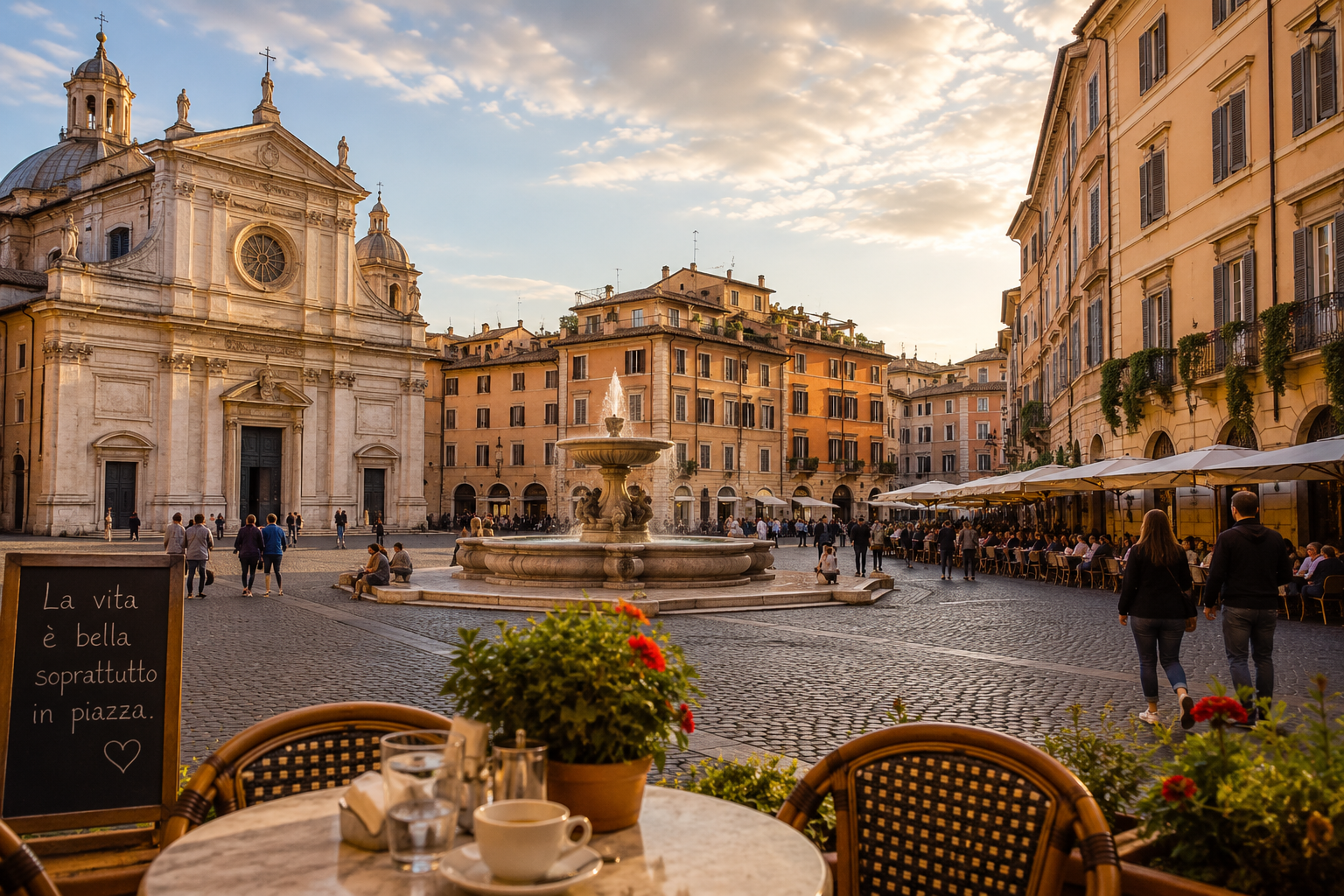
 The Italian Piazza: More Than a Square
Few places reveal the character of Italy as clearly as a piazza.
At first glance, a piazza may appear to be nothing more than an open urban space surrounded by buildings. In reality, the traditional Italian piazza is one of the country’s most important cultural institutions.
It can be a marketplace in the morning, a meeting place in the afternoon, a stage for religious celebrations in the evening and a gathering place for friends and families at night.
A piazza can also tell the story of an entire city.
Look closely and you may find a medieval town hall, a Renaissance palace, a Baroque church, a fountain commissioned by a powerful family, a statue of a national hero or the remains of an ancient Roman structure.
This is one reason Italy’s urban landscapes are so distinctive. Architecture, history and everyday life are rarely separated completely. They meet in the piazza.
For visitors, understanding the Italian piazza can therefore add an entirely new dimension to traveling through Italy.
Italy’s enormous artistic and architectural heritage is explored in greater depth in Italia Mia’s guide to Italian Culture and its overview of Italy and its art cities.
What Is an Italian Piazza?
The Italian word piazza is normally translated as “square,” but the two concepts are not quite identical.
An Italian piazza is not necessarily a perfectly geometric square. Some are rectangular, some triangular, some irregular and others curved. Their shapes often reflect centuries of urban development rather than a single architectural plan.
The word itself is associated with an open urban space, traditionally surrounded by buildings and connected to streets, commercial areas, religious buildings and civic institutions.
The most important feature is not its geometry.
It is its function.
A piazza creates a shared public space where different parts of community life can come together.
People meet friends there. Children play there. Restaurants put tables outside. Markets are held there. Political events take place there. Religious processions pass through. Concerts and festivals transform the space.
In many Italian towns, the piazza remains one of the easiest places to understand the rhythm of local life.
The Ancient Roots of the Italian Piazza
The history of the Italian piazza reaches back to antiquity, although it is important not to suggest that the modern piazza simply existed unchanged in Roman times.
Ancient Roman cities had important public spaces, most famously the forum. The Roman forum served political, religious, commercial and social functions and provided an architectural model for later ideas about public urban space.
Roman cities throughout Italy developed forums, basilicas, temples, markets and civic buildings around these public centers.
Some modern Italian squares occupy or preserve elements of these ancient urban environments.
Rome provides particularly striking examples of how different periods of history can exist in the same public space.
Piazza Navona, for example, retains the elongated shape of the ancient Stadium of Domitian. The stadium was constructed in AD 86, and the modern piazza follows its former perimeter.
The result is quintessentially Italian: an ancient Roman structure became the foundation for a medieval and later Baroque urban environment that remains a lively public space today.
Medieval Italy and the Rise of the Civic Piazza
The piazza became particularly important during the Middle Ages as Italian cities and communes developed their own political and economic identities.
In medieval cities, public space was closely associated with civic power.
A typical urban center might contain:
- the town hall or palazzo comunale
- a cathedral or major church
- merchants’ buildings
- guild headquarters
- markets
- fountains and wells
- residences belonging to wealthy families
The piazza became the place where these different forces met.
It was simultaneously commercial, political, religious and social.
This is especially evident in central and northern Italy, where powerful medieval communes developed elaborate civic centers.
Siena provides perhaps the most famous example.
Piazza del Campo: A Medieval Masterpiece
Siena’s Piazza del Campo is one of the most extraordinary urban spaces in Europe.
The historic center of Siena developed around the square, which occupies a natural meeting point between three hills and the city’s principal streets. UNESCO describes the city as an outstanding example of a medieval city whose urban structure and architecture were carefully integrated with the surrounding landscape.
The piazza’s distinctive shell shape is the result of centuries of development.
During the medieval period, the space became increasingly important for commerce and civic life. Siena’s government eventually regulated the buildings surrounding the piazza, creating a remarkable degree of visual unity.
The Palazzo Pubblico dominates one side of the square, while the Torre del Mangia rises dramatically above it.
The result is more than a beautiful collection of buildings.
The architecture creates a sense of enclosure and community.
Piazza del Campo also demonstrates something fundamental about the Italian piazza: the buildings and the open space were conceived as parts of the same urban composition.
The square is not simply what remains between buildings.
The square itself is architecture.
Renaissance Piazzas: Designing the Ideal City
The Renaissance brought new ideas about proportion, perspective, symmetry and classical architecture.
Italian architects and urban planners increasingly considered how buildings, streets and public spaces could be organized into coherent compositions.
The piazza became an ideal setting for these ideas.
Palaces were designed to create imposing facades around public spaces. Churches provided monumental visual anchors. Fountains and statues became architectural focal points.
The Renaissance also reinforced the relationship between architecture and political power.
A magnificent palace surrounding a piazza was not merely decorative. It could communicate wealth, authority, stability and cultural sophistication.
Florence offers countless examples of this relationship between public space, architecture and power.
The city’s piazzas developed around churches, government buildings, merchant activity and the residences of influential families.
The result is an urban environment in which simply walking from one square to another becomes a journey through Italian history.
For travelers interested in Renaissance architecture, Italia Mia’s guide to Italy’s art cities provides a useful starting point for exploring Florence and other major cultural centers. Explore Italy’s Art Cities
Baroque Italy: When the Piazza Became Theater
If medieval piazzas emphasized civic life and Renaissance spaces emphasized proportion and order, the Baroque period transformed many Italian squares into theatrical environments.
The Baroque piazza was designed to impress.
Movement, perspective, fountains, monumental staircases, domes, statues and elaborate facades created spaces intended to produce an emotional response.
Rome is the supreme example.
Piazza Navona
Piazza Navona combines ancient history, Renaissance development and Baroque architecture in a single extraordinary urban space.
Its elongated shape follows the footprint of the ancient Stadium of Domitian. During the Baroque period, the square was transformed into a monumental setting associated with the Pamphilj family and Pope Innocent X.
Its three fountains include the spectacular Fountain of the Four Rivers by Gian Lorenzo Bernini.
The church of Sant’Agnese in Agone, associated with Francesco Borromini and the Rainaldi family, provides another major architectural element.
Today, the piazza is surrounded by cafés, restaurants, shops and pedestrian activity.
The same space that once hosted festivals and public spectacles continues to function as a stage for urban life.
Rome’s official tourism authority describes Piazza Navona as one of the most characteristic and spectacular squares of Baroque Rome.
Piazza di Spagna
Piazza di Spagna demonstrates another characteristic of the Baroque city: the integration of architecture, movement and topography.
The Spanish Steps connect the lower square with the church of Trinità dei Monti above.
The result is not simply a square but a sequence of spaces, levels and visual perspectives.
Visitors experience the piazza by moving through it.
That principle is fundamental to Italian urban design.
The Fountain as the Center of the Piazza
One of the most recognizable features of an Italian piazza is the fountain.
Historically, fountains were practical as well as decorative.
Before modern plumbing, access to water was an essential part of urban life. Public fountains could provide drinking water, support markets and serve as gathering points.
Over time, they also became monuments.
Rulers, popes, wealthy families and city governments commissioned increasingly elaborate fountains to demonstrate their power and generosity.
Rome’s Piazza Navona is an extraordinary example.
Bernini’s Fountain of the Four Rivers became the visual center of the square, with monumental figures representing four great rivers associated with continents known to Europeans at the time.
Other Italian cities developed their own fountain traditions.
In smaller towns, a simple stone fountain may have been the practical center of a community.
In major capitals, fountains could become masterpieces of sculpture and urban theater.
The Church and the Piazza
Another recurring feature of Italian piazzas is the church.
The relationship is understandable.
For centuries, religious life was one of the principal organizing forces in Italian communities. Churches needed accessible spaces for processions, gatherings and festivals.
A church facing a piazza also creates a dramatic architectural composition.
The façade becomes a visual backdrop for public life.
The relationship can be particularly impressive when a cathedral occupies one side of a large square, as in many Italian cities.
In other places, a smaller church may define the character of a neighborhood piazza.
The scale varies enormously, but the principle remains similar: religious architecture and public space reinforce one another.
The Palazzo and the Piazza
If the church represents the spiritual dimension of traditional Italian urban life, the palazzo comunale represents civic authority.
Town halls frequently occupy prominent positions overlooking a piazza.
The arrangement sends a clear architectural message.
Government belongs at the center of the community.
In medieval and Renaissance Italy, this relationship could be particularly important because city governments, merchant guilds and powerful families competed to demonstrate their influence.
The architecture surrounding a piazza therefore becomes a visual record of political history.
Look at the buildings around an Italian square and you can often identify centuries of changing power.
The Piazza as Marketplace
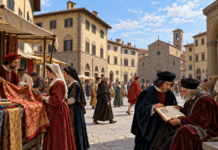
Long before modern shopping centers and supermarkets, the piazza was one of the most important commercial spaces in an Italian town.
Markets brought together farmers, merchants, craftsmen and consumers.
Different days could bring different products.
A square might sell vegetables and fruit in the morning, textiles later in the week and livestock or specialty products during a major market day.
Some piazzas remain important markets today.
Rome’s Campo de’ Fiori is an excellent example.
Its morning market, restaurants, cafés and surrounding streets continue to give the area a strong commercial and social identity. Rome’s official tourism site describes the square as a lively area with an open-air market and cafés and restaurants.
The modern visitor may see a picturesque market.
Historically, however, this type of activity was fundamental to the functioning of the city.
The Piazza as a Political Space
Italian piazzas have also been places of political expression.
Public meetings, speeches, demonstrations, celebrations and ceremonies have traditionally taken place in central squares.
This makes sense because the piazza is one of the few places where large numbers of people can gather without entering a private building.
The political significance of a piazza can sometimes be seen in its monuments.
Statues commemorate rulers, military figures, artists, philosophers and national heroes.
These monuments effectively turn the square into an outdoor history book.
The history can also be controversial.
A monument can become the subject of political debate precisely because the piazza remains a living public space.
The Piazza as a Social Living Room
Perhaps the most important function of the Italian piazza is the simplest: people meet there.
This is particularly visible in smaller towns.
In the late afternoon, residents may stop for coffee.
Children play.
Older residents sit on benches.
Friends meet before dinner.
Visitors photograph the architecture.
Restaurant tables fill the edges of the square.
The piazza becomes a kind of communal living room.
It is public but personal.
You do not necessarily need an appointment to use it.
You simply arrive.
This is one reason the piazza remains important even in an era of smartphones, social media and online shopping.
It offers something digital spaces cannot fully reproduce: physical community.
The Piazza and the Passeggiata
The relationship between the piazza and the passeggiata is especially important.
The passeggiata is the traditional Italian practice of taking a leisurely walk, particularly in the late afternoon or evening.
It is not necessarily exercise.
It is social.
People walk through the center of town, greet acquaintances, stop for a drink or gelato and spend time observing the activity around them.
The piazza frequently becomes the destination or focal point of this ritual.
Italia Mia has also explored the cultural significance of walking and the passeggiata in articles about Italian life and lifestyle. Its discussion of differences between American and Italian life, for example, describes the evening stroll as a communal activity, particularly in smaller towns. The Main Differences Between Living in the USA and Italy
For visitors, one of the best ways to experience an Italian piazza is therefore not to rush through it.
Stop.
Sit down.
Have a coffee.
Watch the people.
Return later in the evening.
The atmosphere may be completely different.
Why Italian Piazzas Feel So Different From Many Modern Squares
Modern urban planning often emphasizes traffic flow, parking, commercial efficiency and functional separation.
Traditional Italian cities developed differently.
Many historic centers were built before automobiles existed.
Streets were narrow.
Buildings were close together.
Public spaces were integrated into the pedestrian fabric of the city.
The result is a different relationship between people and urban space.
A piazza is often surrounded by cafés, shops, churches, municipal buildings and residential streets.
Everything is close.
The square becomes an intersection not only of streets but of social activities.
This helps explain why walking through historic Italian cities can feel so immersive.
You are not simply moving between tourist attractions.
You are moving through a network of interconnected public spaces.
Famous Italian Piazzas Every Traveler Should Know
Italy has thousands of piazzas, from internationally famous monuments to tiny village squares.
Some have become icons of Italian culture.
| Piazza | City | What Makes It Special |
|---|---|---|
| Piazza San Marco | Venice | Basilica, Doge’s Palace and lagoon-city grandeur |
| Piazza del Campo | Siena | Medieval shell-shaped civic square |
| Piazza Navona | Rome | Ancient foundations and spectacular Baroque architecture |
| Piazza di Spagna | Rome | Spanish Steps and Baroque urban design |
| Piazza del Duomo | Florence | Cathedral, Brunelleschi’s dome and Baptistery |
| Piazza della Signoria | Florence | Palazzo Vecchio and monumental sculpture |
| Piazza Maggiore | Bologna | Medieval civic heart of the city |
| Piazza dei Miracoli | Pisa | Cathedral, Baptistery and Leaning Tower |
| Piazza del Plebiscito | Naples | Vast monumental square facing the Royal Palace |
| Piazza del Duomo | Milan | Cathedral and one of Italy’s most famous urban spaces |
Each represents a different chapter in Italian urban history.
Piazza San Marco in Venice
Venice’s Piazza San Marco is perhaps the most famous Italian piazza internationally.
Its significance comes partly from its setting.
Unlike the enclosed urban squares of many Italian cities, Piazza San Marco opens toward the lagoon through the Piazzetta and forms the monumental heart of Venice.
The Basilica di San Marco and Palazzo Ducale establish the architectural character of the space.
The surrounding arcades, cafés and historic buildings create a distinctive urban environment.
It is also a reminder that an Italian piazza does not have to look like the medieval squares of Tuscany or Emilia-Romagna.
Venice developed its own relationship between water, architecture and public space.
Piazza della Signoria in Florence
Florence’s Piazza della Signoria is essentially an open-air gallery.
Palazzo Vecchio dominates the square, while sculptures and architectural elements create a dense artistic environment.
Its location near the Uffizi and the historic center makes it one of the most important spaces for understanding Florence’s political and artistic history.
The square demonstrates how sculpture can become part of everyday urban experience.
Visitors are not entering a museum to see the architecture.
They are walking through it.
Piazza Maggiore in Bologna
Bologna’s Piazza Maggiore represents another important type of Italian civic square.
It is closely associated with the city’s medieval and Renaissance civic identity.
The Basilica of San Petronio, Palazzo d’Accursio, Palazzo dei Notai and Palazzo del Podestà create an imposing architectural ensemble.
But the square is not simply monumental.
It remains part of everyday life in Bologna.
People cross it, meet friends, attend events and sit beneath the surrounding porticoes.
This combination of monumental architecture and ordinary activity is one of the defining characteristics of the Italian piazza.
Piazza del Plebiscito in Naples
Naples offers a different interpretation of the piazza.
Piazza del Plebiscito is enormous compared with many medieval urban squares.
The Royal Palace and Basilica of San Francesco di Paola establish an imposing architectural axis.
The space reflects the monumental ambitions of Bourbon Naples and demonstrates how Italian public squares evolved into grand ceremonial environments.
At the same time, the piazza remains a gathering place for contemporary Neapolitan life.
Piazza dei Miracoli in Pisa
Pisa’s Piazza dei Miracoli, formally Piazza del Duomo, is another essential example.
The cathedral, baptistery, cemetery and Leaning Tower create one of the most recognizable architectural ensembles in Italy.
Unlike a traditional civic piazza, it is principally associated with religious architecture.
That difference is important.
There is no single formula for an Italian piazza.
Some are commercial.
Some are political.
Some are religious.
Some are residential.
Many are all of these things at once.
Small-Town Piazzas: Where Italian Life Becomes Most Visible
The most famous piazzas attract millions of visitors.
But some of the most rewarding examples can be found in small towns.
A village piazza may contain little more than a church, a fountain, a café and a few benches.
Architecturally, it may not compete with Piazza Navona or Piazza San Marco.
Culturally, however, it can be more revealing.
Visit at the right time and you may see residents carrying groceries, children leaving school, older people chatting, workers having coffee and families preparing for dinner.
This is the everyday Italy that tourists can easily miss when they move from monument to monument.
The best way to understand an Italian piazza is often to visit one without a checklist.
The Architecture of an Italian Piazza
Although no two piazzas are identical, several architectural elements appear repeatedly.
The surrounding facades
The buildings around a piazza create its sense of enclosure.
Their height, color, materials and architectural styles establish the character of the space.
The church
A church or cathedral often provides a visual focal point.
The civic building
A town hall, palace or government building frequently represents political authority.
The fountain
Fountains may be functional, decorative or monumental.
The statue
Monuments often provide historical and political meaning.
The pavement
Stone, brick or patterned paving can contribute significantly to the identity of a square.
The café
The modern café has become one of the most recognizable elements of contemporary piazza life.
The arcades
In northern Italian cities such as Bologna, covered porticoes extend the social space beyond the square itself.
The result is an environment in which architecture and human activity continually interact.
Why Buildings Around a Piazza Often Look So Unified
One of the most fascinating aspects of historic Italian squares is their visual coherence.
This does not necessarily mean that every building was constructed at the same time.
Quite the opposite.
Many piazzas developed over centuries.
The apparent unity can result from later regulation, rebuilding and architectural adaptation.
Siena provides a particularly striking example. UNESCO documentation notes that regulations helped establish a degree of uniformity among the facades surrounding Piazza del Campo.
This illustrates a broader principle of Italian urbanism: authorities sometimes treated the public space as a complete composition rather than allowing every property owner to design independently.
The Piazza as a Stage for Festivals
Italian piazzas become particularly spectacular during festivals.
Religious processions, historical reenactments, concerts, markets, Christmas celebrations and local festivals can transform an otherwise familiar square.
In Siena, the Piazza del Campo becomes the setting for the famous Palio.
In other towns, the square may host a patron-saint festival, food market or seasonal celebration.
The architecture provides the stage.
The community provides the performance.
This is why visiting a piazza during a local festival can reveal an entirely different dimension of Italian culture.
The Piazza and Italian Food
Food is inseparable from many Italian piazzas.
Outdoor tables extend restaurants into public space.
Cafés spill onto sidewalks.
Gelaterias attract families.
Markets provide fresh produce and regional specialties.
A simple espresso can become a reason to remain in the square for half an hour.
An aperitivo can turn into dinner.
A dinner can become an evening of conversation.
This connection between food and public space is one of the reasons Italian urban life can feel so sociable.
For visitors who want to understand the broader relationship between food and Italian culture, Italia Mia’s articles on Italian cuisine and traditional foods provide a useful companion to this guide.
The Piazza in Modern Italy
The piazza has changed, but it has not disappeared.
Cars have been restricted in many historic centers.
Tourism has transformed famous squares.
Restaurants and cafés have become important businesses.
Social media has turned iconic piazzas into photographic destinations.
Yet the basic function remains.
People still gather.
They still walk through the square.
They still meet friends.
They still celebrate important occasions.
The modern Italian piazza is therefore both historic and contemporary.
It is a preserved piece of the past that continues to serve a practical social purpose.
Tourism and the Problem of Overcrowding
The popularity of Italy’s most famous piazzas has created challenges.
Venice’s Piazza San Marco, Florence’s central squares, Rome’s Piazza Navona and other iconic spaces can become extremely crowded during peak tourism periods.
This can change the experience for residents as well as visitors.
Some squares have become primarily tourist environments, with souvenir shops and restaurants replacing traditional local businesses.
The challenge for Italian cities is to preserve the architectural and social character of these spaces while accommodating enormous numbers of visitors.
This is particularly important because the value of a piazza lies not only in its buildings.
It lies in its use.
A piazza that becomes nothing more than a backdrop for photographs loses part of its original meaning.
How to Experience an Italian Piazza Like a Local
Visitors often make the same mistake: they arrive, take photographs and leave.
Instead, try spending time in the square.
Visit twice
A piazza can feel completely different in the morning and evening.
Sit down
Find a bench or outdoor café and observe.
Walk around the edges
The architecture is often easier to appreciate from different angles.
Look upward
Italian architecture is full of details above street level that are easy to miss.
Notice the people
Watch how residents use the space.
Visit during a market
Markets reveal the commercial history of the piazza.
Return after dark
Lighting can dramatically change the appearance of fountains, churches and palaces.
Do not rush
The piazza is fundamentally a place for lingering.
The Italian Piazza and La Bella Figura
The piazza is also connected to one of the broader ideas associated with Italian social culture: la bella figura, the importance of making a good impression.
People walking through a town center may be seen by neighbors, friends and acquaintances.
Clothing, manners and social interaction become part of public life.
The piazza is therefore not anonymous.
It is a social environment where people see and are seen.
This helps explain the enduring relationship between the piazza, the passeggiata and Italian fashion.
Even an ordinary evening walk can become a small social ritual.
The Piazza as an Outdoor Museum
One of the great advantages of Italian public spaces is that you do not always need to enter a museum to encounter extraordinary art.
A piazza may contain:
- sculpture
- architectural masterpieces
- fountains
- frescoes
- historic inscriptions
- medieval buildings
- Renaissance palaces
- Baroque churches
- archaeological remains
The art is integrated into everyday life.
A resident can walk past a centuries-old building on the way to buy bread.
A child can play beside a Renaissance fountain.
A café customer can sit beneath a medieval tower.
This coexistence of ordinary life and extraordinary heritage is one of Italy’s greatest cultural strengths.
Why the Italian Piazza Matters
The importance of the piazza goes far beyond architecture.
It represents a particular way of organizing public life.
The Italian piazza brings together:
History — because many squares contain centuries of architectural layers.
Architecture — because buildings were often designed around the public space.
Politics — because civic authority traditionally occupied the center of urban life.
Religion — because churches and religious ceremonies shaped many squares.
Commerce — because markets and shops developed around them.
Food — because cafés, restaurants and markets continue to animate them.
Community — because people meet there.
Tradition — because festivals and rituals continue to use them.
Tourism — because Italy’s most beautiful piazzas have become global destinations.
And perhaps most importantly:
Time — because the piazza encourages people to stop rather than simply pass through.
Italian Piazzas Are Places to Live, Not Just Places to Visit
The most beautiful Italian piazzas are often photographed as if they were monuments.
But their true importance lies elsewhere.
A piazza is successful when people use it.
A child playing football, an elderly couple talking on a bench, a group of friends having an aperitivo, a market vendor arranging vegetables or a family meeting for dinner may tell you more about the living culture of a town than another photograph of its cathedral.
This is what makes the Italian piazza so enduring.
The architecture may be centuries old.
The people are not.
Every generation gives the space a new life.
A Piazza Can Tell You What Kind of Town You Are In
Spend enough time in Italy and you will discover that piazzas reflect regional differences.
A Tuscan medieval square may be dominated by a stone civic palace.
A Sicilian piazza might be centered on an elaborate Baroque church.
A Venetian square may open toward a canal or lagoon.
A northern Italian city may incorporate extensive porticoes.
A southern Italian town may emphasize monumental churches and fountains.
A mountain village may have a tiny stone square surrounded by local houses.
There is no single Italian piazza.
There are thousands of variations.
Together, they form one of the most distinctive elements of the Italian urban landscape.
The Future of the Italian Piazza
The future of Italy’s historic piazzas will depend on maintaining a balance between preservation and everyday use.
Historic buildings require conservation.
Tourism needs management.
Local businesses need to remain viable.
Residents need access to public spaces.
Modern cities also need accessibility, public transportation and infrastructure.
The challenge is not to freeze piazzas in the past.
It is to keep them alive.
A successful historic square should remain a place where residents live their contemporary lives while visitors can appreciate the history surrounding them.
That is a difficult balance, but it is precisely what makes the Italian piazza so valuable.
Final Thoughts: The Heart of Italian Life
The Italian piazza is one of those rare cultural ideas that is simultaneously architectural, historical and deeply human.
It can be monumental or tiny.
Elegant or rustic.
Crowded or almost empty.
Ancient or relatively modern.
But at its best, it provides the same thing: a place where people come together.
The Roman forum helped establish a tradition of public urban space. Medieval communes turned the square into a center of civic life. Renaissance architects refined its proportions. Baroque artists transformed it into theatrical scenery. Modern Italians continue to use it for coffee, conversation, markets, festivals, celebrations and the evening passeggiata.
That continuity is extraordinary.
When you visit Italy, do not think of the piazza merely as something to photograph.
Enter it.
Walk around it.
Sit down.
Have a coffee.
Listen to the conversations.
Watch the people.
Come back after sunset.
You may discover that the most revealing part of an Italian city is not inside its greatest museum or monument.
It is outside, in the piazza, where history and everyday life continue to meet.
Related Italia Mia Guides
- Italian Culture: An Introduction — A broad introduction to Italy’s art, architecture, food, music and cultural traditions.
- Italy and Its Art Cities — Explore Florence and other major Italian destinations where art and urban history intersect.
- The Main Differences Between Living in the USA and Italy — Includes a look at the Italian passeggiata and the social importance of walking.
- Walking in Italy: The Best Hiking Trails to Explore — A broader look at walking as a way to experience Italy.
- The Italian Suit — Explores the relationship between Italian fashion, social life and the passeggiata.
External Links
- UNESCO World Heritage Centre — Historic Centre of Siena — Official UNESCO information on Siena and Piazza del Campo.
- Turismo Roma — Piazza Navona — Official information about Piazza Navona, its Roman origins and Baroque architecture.
- Turismo Roma — Piazza Navona and Campo de’ Fiori — Official Rome tourism guide to two of the city’s most important public squares.
- UNESCO — Piazza del Campo documentation — UNESCO documentation and imagery concerning Siena’s famous piazza.