

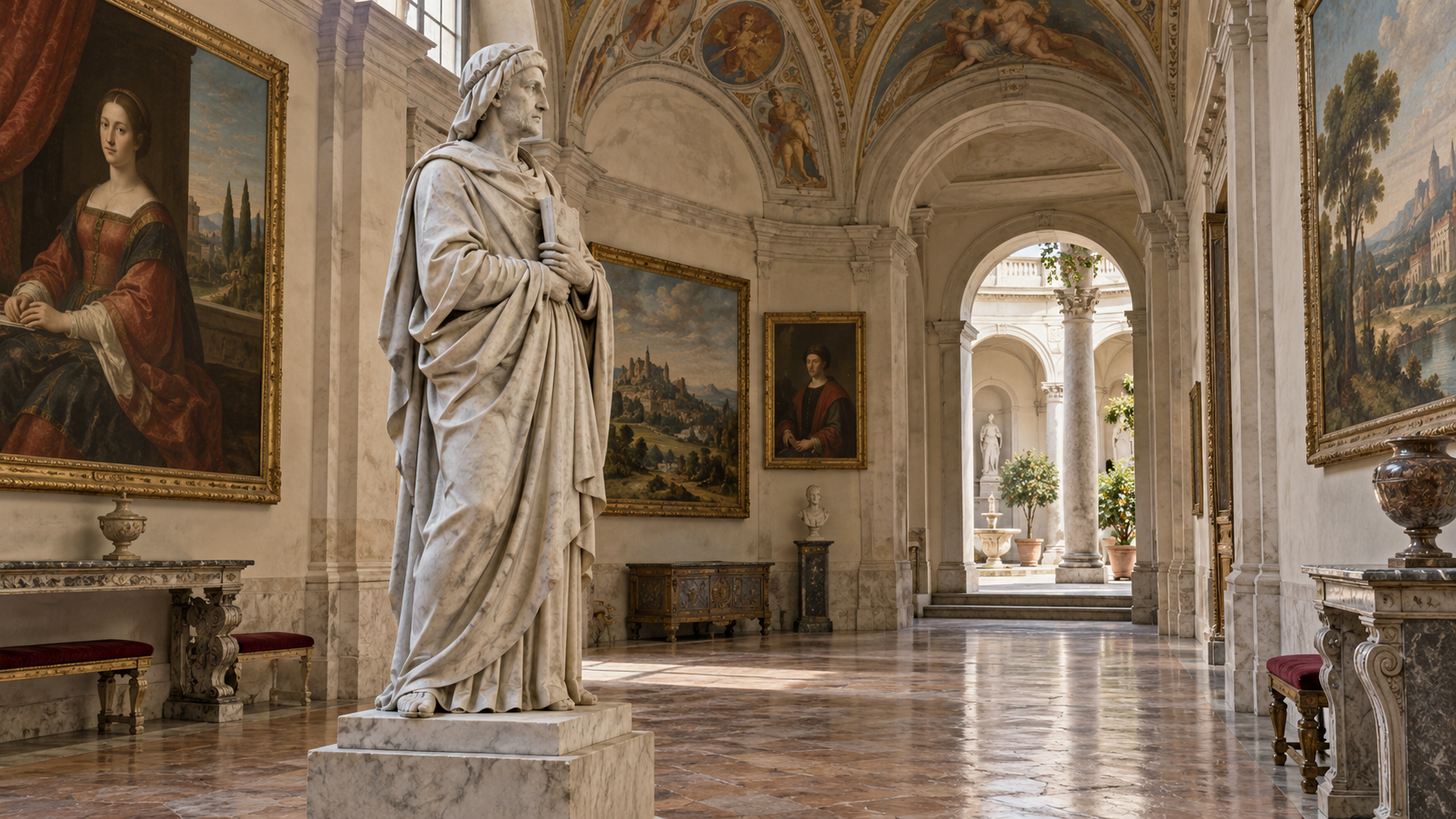
 Italy’s artistic heritage is not confined to museum walls. It appears in Roman mosaics, medieval churches, Renaissance palaces, Baroque fountains, village chapels and contemporary galleries. In cities such as Florence, Rome and Venice, art is woven so closely into the urban landscape that an ordinary walk can become a journey through centuries of creative change.
Italian artists transformed the way the Western world represented the human body, constructed space, used light and expressed emotion. Giotto gave sacred figures new physical and emotional presence. Brunelleschi and other Renaissance innovators developed systematic perspective. Leonardo da Vinci united observation with imagination, Michelangelo pushed the human form toward heroic intensity, and Caravaggio turned light into a dramatic storytelling device.
Italy’s contribution did not end with the Renaissance. The theatrical Baroque, luminous Venetian painting, Neoclassicism, Futurism, Metaphysical Art, Arte Povera and postwar design all demonstrate the country’s ability to reinvent its visual language.
This guide introduces the principal periods of Italian art, the artists who shaped them and the best places to experience their work.
Ancient Art in Italy: Etruscans, Greeks and Romans
The history of Italian art begins long before Italy became a unified country. Ancient civilizations left behind painted tombs, temples, ceramics, bronze figures, mosaics and monumental sculpture.
The Etruscans flourished in central Italy before the rise of Rome. Their painted tombs at Tarquinia depict musicians, dancers, athletes and banquets with an energy that still feels remarkably immediate. Important collections of Etruscan art can be seen at the National Etruscan Museum of Villa Giulia in Rome and the National Archaeological Museum in Florence.
Greek colonies in southern Italy and Sicily produced temples, ceramics and sculpture that connected the peninsula to the wider Mediterranean world. Paestum, Agrigento and Selinunte preserve some of the most impressive ancient Greek architecture outside Greece.
Roman artists absorbed Greek models while developing their own visual culture. Realistic portrait busts, triumphal monuments, frescoes and detailed floor mosaics communicated political authority, social status and religious belief.
Pompeii and Herculaneum provide an extraordinary view of Roman domestic art. Their villas preserve colorful wall paintings, garden scenes, mythological subjects and mosaics that once decorated private homes. Many of the most valuable objects excavated from these cities are now displayed at the National Archaeological Museum of Naples.
Medieval Italy: Mosaics, Frescoes and Sacred Images
After the fall of the Western Roman Empire, artistic traditions continued through Byzantine, Lombard, Carolingian, Romanesque and Gothic culture.
Ravenna became one of the most important centers of early Christian and Byzantine art. The mosaics in San Vitale, Sant’Apollinare Nuovo and the Mausoleum of Galla Placidia combine religious symbolism with brilliant color and shimmering gold backgrounds.
In Sicily, Norman rulers employed Byzantine, Islamic and Western European craftsmen. The mosaics of Palermo’s Palatine Chapel and the cathedrals of Monreale and Cefalù reveal how different Mediterranean traditions could coexist within a single building.
By the late Middle Ages, artists began giving sacred figures greater physical presence and emotional depth. Cimabue and Duccio played important roles in this transition, but Giotto became its most influential figure.
In the Scrovegni Chapel in Padua, Giotto organized biblical stories into clear, dramatically convincing scenes. His figures occupy believable spaces, communicate through gesture and display grief, tenderness, fear and surprise. These frescoes helped prepare the way for the Renaissance.
Italy’s Gothic heritage can also be explored through Italian Gothic architecture and its most remarkable examples.
The Renaissance: Italy Changes Western Art
The Renaissance emerged in Italian cities during the fourteenth and fifteenth centuries. Artists studied classical sculpture, anatomy, mathematics and the natural world while patrons competed to commission increasingly ambitious works.
Florence became a particularly important center. Wealthy merchants, religious institutions, civic authorities and the Medici family supported painters, sculptors and architects.
Filippo Brunelleschi’s experiments with linear perspective gave artists a systematic method for constructing convincing space. Masaccio applied these principles to painting, most famously in the Brancacci Chapel. Donatello brought new independence and psychological complexity to sculpture, while Lorenzo Ghiberti transformed the bronze doors of the Florence Baptistery into intricate pictorial narratives.
Read more about Donatello’s sculptures and artistic development.
Sandro Botticelli created some of the most immediately recognizable paintings of the Early Renaissance. The Birth of Venus and Primavera, now in the Uffizi Gallery, combine classical mythology, graceful movement and the intellectual atmosphere of Medici Florence. Italia Mia’s biography of Sandro Botticelli examines his career and principal works in greater detail.
The High Renaissance brought together three extraordinary artists: Leonardo da Vinci, Michelangelo Buonarroti and Raphael.
Leonardo approached painting as a form of investigation. His studies of anatomy, water, plants, optics and human expression informed works such as The Last Supper in Milan and the Mona Lisa, now in Paris. Although relatively few paintings can be securely attributed to him, his notebooks reveal the breadth of his imagination. Read the complete biography of Leonardo da Vinci.
Michelangelo considered himself primarily a sculptor, yet he produced masterpieces in sculpture, painting and architecture. His David in Florence’s Accademia Gallery presents the biblical hero before battle, physically alert and mentally concentrated. In Rome, the Pietà, Sistine Chapel ceiling and Last Judgment demonstrate his ability to turn the human body into a vehicle for spiritual and psychological drama.
Discover more in Italia Mia’s biography of Michelangelo Buonarroti.
Raphael was admired for clarity, balance and harmonious composition. His Vatican fresco The School of Athens places ancient philosophers within an idealized architectural setting, expressing the Renaissance dialogue between classical learning and contemporary culture. The biography of Raphael follows his development from Urbino and Florence to papal Rome.
For a broader examination of the period, read The Italian Renaissance: Artists, Ideas, Cities and Masterpieces That Changed the World.
Venice and the Power of Color
Venetian Renaissance painting developed differently from the Florentine tradition. While artists in Florence often emphasized drawing and sculptural form, Venetian painters became celebrated for color, atmosphere and the effects of light.
Giovanni Bellini created serene religious paintings filled with luminous landscapes. Giorgione introduced poetic ambiguity, while Titian became one of Europe’s most sought-after painters. His portraits, religious works and mythological scenes combine rich color with psychological authority.
Tintoretto brought dramatic perspective and rapid movement to large religious compositions. Paolo Veronese filled monumental canvases with architecture, luxurious clothing and elaborate gatherings.
During the eighteenth century, Giovanni Battista Tiepolo transformed ceilings and walls into vast theatrical spaces populated by floating figures. His career took him from Venice and northern Italy to Würzburg and Madrid. Read Italia Mia’s expanded biography and guide to the works of Giovanni Battista Tiepolo.
In Venice, masterpieces by these artists can be seen in the Gallerie dell’Accademia, Doge’s Palace, churches and Scuole Grandi. The city itself remains one of Europe’s richest environments for experiencing art in its original architectural setting.
Mannerism and the Baroque
After the balanced compositions of the High Renaissance, Mannerist artists experimented with elongated bodies, sophisticated poses, unusual colors and deliberately complex spaces.
Pontormo’s emotionally charged paintings, Parmigianino’s elegant figures and Bronzino’s cool court portraits reflect a period in which artists began to challenge Renaissance ideals rather than simply continue them.
At the end of the sixteenth century, Caravaggio transformed European painting. He placed sacred events in dark, immediate settings and used powerful contrasts of light and shadow to direct attention toward moments of revelation, fear or violence.
His models looked like people encountered in Roman streets rather than idealized religious figures. The realism of works such as The Calling of Saint Matthew and The Supper at Emmaus was controversial, but his influence spread rapidly across Europe.
Read more about his turbulent life and revolutionary technique in the biography of Michelangelo Merisi da Caravaggio.
Gian Lorenzo Bernini gave the Roman Baroque its theatrical character. His sculptures capture bodies in transformation and at the height of action. In Apollo and Daphne, fingers become leaves and skin becomes bark. In The Ecstasy of Saint Teresa, sculpture, architecture and concealed lighting combine to create an immersive religious spectacle.
Bernini also reshaped Rome through fountains, churches, monuments and St. Peter’s Square. Much of his work can still be seen in the locations for which it was created.
Artemisia Gentileschi was one of the most accomplished painters of the Baroque period. Her forceful compositions, including different versions of Judith Slaying Holofernes, demonstrate her command of Caravaggesque lighting and dramatic narrative. Along with Sofonisba Anguissola, Lavinia Fontana and Rosalba Carriera, she also reminds us that women played a significant role in Italian art despite the institutional restrictions they faced.
Neoclassicism and the Nineteenth Century
The rediscovery of Pompeii and Herculaneum encouraged a renewed fascination with classical art during the eighteenth century. Antonio Canova became the leading Italian Neoclassical sculptor, creating polished marble figures admired throughout Europe.
His Psyche Revived by Cupid’s Kiss, The Three Graces and portraits of Napoleon’s family combine archaeological inspiration with extraordinary technical refinement. Important collections of Canova’s work can be seen at the Gallerie d’Italia in Milan, the Gypsotheca e Museo Antonio Canova in Possagno and Rome’s Galleria Borghese.
During the nineteenth century, Italian artists responded to Romanticism, the Risorgimento and the social transformation of the new nation. Francesco Hayez produced historical subjects and politically resonant images, including The Kiss. The Macchiaioli, working primarily in Tuscany, painted with patches of color and light and anticipated some of the visual concerns later associated with French Impressionism.
Italian Modernism: Futurism and Metaphysical Art
In the early twentieth century, the Futurists rejected nostalgia and celebrated speed, industry, machinery and the energy of modern cities.
Umberto Boccioni attempted to represent movement through fragmented, interpenetrating forms. His sculpture Unique Forms of Continuity in Space presents the human body as if reshaped by motion and air. Giacomo Balla explored speed through repeated forms, while Gino Severini connected Italian Futurism with avant-garde developments in Paris.
Futurism remains controversial because several members became associated with nationalism, militarism and Fascism. Its artistic experiments were influential, but its political history cannot be separated from a serious interpretation of the movement.
Giorgio de Chirico developed a very different vision of modernity. His deserted squares, arcades, statues, towers and long shadows created an atmosphere of mystery and suspended time. His Metaphysical paintings deeply influenced the Surrealists, although de Chirico later rejected much modern art and returned to more traditional styles.
Italia Mia’s biography of Giorgio de Chirico explores his recurring imagery, influence on Surrealism and the controversy surrounding his later replicas.
Postwar and Contemporary Italian Art
After the Second World War, Italian artists responded to industrialization, consumer culture and the physical legacy of conflict.
Lucio Fontana cut and punctured canvases to open them toward real space. Alberto Burri used burlap, plastic, wood and burned materials to create surfaces that suggest wounds, landscapes and transformation. Piero Manzoni challenged traditional definitions of authorship and artistic value.
During the 1960s and 1970s, Arte Povera artists used soil, stone, cloth, vegetation, industrial materials and everyday objects. Michelangelo Pistoletto, Jannis Kounellis, Mario Merz, Marisa Merz and Giuseppe Penone questioned the separation between art, nature and ordinary life.
Marino Marini developed a distinctive modern sculptural language around horses, riders, portrait heads and Pomona figures. His changing equestrian imagery reflected the uncertainty of the twentieth century. Read the complete guide to Marino Marini and his sculpture.
Italian contemporary art continues through museums, foundations, commercial galleries and events such as the Venice Biennale. MAXXI in Rome, the Museo del Novecento in Milan, Castello di Rivoli near Turin, MAMbo in Bologna and the Peggy Guggenheim Collection in Venice provide useful introductions to twentieth- and twenty-first-century art.
The Best Italian Cities for Art Lovers
Florence
Florence is essential for Renaissance art. The Uffizi Gallery contains works by Giotto, Botticelli, Leonardo, Michelangelo, Raphael, Titian and Caravaggio. The Accademia houses Michelangelo’s David, while the Bargello is particularly strong in Renaissance sculpture.
Palazzo Pitti, the churches of Santa Maria Novella and Santa Croce, the convent of San Marco and the Brancacci Chapel add important works in their original religious and architectural settings.
Rome and Vatican City
Rome brings ancient, Renaissance and Baroque art together. The Vatican Museums contain the Sistine Chapel and Raphael Rooms, while the Galleria Borghese displays exceptional sculptures by Bernini and paintings by Caravaggio, Raphael and Titian.
Caravaggio’s paintings can also be seen free of charge in churches including San Luigi dei Francesi and Sant’Agostino. Bernini’s fountains and monuments turn the historic center into an open-air Baroque gallery.
For a detailed introduction, visit Italia Mia’s guide to the Vatican Museums in Rome.
Venice
The Gallerie dell’Accademia traces Venetian painting through Bellini, Giorgione, Titian, Tintoretto, Veronese and Tiepolo. Doge’s Palace surrounds visitors with art created to communicate the wealth and authority of the Venetian Republic.
For modern art, visit the Peggy Guggenheim Collection or Ca’ Pesaro. Churches such as the Frari, San Zaccaria and Madonna dell’Orto preserve major works in the settings for which they were intended.
Milan
Milan’s Pinacoteca di Brera contains works by Mantegna, Raphael, Piero della Francesca, Caravaggio and Hayez. Leonardo’s Last Supper is preserved in the refectory of Santa Maria delle Grazie and requires a separate timed reservation.
The Museo del Novecento concentrates on modern Italian art, while the Pinacoteca Ambrosiana includes works by Leonardo, Caravaggio and Raphael.
Naples
Naples combines ancient collections, Baroque painting and art-filled churches. The Museo e Real Bosco di Capodimonte displays works by Titian, Raphael, Caravaggio, Artemisia Gentileschi and important Neapolitan painters.
The National Archaeological Museum holds many of the finest sculptures, mosaics and frescoes recovered from Pompeii and Herculaneum. Churches such as Pio Monte della Misericordia and the Cappella Sansevero offer unforgettable encounters with Caravaggio and Giuseppe Sanmartino.
For more destinations, consult Italy’s Greatest Art Cities and the guide to 15 places where visitors can see Italy’s best artworks.
Museum Tickets and Reservations
Italy’s most popular museums frequently require timed admission, and availability can become limited during weekends, holidays and the main travel season. Reserving ahead is especially important for the Vatican Museums, Uffizi Gallery, Galleria dell’Accademia and Galleria Borghese.
Ticket prices, opening hours, cancellation conditions and available admission times may change. Read the information shown on the booking page carefully before completing your purchase, and confirm the final date and entrance time printed on your voucher.
Florence Museum Tickets
Uffizi Gallery
The Uffizi contains one of the world’s greatest collections of Renaissance painting, including masterpieces by Botticelli, Leonardo da Vinci, Michelangelo, Raphael, Titian and Caravaggio. Allow at least three hours for a first visit.
Reserve Uffizi Gallery tickets through Weekend in Italy
Galleria dell’Accademia
The Accademia is best known for Michelangelo’s David, but visitors can also see his unfinished Prisoners, Florentine paintings and a collection of historical musical instruments.
Reserve Accademia Gallery tickets through Weekend in Italy
Palazzo Pitti and the Palatine Gallery
Palazzo Pitti houses several collections in the former Medici residence. Highlights include the Palatine Gallery, Royal Apartments, Gallery of Modern Art, Museum of Costume and Fashion, and Treasury of the Grand Dukes. Check the booking page to confirm exactly which areas are included.
Reserve Palazzo Pitti tickets through Weekend in Italy
Bargello Museum
The Bargello is essential for Renaissance sculpture. Its collection includes Donatello’s bronze David, Michelangelo’s Bacchus, works by Verrocchio and Giambologna, and the famous Baptistery competition panels by Ghiberti and Brunelleschi.
Reserve Bargello Museum tickets through Weekend in Italy
For additional attractions and available combinations, browse Florence museum tickets through Weekend in Italy.
Rome and Vatican City Tickets
Vatican Museums and Sistine Chapel
The Vatican Museums contain the Sistine Chapel, Raphael Rooms, Gallery of Maps, classical sculpture and collections assembled by successive popes. Reserve well ahead and arrive before the entrance time shown on your voucher to allow for security controls.
Reserve Vatican Museums tickets through Weekend in Italy
Galleria Borghese
Galleria Borghese offers an exceptional concentration of works by Bernini, Caravaggio, Raphael, Titian and Canova. Admission is organized through scheduled visits, making advance reservations particularly important.
Reserve Galleria Borghese tickets through Weekend in Italy
Browse Rome museum tickets through Weekend in Italy for additional museums, archaeological attractions and available guided visits.
Venice Museum Tickets
Peggy Guggenheim Collection
Located in Peggy Guggenheim’s former home on the Grand Canal, this intimate museum contains important examples of Cubism, Surrealism, Futurism and Abstract Expressionism. Its collection includes works by Picasso, Pollock, Dalí, Magritte and Giorgio de Chirico.
Reserve Peggy Guggenheim Collection tickets through Weekend in Italy
For other museums and cultural attractions, browse Venice museum tickets through Weekend in Italy.
Milan Museum Tickets
Pinacoteca di Brera
The Pinacoteca di Brera contains masterpieces by Mantegna, Raphael, Piero della Francesca, Bellini, Caravaggio and Hayez. Allow approximately two hours and review the cancellation conditions before purchasing.
Reserve Pinacoteca di Brera tickets through Weekend in Italy
Browse Milan museum tickets through Weekend in Italy for additional museums and cultural experiences.
Naples Museum Tickets
National Archaeological Museum of Naples
The National Archaeological Museum preserves many of the finest mosaics, frescoes and sculptures recovered from Pompeii and Herculaneum. Its collections also include the Farnese sculptures and the celebrated Alexander Mosaic.
Reserve National Archaeological Museum of Naples tickets through Weekend in Italy
Browse Naples museum tickets through Weekend in Italy for other museums, archaeological sites and available excursions.
Turin Museum Tickets
Browse Turin museum tickets through Weekend in Italy for available reservations, including admission to the city’s major collections and cultural attractions.
Important Booking Advice
The entrance time requested during booking may sometimes be treated as a preferred time rather than a guaranteed appointment. Always check the final voucher for the confirmed date and time.
Advance-booking services may charge reservation or service fees in addition to the museum’s basic admission price. Some confirmed tickets cannot be changed or refunded, so review the conditions before paying.
Visitors using reduced or free admission must carry the identification or eligibility documents specified by the ticket provider.
Italia Mia may earn a commission when readers reserve tickets through Weekend in Italy links on this page. This does not increase the customer’s price.
Tips for Planning an Art Journey Through Italy
Book the hardest ticket first. If your itinerary includes The Last Supper, the Vatican Museums, Galleria Borghese, the Uffizi or the Accademia, secure that reservation before finalizing the rest of the day.
Avoid scheduling several major museums consecutively. One large collection in the morning and a church, smaller museum or architectural walk in the afternoon usually produces a more rewarding experience.
Allow time for works outside museums. Some of Italy’s greatest artistic experiences remain in churches, chapels, palaces and public squares. These settings reveal how art interacted with worship, civic authority and everyday life.
Check photography and dress rules. Flash, tripods and large bags may be restricted. Churches generally require clothing that covers shoulders and knees.
Look for temporary closures. Important works occasionally leave their usual galleries for restoration or exhibitions. Official museum websites normally publish notices about closed rooms and unavailable masterpieces.
Travel between the major art cities is straightforward by high-speed train. Florence, Rome, Naples, Milan and Venice can be combined without renting a car, although smaller towns and rural sites may require regional trains, buses or private transportation.
For a museum-centered itinerary, see Italia Mia’s guide to the best museums in Italy, including masterpieces, tickets and travel advice.
Understanding Italian Art as a Continuing Story
Italian art cannot be reduced to a list of Renaissance masters. It is a continuing story shaped by ancient Mediterranean civilizations, medieval religion, wealthy courts, independent city-states, papal ambition, political unification, industrialization and modern experimentation.
The Renaissance remains central because it changed how artists represented space, nature and the human body. Yet Giotto’s frescoes, Ravenna’s mosaics, Bernini’s theatrical sculpture, Tiepolo’s luminous ceilings, de Chirico’s silent piazzas and Arte Povera’s unconventional materials belong to the same evolving cultural landscape.
The best way to understand this history is to experience art in different settings. See a Botticelli inside the Uffizi, but also enter a small church. Admire Michelangelo’s David, then walk through the streets and civic spaces that shaped Florentine identity. Study Caravaggio in a museum, but also seek his altarpieces in the Roman chapels for which they were painted.
Every Italian city reveals a different chapter. Together, they form one of the richest and most influential artistic journeys in the world.
External Links
- Italian Ministry of Culture
- Uffizi Galleries
- Vatican Museums
- Galleria Borghese
- Gallerie dell’Accademia di Venezia
- Pinacoteca di Brera
- Museo e Real Bosco di Capodimonte
- Venice Biennale