

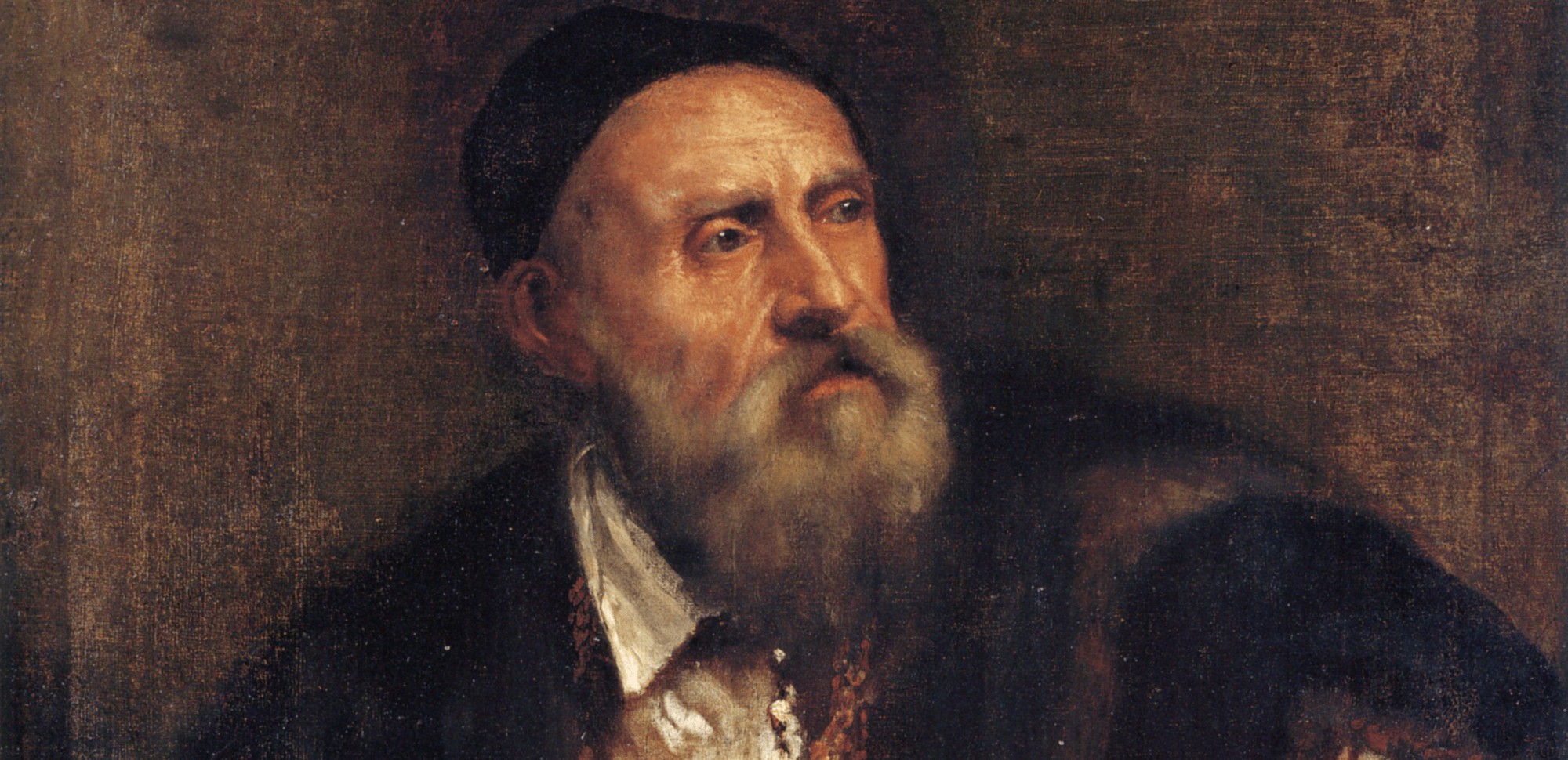
 Titian—known in Italian as Tiziano Vecellio—was the dominant painter of sixteenth-century Venice and one of the most influential artists in European history. His command of color, light, atmosphere and expressive brushwork transformed religious painting, portraiture and mythological art. Kings, popes, princes and wealthy Venetian families competed for his services, while later masters from Rubens and Velázquez to Rembrandt, Delacroix and the Impressionists studied the freedom and emotional power of his technique.
Titian’s long career followed the Venetian Renaissance from the poetic naturalism of Giorgione and Giovanni Bellini to a remarkably modern late style built from broken brushstrokes, translucent glazes and areas of exposed canvas. His paintings could be sensuous, devotional, politically calculated or profoundly tragic. Whether representing the Virgin rising into heaven, an emperor on horseback, a reclining nude or a mythological scene of violence and desire, Titian gave paint itself an unprecedented expressive force.
Early Life in Pieve di Cadore
Tiziano Vecellio was born in Pieve di Cadore, a mountain town in the Dolomites then governed by the Republic of Venice. His birth year is uncertain. Traditionally it was placed around 1477, partly because Titian presented himself as exceptionally old late in life, but most modern scholars favor a date between approximately 1488 and 1490.
He belonged to a locally prominent family. His father, Gregorio Vecellio, held administrative and military responsibilities in Cadore. Although Titian spent most of his working life in Venice, he never severed his connection with his birthplace. He invested in local property, maintained relationships with family members and employed relatives in his workshop and business affairs.
As a boy, Titian was sent to Venice with his brother Francesco. The city was one of Europe’s richest commercial centers, filled with imported pigments, luxury fabrics, printed books and artistic influences arriving from northern Europe, the eastern Mediterranean and mainland Italy.
According to later accounts, Titian first entered the workshop of the mosaicist Sebastiano Zuccato before training with Gentile and Giovanni Bellini. Giovanni Bellini was the leading painter of Venice and an essential figure in the development of the city’s luminous, color-centered style.
Readers can place Titian’s career within its wider historical setting through Italia Mia’s guide to the Italian Renaissance.
Titian, Giorgione and the Birth of a New Venetian Style
The young Titian worked closely with Giorgione, whose poetic landscapes and mysterious figures offered an alternative to the more precisely drawn art associated with Florence and central Italy. The two artists collaborated around 1508 on fresco decorations for the Fondaco dei Tedeschi, the German merchants’ trading house near the Rialto Bridge.
Very little of the exterior decoration survives. Nevertheless, the commission demonstrates that Titian was already participating in an important public project while still a young painter.
The artistic relationship between Titian and Giorgione has generated centuries of debate. Some early paintings were repeatedly transferred from one artist to the other because both used soft contours, atmospheric landscapes and figures absorbed in music, love or contemplation. Giorgione’s death during the plague of 1510 left several works unfinished, and Titian may have completed some of them.
Titian soon moved beyond Giorgione’s intimate and enigmatic approach. His figures became more solid, his colors more forceful and his compositions increasingly ambitious. Paintings such as Noli me tangere, The Three Ages of Man and Sacred and Profane Love reveal an artist exploring landscape, sensual beauty, psychological suggestion and complex allegory.
Sacred and Profane Love, now in Rome’s Galleria Borghese, presents two women seated beside an elaborately carved fountain or sarcophagus. One is richly dressed, while the other is nearly nude. The precise meaning remains disputed, but the painting demonstrates Titian’s ability to combine sumptuous surfaces with intellectual ambiguity.
The Assumption of the Virgin and Titian’s Venetian Triumph
Titian’s decisive public breakthrough came with The Assumption of the Virgin, created between 1516 and 1518 for the high altar of the Basilica of Santa Maria Gloriosa dei Frari in Venice.
The enormous altarpiece is organized in three ascending zones. The apostles react with astonishment below, the Virgin rises through a blaze of golden light and God the Father waits above. Titian unifies the composition through dramatic gestures, sweeping movement and a powerful concentration of red.
The scale and energy of the painting must have appeared revolutionary. Instead of presenting a quiet devotional scene, Titian turned the Assumption into a theatrical event capable of commanding the vast Gothic interior of the Frari. The work established him as Venice’s leading painter.
Following Giovanni Bellini’s death in 1516, Titian became the principal official painter of the Venetian Republic. His responsibilities included portraits of successive doges, although many of these state images were later lost in fires at the Doge’s Palace.
At the Frari, visitors can also see Titian’s Madonna of the Pesaro Family, commonly called the Pesaro Madonna. Painted between approximately 1519 and 1526, it rejects the convention of placing the Virgin directly at the center. Instead, Titian moves her to one side and uses monumental columns, flags, kneeling patrons and diagonally arranged figures to lead the viewer through the sacred encounter.
Ferrara, Mantua and Italy’s Princely Courts
Titian’s fame soon extended beyond Venice. Alfonso I d’Este, Duke of Ferrara, commissioned him to produce mythological paintings for the camerino d’alabastro, or Alabaster Chamber, in the Castello Estense.
These works included The Worship of Venus, Bacchus and Ariadne and The Bacchanal of the Andrians. Inspired by classical literature, they combine landscape, music, wine, movement and erotic energy. Titian did not treat antiquity as an archaeological reconstruction. He made its gods and mortals appear sensually alive.
Bacchus and Ariadne, now in the National Gallery in London, captures the instant when Bacchus leaps from his chariot after seeing the abandoned Ariadne. The sky, animals, twisting bodies and flying drapery transform the story into an explosion of movement and color.
Titian also developed a productive relationship with Federico II Gonzaga, ruler of Mantua. Through Gonzaga’s court, the painter gained access to Emperor Charles V and the international world of Habsburg patronage.
Titian as a Portrait Painter
Titian became one of the greatest portraitists of the Renaissance because he could communicate social rank while suggesting the private personality behind the public image. His sitters rarely appear overwhelmed by decorative settings. A restrained background, carefully selected clothing and the position of a hand can communicate authority, intelligence, anxiety or self-control.
His portraits of men often present them in dark clothing against muted backgrounds, allowing faces and hands to carry the psychological weight. Portraits such as Man with a Glove, Pietro Aretino and the so-called Man with a Blue Sleeve combine aristocratic elegance with a sense of living presence.
Titian’s friendship with the writer Pietro Aretino proved especially valuable. Aretino praised the artist, introduced him to powerful patrons and helped promote his reputation across Europe. Their relationship also demonstrates how artistic celebrity was cultivated through correspondence, personal connections and carefully managed public identity.
Titian portrayed Charles V several times. In Charles V at Mühlberg, now in the Museo del Prado, the emperor appears on horseback after his victory over the Protestant Schmalkaldic League in 1547. Titian combined the traditions of the Roman equestrian monument, Christian knighthood and court portraiture to create an enduring image of imperial command.
Charles V reportedly admired Titian greatly, and the artist received privileges, titles and financial rewards from the imperial court. The often-repeated story that the emperor once picked up a brush Titian had dropped may be legendary, but it reflects the extraordinary prestige the painter enjoyed.
The Venus of Urbino
Among Titian’s most famous paintings is the Venus of Urbino, completed in 1538 and now housed in the Uffizi Galleries in Florence.
A nude woman reclines in a luxurious interior and looks directly at the viewer. In the background, servants search through a chest while a small dog sleeps near the woman’s feet. The painting has been interpreted as an image connected with marriage, fertility, fidelity and domestic life, although its open sensuality resists a single explanation.
Titian adapted the reclining pose associated with Giorgione’s Sleeping Venus but made the figure awake, self-aware and psychologically present. The result influenced centuries of European art, including Velázquez’s Rokeby Venus, Goya’s Nude Maja and Édouard Manet’s Olympia.
Travelers wishing to see the painting can reserve Uffizi Gallery admission through Weekend in Italy. Advance booking is particularly advisable during Florence’s busiest months.
Affiliate disclosure: Italia Mia may receive a commission from qualifying reservations made through selected links, without increasing the price paid by the reader.
Rome and the Farnese Family
Titian traveled to Rome in 1545–1546, where he encountered the monumental achievements of Michelangelo and the artistic world of the papal court. He worked for the powerful Farnese family, producing portraits of Pope Paul III and his relatives.
Pope Paul III and His Grandsons is among Titian’s greatest psychological portraits. The elderly pope turns toward the approaching Ottavio Farnese, who bends in a gesture of exaggerated respect, while Cardinal Alessandro Farnese stands behind them. Their glances and movements suggest suspicion, ambition and family calculation.
The painting is much more than a record of three individuals. It is an unsparing study of power. Titian left parts of the work unfinished, allowing the viewer to see how he constructed forms through rapid strokes and changes made directly on the canvas.
Philip II and Titian’s “Poesie”
Titian’s most important later patron was Philip II of Spain. For him, the painter created a celebrated group of mythological works that he called poesie—painted poems inspired primarily by Ovid’s Metamorphoses.
The series included Danaë, Venus and Adonis, Perseus and Andromeda, Diana and Actaeon, Diana and Callisto and The Rape of Europa. The paintings explore desire, pursuit, transformation, punishment and death. Their beauty is inseparable from danger.
In Diana and Actaeon, the hunter accidentally discovers the goddess Diana bathing with her attendants. Actaeon’s intrusion sets in motion the punishment that will transform him into a stag and cause his own hounds to kill him. Titian arranges the figures, curtains, columns, water and flashes of color like the unfolding lines of a poem.
The poesie were designed as related inventions rather than exact illustrations. Titian sometimes changed details from his literary sources to strengthen a composition or heighten its emotional impact. He demonstrated that painting could rival poetry in narrative complexity, sensuality and imagination.
Several of these masterpieces are now divided among the Museo del Prado, National Gallery in London, National Galleries of Scotland, Wallace Collection, Isabella Stewart Gardner Museum and other institutions.
Titian’s Painting Technique
Florentine Renaissance theory often emphasized disegno—the intellectual and technical importance of drawing. Venetian painting became especially associated with colorito, meaning the construction of form through color, tone and the handling of paint.
Titian did not simply fill carefully drawn outlines with color. He revised his compositions while painting, layered translucent glazes over opaque passages and varied the surface from smoothly blended flesh to visible ridges and strokes.
His early paintings are generally characterized by brilliant color, polished surfaces and clearly defined forms. In later works, contours become less stable. Figures seem to emerge from shadow through scattered touches of red, white, brown and black.
Contemporaries reported that Titian sometimes left paintings facing the wall for long periods before returning to judge and revise them. Late accounts also describe him applying paint with his fingers as well as brushes. Although such stories should be treated cautiously, technical examination confirms the complexity and physical variety of his working methods.
Titian’s late brushwork was not the result of failing eyesight or declining skill. It was an expressive choice. Viewed closely, some passages appear fragmented or unfinished; from a suitable distance, they form bodies, fabric, light and atmosphere.
Religious Paintings and Personal Faith
Throughout his career, Titian produced altarpieces and smaller devotional works. His religious paintings range from the triumphant spectacle of the Assumption to intimate images of the Madonna and Child, penitent saints and Christ’s Passion.
The Martyrdom of Saint Lawrence exists in important versions in Venice and at El Escorial. Titian sets the saint’s execution in darkness, using fire, torches and shafts of heavenly light to create an atmosphere of terror and divine intervention.
In The Crowning with Thorns and later versions of the Penitent Magdalene, bodies and emotions are increasingly dissolved into paint. Sacred experience is communicated through movement, light and surface rather than precise description alone.
The final Pietà, now at the Gallerie dell’Accademia in Venice, was apparently intended for Titian’s own funerary chapel. The aged artist included himself as the kneeling figure of Saint Jerome before the dead Christ. The painting is dark, rough and deeply personal, with figures emerging from a shadowy architectural setting.
Titian left the Pietà unfinished when he died. Palma il Giovane subsequently completed portions of it while respecting much of the older master’s conception.
Family, Workshop and Unfinished Paintings
Titian married Cecilia, with whom he had several children, including Pomponio, Orazio and Lavinia. Cecilia died in 1530. Orazio became a painter and an important assistant in his father’s workshop, while Lavinia appeared in portraits traditionally associated with Titian’s family.
Like other successful Renaissance masters, Titian operated a busy studio. Assistants prepared materials, copied popular compositions and contributed to commissions. Determining precisely how much Titian painted in certain late works remains difficult because the master’s intentionally loose handling can resemble unfinished workshop production.
Titian also repeated successful subjects. Different versions of Danaë, the Penitent Magdalene, Venus and Adonis and other compositions were produced for different patrons. These repetitions demonstrate both the commercial organization of his workshop and his continuing desire to reconsider earlier ideas.
Titian’s Death During the Plague
Titian died in Venice on August 27, 1576, during a devastating outbreak of plague. Orazio also died during the epidemic, and the family home was reportedly looted.
Despite emergency restrictions normally governing plague burials, Titian was interred in the Basilica of Santa Maria Gloriosa dei Frari. His tomb stands in the same church as the Assumption and Pesaro Madonna, two works that had established and confirmed his fame in Venice.
A large nineteenth-century monument now marks his burial place. Facing it across the church is the monument to the sculptor Antonio Canova, making the Frari one of Venice’s most important destinations for anyone interested in Italian art.
Titian’s Influence on European Art
Titian’s influence extended far beyond Venice. Tintoretto and Paolo Veronese responded to his color, scale and dramatic compositions, even while developing very different artistic identities.
Rubens copied and reinterpreted Titian’s mythological paintings. Velázquez studied the royal portraits in the Spanish collections and adapted Titian’s controlled informality to the Habsburg court. Rembrandt’s late self-portraits share the Venetian master’s interest in rough surfaces and aging faces.
Goya, Delacroix and Manet found in Titian a precedent for direct color and sensual paint handling. His influence also reached artists who rejected traditional academic finish. The apparent spontaneity of his late canvases helped later painters understand that visible brushwork could carry meaning rather than merely reveal an incomplete surface.
Titian therefore occupies a central place in the history of painting. He inherited the achievements of Bellini and Giorgione, transformed them through a long process of experimentation and transmitted a new understanding of color and painted texture to later European art.
Where to See Titian’s Paintings
Venice remains the essential place to encounter Titian in his original cultural and architectural setting.
At the Basilica dei Frari, visitors can see the Assumption of the Virgin and the Pesaro Madonna, as well as Titian’s tomb. The Gallerie dell’Accademia houses the late Pietà, the Presentation of the Virgin and other important Venetian paintings.
The Uffizi Galleries in Florence display the Venus of Urbino, Flora and portraits associated with the Medici collections. Rome’s Galleria Borghese contains Sacred and Profane Love, while the Museo e Real Bosco di Capodimonte in Naples holds Pope Paul III and His Grandsons.
Outside Italy, the Museo del Prado in Madrid has one of the world’s richest Titian collections, including imperial portraits, religious paintings and mythological works created for Philip II. The National Gallery in London displays Bacchus and Ariadne, Diana and Actaeon, Diana and Callisto and The Death of Actaeon.
Other important works can be found at the Louvre, the Metropolitan Museum of Art, the National Gallery of Art in Washington, the Kunsthistorisches Museum in Vienna and the Alte Pinakothek in Munich.
Italia Mia’s guide to Italy’s greatest art cities can help readers plan a broader journey through Venice, Florence, Rome and other destinations associated with Renaissance art.
Recommended Books About Titian
Readers who want to explore Titian’s life, paintings and historical world can browse this selection of Titian books and exhibition catalogues on Amazon.com.
Particularly useful subjects include Titian’s complete paintings, the poesie created for Philip II, his late technique and the biography Titian: His Life by Sheila Hale.
As an Amazon Associate, Italia Mia may earn from qualifying purchases.
Titian’s Enduring Legacy
Titian achieved something rare even among the greatest Renaissance artists: he remained innovative throughout an exceptionally long career. The painter who established his reputation through the brilliant color and monumental clarity of the Assumption eventually created late works in which bodies, landscape, light and shadow seem to dissolve into one another.
His paintings helped establish the visual language of European rulers, transformed the nude into a psychologically charged subject and demonstrated that mythological art could possess the emotional range of poetry. His religious works moved between public spectacle and private meditation.
More fundamentally, Titian changed how artists understood paint. Color was not simply an addition to drawing, and brushwork was not merely a means of hiding the labor behind an image. Both could become the image’s emotional substance.
That discovery remained alive in the art of Rubens, Velázquez, Rembrandt, Goya, Delacroix, Manet and countless later painters. Titian belongs not only to the history of the Venetian Renaissance but to the continuing history of painting itself.
External Sources
National Gallery, London: Titian’s biography and paintings
National Gallery of Art, Washington: Titian
Museo Nacional del Prado: Titian in the collection
Uffizi Galleries: Venus of Urbino
Gallerie dell’Accademia di Venezia: Collections
The Metropolitan Museum of Art: Titian
Centro Studi Tiziano e Cadore: Tiziano Vecellio