
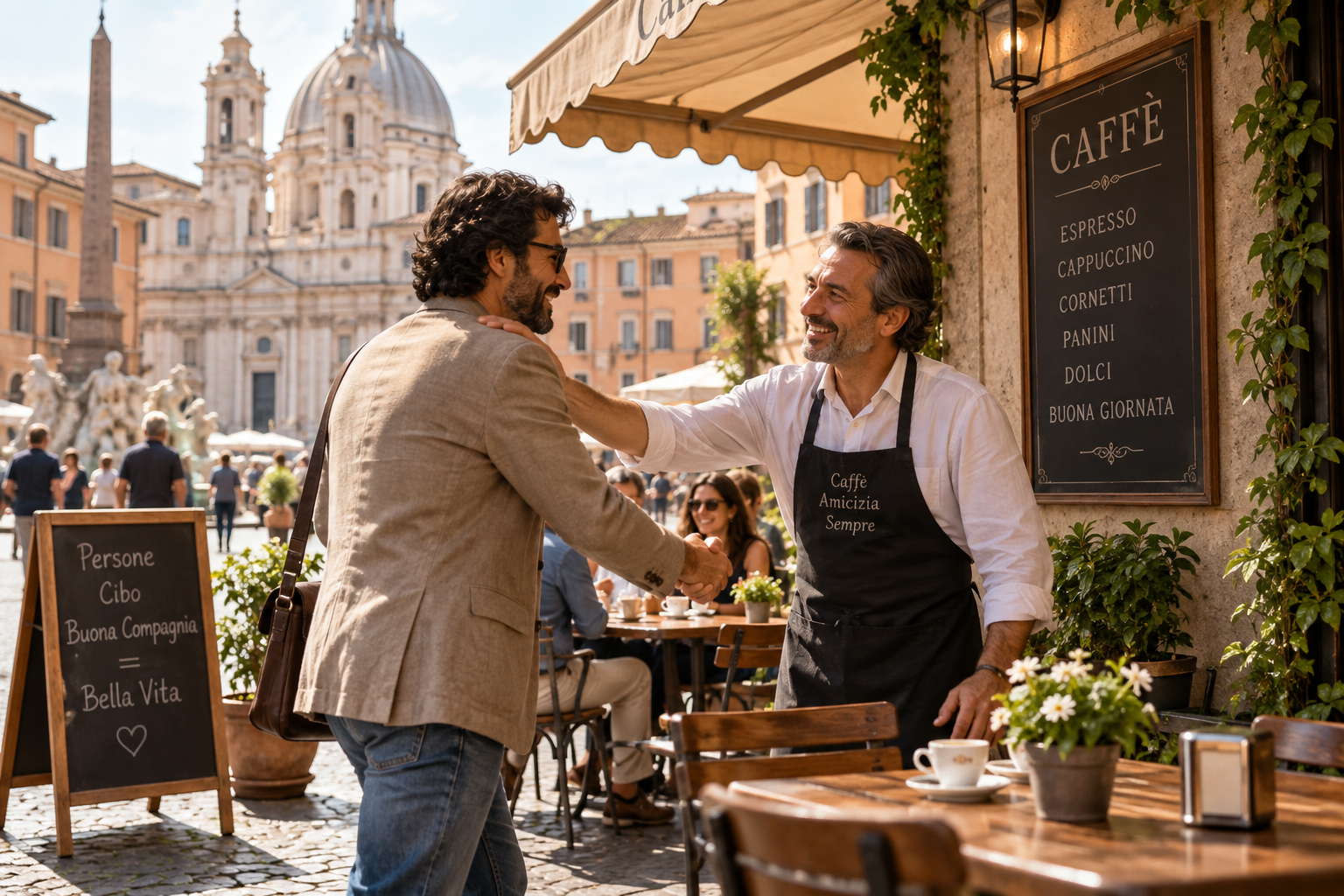
 Walk into a café in Rome, a small shop in Florence or a family-run restaurant in Sicily and one of the first words you are likely to hear is “Buongiorno.” Leave a group of friends in Milan late at night and you may hear several overlapping cries of “Ciao, ciao! A presto!”
Greetings in Italy can seem simple at first. After all, almost everyone knows ciao. But Italian greetings are more nuanced than a handful of familiar words might suggest.
The expression you choose depends on the time of day, the relationship between the speakers, their ages and sometimes the setting itself. Body language matters too. A handshake, a smile, a kiss on the cheek or the choice between the formal Lei and informal tu can communicate almost as much as the words being spoken.
Understanding these conventions is useful not only for people learning Italian but also for travelers who want to interact naturally with Italians.
Italian greetings also reveal something larger about the country. They illustrate the importance Italians traditionally place on personal relationships, social recognition and everyday courtesy.
Much like the ritual of the Italian evening passeggiata or the social life surrounding an Italian piazza, greeting people is one of those apparently small customs that helps explain how everyday life in Italy works.
Why Greetings Matter in Italy
In many parts of Italy, acknowledging another person when entering a shared space is considered basic courtesy.
Walk into a bakery and say nothing before asking for bread and the interaction may feel abrupt. Enter with a friendly “Buongiorno” and the tone immediately changes.
The same principle applies to cafés, pharmacies, hotel reception desks, small stores and many other everyday situations.
A typical interaction might begin:
“Buongiorno.”
And end:
“Grazie, arrivederci.”
These few words establish a small but important social connection.
This is particularly noticeable in smaller towns and neighborhoods where customers and shopkeepers may recognize each other. In such environments, greetings are not simply linguistic formulas. They are part of maintaining everyday social relationships.
Buongiorno: The Essential Italian Greeting
Buongiorno literally means “good day,” although English speakers usually translate it as “good morning.”
It is one of the safest greetings you can use in Italy.
You can say buongiorno when entering:
- a café
- a hotel
- a restaurant
- a shop
- an office
- a museum ticket counter
- a pharmacy
- a taxi
It is polite without sounding excessively formal.
A visitor entering a café might simply say:
“Buongiorno.”
The person behind the counter will normally respond:
“Buongiorno.”
Only then does the transaction begin.
There is no universally enforced hour when Italians stop saying buongiorno. Usage varies by region, individual and context. Around lunchtime and into the afternoon, you may increasingly hear buonasera.
Trying to identify an exact nationwide cutoff is therefore unnecessary. Listen to the people around you and follow their lead.
Buonasera: Good Evening — and Sometimes Good Afternoon
Buonasera means “good evening,” but Italians often begin using it considerably earlier than English speakers would use the equivalent expression.
Depending on local habits and circumstances, you may hear buonasera from the afternoon onward.
It works particularly well in more formal situations:
“Buonasera, signora.”
“Buonasera, avete un tavolo per due?”
Good evening, do you have a table for two?
It can be used both when meeting someone and when entering a business later in the day.
As with buongiorno, there is no need for visitors to become obsessed with the precise hour. Italians themselves vary in their usage.
Ciao: Italy’s Most Famous Word
Few Italian words are as internationally recognizable as ciao.
It means both:
Hello
and
Goodbye
That makes it wonderfully convenient.
However, ciao is fundamentally informal.
It is appropriate among:
- friends
- relatives
- children
- classmates
- close colleagues
- people who have already established an informal relationship
You might greet a friend:
“Ciao, Marco! Come stai?”
And leave an hour later saying:
“Ciao, ci vediamo!”
The mistake many visitors make is assuming that ciao is the universal Italian equivalent of “hello.”
It isn’t always.
Walking into a formal business meeting and greeting a senior executive with ciao may sound overly familiar unless an informal relationship has already been established.
Likewise, when addressing an older stranger, hotel employee or professional for the first time, buongiorno or buonasera is usually the safer choice.
Salve: The Useful Middle Ground
One of the most useful Italian greetings for foreigners is salve.
It occupies an interesting position between formal and informal speech.
It is less formal than buongiorno but generally more neutral than ciao.
You may hear:
“Salve, posso chiedere un’informazione?”
Hello, may I ask for some information?
It is particularly useful when you are unsure whether ciao would sound too familiar.
However, salve is normally used when meeting someone rather than when leaving.
Arrivederci: The Classic Italian Goodbye
The standard polite Italian expression for goodbye is:
Arrivederci.
It roughly means “until we see each other again.”
You can use it when leaving:
- restaurants
- hotels
- stores
- offices
- professional meetings
- conversations with people you don’t know well
A typical exchange might be:
“Grazie mille.”
“Prego.”
“Arrivederci.”
“Arrivederci, buona giornata.”
It is polite, neutral and appropriate in almost every situation.
ArrivederLa: The More Formal Goodbye
You may occasionally hear arrivederLa, a more explicitly formal version of arrivederci directed toward one person.
For example:
“Grazie, professore. ArrivederLa.”
Foreign visitors rarely need to worry about mastering this distinction immediately. Arrivederci works perfectly well in the overwhelming majority of everyday situations.
Still, recognizing arrivederLa can help learners understand the formal register of Italian.
A Presto: See You Soon
When you expect to see someone again relatively soon, you can say:
A presto!
Meaning:
See you soon!
It is friendly without necessarily being overly intimate.
Similar expressions include:
A dopo — See you later.
A più tardi — See you later.
A domani — See you tomorrow.
Alla prossima — Until next time.
Ci vediamo — See you.
These expressions are extremely common in everyday conversation.
Buona Giornata and Buona Serata
Two particularly useful expressions for visitors are:
Buona giornata — Have a good day.
Buona serata — Have a good evening.
Notice the distinction between:
Buongiorno — a greeting.
and
Buona giornata — usually a wish offered as someone leaves.
Similarly:
Buonasera — good evening.
Buona serata — have a nice evening.
For example, after paying for coffee:
“Grazie. Buona giornata.”
The barista might reply:
“Grazie, altrettanto!”
Meaning:
“Thank you, you too!”
Understanding these small exchanges makes everyday interactions in Italy considerably easier.
Buonanotte Is Different
Buonanotte means “good night.”
Unlike buonasera, it is generally not used as a greeting when you arrive somewhere.
It is normally said when someone is leaving late at night or going to bed.
For example:
“Io vado a dormire. Buonanotte.”
“Buonanotte, dormi bene.”
A visitor entering a restaurant at 10 p.m. would normally say buonasera, not buonanotte.
Come Stai? Come Sta? And How Are You?
After greeting someone, Italians may ask how they are.
Among friends:
Come stai?
How are you?
More formally:
Come sta?
Among friends you may also hear:
Come va?
How’s it going?
Tutto bene?
Everything okay?
Come butta?
How’s it going? — very informal and colloquial.
Common responses include:
Bene, grazie. E tu?
Fine, thanks. And you?
Or formally:
Bene, grazie. E Lei?
The distinction between tu and Lei is one of the most important aspects of Italian social etiquette.
Tu or Lei? Understanding Formal Italian
Italian distinguishes between informal and formal forms of “you.”
Tu is informal.
Lei is formal.
Traditionally, Lei is used with strangers, older people, professionals and people in positions of authority, especially when meeting them for the first time.
For example:
“Come sta?”
rather than:
“Come stai?”
Modern Italy is generally less formal than it once was, particularly among younger generations and in creative or casual workplaces. Nevertheless, the distinction remains important.
When uncertain, starting with Lei is usually safer.
The Italian person may then say:
“Diamoci del tu.”
Literally, this means something like:
“Let’s use tu with each other.”
At that point, the relationship moves to the informal register.
Signore, Signora and Titles
Italian etiquette traditionally makes frequent use of titles.
The basic forms are:
Signore — Mr./Sir
Signora — Mrs./Ms./Madam
You may hear:
“Buongiorno, signora.”
or:
“Prego, signore.”
Professional and academic titles can also be important in certain settings.
Dottore / Dottoressa
Professore / Professoressa
Avvocato
Ingegnere
Italian use of titles does not correspond perfectly to English usage. In particular, dottore can apply to university graduates in contexts where an English speaker would not use “doctor.”
Visitors do not need to master Italy’s complex culture of professional titles, but recognizing them is useful.
The Italian Handshake
In formal introductions, the handshake remains a standard greeting.
A handshake is appropriate when:
- meeting someone professionally
- being introduced to someone for the first time
- greeting someone in a formal environment
- meeting an older person when the relationship has not yet become informal
The usual combination is straightforward:
“Buongiorno, piacere.”
with a handshake.
Piacere means “pleased to meet you.”
You may also hear:
“Molto piacere.”
The handshake should generally be natural and brief.
The Famous Italian Cheek Kiss
The Italian cheek kiss is one of the customs most likely to confuse visitors.
Friends and relatives may greet each other with kisses on the cheeks, usually accompanied by a light embrace.
But visitors should understand an important point:
Italians do not automatically kiss everyone they meet.
Cheek kissing generally indicates familiarity.
If you are meeting someone for the first time, especially in a formal context, a handshake may be more appropriate.
Once a friendly relationship has developed, cheek kisses may become natural.
Regional habits, age and personal preference all influence the practice.
The safest approach for a visitor is simple: follow the other person’s lead.
If they extend a hand, shake it.
If they clearly lean forward for a familiar cheek greeting, respond accordingly.
Which Cheek Comes First?
This question causes disproportionate anxiety among travelers.
There are regional and personal variations, and trying to memorize a rigid nationwide rule can create more confusion than it solves.
Watch the other person’s movement and respond naturally.
And remember: the “kiss” is often largely symbolic. Cheeks may touch while the kiss itself is made into the air.
Do Italian Men Kiss Each Other?
Yes, they can.
Male friends and relatives may greet each other with cheek kisses or an embrace, particularly when they know each other well.
This varies according to generation, region, relationship and individual personality.
A handshake, pat on the shoulder or hug may also be common.
The broader lesson is that Italian male social behavior can involve more physical warmth than visitors from some cultures expect, without that contact carrying any unusual implication.
Hugging in Italy
Hugs are common among friends and relatives.
You might see two friends greet each other with:
“Ciao! Come stai?”
followed by an embrace.
Again, context matters.
You would not normally walk into an accountant’s office for your first appointment and immediately hug the accountant.
Italian culture can be physically expressive, but it still maintains clear distinctions between formal and familiar relationships.
Greeting People When Entering a Shop
One of the easiest ways to improve your interactions in Italy is to greet staff when entering a smaller shop.
Say:
“Buongiorno.”
or:
“Buonasera.”
Then ask your question.
For example:
“Buongiorno. Avete questa camicia in una taglia più grande?”
When leaving:
“Grazie, arrivederci.”
Even if you do not buy anything, acknowledging the shopkeeper is polite.
This small custom is particularly useful when exploring independent boutiques, food shops and neighborhood businesses.
Greetings at the Italian Bar
Italian coffee culture has its own rhythm and etiquette.
Entering an Italian bar, you might say:
“Buongiorno.”
Then:
“Un caffè, per favore.”
After drinking your espresso:
“Grazie, arrivederci.”
Regular customers may have much more informal relationships with the barista:
“Ciao, Paolo. Il solito?”
“Sì, grazie.”
“The usual?”
“Yes, thanks.”
This daily familiarity is part of what makes the traditional Italian bar more than simply a place to buy coffee. It can function as a small neighborhood social center.
Read more about this tradition in Italia Mia’s guide to Italian coffee culture, espresso, cappuccino and the Italian bar.
Restaurant Etiquette
When entering a restaurant, a polite greeting is appropriate before announcing your reservation or asking for a table.
For example:
“Buonasera. Abbiamo una prenotazione a nome Rossi.”
Or:
“Buonasera. Avete un tavolo per due?”
When leaving:
“Grazie, buonasera.”
or:
“Grazie, arrivederci.”
If you particularly enjoyed the meal:
“Era tutto buonissimo.”
Everything was delicious.
Even a few words of Italian are usually appreciated.
Meeting Someone for the First Time
A useful standard introduction is:
“Buongiorno, sono John Smith. Piacere.”
Hello, I’m John Smith. Nice to meet you.
The response might be:
“Piacere mio.”
The pleasure is mine.
Or simply:
“Piacere.”
In a casual situation:
“Ciao, sono Anna.”
“Ciao, Marco. Piacere.”
Simple, natural and effective.
Introducing Other People
To introduce someone, Italians might say:
“Ti presento Marco.”
Let me introduce you to Marco.
Or formally:
“Le presento la signora Bianchi.”
Let me introduce you to Mrs./Ms. Bianchi.
Another very common informal construction is:
“Questo è Marco.”
This is Marco.
Followed by the almost inevitable:
“Piacere.”
Saying Hello on the Telephone
Telephone greetings follow slightly different conventions.
The classic Italian way of answering the telephone is:
“Pronto?”
Literally, pronto means “ready,” but in this context it simply functions as “Hello?”
A caller might then say:
“Pronto, buongiorno. Sono Marco Rossi.”
In informal conversations:
“Pronto, ciao! Come stai?”
In business calls, buongiorno or buonasera normally follows pronto.
Kissing Hands: Tradition Versus Modern Reality
Older descriptions of Italian etiquette sometimes emphasize hand-kissing and elaborate formal gestures.
These practices certainly belong to parts of Italian social history, but visitors should not expect modern Italians to behave like characters in a nineteenth-century opera.
Contemporary Italy is far more relaxed.
Hand-kissing today is unusual in ordinary social life and may appear ceremonial, old-fashioned, playful or highly context-dependent.
Modern Italian etiquette is better understood through courtesy, appropriate levels of formality and awareness of personal relationships rather than elaborate rituals.
Personal Space and Physical Communication
Italians have a reputation for being expressive, and there is some truth behind the stereotype.
Conversation may involve:
- gestures
- expressive facial movements
- touching an arm or shoulder
- closer conversational distance
- enthusiastic greetings
However, Italy is a modern and diverse country. Not every Italian communicates in the same way.
Someone from Milan may behave differently from someone in Naples. A 25-year-old may have different social habits from an 80-year-old. Close friends behave differently from business colleagues.
Regional and generational variation is therefore important.
Avoid treating Italian gestures or physical warmth as rigid national rules.
Greetings in Northern and Southern Italy
Broad cultural differences between northern and southern Italy are often discussed, but they should not be exaggerated.
Southern Italy has traditionally been associated with somewhat more expressive social interaction and stronger family-centered customs, while some northern urban environments can appear more reserved or businesslike.
Yet modern mobility has blurred many distinctions.
Milan, Rome, Naples, Bologna, Palermo and Florence each have their own social rhythms, and individual personality usually matters more than stereotypes.
Visitors are better served by observing the people around them than by following simplistic north-versus-south rules.
Greeting Older Italians
When meeting an older person for the first time, slightly more formality is generally appropriate.
Start with:
“Buongiorno.”
Use Lei rather than tu unless invited otherwise.
If introduced:
“Piacere.”
A handshake may be appropriate depending on the situation.
These small signs of respect are particularly appreciated by generations who grew up with more formal social conventions.
Greetings Among Young Italians
Among younger Italians, communication can be considerably more casual.
Ciao dominates.
Friends might say:
“Ciao!”
“Ehi!”
“Come va?”
“Tutto bene?”
“Bella!”
The last expression belongs to very informal youth slang and is not something a tourist needs to imitate.
You may also hear English expressions mixed into Italian, particularly among younger urban Italians.
Language constantly evolves, and contemporary Italian social speech is no exception.
The Double Ciao
Visitors quickly notice Italians saying:
“Ciao, ciao!”
Sometimes it becomes:
“Ciao ciao, a presto!”
Or even a rapid succession of goodbyes as people slowly separate.
This repeated ciao is completely natural.
Italian farewells can take longer than the simple act of walking out the door.
Friends may announce that they are leaving, continue talking, say goodbye again, remember something else, talk for another few minutes and finally depart amid another round of ciao.
For anyone familiar with Italian family gatherings, this phenomenon requires little explanation.
Baci: Kisses in Messages
In written communication among friends, relatives or romantic partners, you may see:
Baci
meaning:
Kisses
Or:
Un bacio
A kiss.
Other common endings include:
Un abbraccio — A hug.
A presto — See you soon.
Ci sentiamo — We’ll talk/be in touch.
These are common in texts, WhatsApp messages and informal emails.
Formal Email Greetings in Italian
Written Italian has its own conventions.
A formal email might begin:
Gentile Signora Bianchi,
or:
Gentile Dott. Rossi,
A more formal letter may use:
Egregio Signor Rossi,
Common closings include:
Cordiali saluti
or:
Distinti saluti
These are roughly equivalent to formal English closings such as “Kind regards” or “Yours sincerely,” depending on context.
Greetings for Special Occasions
Italian has many expressions associated with celebrations and holidays.
Buon compleanno! — Happy birthday!
Buon Natale! — Merry Christmas!
Buona Pasqua! — Happy Easter!
Buon anno! — Happy New Year!
Auguri! — Best wishes / Congratulations!
Auguri is especially versatile.
It can be used for birthdays, weddings, anniversaries, holidays and many other celebratory occasions.
You may also hear:
Tanti auguri!
Literally, “many good wishes.”
The phrase is famously associated with the Italian version of the Happy Birthday song.
Congratulating Someone
The standard expression is:
Congratulazioni!
But Italians frequently use:
Complimenti!
This can mean “congratulations,” “well done” or simply “compliments,” depending on the situation.
For example:
“Ho finalmente finito l’università.”
“I finally graduated from university.”
“Complimenti!”
“Well done/Congratulations!”
Saying Thank You
No guide to Italian etiquette would be complete without grazie.
The basic expression is:
Grazie — Thank you.
More emphatic versions include:
Grazie mille — A thousand thanks / Thank you very much.
Molte grazie — Many thanks.
Grazie infinite — Endless thanks.
The usual response is:
Prego.
But you may also hear:
Di niente — It’s nothing.
Figurati — Don’t mention it, informal.
Si figuri — Don’t mention it, formal.
Per Favore, Permesso and Scusi
Three expressions are especially useful for navigating everyday Italian life.
Per favore — Please.
Permesso? — May I? / Excuse me while passing or entering.
Scusi — Excuse me, formal.
Informally:
Scusa.
For example, in a crowded train:
“Permesso, devo scendere.”
Excuse me, I need to get off.
To ask a stranger for directions:
“Scusi, dov’è la stazione?”
Excuse me, where is the station?
These small words often matter more than perfect grammar.
Common Greeting Mistakes Tourists Make
The most frequent mistake is using ciao with absolutely everyone.
It is not a catastrophic social error, and Italians understand that foreigners are learning. Nevertheless, buongiorno and buonasera are better choices in many encounters with strangers.
Another mistake is entering a small business and immediately asking:
“Quanto costa?”
“How much does it cost?”
A more natural interaction begins:
“Buongiorno.”
Then comes the question.
Visitors also sometimes worry excessively about cheek kissing. There is no need to initiate it. Follow the Italian person’s lead.
Finally, do not assume that every Italian expects exaggerated gestures, loud conversation or theatrical enthusiasm. Natural courtesy works better than attempting to perform an Italian stereotype.
A Quick Italian Greeting Cheat Sheet
| Situation | Italian Expression | Meaning |
|---|---|---|
| Morning/daytime greeting | Buongiorno | Good morning / Good day |
| Afternoon/evening greeting | Buonasera | Good afternoon / evening |
| Informal hello | Ciao | Hi |
| Neutral hello | Salve | Hello |
| Formal/polite goodbye | Arrivederci | Goodbye |
| See you soon | A presto | See you soon |
| See you later | A dopo | See you later |
| See you tomorrow | A domani | See you tomorrow |
| Have a good day | Buona giornata | Have a good day |
| Have a good evening | Buona serata | Have a good evening |
| Good night | Buonanotte | Good night |
| Nice to meet you | Piacere | Pleased to meet you |
| How are you? informal | Come stai? | How are you? |
| How are you? formal | Come sta? | How are you? |
| Thank you | Grazie | Thank you |
| You’re welcome | Prego | You’re welcome |
| Excuse me, formal | Scusi | Excuse me |
| Excuse me, informal | Scusa | Excuse me |
| Please | Per favore | Please |
| Best wishes | Auguri | Best wishes / Congratulations |
| Telephone greeting | Pronto? | Hello? |
The Safest Rule for Visitors
If you remember only a few things, remember these:
When entering a shop, café or restaurant, greet people before asking for something.
Use buongiorno or buonasera when you are unsure about the appropriate level of formality.
Use ciao with people you know or when the situation is clearly informal.
Begin with Lei when addressing someone formally and switch to tu when the relationship becomes informal.
Don’t initiate cheek kissing if you are uncertain. Let the other person set the tone.
And when leaving, a simple:
“Grazie, arrivederci.”
works almost everywhere.
More Than Just Saying Hello
Italian greetings provide a small window into a much larger social culture.
A buongiorno exchanged with a barista, a handshake at a business meeting, two kisses between old friends or a prolonged chorus of ciao after Sunday lunch all express different degrees of familiarity and connection.
They also reflect an important characteristic of everyday Italian life: social interactions are often treated as relationships, however brief, rather than purely functional transactions.
The person selling you bread is acknowledged. The bartender serving your espresso is greeted. The neighbor passing in the stairwell receives a buongiorno. Friends rarely meet or separate without some form of verbal or physical acknowledgment.
Travelers do not need flawless Italian to participate in this culture.
Sometimes four words are enough:
Buongiorno. Per favore. Grazie. Arrivederci.
Use them generously, pay attention to how Italians around you interact, and you will already understand one of the simplest — and most useful — lessons in Italian etiquette.
Related Italia Mia Guides
- 11 Italian Phrases to Write Down or Learn for Your Trip to Italy — useful companion for buongiorno, grazie, per favore and other everyday expressions.
11 Italian Phrases to Write Down or Learn for Your Trip to Italy - Italian Culture: An Introduction — broader context for customs, language and everyday Italian culture.
Italian Culture: An Introduction - Italian Food Etiquette: What to Know and What Not to Order at an Italian Restaurant — highly relevant to greetings and manners in restaurants and cafés.
Italian Food Etiquette - Italy for First-Time Visitors: The Complete Guide to Your First Italian Vacation — useful for readers learning basic behavior and customs before traveling.
Italy for First-Time Visitors - The Stovetop Moka: An Icon of Italian Coffee Culture — useful where the article discusses greetings and interactions at the Italian bar.
The Stovetop Moka: An Icon of Italian Coffee Culture - Do Italians Really Avoid Cappuccino After Breakfast? The Truth Explained — another natural cross-link from the café/bar etiquette section.
Do Italians Really Avoid Cappuccino After Breakfast?
These topics show how seemingly ordinary rituals — drinking an espresso at the bar, taking an evening walk through town or exchanging greetings with a shopkeeper — remain important parts of Italy’s social fabric.
External Links
Accademia della Crusca — Italy’s leading institution dedicated to the study and preservation of the Italian language:
https://accademiadellacrusca.it/
Treccani – Italian Encyclopedia and Dictionary — Authoritative reference for Italian vocabulary and usage:
https://www.treccani.it/
Società Dante Alighieri — International organization promoting Italian language and culture:
https://www.dante.global/
Italian Ministry of Foreign Affairs – Italian Language and Culture — Official information about the promotion of Italian language and culture worldwide:
https://www.esteri.it/