

Italy’s sacred architecture is unparalleled. From towering Gothic facades to shimmering Byzantine mosaics, from Romanesque sanctuaries to Baroque marvels, Italy’s cathedrals (duomi), basilicas, and churches combine spiritual resonance with artistic brilliance. Each region boasts its own masterpieces — monuments that uplift, inspire, and tell stories of local devotion and national identity. Join me on an unforgettable traverse from the Alps to the Mediterranean.
Milan — Duomo di Milano: Gothic Majesty and Marble Spires
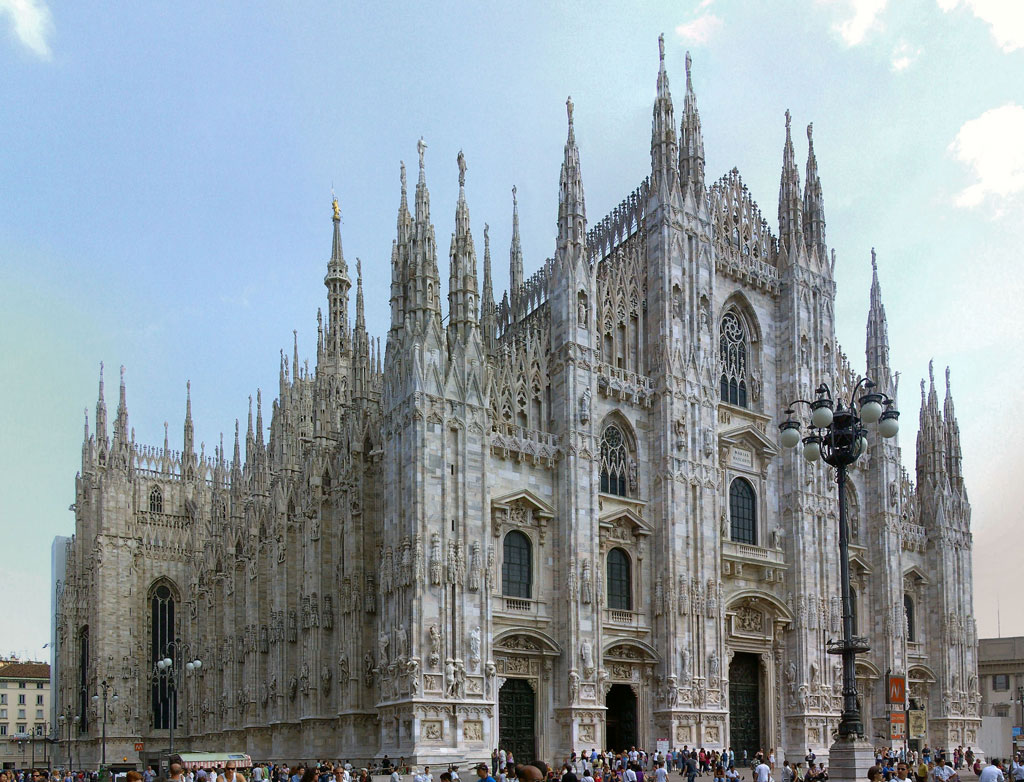
The Duomo di Milano, officially the Metropolitan Cathedral-Basilica of the Nativity of Saint Mary, is not only the most iconic church in Milan but also one of the most stunning Gothic cathedrals in the world. Its construction began in 1386 and stretched over six long centuries, resulting in a spectacular profusion of spires, statues, and delicate ornamentation.
The exterior is clad in shimmering Candoglia marble that changes hue with the sun, while more than 3,000 statues and 135 spires punctuate the skyline. Visitors can ascend to the roof terraces — easily one of the best experiences in northern Italy — to walk among pinnacles and gargoyles and take in sweeping views of Milan’s urban grid.
Milan’s Duomo isn’t just giant size. It’s a vessel of spiritual art: stained glass windows cast dramatic light inside, and elaborate altars draw the gaze toward the high altar. The golden Madonnina — a statue of the Virgin Mary that crowns the cathedral — has watched over the city since the 18th century and remains a beloved symbol of Milan’s identity.
Turin — Cathedral of Saint John the Baptist and the Holy Shroud
In elegant Turin, the Cathedral of Saint John the Baptist (Cattedrale di San Giovanni Battista) is a quieter but no less significant marvel of Renaissance architecture. This cathedral is perhaps best known as the home of the Holy Shroud (Shroud of Turin) — a relic many associate with the burial cloth of Christ.
The church’s interior balances Renaissance proportions with spiritual gravity. Though more reserved in decoration compared to Milan’s flamboyant silhouette, its historical importance and central role in Turin’s civic life make it a must-see. It also connects visually and spiritually to the Royal Palace and nearby medieval core of the city.
Genoa — Cattedrale di San Lorenzo: Maritime Mirror of Faith
In the Ligurian port city of Genoa, the Cathedral of Saint Lawrence (Cattedrale di San Lorenzo) reflects centuries of history fed by sea trade and artistic exchange. Built from the 12th century onward, it mixes Romanesque and Gothic styles with a striking black-and-white striped marble façade — a visual signature of medieval Genoese design.
Inside, the cathedral holds sacred relics and art works, including a Genoese Holy Grail — a chalice some traditions claim was used at the Last Supper. The nearby old port area, with its lively markets and seafood restaurants, makes for a memorable backdrop.
Verona — Basilica of San Zeno Maggiore: Romanesque Harmony
In Verona, the Basilica of San Zeno Maggiore is a masterpiece of Romanesque architecture and holds one of Italy’s most iconic religious portals. Dated to the 10th-12th centuries, its façade is simple yet majestic, and inside you’ll find a famous 15th-century triptych by Andrea Mantegna, depicting the Madonna and Saints.
Verona’s ancient streets and the nearby Roman arena create a poetic setting for this basilica — a reminder that architectural beauty isn’t limited to capitals and major cities.
Venice — St Mark’s Basilica: Byzantine Opulence on the Lagoon
In the floating city of Venice, nothing captures the imagination quite like St. Mark’s Basilica (Basilica di San Marco). This cathedral is not just the religious heart of Venice — it’s the crown jewel of Byzantine-inspired architecture in Italy.
Adorned with soaring domes, gilded mosaics, and ornate stonework, St Mark’s reflects centuries of Venetian wealth and cosmopolitan influence from the East. Inside, 7,500 square metres of golden mosaics narrate biblical scenes in luminous detail.
The basilica sits at the eastern end of Piazza San Marco, framed by the bell tower (Campanile) and the Doge’s Palace — itself a masterpiece of Gothic elegance. Every inch of the basilica’s interior and exterior speaks to Venice’s mercantile power and unfettered artistic ambition.
Bologna — Basilica of San Petronio: Grand Civic Cathedral
Unlike many cathedrals, Basilica of San Petronio was conceived as a civic church — built not by bishops, but by the people of Bologna. Construction began in the late 14th century and the result is one of the largest brick churches in the world.
Its façade remains unfinished, a distinctive sight, while the spacious interior impresses with soaring vaults, luminous stained glass, and intricate chapels. The basilica holds astronomical and artistic curiosities, including the famous meridian line designed by astronomer Giovanni Domenico Cassini.
Tuscany — Florence Cathedrals and Sacred Art
Florence — Cathedral of Santa Maria del Fiore (Il Duomo)
No article on Italy’s churches would be complete without mentioning Santa Maria del Fiore, the crowning glory of Florence and one of the most recognizable cathedrals in the world.
Its Renaissance dome, engineered by Filippo Brunelleschi, redefined architectural possibility in the 15th century. The façade’s polychrome marble — pink, green, and white — gleams under the Tuscan sun.
Inside, the vast nave directs your gaze upwards toward Giorgio Vasari’s Last Judgment fresco inside the dome, while exterior platforms and bell towers offer panoramic views of Florence’s red-tiled skyline.
Florence — Basilica di Santa Croce: Temple of the Italian Glories
Also in Florence stands the Basilica di Santa Croce, famed not for its size but for its burial of Italian luminaries: Michelangelo, Galileo, Machiavelli, and Rossini among them.
Its Gothic interior welcomes contemplative walks among chapels adorned with Giotto frescoes, while the exterior’s elegant simplicity anchors the lively Piazza Santa Croce — a perfect place to sit and reflect.
Pisa — Piazza dei Miracoli and the Cathedral of Santa Maria Assunta
The Pisa Cathedral, situated in the Piazza dei Miracoli, is one of Italy’s most historically significant Romanesque cathedrals.
With its striped marble façade, clustered columns, and proximity to the famous Leaning Tower, the cathedral’s harmonious proportions and interior mosaic decoration make it both architecturally and visually compelling.
Siena — Duomo di Siena: Gothic Zebra Stripes and Artistic Splendor
In Siena, the Duomo of Siena stands as one of Italy’s most visually striking Gothic churches. Characterized by alternating black and white marble — a symbolic representation of the city itself — its façade and interior are brimming with artworks by Pisano, Pinturicchio, and others.
One of its greatest treasures is the marble floor, a series of intricate inlaid designs depicting biblical scenes — a masterpiece rarely seen in full due to protective coverings.
Umbria — Orvieto Cathedral: Gothic Facade on a Volcanic Cliff
Perched atop a dramatic rocky outcrop, Orvieto Cathedral commands the skyline of Umbria. Its façade is one of the most ornate in Italy — shimmering mosaics, sculptures, and a grand rose window decorate this masterpiece of Italian Gothic.
Inside, frescoed chapels narrate biblical cycles with emotional intensity. The cathedral also preserves a fragile relic associated with a Eucharistic miracle, which helped inspire its construction.
Campania — Amalfi Cathedral: Stairway to the Divine
On the dramatic cliffs of the Amalfi Coast, Amalfi Cathedral (Duomo di Sant’Andrea) greets visitors with a broad staircase rising from the Piazza Duomo.
The cathedral’s architecture is a blend of Arab-Norman, Gothic, Renaissance, and Baroque elements, reflecting centuries of additions and refinements. Inside, the crypt holds relics of Saint Andrew, the apostle, making it both an artistic highlight and a pilgrimage destination.
This coastal cathedral exemplifies how sacred architecture can harmonize with stunning landscapes — its golden mosaics and arcades mirroring the vibrant Mediterranean light.
Campania — Salerno Cathedral: Norman Paths and Crypt of Saint Matthew
In the southern city of Salerno, the cathedral dedicated to Saint Matthew — whose relics are kept in the crypt — combines Romanesque, Norman, and Byzantine design.
Dating back to 1084, this cathedral conveys the complexity of medieval southern Italian art and faith. Its crypt is especially atmospheric, an evocative space where history and devotional reverence meet.
Puglia — Lecce Cathedral and Baroque Marvels
In Lecce, the Baroque style reaches exuberant heights. The Lecce Cathedral, rebuilt in the 17th century by Giuseppe Zimbalo, is richly decorated with sculpted details that showcase the region’s unique artistic language.
The entire city — sometimes called the “Florence of the South” — is dotted with churches and palazzi that transcend simple Baroque exuberance to become works of poetic stone craftsmanship.
Puglia — Basilica of San Nicola and Bitonto Cathedral
In Bari, the Basilica of San Nicola houses the relics of Saint Nicholas and stands as a key pilgrimage site.
Nearby, the Bitonto Cathedral is an authoritative example of Apulian Romanesque architecture — its large rose window and sculptural doorway are testaments to the region’s artistic pride.
Basilicata — Matera Cathedral: Stone City Guardian
Dominating the ancient stone city of Matera from its hilltop perch, Matera Cathedral blends medieval origins with Baroque refurbishments.
Its façade and interior reflect a deep connection with the austere, evocative landscape of the Sassi di Matera, a UNESCO World Heritage site. The cathedral’s choir and frescoes add further layers to its historic appeal.
Calabria — Santa Maria dell’Isola, Tropea
Though smaller than the grand cathedrals, the Church of Santa Maria dell’Isola in Tropea captivates with its dramatic position atop a rocky promontory overlooking the sea.
Reaching it requires a climb of stone steps, but the views — of turquoise waters and rugged cliffs — make it one of Italy’s most romantic sacred sites.
Sicily — Cathedral of Monreale and Palermo Cathedral
Monreale Cathedral — Byzantine Splendor and Mosaic Wonders
Near Palermo, the Cathedral of Monreale is a jewel of Norman-Arab-Byzantine architecture. Its interior gleams with extensive Byzantine mosaics depicting biblical scenes in gold and jewel tones — a spiritual and artistic feast.
The cloister, with its intricately carved columns, is another highlight.
Palermo Cathedral — Layered Histories and Architectural Fusion
In the capital city of Sicily, Palermo Cathedral reflects centuries of stylistic change — from Norman roots to Gothic, Renaissance, and Baroque additions. Its exterior is a tapestry of cultural influence, emblematic of Sicily’s multifaceted history.
Sardinia — Cagliari Cathedral: Island Majesty
On the island of Sardinia, Cagliari Cathedral (Cathedral of Santa Maria del Castello) brings a blend of medieval origin and later reinterpretation.
Set beside the old city, its interior treasures frescoes, sculptures, and a history that mirrors the waves and winds of Mediterranean life.
Rome — Eternal City’s Sacred Heart
No list of holy places in Italy can sidestep Rome, whose churches are so numerous they fill a lifetime of exploration.
St. Peter’s Basilica — Heart of the Catholic World
Although technically within Vatican City, St. Peter’s Basilica is inseparable from an Italian pilgrimage itinerary. As one of the largest and most important churches in Christendom, its monumental Renaissance architecture was shaped by Michelangelo, Bernini, Bramante, and others.
Inside, Michelangelo’s Pietà is a highlight, while the soaring dome overlooks Rome like a guardian. The vast colonnade of St. Peter’s Square amplifies the basilica’s grandeur and sense of welcome.
Basilica di San Giovanni in Laterano and Santa Maria Maggiore
Rome’s own cathedral is Basilica di San Giovanni in Laterano, the official seat of the Bishop of Rome (the Pope). Other major basilicas include Santa Maria Maggiore, rich in mosaics and relics, and San Clemente, layered with history from early Christianity to the medieval era.
Why Italy’s Churches Are Unforgettable
Italy’s cathedrals and churches are more than architectural wonders. They are cultural time capsules, preserving art, history, and the evolving spirit of their communities. Each — whether grand like Milan’s Duomo, radiant like St Mark’s, humble like Santa Maria dell’Isola, or profound like St. Peter’s — tells a story of faith, artistic ambition, and human resilience.
For travelers, pilgrimage seekers, art lovers, and curious wanderers alike, exploring Italy’s cathedrals and churches offers a deeply enriching journey through centuries of sacred heritage.