
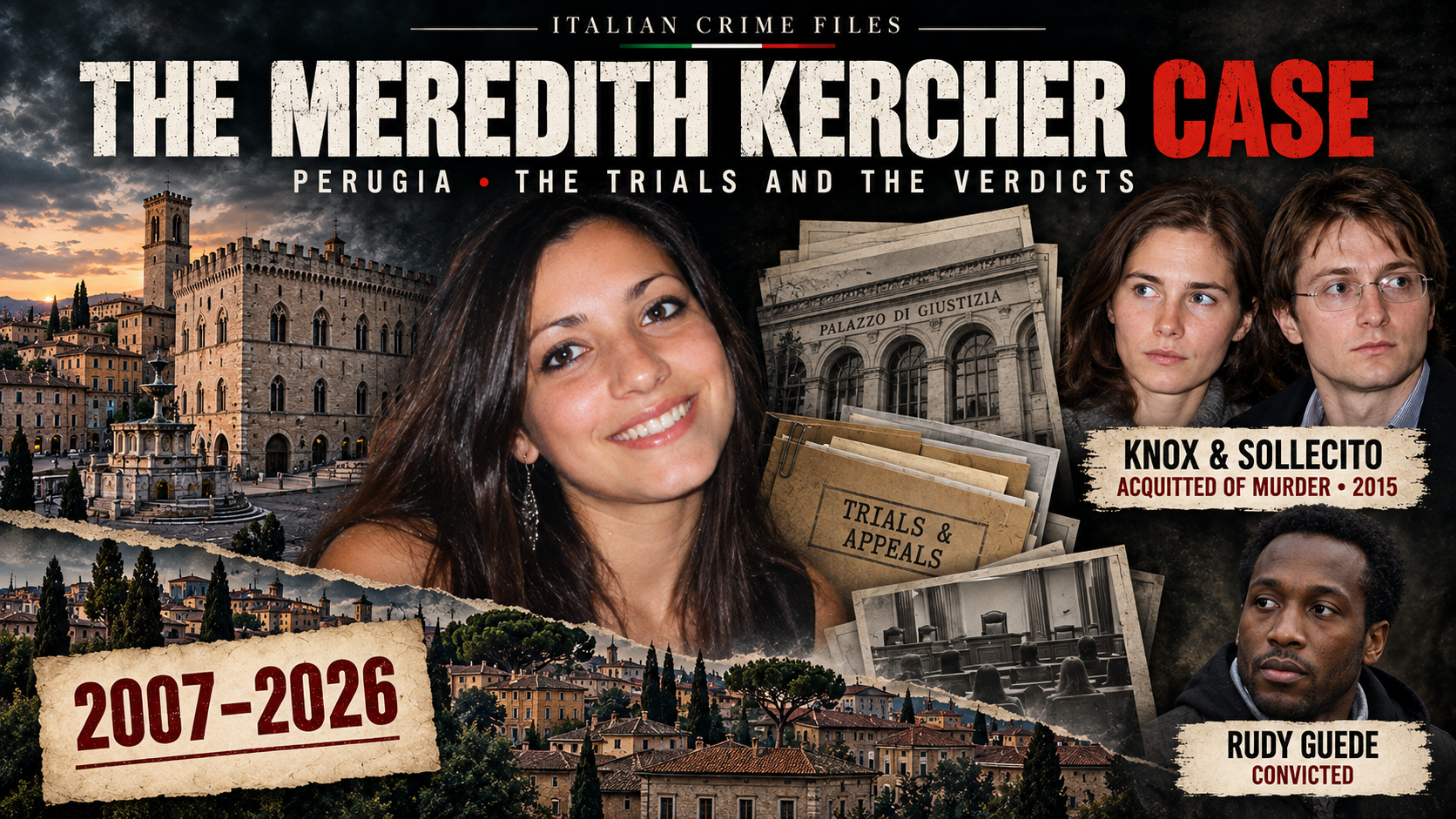
 Meredith Kercher was 21 when she was murdered in Perugia in November 2007. She had come to Italy to study, improve her Italian and experience life abroad. Instead, her death became the starting point of an international legal and media story that frequently pushed Meredith herself into the background.
Understanding the case means separating three different proceedings: Rudy Guede’s prosecution for murder and sexual violence; the murder trials that ended in the definitive acquittals of Amanda Knox and Raffaele Sollecito; and Knox’s separate prosecution for falsely accusing Patrick Lumumba.
Those outcomes are distinct. Guede remains convicted of participating in Meredith’s murder. Knox and Sollecito were definitively acquitted of the murder in 2015. Knox’s conviction for the accusation against Lumumba was upheld by Italy’s highest court in January 2025.
Who Was Meredith Kercher?
Meredith was a British student at the University of Leeds who chose Perugia for her year abroad. Her interest in Italy was personal and academic: she wanted to develop her language skills and learn more about Italian culture.
When her family testified in Perugia in 2009, their memories offered a picture far removed from the courtroom headlines. They described an intelligent, conscientious young woman who was excited about studying overseas. Her sister Stephanie recalled how much Meredith had looked forward to the experience.
There were ordinary pleasures, too. Her mother remembered that Perugia’s chocolate festival had helped make the city attractive to her. These details matter because they restore something the public story often loses: Meredith had interests, relationships and plans that existed independently of the people later prosecuted over her death.
What Happened in Perugia in November 2007?
Meredith was killed on the evening of 1 November 2007. Her body was discovered the following day in her bedroom in the apartment she shared with Knox and two Italian women.
Police found evidence of a violent attack and sexual assault. The investigation soon focused on Knox, an American student, and her Italian boyfriend, Raffaele Sollecito. Both denied involvement.
During questioning in the early hours of 6 November, Knox accused Patrick Lumumba, the owner of the bar where she worked. Lumumba was arrested but subsequently released. He was innocent of Meredith’s murder.
Investigators also identified Rudy Guede through forensic evidence associated with the crime scene. His prosecution would proceed separately from the trial of Knox and Sollecito.
The Verdicts at a Glance
The simplest way to follow the case is to keep each defendant’s legal position separate.
| Person | Proceedings | Outcome |
|---|---|---|
| Rudy Guede | Murder and sexual violence, tried separately through an abbreviated procedure | Convicted; his 16-year sentence became final in 2010. |
| Amanda Knox | Murder prosecution alongside Sollecito | Definitively acquitted in March 2015. |
| Raffaele Sollecito | Murder prosecution alongside Knox | Definitively acquitted in March 2015. |
| Amanda Knox | Separate charge of falsely accusing Patrick Lumumba, known in Italy as calunnia | Three-year sentence upheld by the Court of Cassation on 23 January 2025; no additional imprisonment because of time already served. |
| Patrick Lumumba | Initially arrested after Knox’s accusation | Released and cleared; he was not responsible for Meredith’s murder. |
The table describes judicial outcomes. Earlier accusations and overturned convictions should not be presented as though they remain the legal position.
Rudy Guede’s Separate Trial and Conviction
Guede chose the Italian rito abbreviato, an abbreviated form of trial conducted principally on the investigation record. His case therefore followed a different timetable from the proceedings against Knox and Sollecito.
He was convicted in October 2008 and initially sentenced to 30 years. On appeal in December 2009, the sentence was reduced to 16 years. The Court of Cassation upheld his conviction and sentence in December 2010.
The conviction concerned his participation in Meredith’s murder and sexual violence. Guede has denied killing her. His denial does not alter the final conviction.
He was released in November 2021 after serving most of the sentence. Release from prison did not overturn the judgment or clear him of the crime.
An important complication is that judgments in Guede’s proceedings described participation with others. That finding did not itself establish the guilt of Knox or Sollecito, whose responsibility had to be determined in their own proceedings. Their eventual acquittals must be respected when describing the case.
Amanda Knox and Raffaele Sollecito: The Trials and Appeals
The proceedings against Knox and Sollecito produced a succession of conflicting decisions.
| Date | Decision |
|---|---|
| December 2009 | A Perugia court convicted both defendants. Knox received 26 years and Sollecito 25 years. |
| 3 October 2011 | An appeals court acquitted them of murder and sexual assault. They were released, and Knox returned to the United States. |
| March 2013 | The Court of Cassation overturned the acquittals and ordered a fresh appeal hearing. |
| 30 January 2014 | A Florence appeals court convicted them again. |
| 27 March 2015 | The Court of Cassation definitively acquitted both of the murder. |
These were stages in the Italian trial and appeal process, rather than a sequence of unrelated prosecutions. Reporting an intermediate decision without its later reversal creates a misleading account of the outcome.
Why the Forensic Evidence Mattered
Two much-discussed items were a kitchen knife recovered from Sollecito’s apartment and a clasp from Meredith’s bra.
The evidential questions concerned the collection and interpretation of biological traces, including possible contamination. A scientific review of the case later examined how these problems contributed to the wrongful convictions. DNA evidence requires context: the reliability of a result depends on how material was recovered, handled and analysed.
In the reasons published for the final acquittals in September 2015, the Court of Cassation criticised serious investigative shortcomings. It noted the absence of certain biological traces attributable to Knox or Sollecito in the murder room or on Meredith’s body.
The definitive result was an acquittal, not an unresolved charge awaiting another ordinary appeal.
Patrick Lumumba and the Separate False-Accusation Case
Lumumba’s experience is essential to understanding the consequences of the early investigation.
He employed Knox at his bar in Perugia. Her accusation led to his arrest and approximately two weeks in custody before he was released. His innocence should be stated plainly, without leaving readers with the impression that he remains a suspect.
Knox’s prosecution over that accusation concerned calunnia. English-language reports often call it “slander,” but the relevant conduct was falsely accusing an innocent person of a crime.
Knox has maintained that police pressure and the circumstances of her questioning produced the accusation. Italian courts nevertheless upheld a conviction in the renewed proceedings. The Court of Cassation confirmed the three-year sentence on 23 January 2025.
She did not return to prison because the sentence was covered by the time she had already spent in custody. This judgment did not reverse her acquittal of Meredith’s murder.
What Did the European Court of Human Rights Decide?
On 24 January 2019, the European Court of Human Rights found violations relating to Knox’s access to legal assistance and the interpreting assistance provided during questioning.
It also found that Italy had failed to investigate her allegations of ill-treatment adequately. However, it did not find sufficient evidence to establish that the alleged ill-treatment itself had occurred. That distinction matters: a failure to investigate an allegation and a finding that the allegation is proved are different conclusions.
The European judgment addressed Convention rights. It was not a new murder trial and did not determine who killed Meredith.
The Later European Application
The European court’s public record also identifies a further application by Knox, lodged on 4 August 2025 and communicated to the Italian government on 3 November 2025.
It concerns fair-trial issues arising from the renewed proceedings. Communicating an application is a procedural step, not a judgment overturning a conviction. The January 2025 Italian ruling should therefore not be described as having been annulled by that development.
How the Media Changed the Story
The case became an international spectacle. Coverage repeatedly focused on Knox’s appearance, relationships and perceived behaviour, encouraging audiences to interpret personality as evidence.
The public narrative often became a contest between people convinced of guilt and people convinced of innocence. Meredith’s life received far less attention than the controversy surrounding the defendants.
A responsible account should resist that pattern. It should distinguish an allegation from a finding, identify when a conviction was overturned, and avoid using a separate conviction to insinuate guilt for a crime that ended in acquittal.
Readers following Italia Mia’s Crime series can also explore the Garlasco case and the murder of Chiara Poggi. The cases have different evidence and judicial histories, but both require careful separation of court decisions from public speculation.
Remembering Meredith Beyond the Courtroom
Meredith’s family faced years of hearings, reversals and public argument while grieving her death. After the 2015 acquittals, relatives expressed shock and continued uncertainty about the full circumstances of the murder. Their distress deserves acknowledgment alongside an accurate account of the final verdicts.
There is also a legacy connected to the reason Meredith went to Italy. A scholarship established in her memory supported study of Italian language and culture in Perugia. An Italian Embassy announcement documenting its 2014–2015 edition described a two-month study opportunity at the University for Foreigners.
That memorial returns attention to Meredith as a student with curiosity and ambitions. Any account of this case should leave room for the life she intended to live.
External Links and Sources
- European Court of Human Rights: 2019 judgment summary
- European Court of Human Rights: later application, no. 24153/25
- ANSA: Cassation upholds Knox’s false-accusation conviction
- ABC News: Meredith Kercher’s family testimony
- Italian Embassy in London: scholarship in Meredith’s memory