

 Updated September 21, 2026. Italy’s election date and electoral law may change. This article will be updated as official decisions are announced.
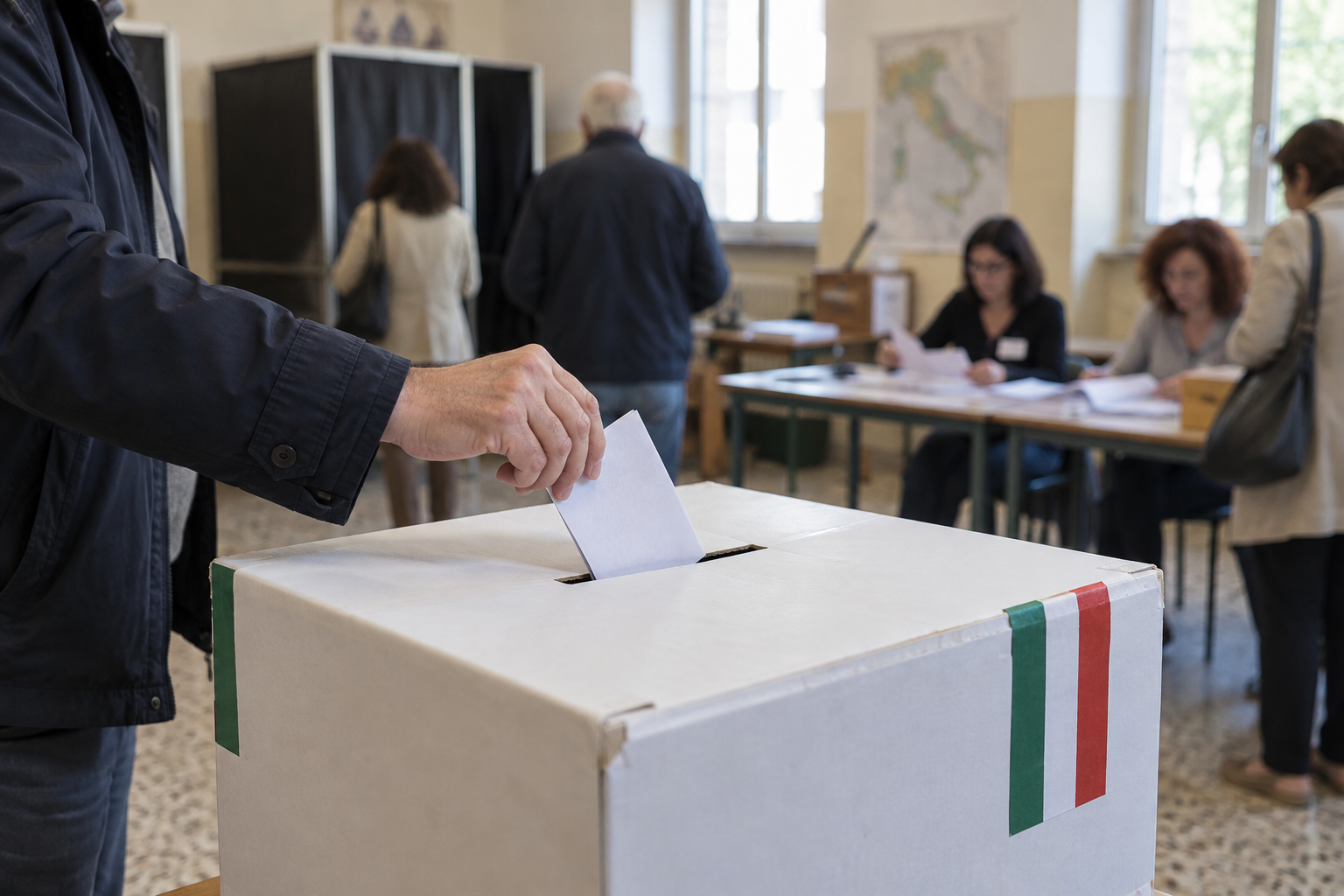
Italy is preparing for a general election in 2027 that could reshape the country’s government, its relationship with the European Union and its position on issues ranging from migration to public spending.
The precise election date has not yet been announced. Prime Minister Giorgia Meloni has said that she intends to complete the legislature, which would place the vote in the second half of 2027. An earlier election remains possible if the government loses its parliamentary majority or the president dissolves Parliament before the end of its term.
The campaign has effectively begun, however. Political parties are reorganizing, alliances are being tested and Parliament is considering a major change to the electoral law.
For continuing coverage of Italian politics and current affairs, follow Italian News in English on Italia Mia.
What Italians Will Elect
Italian voters will elect the two houses of Parliament:
- The Chamber of Deputies, with 400 elected members
- The Senate of the Republic, with 200 elected members
Unlike voters in a United States presidential election, Italians do not directly elect their prime minister under the present constitutional system.
Citizens vote for parties, coalitions and parliamentary candidates. After the election, the president of the Republic consults the political parties and appoints a prime minister who appears capable of obtaining the confidence of both houses of Parliament.
This makes coalition building especially important. A party can receive more votes than any other individual party without having enough parliamentary support to govern alone.
When Will Italy’s General Election Take Place?
The national election is expected during the second half of 2027, although no official date has been set.
Meloni became prime minister in October 2022 after the centre-right coalition won that year’s general election. She has repeatedly indicated that she wants the government to complete its full term.
That would be a significant accomplishment in a country known for frequent changes of government. Meloni has already led one of the longest continuously serving Italian governments of the postwar period.
Nevertheless, Italian legislatures do not always reach their scheduled conclusion. Coalition disputes, confidence votes or a political crisis could still produce an early election.
Italy May Vote Under a New Electoral Law
One of the greatest uncertainties surrounding the election is the voting system itself.
Under the system currently in force, most parliamentary seats are allocated proportionally according to each party’s share of the vote. Approximately one-third are decided in single-member constituencies, where the candidate receiving the most votes wins.
This combination rewards parties that form alliances before the election. Coalition partners can support one common candidate in a constituency while competing with separate party lists in the proportional part of the ballot.
In September 2026, the Senate approved a proposed reform that would replace this mixed system with a fully proportional model. The proposal would award a parliamentary majority to an alliance receiving more than 42 percent of the national vote.
It would also require each alliance to identify its candidate for prime minister before the election.
The measure must still receive final approval from the Chamber of Deputies. Until that happens, the existing electoral system remains in force. The outcome of this debate could materially affect party strategies, coalition negotiations and the final distribution of parliamentary seats.
Giorgia Meloni and the Governing Coalition
Giorgia Meloni is expected to seek another term at the head of Italy’s conservative government.
Her Brothers of Italy party remains the largest individual political force in the country. Meloni has also developed a prominent international role through Italy’s membership in the European Union, NATO and the Group of Seven.
Her governing coalition includes three principal parties:
Brothers of Italy
Meloni’s national-conservative party has dominated the coalition since the 2022 election. Its campaign is likely to emphasize government stability, national sovereignty, border control, support for families and Italy’s influence within Europe.
Forza Italia
Led by Antonio Tajani, Forza Italia represents the coalition’s more traditionally pro-European, liberal-conservative wing. The party will attempt to preserve the political space once occupied by its founder, Silvio Berlusconi.
The League
Matteo Salvini’s League has faced falling support, internal divisions and questions about its future direction. Some members favor returning to the party’s northern regionalist roots, while Salvini has continued to present it as a nationwide nationalist party.
Salvini has called an extraordinary party congress as the League attempts to strengthen its organization before the election.
The arrival of National Future, a new right-wing party led by former general Roberto Vannacci and formed with League dissidents, has further complicated the conservative landscape. Its growth could divide the right-wing vote or make it a factor in future coalition negotiations.
The Centre-Left Opposition
The Democratic Party, led by Elly Schlein, is the largest party on the centre-left and the main challenger to Meloni’s Brothers of Italy.
Schlein has emphasized public healthcare, wages, employment rights, environmental policy and greater social equality. The Democratic Party is also generally supportive of European integration.
Its central challenge will be building a coalition broad enough to compete with the right while maintaining a coherent program.
The centre-left may include the Green and Left Alliance, led by Angelo Bonelli and Nicola Fratoianni, together with smaller progressive and centrist organizations.
Recent opinion polls have suggested that a united centre-left alliance could compete closely with the governing coalition. Polls taken many months before an election, however, are snapshots rather than reliable predictions.
The Five Star Movement and Giuseppe Conte
The Five Star Movement remains one of the most important independent forces in Italian politics.
Its leader, former prime minister Giuseppe Conte, has tried to position the movement as a socially focused alternative to both Meloni’s government and the traditional political establishment.
The movement advocates stronger welfare protections and has frequently criticized military spending and aspects of Italy’s support for Ukraine.
Whether the Five Star Movement forms an electoral alliance with the Democratic Party could be decisive. Cooperation could make the broader opposition more competitive, but the parties continue to disagree over leadership, foreign policy and other major questions.
Italy’s Centrist Parties
Several smaller parties occupy the political center, including Carlo Calenda’s Action and Matteo Renzi’s Italia Viva.
Their individual levels of support may be modest, but they could still influence the election. Under the existing system, centrist votes can be particularly important in closely contested single-member constituencies.
The proposed proportional voting system would change those calculations and could encourage smaller parties to negotiate places within larger alliances.
The Issues Likely to Decide the Election
Cost of Living and Household Finances
Rising electricity, gas, fuel, food and housing costs are likely to remain central campaign issues.
The government has introduced tax reductions and subsidies intended to provide relief to households and motorists. Supporters describe these measures as practical assistance, while opponents question whether temporary benefits are financially sustainable.
Voters will judge whether their wages and pensions have kept pace with living costs and whether the government has improved their everyday economic security.
Public Debt, Taxes and Economic Growth
Italy carries one of the largest public-debt burdens in Europe. Any new tax reduction or spending promise will therefore face questions about how it will be financed.
The government is likely to defend its tax policies as a way to support families and businesses. Opposition parties will focus on the distribution of those benefits and the condition of public services.
Employment, productivity, economic growth and the continuing use of European recovery funds will all feature prominently in the campaign.
Healthcare
Waiting times, shortages of medical personnel and differences between regional healthcare systems affect millions of Italian families.
The opposition is expected to argue for greater investment in the public health service. The government will point to its own funding decisions and may emphasize regional efficiency, recruitment and the reduction of waiting lists.
Healthcare could become especially important among older voters and families unable to afford private treatment.
Immigration and Citizenship
Migration across the Mediterranean will remain one of the most divisive subjects in Italian politics.
Meloni’s coalition favors stronger border controls, faster repatriations and agreements with countries outside the European Union. Opposition parties generally call for a greater emphasis on humanitarian protection, legal migration routes and European responsibility-sharing.
Citizenship reform may also return to the debate, particularly proposals affecting children born or educated in Italy.
Italy’s Role in Europe
The election will help determine how Italy approaches European fiscal rules, migration agreements, energy policy and institutional reform.
Meloni has combined criticism of some European policies with a pragmatic working relationship with EU institutions. The Democratic Party and Forza Italia are strongly pro-European, while other parties favor a more confrontational approach to Brussels.
The result will matter beyond Italy because the country is one of the European Union’s largest economies and founding members.
Ukraine, NATO and Foreign Policy
Italy’s support for Ukraine could create divisions within and between the major alliances.
Meloni has maintained Italy’s commitment to NATO and support for Kyiv. Other political forces have questioned the supply of weapons or called for a stronger emphasis on negotiations.
Relations with the United States, defense spending, Middle East policy and Italy’s role in the Mediterranean are also likely to appear in campaign debates.
Can Italian Citizens Living Abroad Vote?
Italian citizens who live abroad and are properly registered with AIRE can normally vote by mail in national elections.
Italy’s Overseas Constituency elects members of both the Chamber of Deputies and the Senate. Ballot materials are sent through the appropriate Italian consular office.
Eligible voters should check that their AIRE address is current well before the election. An outdated address can prevent the ballot package from reaching the voter in time.
Italian citizens temporarily abroad for at least three months for work, study or medical treatment may also be able to request postal voting, but they must follow the application procedure and deadline announced for the election.
The official Italian Foreign Ministry guide to voting abroad provides information for overseas voters.
Why the Election Matters Outside Italy
The next government will inherit decisions with consequences far beyond the Italian peninsula.
Italy is a major EU economy, a NATO member and an important actor in the Mediterranean. Its government will influence European migration policy, relations with the United States, support for Ukraine, energy strategy and the future direction of the European Union.
The election will also be closely watched as a test of whether Meloni can turn her personal popularity and record of government stability into a second mandate.
For the opposition, the central question is whether parties with different political identities can unite around a common candidate and program.
What to Watch Before Election Day
Several developments will determine the shape of the campaign:
- Whether the Chamber of Deputies gives final approval to the proposed electoral reform
- Whether Meloni’s governing coalition remains united
- Whether the League recovers support after its extraordinary congress
- How National Future affects the balance on the political right
- Whether the Democratic Party and Five Star Movement form an electoral alliance
- Which alliance, if any, can approach the proposed 42-percent threshold
- Whether economic conditions improve before Italians vote
- Whether Parliament completes its term or an early election is called
Until the election date and voting system are confirmed, seat projections should be treated cautiously. In Italy, alliances and electoral rules can be just as important as the popularity of individual parties.
A Campaign That Could Transform Italian Politics
Italy’s next general election will be more than a contest between Giorgia Meloni and her opponents.
It will test the durability of the conservative coalition, the ability of the centre-left to organize a credible alternative and the continuing influence of smaller and newer parties.
It may also be conducted under an entirely new electoral law.
The political situation will continue to evolve, but one point is already clear: the decisions made before election day—about alliances, leadership and the rules of the vote—could prove almost as important as the ballots cast by Italian citizens.
External Sources
Italian Senate approves proposed electoral reform
League calls an extraordinary congress before the election
Italian government announces vehicle-tax measure ahead of the election
Italian Foreign Ministry: Voting Abroad
Constitution of the Italian Republic