

 Italy’s political system can be confusing to outsiders, partly because the titles “President” and “Prime Minister” suggest a division of power similar to that found in other countries. In reality, Italy is a parliamentary republic in which the President of the Republic, the Prime Minister and Parliament perform separate but closely connected constitutional roles.
The President is the head of state and guardian of the constitutional order. The Prime Minister leads the government and directs national policy. Parliament debates and passes legislation, approves the budget and determines whether the government can remain in office.
Understanding this relationship also helps explain why Italian governments sometimes change without a general election—and why the President can become particularly important during a political crisis.
Italy Is a Parliamentary Republic
The modern Italian Republic was established after the institutional referendum of June 2, 1946, when Italians voted to replace the monarchy with a republic. The Constitution entered into force on January 1, 1948.
Article 1 of the Constitution describes Italy as “a democratic Republic founded on labour” and states that sovereignty belongs to the people. However, citizens do not directly elect the national government or the Prime Minister. They elect Parliament, and the government must obtain the confidence of Parliament.
The main institutions of the Italian state are:
- The President of the Republic
- Parliament
- The Government
- The judiciary
- The Constitutional Court
These institutions are designed to balance one another. No single officeholder exercises all executive or legislative authority.
The President of the Republic
The President of the Republic, or Presidente della Repubblica, is Italy’s head of state. The office should not be confused with an executive presidency such as that of the United States.
Italy’s President does not normally determine the government’s daily political program. The President represents national unity, protects the constitutional balance and ensures that political and institutional procedures follow the Constitution.
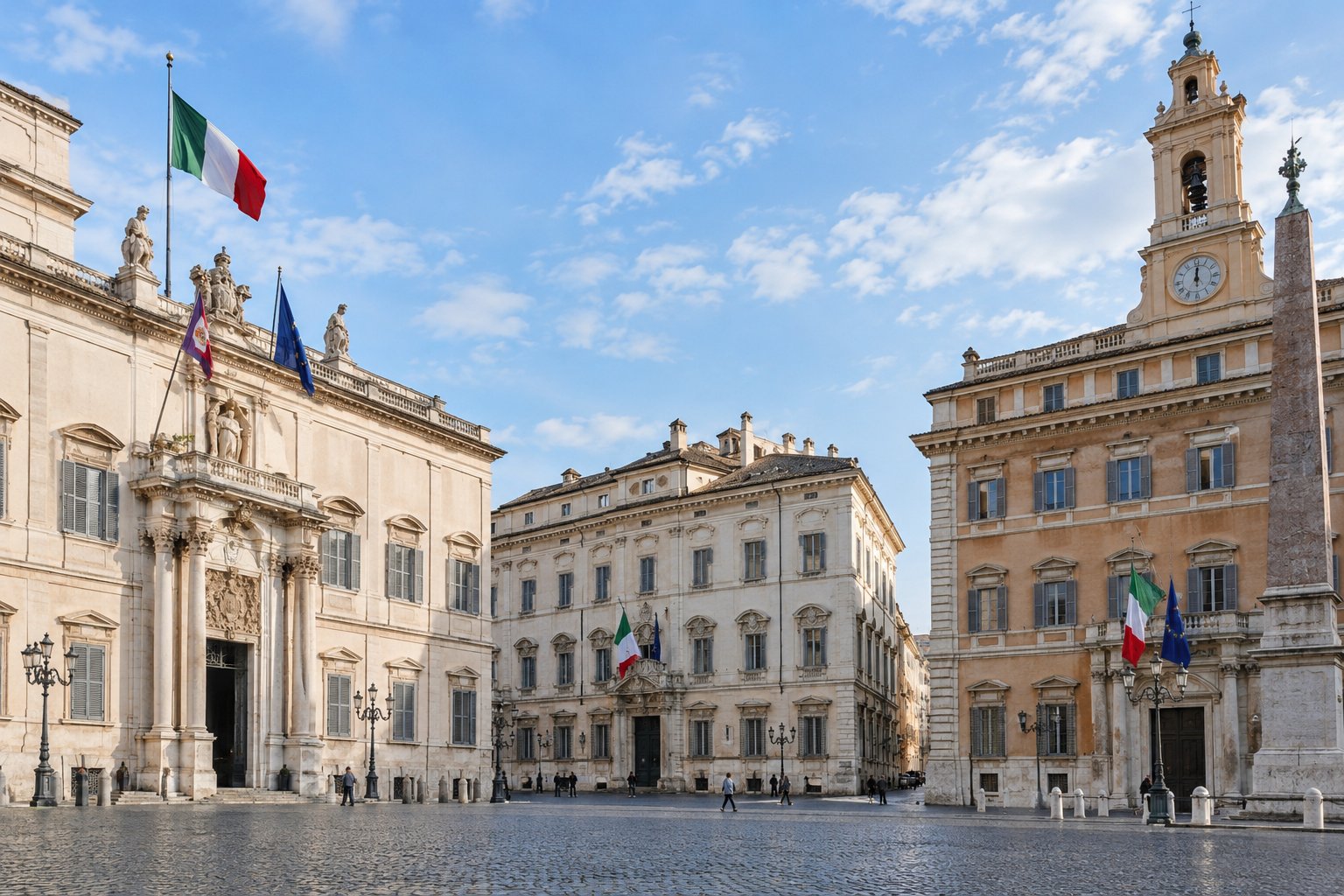
The President’s official residence is the Quirinal Palace in Rome, which is why Italian newspapers often use “the Quirinal” as shorthand for the presidency.
How the President Is Elected
The President is not elected directly by the public. The election is conducted by Parliament in a joint sitting, with the participation of delegates representing Italy’s regions.
Each region sends three delegates, except Valle d’Aosta, which sends one. The system is intended to give the regions a voice while preserving the national character of the office.
A two-thirds majority of the assembly is required during the first three ballots. From the fourth ballot onward, an absolute majority is sufficient. Because agreement can be difficult, presidential elections may require several rounds of voting.
The presidential term lasts seven years, longer than Parliament’s normal five-year term. This helps place the presidency above the immediate electoral cycle. The Constitution does not prohibit reelection.
Sergio Mattarella was first elected President in 2015 and reelected in January 2022. His current term is scheduled to end in 2029, unless he leaves office earlier.
What Powers Does the President Have?
Many presidential acts are formal and require the countersignature of a minister. Nevertheless, the President possesses important constitutional powers.
The President:
- Appoints the Prime Minister
- Appoints government ministers on the Prime Minister’s proposal
- Authorizes the presentation of government bills to Parliament
- Promulgates laws approved by Parliament
- May return a law to Parliament once for reconsideration
- Can dissolve one or both houses of Parliament under constitutional conditions
- Calls national elections and referendums
- Ratifies international treaties when parliamentary authorization is required
- Presides over the High Council of the Judiciary
- Serves as commander of the armed forces
- Appoints five of the Constitutional Court’s fifteen judges
- May grant pardons and commute sentences
The President’s role becomes especially visible after an election, following a government resignation or when no political coalition has a clear parliamentary majority.
In those situations, the President consults party leaders and parliamentary representatives before deciding whom to ask to form a government.
The Prime Minister and the Government
The Italian Prime Minister’s official title is President of the Council of Ministers, or Presidente del Consiglio dei Ministri.
The Prime Minister leads the Government, coordinates the work of ministers and is responsible for maintaining the unity of its political and administrative program. The official seat of the Prime Minister is Palazzo Chigi in Rome.
At the time of this update, Italy’s Prime Minister is Giorgia Meloni, who has led the government since October 2022.
Italians Do Not Directly Elect the Prime Minister
During an election campaign, political parties normally identify their preferred candidate for Prime Minister. Voters may therefore feel that they are choosing between different potential leaders.
Constitutionally, however, citizens elect the members of Parliament—not the Prime Minister.
After an election, the President of the Republic holds consultations to determine whether a person can assemble a government supported by a parliamentary majority. The President then appoints the Prime Minister, who proposes a list of ministers.
The Prime Minister and ministers take an oath before the President of the Republic. The new government must then appear before both houses of Parliament and obtain their confidence.
This distinction explains how Italy can receive a new Prime Minister without holding an immediate general election. If Parliament can support another government, a new administration may be formed within the existing legislature.
The Council of Ministers
The Prime Minister and ministers collectively form the Council of Ministers. It is the government’s central decision-making body.
Ministers usually lead specific departments, such as:
- Foreign Affairs
- Interior
- Economy and Finance
- Justice
- Defence
- Health
- Education
- Infrastructure and Transport
- Agriculture
- Culture
A government may also include ministers without portfolio. These ministers do not direct a traditional ministry but are assigned responsibility for areas such as European affairs, regional affairs, civil protection or institutional reforms.
The Council of Ministers approves government bills, decree-laws, legislative decrees, regulations and major policy decisions before they proceed through the appropriate constitutional process.
Parliament: The Chamber and the Senate
The Italian Parliament consists of two houses:
- The Chamber of Deputies, or Camera dei Deputati
- The Senate of the Republic, or Senato della Repubblica
The Chamber meets at Palazzo Montecitorio, while the Senate meets at Palazzo Madama. Both buildings are in Rome.
The Chamber has 400 elected deputies. The Senate has 200 elected senators, in addition to former Presidents of the Republic and any senators for life appointed under the Constitution.
Members of both houses are elected for five-year terms unless Parliament is dissolved early.
Italy’s “Perfect” Bicameral System
Italy is known for its system of bicameralismo paritario, often translated as equal or perfect bicameralism.
The Chamber of Deputies and the Senate possess substantially the same legislative powers. A government must have the confidence of both houses, and most legislation must be approved by both in exactly the same wording.
This differs from systems in which one parliamentary chamber is clearly more powerful than the other.
Equal bicameralism provides additional scrutiny, but it can also slow the legislative process. If the Senate changes a bill already approved by the Chamber, the amended text must return to the Chamber. This movement between the houses may continue until both approve an identical version.
How a Government Wins—or Loses—Confidence
Within ten days of its formation, a new government must present its program to both houses of Parliament. Each chamber then holds a debate and votes on a motion of confidence.
The government must retain the support of both the Chamber and the Senate throughout its time in office.
A government may fall when:
- It loses a formal vote of confidence
- Parliament approves a motion of no confidence
- The governing coalition breaks apart
- The Prime Minister resigns after losing reliable parliamentary support
- A major government proposal is rejected and the Prime Minister treats the result as politically decisive
A defeat on an ordinary bill does not automatically dismiss the government. However, the government may attach a formal confidence question to important legislation, forcing its parliamentary majority to support the measure or risk the government’s collapse.
What Happens When a Prime Minister Resigns?
A Prime Minister’s resignation does not automatically produce an election.
The President of the Republic first holds consultations to determine whether another government can be formed from the existing Parliament. Several outcomes are possible:
- The same Prime Minister may receive a new mandate with a revised coalition.
- Another political leader may form a government.
- A broader coalition or government of national unity may be created.
- A temporary or technocratic government may be appointed.
- Parliament may be dissolved and an early election called.
This flexibility is one reason Italy has had many governments since 1948, even though the number of general elections has been considerably lower. A change of government does not necessarily mean a new parliamentary legislature.
When a government resigns, it normally remains in office temporarily to handle current affairs until a successor is sworn in.
How Italian Laws Are Made
Legislation can be proposed by the government, individual parliamentarians, regional councils, the National Council for Economics and Labour or groups of at least 50,000 voters.
A bill is examined by a parliamentary committee before being debated and voted on. The precise procedure varies according to the type of legislation, but ordinary national laws generally follow these stages:
- A bill is introduced in either the Chamber or the Senate.
- A parliamentary committee examines the proposal.
- The house debates and votes on the bill.
- The approved text goes to the other house.
- Both houses must approve the same text.
- The President of the Republic promulgates the law.
- The law is published in the Official Gazette.
- It enters into force, normally after a fifteen-day waiting period unless the law specifies otherwise.
Before promulgating a law, the President may send it back to Parliament with an explanation and request reconsideration. If Parliament approves the law again, the President is generally required to promulgate it.
Decree-Laws and Legislative Decrees
Not every national measure begins as an ordinary parliamentary bill.
In extraordinary cases of necessity and urgency, the government may adopt a decree-law. It takes effect immediately but must be presented to Parliament and converted into law within 60 days. If Parliament does not convert it, the decree loses effect.
A legislative decree is different. Parliament first passes a delegation law establishing the subject, principles, limits and deadline. The government then adopts detailed legislation within that authority.
These instruments allow the government to act more quickly or handle technically complex reforms, but Parliament remains constitutionally involved.
The Constitutional Court
The Constitutional Court is separate from both Parliament and the government. Its primary responsibility is to determine whether laws comply with the Constitution.
It can also resolve conflicts between state institutions and between the national government and Italy’s regions.
The Court has fifteen judges:
- Five are appointed by the President of the Republic.
- Five are elected by Parliament.
- Five are elected by the highest ordinary and administrative courts.
This mixed appointment system is intended to protect the Court’s independence and prevent a single institution from controlling its composition.
The Role of the Judiciary
Italian judges are constitutionally independent and subject only to the law. The government’s Minister of Justice is responsible for the organization and functioning of justice services but cannot direct judges on how to decide individual cases.
The High Council of the Judiciary oversees important matters involving the careers, assignments and discipline of magistrates. The President of the Republic formally presides over the council.
Italy’s court system is distinct from the Constitutional Court. Ordinary courts handle civil and criminal cases, while administrative courts hear disputes involving public authorities.
Regional and Local Government
Italy is divided into 20 regions, five of which—Sicily, Sardinia, Trentino-Alto Adige/Südtirol, Valle d’Aosta and Friuli-Venezia Giulia—have special autonomous status.
The regions possess legislative and administrative powers in areas assigned to them by the Constitution. Responsibilities are divided among the national government, regions, provinces, metropolitan cities and municipalities.
Regional authority is particularly visible in healthcare, territorial planning, public transport and some areas of economic development.
Disputes over whether a matter belongs to the state or the regions may be decided by the Constitutional Court.
Italy and the European Union
Italy is a founding member of the European Union. Consequently, some decisions affecting Italian citizens are made through cooperation between Italian institutions and EU bodies.
The Italian government represents the country in the European Council and the Council of the European Union. Parliament examines European legislation and oversees government participation in EU decision-making. Italian voters also directly elect representatives to the European Parliament.
European rules do not replace Italy’s Constitution, but EU membership adds another level to the country’s political and legal system.
Who Holds the Most Power?
There is no single answer because power depends on the political circumstances.
When a government has a stable parliamentary majority, the Prime Minister and the governing coalition usually drive national policy. Parliament passes legislation and scrutinizes the executive, while the President performs a more restrained constitutional role.
During a fragmented election result or government crisis, the President becomes much more influential because the head of state must determine whether a viable government can be formed.
Parliament remains central in both situations. No government can remain in office without the confidence of the Chamber and the Senate.
A System Based on Negotiation
Italian government is built around negotiation among institutions, parties and parliamentary coalitions. The Prime Minister leads the government but depends on Parliament. Parliament passes laws but must follow constitutional procedures. The President rarely directs everyday policy but acts as an institutional guarantor, especially during moments of uncertainty.
The result can appear complicated, particularly when coalitions change or a new Prime Minister takes office between elections. Yet the basic principle is straightforward: political leadership belongs to a government that commands parliamentary confidence, while the President protects the continuity and constitutional balance of the Republic.
For current political developments, government decisions and election coverage, follow Italiamia’s Italian News in English.
External Sources
Constitution of the Italian Republic – Senate of the Republic
President of the Italian Republic – Quirinale
Biography of President Sergio Mattarella – Quirinale
Presidency of the Council of Ministers