

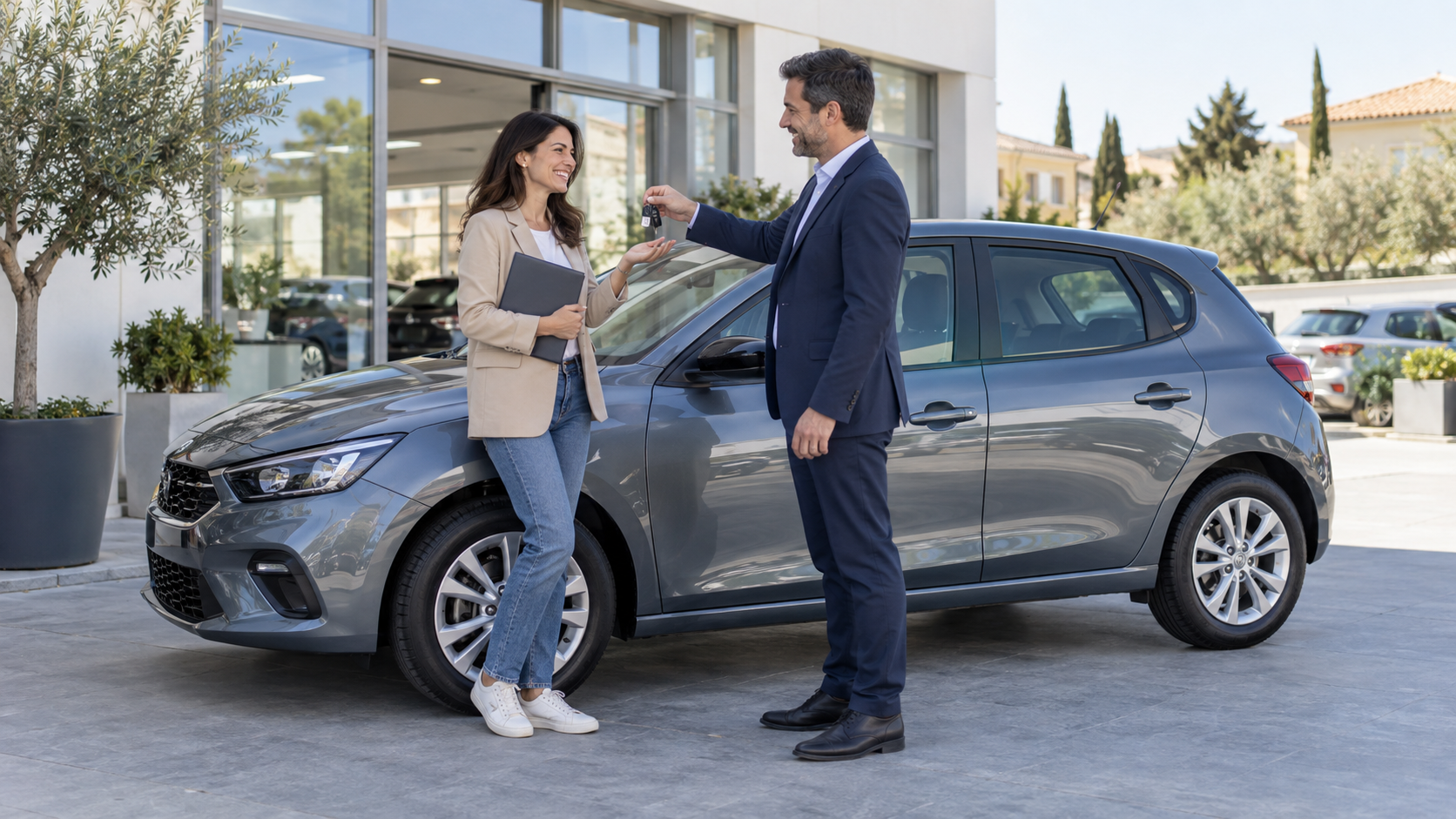
 Buying a car in Italy can make everyday life considerably easier, especially in rural areas, small towns and regions where public transportation is limited. However, the purchase price is only one part of the calculation. Registration, insurance, road tax, inspections, maintenance, fuel and parking can substantially increase the real cost of ownership.
The administrative process is manageable once you understand the roles of the dealership, the Motorizzazione Civile and the Public Vehicle Register, known as the Pubblico Registro Automobilistico or PRA.
This guide explains how residents can buy and register a new or used car, what to check before purchasing and how much car ownership in Italy may realistically cost.
Can a Foreign Resident Buy a Car in Italy?
Foreign nationals can buy and register a car in Italy, but they will normally need to demonstrate that they are legally resident in the country.
Documents commonly requested include:
- A valid passport or Italian identity card
- An Italian tax identification number, or codice fiscale
- Proof of registered residence in Italy
- A valid residence permit for non-EU citizens, when applicable
- Payment details for the purchase and administrative charges
Requirements can vary according to the buyer’s nationality, immigration status and the office processing the registration. Non-EU buyers may be asked for their original residence permit or evidence that its renewal is in progress.
If you are still completing your municipal registration, consult our guide to registering your residence in Italy.
You do not necessarily need an Italian driving licence to own a vehicle. However, you must hold a licence that is legally valid in Italy before driving it. Foreign-licence rules depend on the issuing country and the date on which you established Italian residence.
Our guide to getting an Italian driving licence explains conversion deadlines and the different rules for EU and non-EU licences.
Buying a New Car in Italy
Buying from an authorised dealership is generally the simplest option. The dealer normally handles the initial registration, number plates, entry in the PRA and issue of the Documento Unico di Circolazione e di Proprietà.
The Documento Unico, usually abbreviated to DU, combines the vehicle’s circulation and ownership information in one official document.
Before signing the purchase contract, request a complete written quotation showing:
- The vehicle’s base price
- VAT
- Optional equipment
- Dealer preparation and delivery charges
- Registration and number-plate costs
- Imposta Provinciale di Trascrizione, or IPT
- Financing expenses and interest, if applicable
- Any government or manufacturer incentive
- The amount offered for a vehicle being traded in
Ask whether the advertised price depends on using the dealer’s financing. A discount may appear attractive while interest, loan insurance and administrative charges make the total amount payable considerably higher.
The dealer should provide the purchase contract, invoice, warranty documents, Documento Unico, certificate of conformity and maintenance schedule. Verify that the owner’s name, address, tax code and vehicle details are correct before taking delivery.
Buying a Used Car from a Dealer
A professional dealer normally manages the transfer of ownership and delivers the vehicle with its paperwork updated. The advertised price may or may not include the passaggio di proprietà, so this must be confirmed in writing.
Used vehicles sold by a business to a consumer are covered by Italian and European consumer-protection rules. The legal conformity guarantee is generally two years, although for a used vehicle the period may be reduced by agreement to no less than one year. The contract should state the applicable period clearly.
Before purchasing, ask for:
- The vehicle’s complete service history
- The date and recorded mileage of its most recent inspection
- Details of previous accidents or major repairs
- The number of previous owners
- Both sets of keys
- Confirmation of the emissions category
- The age and condition of the tyres
- Written details of the dealer’s warranty
- The Vehicle Identification Number, or VIN
A dealer’s commercial warranty is not necessarily the same as the statutory conformity guarantee. Read its exclusions carefully, particularly those concerning ordinary wear, batteries, electronics, labour charges and diagnostic expenses.
Buying a Car Privately
A private sale may cost less, but the buyer assumes more responsibility for checking the vehicle and completing the transfer correctly.
Before paying, compare the seller’s identity with the registered owner and obtain an ACI PRA search, known as a visura. This can reveal recorded ownership information and restrictions such as a fermo amministrativo, mortgage or other encumbrance.
A more detailed estratto cronologico provides the vehicle’s recorded ownership history. Neither document replaces a mechanical inspection, but both reduce the risk of buying a car that cannot be transferred normally.
Arrange an independent inspection if the vehicle is valuable or its history is unclear. The mechanic should examine:
- Engine and transmission
- Brakes and suspension
- Steering
- Tyres
- Electronics
- Bodywork
- Fluid leaks
- Battery condition
- Evidence of previous collision damage
- Consistency between wear and the recorded mileage
Check that the VIN displayed on the vehicle matches the identification number in the Documento Unico.
Private sales do not provide the same consumer protections as purchases from professional dealers. Any statements about mileage, condition or recent repairs should therefore be included in the written sale agreement.
The Passaggio di Proprietà
The transfer of a used vehicle is called the passaggio di proprietà. The seller signs a declaration of sale, and the transaction is registered through an authorised Sportello Telematico dell’Automobilista, commonly called an STA.
STA services are available through participating ACI-PRA offices, Motorizzazione offices, municipal offices and authorised vehicle-document agencies.
The safest approach is for the buyer and seller to complete the transfer together at an STA. The seller’s signature can be authenticated and the ownership change registered immediately, reducing the risk of later disputes.
Documents normally required include:
- The seller’s identity document
- The buyer’s identity document
- The buyer’s codice fiscale
- The Documento Unico or previous registration documents
- The authenticated declaration of sale
- Residence documentation when requested
- A valid residence permit for a non-EU buyer, when applicable
Under the ordinary procedure, registration of the transfer must be requested within 60 days of the authenticated signature. Waiting unnecessarily can expose both parties to fines, tax demands and disputes over responsibility for the vehicle.
How Much Does the Transfer Cost?
The cost of transferring a car is not based on a single national flat fee. Its largest component is usually the Imposta Provinciale di Trascrizione, which depends on the vehicle’s power and the province in which the buyer resides.
The principal statutory charges listed by ACI are:
- €27 in ACI fees
- €10.20 in Motorizzazione rights
- €32 stamp duty for the unified application
- €16 stamp duty for issue of the Documento Unico
- A possible additional €16 stamp duty for authentication of a digitally prepared sale document
- The variable IPT
- Payment-service and agency charges, when applicable
The principal fixed charges therefore total approximately €85.20 before authentication, IPT and any agency commission.
For an ordinary car, the complete transfer commonly costs several hundred euros. Powerful vehicles and provinces applying higher IPT adjustments cost more.
Before buying, request a calculation based on the car’s exact power in kilowatts and your province of residence. The official ACI transfer-of-ownership guide lists the applicable administrative charges.
Registering an Imported Car
Importing a vehicle from another EU country can be worthwhile, but the administrative and tax process is more complicated than buying a car already registered in Italy.
Italian authorities may require:
- The foreign registration documents
- The European certificate of conformity
- Evidence of ownership
- Technical vehicle information
- Proof concerning VAT or other tax obligations
- An official translation of certain documents
- A technical inspection when the documentation is incomplete
- Cancellation or export documentation from the previous country
- Italian registration, number plates and PRA entry
For VAT purposes, a vehicle is generally treated as new within the EU when it has travelled no more than 6,000 kilometres or was supplied within six months of its first entry into service.
The tax treatment of new and used vehicles is different. Anyone considering a valuable import should confirm the VAT position before paying the seller.
A foreign national who becomes resident in Italy and owns a foreign-registered vehicle is generally required to re-register it in Italy within three months of obtaining residence.
Different rules apply when an Italian resident uses a foreign vehicle owned by another person or a foreign company. A dated document establishing the right and duration of use must be carried in the vehicle.
Use exceeding 30 days in a calendar year, even when the days are not consecutive, can require registration in the Registro dei Veicoli Esteri, or REVE. The ACI guide to REVE explains when registration is required.
Do not assume that keeping foreign plates is a simple way to avoid Italian registration, insurance or taxation.
Mandatory RC Auto Insurance
Every car used on Italian roads must have the legally required third-party liability insurance, called responsabilità civile auto or RC Auto.
RC Auto covers injury and property damage caused to other people. It does not automatically pay for damage to your own vehicle, theft, fire, vandalism, hail or injury suffered by the driver responsible for the accident.
Optional protections can include:
- Theft and fire
- Collision damage
- Comprehensive cover, known as kasko
- Windscreen and glass damage
- Weather and hail damage
- Vandalism
- Driver injury
- Legal assistance
- Roadside assistance
Premiums vary dramatically according to the policyholder’s age, claims history, municipality of residence, vehicle, annual mileage, parking arrangements and insurance class.
A newly arrived foreign resident may find that an overseas no-claims history is not automatically recognised by every company. Ask several insurers what documentation they accept from a foreign insurer and whether a translated claims-history certificate is required.
The official Preventivass comparison service, developed by IVASS and the Italian government, compares the basic RC Auto contracts offered by insurers operating in Italy.
Optional protections, exclusions, deductibles and repair conditions should then be compared separately.
Do not choose a policy on price alone. Check:
- Liability limits
- Permitted drivers
- Territorial coverage
- Deductibles
- Claim procedures
- Roadside assistance
- Repair-network restrictions
- Whether the policy permits only named or experienced drivers
Request a quotation before purchasing the car. A vehicle that appears inexpensive can attract a surprisingly high premium for a newly insured driver or in a high-cost province.
The Bonus-Malus System
Most Italian RC Auto policies use a bonus-malus system. Drivers are assigned a merit class, or classe di merito, which can improve during claim-free years and worsen after an at-fault accident.
The universal conversion class is known as the CU. It helps preserve an insurance history when a policyholder changes companies.
Eligible members of the same household may, under the applicable family-insurance rules, be able to use a more favourable merit class associated with another household vehicle.
Receiving the same merit class does not guarantee the same premium. Insurers still calculate prices using the driver’s age, residence, vehicle, driving experience and claims history.
Bollo Auto: Italy’s Annual Road Tax
The bollo auto is an annual vehicle-ownership tax administered by the regions or autonomous provinces. It is generally payable because you own the registered vehicle, not according to how many kilometres you drive.
The amount depends principally on:
- Engine power in kilowatts
- Emissions classification
- Region or autonomous province of residence
- Vehicle type
- Applicable exemptions or reductions
Rates and concessions can differ by region. Electric, hybrid, historic and specially adapted vehicles may receive temporary or permanent relief, but eligibility must always be checked locally.
The due date is connected to the existing tax period and the vehicle’s registration history. Do not rely solely on receiving a reminder by post.
Owners can verify the amount through the ACI bollo and superbollo calculator or the appropriate regional tax portal.
When buying a used vehicle, ask for evidence of its current bollo position. Responsibility for a particular tax period depends on who was registered as the owner on the legally relevant date.
Superbollo for Powerful Cars
Cars with a power rating above 185 kW are also subject to the national superbollo.
For a relatively new vehicle, the charge is €20 for every kilowatt above 185 kW. The amount decreases as the car ages:
- 60% of the original amount after five years
- 30% after ten years
- 15% after fifteen years
- No superbollo after twenty years
The age calculation follows statutory rules based on the vehicle’s construction date. Superbollo is paid separately from the ordinary regional bollo, normally using the F24 payment system.
A powerful used car can therefore have an attractive purchase price but a substantial annual tax bill. ACI provides a detailed explanation of how superbollo is calculated.
Revisione: The Mandatory Vehicle Inspection
An ordinary privately used car must normally undergo its first revisione within four years of initial registration, by the end of the month in which it was first registered.
After that, the inspection is normally required every two years, again by the end of the relevant month.
The inspection covers matters such as:
- Brakes
- Steering
- Lights and electrical equipment
- Tyres and suspension
- Visibility
- Chassis identification
- Exhaust emissions
- Safety equipment
The inspection can be completed through the Motorizzazione Civile or an authorised testing centre. The official charge at the Motorizzazione is listed as €45, while authorised private centres apply the regulated service tariff together with administrative and payment charges.
Driving without a valid inspection can result in a fine and suspension of the vehicle from ordinary circulation until it passes the test.
Vehicle owners can consult the official inspection information provided by Il Portale dell’Automobilista.
Maintenance and Repairs
Routine maintenance normally includes oil, filters, fluids, brake components, battery checks and replacement of worn parts. Follow the manufacturer’s maintenance schedule, particularly while the vehicle remains under warranty.
Annual maintenance costs depend on the car’s age, mileage and condition. A recent compact car may need only a routine service, while an older vehicle may require suspension components, a clutch, timing-belt replacement or electronic repairs.
Keep invoices and service records. A documented maintenance history can increase the vehicle’s resale value and help establish that warranty conditions were followed.
Tyres and Winter Equipment
Tyres must meet the specifications approved for the vehicle and have a legal tread depth. Their condition should be checked regularly for cracks, uneven wear and incorrect pressure.
Many roads require winter tyres or approved snow chains during locally established winter periods, frequently between November and April.
The obligation is indicated by road signs and local ordinances rather than one identical nationwide rule. Drivers travelling between regions should check the requirements for every part of their route.
Motorists who frequently travel in mountain areas may find seasonal tyres more practical than carrying chains alone.
Electric and Hybrid Cars
Electric cars can qualify for reduced or temporarily exempt bollo, depending on the region. They may also receive favourable access or parking treatment in some municipalities.
However, potential buyers should compare:
- Home-charging access
- Installation costs for a private charging point
- Public charging availability
- Charging tariffs
- Battery warranty
- Real-world driving range
- Regional tax concessions
- Local ZTL rules
- Insurance and repair costs
- Future resale value
Hybrid vehicles do not all receive the same treatment. Mild hybrids, full hybrids and plug-in hybrids can be classified differently under regional tax or incentive schemes.
Our updated guide to electric and hybrid cars in Italy provides additional information about available models, charging and ownership considerations.
Fuel Costs
Fuel prices vary according to location, operator and whether the station is self-service or served. Motorway service stations are often more expensive than urban or supermarket stations.
At Italian filling stations, self-service is usually identified by the word self, while servito means that an attendant fills the vehicle. The served price can be noticeably higher.
When comparing cars, calculate fuel consumption using your expected annual mileage rather than relying only on official laboratory figures.
For example, a car consuming six litres per 100 kilometres and travelling 10,000 kilometres per year will use approximately 600 litres of fuel. The annual cost will then depend on the average price paid per litre.
Motorway Tolls
Most Italian motorways charge tolls according to the distance travelled and the type of vehicle.
At an ordinary entry gate, the driver collects a ticket and presents it when leaving the motorway. Payment can generally be made with cash or a card in the appropriate lane.
Electronic toll devices can make payment easier for frequent users, but drivers should compare subscription charges and service conditions.
Motorway tolls can become a meaningful part of the annual budget for commuters or anyone making frequent long-distance journeys.
Parking and ZTL Restrictions
Urban car ownership can involve several additional expenses:
- Resident parking permits
- Private garages
- Blue-line paid parking
- Motorway tolls
- Limited-traffic-zone permits
- Congestion or environmental charges
- Fines for entering restricted areas
Many historic centres have a Zona a Traffico Limitato, or ZTL, monitored by cameras. A navigation app may direct you toward a restricted entrance, but it does not provide permission to enter.
Always read the signs before crossing a camera-controlled access point. Restrictions can apply only during certain hours, but the schedule varies from one municipality to another.
Municipalities may also restrict older diesel and petrol vehicles during pollution-control periods. Check local rules before buying an older car, particularly if you live near a major northern Italian city.
A Realistic Annual Ownership Budget
Actual expenses depend heavily on the vehicle, driver and location. The following ranges illustrate the annual operating costs of a modest car driven approximately 10,000 kilometres per year.
| Expense | Indicative annual amount |
|---|---|
| RC Auto insurance | €400–€1,200 or more |
| Bollo auto | €150–€400 |
| Fuel or electricity | €700–€1,500 |
| Servicing and routine repairs | €300–€800 |
| Tyres, averaged over several years | €100–€250 |
| Revisione, averaged annually | Approximately €25–€45 |
| Parking, tolls and permits | €100–€1,500 or more |
| Roadside assistance | €50–€150 |
A reasonable operating budget is therefore approximately €1,825 to €5,845 per year, excluding the purchase price, financing, depreciation and major unexpected repairs.
City-centre garage rental can push the total much higher. Conversely, a driver with secure free parking, a good insurance history and low annual mileage may spend less.
For a broader comparison with housing and household expenses, see our realistic guide to the cost of living in Italy.
Should You Own a Car in Italy?
A car is often extremely useful in the countryside, in mountain communities, along less-connected coastlines and in small towns with infrequent public transportation.
It may be unnecessary or inconvenient in central Rome, Milan, Florence, Bologna, Turin or Venice, where parking, traffic and access restrictions can outweigh the benefits.
Before buying, consider:
- How often you will genuinely drive
- Whether your home includes secure parking
- Local ZTL and emissions rules
- Insurance quotations for the exact vehicle
- Regional bollo and possible superbollo
- Public transportation near your home
- Car-sharing and short-term rental alternatives
- The cost of travelling by train for longer journeys
Our guide to travelling in Italy without a car can help you compare the alternatives.
Final Buying Checklist
Before committing to a car in Italy:
- Confirm that you have the documents required to register it
- Obtain an insurance quotation for the exact model
- Calculate bollo and any superbollo
- Request the complete transfer or registration cost
- Check the PRA record of a used vehicle
- Verify the VIN and Documento Unico
- Review the inspection and service history
- Arrange an independent mechanical inspection when appropriate
- Check local ZTL, parking and emissions restrictions
- Complete the transfer at an authorised office
- Keep copies of the contract, payment and registration documents
The paperwork surrounding Italian car ownership is not especially difficult, but costs that appear separately can produce a much larger total than buyers expect.
Calculating insurance, taxes, transfer charges, parking and routine maintenance before signing the contract is the best protection against an expensive surprise.
External Sources
ACI – Transfer of ownership procedures and costs
ACI – Bollo and superbollo calculator
ACI – Superbollo calculation and payment
ACI – Registro dei Veicoli Esteri
IVASS – Motor insurance in Italy
Preventivass – Official RC Auto comparison service
Il Portale dell’Automobilista – Vehicle inspections