 Moving to Italy changes the way you learn Italian. Before the move, the language may have been something you studied for a holiday, practiced with an app or picked up from films and television. Once you live here, Italian becomes part of almost everything you do.
You need it when talking to a doctor, arranging an internet connection, understanding a condominium notice, asking a mechanic what is wrong with the car, speaking with your child’s school or simply figuring out why the Comune wants another document.
The good news is that living in Italy gives you something no language course can completely reproduce: immersion.
You hear Italian every day. You see it on signs, bills and notices. You use it at the supermarket, pharmacy, bar and post office. Even a frustrating conversation can become a lesson.
But immersion alone does not guarantee progress. The best approach is usually a combination of structured lessons, deliberate study and regular contact with Italians.
Start With the Italian You Actually Need
Many newcomers make the mistake of approaching Italian as if they were still studying for an exam at school.
Grammar matters, but your first objective after moving should be functional independence.
Concentrate initially on situations you encounter repeatedly:
- introducing yourself and explaining where you live;
- shopping and asking about prices;
- ordering food and drinks;
- making appointments;
- understanding dates and times;
- giving your address and telephone number;
- talking about basic health problems;
- asking for directions;
- understanding transport announcements;
- speaking to tradespeople;
- dealing with the Comune, ASL, post office and other public offices.
Learn complete phrases rather than isolated words whenever possible.
Knowing that bolletta means bill is useful. Knowing how to say Vorrei capire questa bolletta — “I would like to understand this bill” — is considerably more useful.
This type of practical vocabulary produces quick results because you have opportunities to use it almost immediately.
CPIA: One of the First Places to Investigate
People who move to Italy are sometimes surprised to discover that the public education system includes schools specifically designed for adults.
They are called CPIA — Centri Provinciali per l’Istruzione degli Adulti, or Provincial Centres for Adult Education.
CPIA centres form part of Italy’s public adult-education system and operate throughout the country. Their programs include basic education and Italian-language learning for foreign adults.
For newcomers, they can be one of the most useful and economical ways to study Italian locally.
Depending on the centre and local demand, Italian courses may be offered at different levels and at locations other than the CPIA’s main administrative office. Classes may take place in schools or other facilities within the area served by the centre.
Schedules also vary. Some locations provide morning courses, while others have afternoon or evening classes designed for adults who work.
Search online for:
CPIA + the name of your province or town
You can also ask your Comune, local library or immigration information office where the nearest CPIA classes are held.
Do not assume that the closest course will necessarily be in the centre of a large city. CPIA networks often serve a wider territory.
Why CPIA Can Be Particularly Useful for Non-EU Residents
For some non-EU residents, learning Italian is not simply about making daily life easier.
Italian-language competence can also have an administrative importance.
For the EU long-term residence permit, applicants who are subject to the language requirement generally need to demonstrate Italian at A2 level under the Common European Framework of Reference for Languages.
A2 is still a basic level. It does not mean speaking fluent Italian.
At approximately this level, a learner should be able to communicate about familiar everyday matters, exchange straightforward information and describe basic aspects of their life and surroundings.
There are different ways of demonstrating the required knowledge, depending on the person’s circumstances. Therefore, anyone studying Italian specifically for immigration or residence purposes should check the current official requirements rather than assuming that any private language course will provide the necessary documentation.
This distinction is important.
A private course can be excellent for improving your Italian without necessarily producing the certificate or qualification required for a particular administrative procedure.
If your objective is connected to a residence permit, ask before enrolling:
“Questo corso rilascia un’attestazione valida per il livello A2?”
If you are dealing with Italian residence paperwork more generally, see our Italia Mia guide to Permesso di Soggiorno in Italy: Applications, Renewals and What to Expect.
Private Italian Language Schools
CPIA is not your only option.
Most larger Italian cities — and many smaller ones — have private schools specializing in Italian for foreigners.
These can be especially useful if you want more intensive instruction or a faster progression than a public adult-education course provides.
Private schools commonly offer:
- group courses;
- intensive courses;
- individual lessons;
- conversation classes;
- evening courses;
- online lessons;
- exam preparation;
- business Italian;
- specialized courses for long-term residents.
Before paying for a course, ask how many students will be in the class.
A group of six or eight students provides a very different learning experience from a room containing twenty-five people.
Also ask how much of the lesson is conducted in Italian.
Beginners sometimes feel reassured when a teacher explains everything in English. In the long term, however, spending more of the lesson listening and responding in Italian usually helps develop comprehension.
Comune, Library and Association Courses
Do not overlook your own town.
Municipalities, libraries, volunteer organizations, cultural associations, universities and nonprofit groups sometimes organize Italian courses or conversation programs for foreign residents.
Availability varies enormously from one area to another, so there is no single national directory containing every opportunity.
Ask locally.
Your municipal library is a particularly good starting point. Libraries frequently know about local cultural programs even when they do not organize language classes themselves.
Look for notices containing expressions such as:
corso di italiano per stranieri
italiano L2
corso di lingua italiana
conversazione italiana
alfabetizzazione
Some programs are free, while others charge a modest registration or membership fee.
Conversation Groups Are More Valuable Than They Look
A classroom teaches you how Italian works. Conversation teaches you how Italians actually use it.
Language exchanges can therefore be extremely valuable after moving.
The arrangement is simple: you spend part of the time speaking Italian and part speaking a language that your conversation partner wants to practice.
Libraries, universities, international associations and social groups sometimes organize these exchanges.
There are also informal conversation groups in cafés and cultural centres.
The advantage is not simply vocabulary. You begin hearing different accents, speeds and ways of expressing the same idea.
That matters in Italy.
The Italian you hear from a teacher speaking slowly in a classroom can sound very different from the conversation between three people standing next to you at a bar.
Turn Everyday Errands Into Italian Lessons
Living in Italy gives you hundreds of small opportunities to practice.
Use them.
When you enter a shop, speak Italian before switching to English.
At the bar, order in Italian.
At the market, ask the price even if you can already see it.
If you need something at the pharmacy, try explaining it in simple Italian before reaching for your phone.
The objective is not to create unnecessary conversations. It is to stop avoiding the conversations that naturally occur.
This makes an enormous difference.
It is tempting to use English whenever someone speaks it well. If your objective is to improve your Italian, resist switching immediately.
You can say:
“Possiamo parlare in italiano? Sto imparando.”
Most people will understand exactly what you are trying to do.
Learn the Italian of Your Neighborhood
One of the advantages of learning after you move is that you can concentrate on vocabulary directly connected to your life.
If you live in an apartment building, learn words such as condominio, amministratore, assemblea, spese condominiali and raccolta differenziata.
Our guides to Living in an Italian Apartment Building: Condominio Fees, Rules and Responsibilities and Waste Collection and Recycling in Italy: Bins, Calendars and TARI Explained can help with two areas where newcomers quickly encounter specialized vocabulary.
If you are handling bureaucracy, learn terms such as residenza, documento d’identità, codice fiscale, appuntamento, modulo, firma and fotocopia.
You do not need to memorize an entire Italian dictionary. Build vocabulary around the life you actually lead.
Keep a Personal Italian Notebook
A small notebook can be surprisingly effective.
Do not fill it with random vocabulary lists.
Instead, record words and sentences that you genuinely needed but could not produce.
Perhaps you wanted to tell a plumber that the kitchen tap was leaking.
Write down:
Il rubinetto della cucina perde.
Perhaps somebody at the Comune asked for a document you did not understand.
Write down the name of the document and what it means.
Your notebook gradually becomes a personalized Italian course based on your own life.
Review it for ten minutes each day.
Because the vocabulary is connected to real situations, you are more likely to remember it.
Use Your Phone as a Tool, Not a Crutch
Translation apps are extremely useful when living abroad. They can also prevent you from learning if you automatically use them for every interaction.
Try speaking first.
If communication breaks down, use your phone.
When you discover the missing word or expression, repeat it aloud and save it.
The same principle applies to menus, letters and notices.
Before translating the entire page, see how much you can understand yourself. Look for familiar words and infer the meaning from context.
Then check the translation.
This transforms the phone from a replacement for Italian into a learning tool.
Listen to Italian Every Day
Listening is one of the biggest obstacles for adult learners.
You may understand a sentence perfectly when reading it and fail to recognize the same sentence when an Italian says it at normal speed.
The solution is exposure.
Watch Italian television. Listen to radio, podcasts and news programs. Follow Italian YouTube channels about subjects you already enjoy.
At the beginning, understanding 100 percent is unnecessary.
Try to identify the subject and pick out familiar words.
Italian subtitles can be helpful because they connect the sounds you hear with written Italian. English subtitles are less useful for language learning because your attention naturally shifts toward English.
Even fifteen or twenty minutes every day accumulates into a substantial amount of listening practice over a year.
Read Things You Encounter in Real Life
You do not have to begin with Dante.
Read supermarket advertisements, menus, train notices, weather forecasts, local newspapers, condominium notices and messages from your Comune.
These are excellent learning materials because they contain vocabulary relevant to your daily life.
When you become more confident, move to short newspaper articles and books written for learners.
Eventually, try an Italian novel you already know in English.
Familiarity with the story allows you to concentrate on the language without becoming lost in the plot.
Useful Books for Learning Italian at Home
A good language book is especially useful when it complements your Italian classes and the practice you get simply by living in Italy. I prefer books that can stay on the table and be opened for twenty minutes of grammar, vocabulary or exercises rather than courses that promise instant fluency.
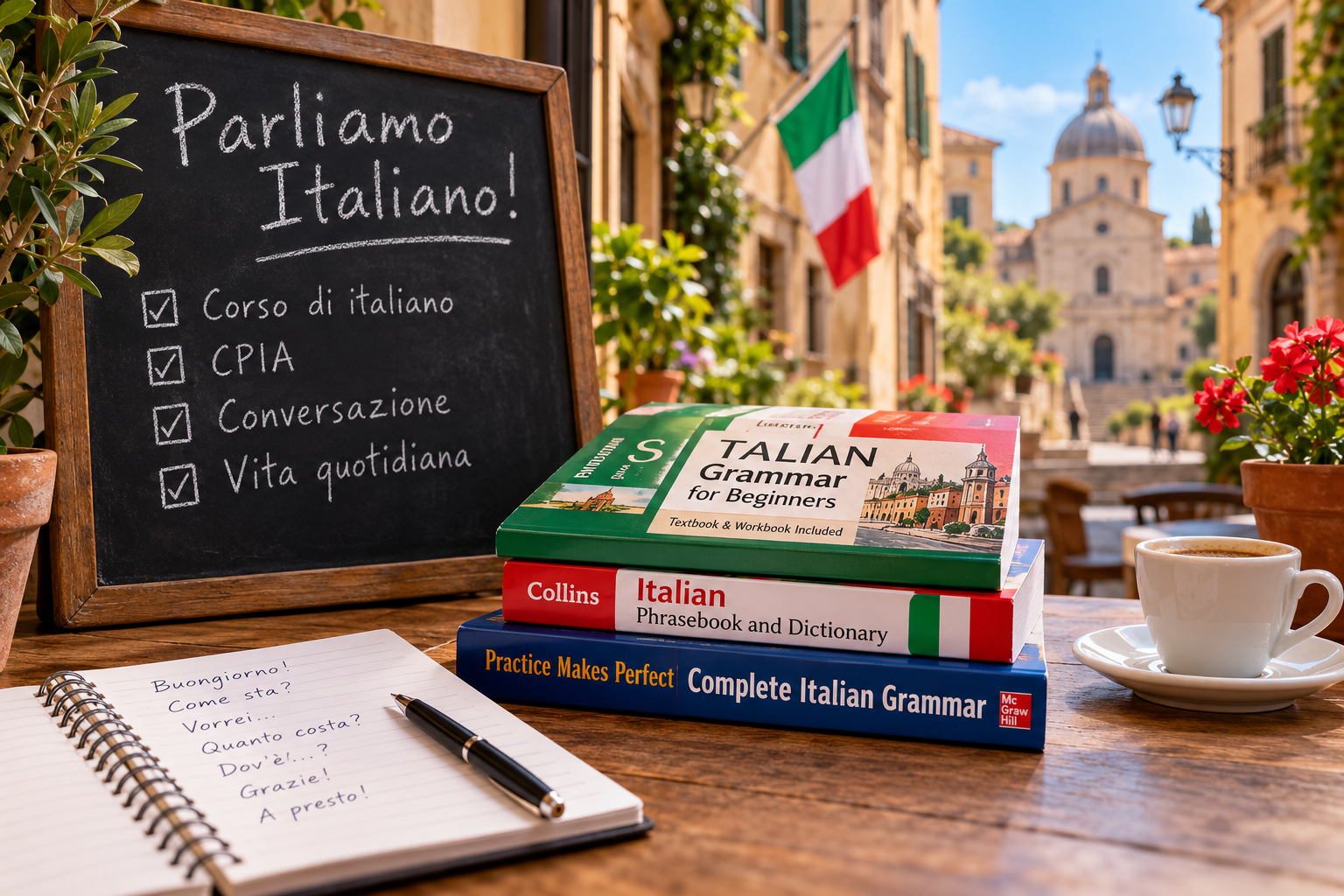
For beginners, Italian Grammar for Beginners provides structured grammar practice that can help fill the gaps left by everyday conversation. Readers in Italy can also find Italian Grammar for Beginners on Amazon.it.
For something you can consult quickly, Collins Italian Phrasebook and Dictionary is useful for common expressions, vocabulary and situations you are likely to encounter while living or traveling in Italy. It is also available through Amazon.it.
Once you have mastered some of the basics, Practice Makes Perfect: Complete Italian Grammar offers more extensive grammar exercises and is a useful book to work through gradually. Readers based in Italy can look for Practice Makes Perfect: Complete Italian Grammar on Amazon.it.
You do not need to buy several language books at once. One good grammar or exercise book, combined with a local course and daily conversation, is usually a better approach than accumulating resources you never finish.
As an Amazon Associate, Italia Mia earns from qualifying purchases.
Do Not Wait Until Your Italian Is “Good Enough”
One of the biggest barriers to learning a language as an adult is embarrassment.
You know exactly what you want to say, but you cannot express it with the same intelligence or precision you would use in your native language.
That can be uncomfortable.
The only practical solution is to accept imperfect Italian.
Use the verbs you know. Make mistakes with articles. Forget whether a noun is masculine or feminine. Ask people to repeat themselves.
Useful phrases include:
Può ripetere, per favore?
Can you repeat that, please?
Può parlare un po’ più lentamente?
Can you speak a little more slowly?
Non ho capito.
I didn’t understand.
Come si dice in italiano?
How do you say it in Italian?
Cosa significa?
What does it mean?
These sentences keep a conversation going instead of ending it.
Give Yourself Measurable Goals
“Become fluent in Italian” is a poor short-term objective because it is difficult to define and can feel impossibly distant.
Set smaller targets.
During your first months, your goals might be:
order confidently at a restaurant;
make a medical appointment by telephone;
understand the main point of a letter from the Comune;
have a five-minute conversation with a neighbor;
follow a simple Italian news report;
complete an errand without switching to English.
Later, you can aim for A2, B1 or B2 according to your needs.
Progress becomes much easier to see when it is connected to things you can actually do.
What About Regional Dialects?
Living in Italy also means discovering that the language around you may not always sound like textbook Italian.
Regional accents are everywhere, while dialects and regional languages remain important in many communities.
Do not worry about learning dialect when you are beginning.
Learn standard Italian first.
Over time, you will naturally recognize local expressions and pronunciation. Knowing a few local words can also be a wonderful way to connect with neighbors.
But standard Italian should remain your foundation because it works throughout the country and in official, professional and educational settings.
Learning Italian Is Part of Making Italy Home
Learning Italian after moving to Italy is about much more than passing an examination.
It changes your relationship with the country.
You understand jokes that previously passed you by. You can talk to an elderly neighbor who does not speak English. You understand what people at the next table are discussing. You can follow local politics, read notices without translating every sentence and deal with everyday problems more independently.
Most importantly, Italy becomes less like a place where you happen to live and more like your community.
Start with a local class or CPIA course if one is available. Add a grammar book and regular listening practice. Speak Italian during ordinary errands, even when your sentences are imperfect.
Twenty minutes of deliberate study each day plus the Italian you use in real life can accomplish far more than an occasional intensive study session.
And once you live in Italy, the classroom is no longer confined to a classroom.
It is the bar downstairs, the weekly market, the pharmacy, the train station, the condominium meeting and the conversation with the person standing next to you in line.
That is where Italian gradually stops being something you study and becomes a language you live.