 Moving to Italy means learning a surprising number of small systems that Italians rarely think twice about. Waste collection is one of them.
At first, throwing away a bag of rubbish may seem straightforward. Then you discover raccolta differenziata, different-colored bins, collection calendars, bags that can only be put outside on particular evenings, municipal recycling centers, special rules for glass, and a waste tax called TARI.
The most important thing to understand is that there is no single collection system that works exactly the same way everywhere in Italy. National legislation provides the broader framework, but municipalities organize local collection. The rules you encounter in Milan may therefore differ from those in Florence, Naples, Palermo, or a small Tuscan town.
Even neighboring municipalities can have different collection days and procedures.
For anyone moving to Italy, here is how the system works and what you need to know.
Raccolta Differenziata: Recycling the Italian Way
The expression you will hear most often is raccolta differenziata, literally “separate collection.”
It means separating household waste into different categories so recyclable and organic materials can be recovered rather than sent together for disposal.
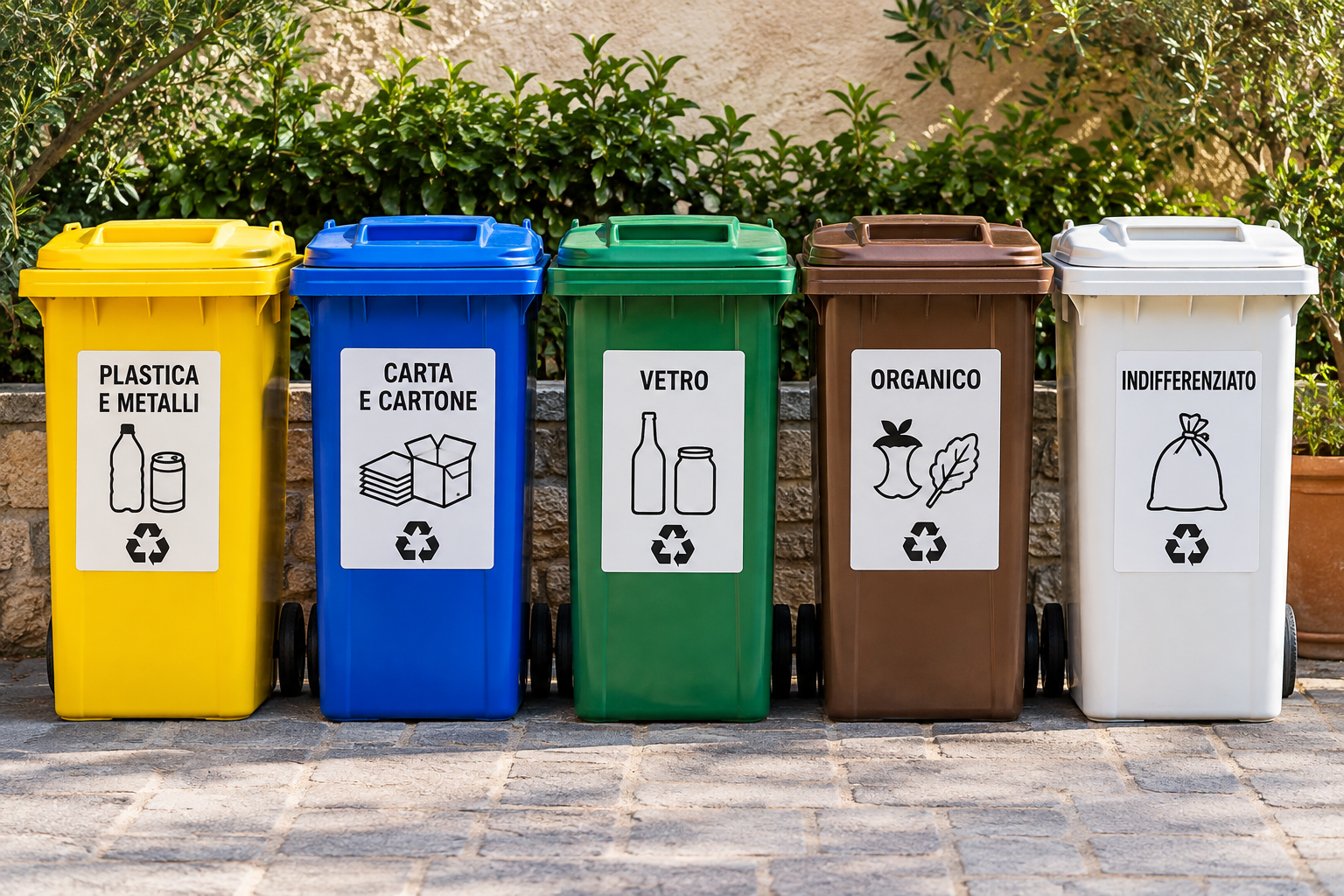
The principal categories normally include:
- organico or umido — organic/food waste
- carta e cartone — paper and cardboard
- plastica — plastic packaging
- vetro — glass
- metalli — metals, often collected with plastic or glass
- indifferenziato or secco residuo — non-recyclable residual waste
You may also encounter separate systems for batteries, medicines, used cooking oil, clothing, garden waste, electrical appliances, and bulky household items.
Italy has worked toward greater consistency in identifying waste containers. The UNI 11686 standard establishes a visual identification system using colors, symbols, and text to make containers easier to recognize.
However, do not assume that a particular bin color always means exactly the same thing everywhere.
Older containers remain in use, collection contractors differ, and municipalities may combine certain materials. Always read the label on the container and check your Comune’s instructions rather than relying exclusively on color.
Understanding the Bins
In many parts of Italy, waste separation begins inside the home.
You may keep several small containers or bags in your kitchen, balcony, utility room, or garage and transfer them to communal containers or place them outside according to a collection calendar.
Organic Waste — Organico or Umido
Food and biodegradable kitchen waste normally goes into the organic collection.
Typical examples include fruit and vegetable scraps, coffee grounds, tea, eggshells, leftovers and other biodegradable food waste.
Municipalities commonly require compostable bags for this fraction.
Do not assume that an ordinary plastic shopping bag can be used for organic waste. A bag described merely as biodegradable is not necessarily suitable for composting. Look for bags specifically certified as compostable according to the appropriate standard. UNI notes that compostability, rather than simply the color or appearance of a bag, is the important characteristic.
Paper and Cardboard — Carta e Cartone
Newspapers, magazines, cardboard boxes and many types of clean paper packaging belong here.
Cardboard boxes should generally be flattened so that they do not fill the container unnecessarily.
Greasy or heavily contaminated paper may not be recyclable. Pizza boxes are a classic source of confusion: clean sections can generally be recycled as paper, while food-soiled portions may have to go elsewhere according to local rules.
Again, check the instructions from your local waste operator.
Plastic — Plastica
One of the most common mistakes newcomers make is assuming that every object made of plastic belongs in the plastic recycling bin.
Italian household plastic collection is generally centered on packaging, not simply on the material from which an object is made.
Plastic bottles, containers, food packaging and similar packaging materials may belong in this collection. A broken plastic household object, toy or other non-packaging item may not.
Some municipalities collect plastic together with metal packaging in a multimateriale collection.
Glass — Vetro
Bottles and glass jars normally belong in the glass collection.
Drinking glasses, mirrors, ceramics, Pyrex-type cookware and light bulbs should not automatically be treated as recyclable glass. They have different compositions and can interfere with recycling.
This is another situation where the instructions printed on the container matter.
Residual Waste — Indifferenziato
Anything that cannot be placed in one of the recyclable categories generally goes into indifferenziato, also called secco residuo in some areas.
This is the fraction municipalities increasingly try to reduce.
In areas using more advanced collection systems, the amount of residual waste produced by each household may even be monitored through coded bags, cards, electronic containers or other identification systems.
Porta a Porta: When the Garbage Truck Comes to You
Many Italian municipalities have replaced or supplemented large street containers with raccolta porta a porta — door-to-door collection.
Under this system, households receive bins, containers or designated bags for different waste categories.
Each type of waste is collected on specific days.
A simplified weekly calendar might look something like this:
Monday — organic waste
Tuesday — paper
Wednesday — organic waste
Thursday — plastic and metals
Friday — residual waste
Saturday — organic waste
That is only an example. Do not use it as an actual collection schedule.
Your Comune determines the real schedule.
There may also be rules about when containers can be placed outside. Collection might take place early in the morning, for example, while residents are instructed to put bins outside only after a specified time the previous evening.
Leaving rubbish outside on the wrong day can create problems for neighbors and may constitute a violation of local regulations.
How to Find Your Waste Collection Calendar
When you move into a new home, finding the local collection calendar should be one of your first practical tasks.
Look on the website of your Comune or the local waste-management company. Search for terms such as:
calendario raccolta rifiuti
raccolta differenziata
porta a porta
calendario utenze domestiche
Many waste operators now provide apps that show collection days and explain where particular objects should be discarded.
Be careful if you find an old PDF through a search engine. Collection schedules can change. Make sure the calendar is for the correct year, municipality and, where applicable, your particular neighborhood or collection zone.
This matters especially in cities where different districts have different pickup days.
Communal Street Bins
Not every Italian town uses door-to-door collection.
In some areas you will still find groups of large communal containers along the street. Residents carry their separated waste to these collection points.
Increasingly, some communal bins are controlled electronically.
You may need a municipal card, waste card or electronic key to open them. Some systems also record access or the amount of residual waste deposited.
If you move into an area using controlled bins, ask the Comune, landlord, property manager or waste operator how to obtain the necessary card.
If you live in an apartment building, our guide to living in an Italian apartment building also explains why condominium rules and shared spaces can become part of everyday life in Italy.
What About Large Items?
An old mattress does not belong next to the regular rubbish bin.
Neither does a sofa, refrigerator, washing machine or wardrobe.
Large household items are generally classified as rifiuti ingombranti — bulky waste.
Municipalities normally provide one or both of two solutions:
Home collection: You book a pickup and leave the item in the designated place at the specified time.
Municipal collection center: You take the item to a centro di raccolta, sometimes informally called an isola ecologica.
The service may be free for residents within certain limits, but rules vary.
Never assume that because somebody else has abandoned furniture next to a street bin, you are allowed to do the same.
Centri di Raccolta and Isole Ecologiche
Municipal collection centers are extremely useful once you know they exist.
Depending on the facility, residents may be able to bring items such as:
- electrical appliances
- electronics
- furniture
- scrap metal
- batteries
- garden waste
- used cooking oil
- paint or certain household chemicals
- fluorescent lamps
- large quantities of cardboard
- other materials not suitable for normal household collection
Access rules vary. You may be asked for identification, proof of residence or a waste-service card.
Check opening hours before loading the car. These centers often operate on specific schedules rather than remaining open all day.
Batteries, Medicines and Used Oil
Certain household waste requires special treatment.
Used household batteries can often be deposited in small collection containers at supermarkets, electronics retailers, municipal facilities or other designated points.
Expired medicines should generally be taken to the dedicated collection containers found at pharmacies rather than thrown into ordinary household rubbish.
Used cooking oil should never be poured down the sink or toilet. Many municipalities provide special containers or collection points for it.
Electrical and electronic equipment falls under separate waste rules as well. Retailers may provide take-back services in circumstances covered by the applicable regulations.
When in doubt, your local waste operator’s website should tell you where a particular item belongs.
Living in a Condominio Changes Things Slightly
If you live in a condominio, the apartment building may have its own designated waste area.
Large buildings sometimes have communal bins that residents use before the waste is collected. Other buildings rely directly on the municipal door-to-door system.
Your amministratore di condominio may distribute instructions about where bins should be stored and when they can be moved onto the street.
This is not a trivial issue.
Bins left permanently in entrances, courtyards or on pavements can create hygiene, accessibility and neighborhood problems. Individual condominium rules may therefore govern how residents use shared waste areas.
New tenants should ask about the system when moving in rather than discovering it after missing the first collection day.
TARI: The Italian Waste Tax
Then there is the part of waste collection that has nothing to do with bins: TARI.
TARI stands for Tassa sui Rifiuti, the municipal waste tax.
Broadly speaking, TARI applies to people who possess or occupy premises or areas capable of producing municipal waste. Municipal regulations published through the Italian Finance Department reflect this principle and also illustrate how taxable surface area is used in determining liability.
For a normal home, the amount is generally influenced by factors including the size of the property and household characteristics, while the actual tariff is determined locally.
This means there is no single nationwide TARI bill that every Italian household pays.
Two similar apartments in different municipalities can face different charges.
Who Pays TARI: Owner or Tenant?
This question causes considerable confusion among foreigners renting property in Italy.
TARI is not automatically an owner’s tax simply because the owner owns the property.
The tax is connected to possession or occupation of premises capable of producing waste.
For a normal long-term rental, this generally means the tenant or occupier is responsible for TARI.
Short-term occupancy can be treated differently under the applicable rules, and particular circumstances can change liability. Therefore, tenants should check both their rental arrangement and the regulations of their Comune.
Do not assume that TARI is included in the rent unless that has been clearly established.
If you are planning a move, our Moving & Residency section covers other administrative steps newcomers encounter, including residence and immigration procedures.
Registering for TARI
Moving into a property does not mean you should simply wait indefinitely for a bill to appear.
The user is normally required to communicate the start, change or termination of the waste service to the relevant authority or service manager. ARERA’s waste-service quality framework established a maximum 90-day period for certain user requests and declarations, although specific local procedures must still be checked.
The precise procedure varies by municipality.
You may need information such as:
- your codice fiscale
- identification
- address of the property
- date occupancy began
- floor area
- cadastral information
- number of household members
- rental contract or ownership information
Some municipalities allow the declaration to be completed online. Others provide downloadable forms or handle it through municipal offices.
If you have difficulty navigating Italian bureaucracy, our guide to CAF and Patronato services in Italy explains two institutions foreigners frequently encounter when dealing with Italian paperwork. For TARI itself, however, the competent Comune or waste/tariff office remains the primary source for the procedure that applies to your property.
How Is TARI Calculated?
For domestic users, TARI generally contains elements connected to the property and household.
The taxable surface of the premises is important, and municipal regulations establish the applicable tariffs and calculations. Finance Department materials show that, pending full implementation of cadastral data-exchange rules, municipal regulations may use the walkable surface of relevant premises and may use cadastral information in assessment procedures.
Household composition can also affect the calculation for domestic users.
This is why comparing your bill with that of a friend living in another town is not particularly useful.
The local tariff matters.
Some municipalities have also introduced or are developing more precise systems intended to connect charges more closely with the amount of waste produced, particularly residual waste. ARERA has identified tariffazione puntuale and “pay-as-you-throw” approaches as part of the development of waste tariffs and circular-economy policy.
How Do You Pay TARI?
The Comune or responsible entity normally issues payment instructions.
Depending on the municipality, payment systems can include F24 and PagoPA, among other legally permitted methods. Municipal regulations published through the Finance Department demonstrate that the precise mechanism and installment schedule are locally established.
The bill or payment notice should tell you:
- the amount due
- the property concerned
- the applicable period
- installments
- payment deadlines
- accepted payment method
Do not assume every Comune has the same deadlines.
TARI is one of those Italian taxes where searching online for “When is TARI due?” can produce several apparently contradictory answers because different municipalities establish different payment schedules.
Check your Comune.
Moving Out? Do Not Forget to Close or Change Your TARI Position
This is one of the easiest administrative details to overlook.
If you leave a rented apartment, sell a property, or otherwise stop occupying premises, notify the relevant TARI office or service manager according to the local procedure.
Do not assume that changing your official residence automatically resolves every municipal tax position.
Keep documentation showing the date your occupancy ended and retain confirmation of any declaration you submit.
The same principle applies when the number of people living in the household changes if that information affects your local tariff.
Are There TARI Reductions or Exemptions?
Possibly.
Municipal regulations can provide reductions or other forms of relief in circumstances defined by law and local rules.
Eligibility may depend on factors such as property use, household circumstances, service conditions or other criteria.
Never assume that a reduction available in one municipality exists in another.
Search your Comune’s website for:
TARI riduzioni
TARI agevolazioni
TARI esenzioni
Then read the current year’s rules.
There may also be deadlines for requesting a reduction, so it is worth checking before the annual bill arrives.
What Happens If You Recycle Incorrectly?
Waste rules are not merely suggestions.
Municipal regulations can provide administrative penalties for improper disposal, including leaving waste beside containers, using bins incorrectly, putting rubbish outside at unauthorized times or abandoning bulky waste.
Enforcement differs enormously from place to place.
Some municipalities inspect incorrectly deposited bags. Others use controlled-access containers, cameras or local enforcement officers to address repeated illegal dumping.
The easiest approach is simple: follow the instructions supplied by your waste operator.
If you genuinely do not know where an item belongs, do not guess based solely on its material. Search the operator’s recycling guide.
Common Mistakes Foreign Residents Make
One common mistake is assuming that bin colors are universal throughout Italy.
They are not reliable enough to replace the local label and instructions.
Another is putting every plastic object into plastic recycling. Packaging collection and plastic as a material are not necessarily the same thing.
New residents also sometimes miss door-to-door collections because they put bins outside on the morning of collection when local rules require them to be placed outside the previous evening.
Bulky waste causes another problem. Leaving a mattress or chair beside a communal bin because “someone will eventually take it” can amount to illegal dumping.
And perhaps the most expensive mistake is forgetting TARI entirely.
A person moves into an apartment, assumes the landlord handles the waste tax, receives no immediate bill and concludes there is nothing to pay. That assumption can eventually lead to assessments, arrears and penalties.
Families Should Learn the System Early
For families moving to Italy, recycling quickly becomes part of the household routine.
Children attending Italian schools may actually become the family recycling experts, since environmental education and waste separation are familiar parts of everyday life.
Parents preparing for life in Italy can also read our Italian Schools Explained guide for an introduction to the school system and what families can expect after moving.
A simple set of clearly labeled containers at home makes Italian waste separation much easier, particularly during the first few weeks.
The Best Rule: Check Your Comune
If there is one thing to remember from this guide, it is this:
Italy has a national framework for waste management, but the practical rules you follow every day are local.
Your Comune and local waste operator determine the collection system, calendar, local disposal instructions and many practical aspects of TARI administration.
So when you move to a new Italian town, find four things immediately:
- your local recycling instructions;
- your collection calendar;
- the nearest municipal collection center;
- the procedure for registering or updating your TARI position.
Once those are sorted out, the system becomes surprisingly routine.
After a few weeks, organico, carta, vetro and indifferenziato become just another part of everyday Italian vocabulary — along with remembering which bin has to go outside tonight.
External Sources
ARERA — Italian Regulatory Authority for Energy, Networks and Environment
Italian Ministry of Economy and Finance — Department of Finance