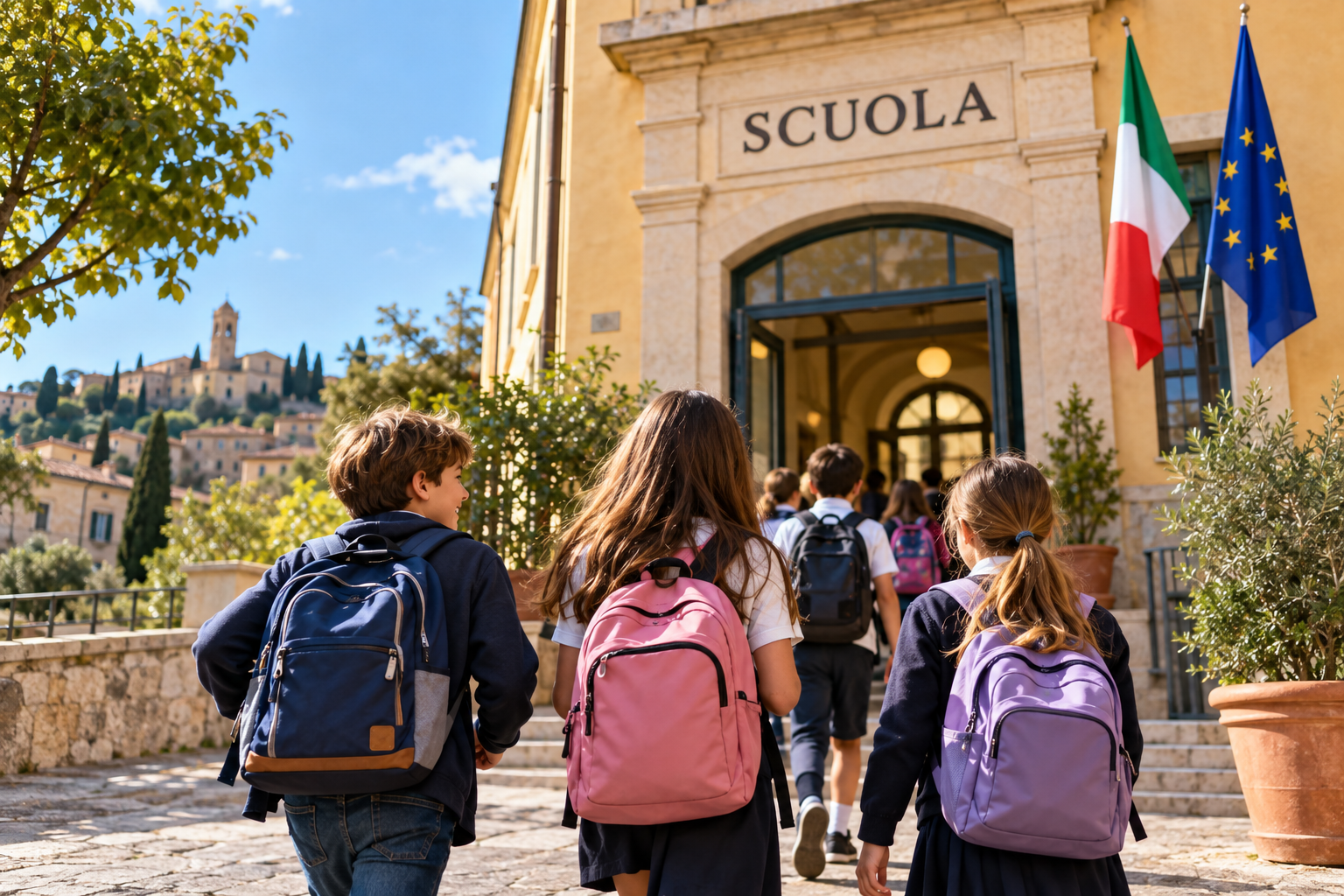
 Moving to Italy with children adds an important question to the usual decisions about visas, housing and healthcare: where will the children go to school?
The Italian education system can seem complicated at first, particularly for parents coming from the United States, the United Kingdom or another country with different grade structures. Terms such as scuola primaria, scuola secondaria di primo grado, liceo and istituto tecnico do not always have exact equivalents abroad.
The good news is that the basic structure becomes fairly straightforward once you understand the stages.
For families planning a permanent move, school should be considered at the same time as housing. Your address can influence which public schools are available, while transportation, school schedules and after-school care can have a major effect on daily family life.
If you are still organizing the broader relocation, start with our guide to Moving to Italy: Complete Guide for Expats.
How the Italian School System Works
Italian education is divided into several stages.
The terminology is important because Italians rarely describe education simply by American-style grade numbers.
| Approximate age | Italian school | Typical duration |
|---|---|---|
| 0–3 | Asilo nido / nido d’infanzia | Up to 3 years |
| 3–6 | Scuola dell’infanzia | 3 years |
| 6–11 | Scuola primaria | 5 years |
| 11–14 | Scuola secondaria di primo grado | 3 years |
| 14–19 | Scuola secondaria di secondo grado | Usually 5 years |
You may still hear older terminology in everyday conversation. Scuola primaria, for example, is commonly called scuola elementare, while scuola secondaria di primo grado is often simply called scuola media.
For a foreign parent, knowing both the official and everyday names makes conversations with schools and other parents considerably easier.
Asilo Nido: Childcare for the Youngest Children
The asilo nido, or nursery, generally serves children under three.
Nido is not part of compulsory schooling. Availability, admission rules, schedules and fees can vary significantly according to the municipality and whether the facility is public or private.
Municipal nurseries may determine fees according to family circumstances and often have limited places. In areas with high demand, families may need to apply well in advance.
Private nurseries provide another option and can sometimes offer longer opening hours, but they normally cost more.
If you are moving to Italy with a baby or toddler and both parents intend to work, investigate childcare before choosing a home. A beautiful apartment is much less convenient if the nearest available nursery requires a difficult commute every morning.
Scuola dell’Infanzia: Preschool from About Three to Six
Scuola dell’infanzia is broadly comparable to preschool or kindergarten and generally covers ages three to six.
Attendance is not compulsory, but it is an important part of childhood education in Italy.
For a child arriving from another country, preschool can also provide an excellent introduction to Italian. Young children are immersed in the language through play, meals, songs, classroom activities and friendships rather than through formal language lessons alone.
This can make scuola dell’infanzia particularly valuable for families who do not speak Italian at home.
Families can choose among state, municipal and private schools depending on what is available locally.
Scuola Primaria: Five Years of Primary Education
Children normally begin scuola primaria at around age six and attend for five years.
This stage was traditionally called scuola elementare, a term you will still hear constantly in Italy.
The curriculum includes subjects such as Italian, mathematics, science, history, geography, English, art, music, physical education, technology and civic education, although organization and teaching hours can vary.
Public primary schools may offer different schedules.
Some children attend primarily in the morning, while others are enrolled in tempo pieno, a full-time schedule that normally includes afternoon classes and lunch at school.
For working parents, this distinction can be extremely important.
Never assume that two nearby primary schools have identical hours. Ask specifically about:
- Weekly timetable
- Number of afternoon sessions
- Tempo pieno availability
- School meals
- Pre-school supervision
- After-school programs
- Saturday lessons, if applicable
- School-bus services
These practical differences can matter as much as academic considerations.
Scuola Media: Lower Secondary School
After primary school, children generally spend three years in scuola secondaria di primo grado, almost universally referred to in conversation as scuola media.
Students are approximately 11 to 14 years old.
The curriculum becomes more subject-oriented, and pupils usually work with different teachers rather than spending most of the day with one principal classroom teacher.
At the end of this stage, students complete the esame di Stato conclusivo del primo ciclo di istruzione, commonly associated with finishing scuola media.
The next decision is one of the most important in the Italian education system: choosing an upper-secondary school.
High School in Italy Is Not One Single Type of School
This is where many foreign parents encounter the biggest difference.
At approximately 14, Italian students choose among different educational pathways. The decision can influence the subjects they study, the style of education they receive and their preparation for university or employment.
The three broad categories families are most likely to encounter are:
Liceo
A liceo provides a predominantly academic education and is generally associated with preparation for university.
There are several types.
The liceo classico traditionally emphasizes Italian literature, Latin, ancient Greek, history and philosophy.
The liceo scientifico places greater emphasis on mathematics and science while retaining a substantial humanities curriculum.
Other options include the liceo linguistico, specializing in languages; liceo artistico, focusing on art; liceo musicale e coreutico, concentrating on music or dance; and liceo delle scienze umane, with an emphasis on human and social sciences.
Choosing a liceo therefore involves much more than selecting a school building. Students are selecting a particular academic orientation.
Istituto Tecnico
An istituto tecnico combines general education with more specialized technical and economic subjects.
Programs can include areas such as information technology, electronics, mechanics, tourism, business administration, finance, marketing, construction and transportation.
These schools can prepare students both for employment and for further education.
A common misconception among foreigners is that technical education automatically prevents a student from attending university. It does not. Students completing qualifying upper-secondary education can continue into higher education, subject to the requirements of the university and program concerned.
Istituto Professionale
An istituto professionale has a stronger vocational orientation.
Programs may concentrate on sectors such as hospitality, food services, maintenance, industry, commercial services, agriculture or other professional fields.
Practical training generally plays a more prominent role.
The important point for foreign parents is that Italian secondary education begins specializing relatively early. A 14-year-old may therefore face a more consequential educational choice than a student of the same age in some other countries.
Families should discuss the options with the child’s middle school well before enrollment deadlines.
The Maturità and Finishing Secondary School
Students completing a standard five-year upper-secondary program generally finish at around age 19 and take the final State examination, commonly known as the maturità.
Its formal name is the Esame di Stato conclusivo del secondo ciclo di istruzione.
Passing the examination leads to the upper-secondary diploma associated with the student’s course of study.
For students planning to attend university, the diploma is an important step, although individual university courses may have additional admission requirements or entrance examinations.
Is School Compulsory in Italy?
Italy requires education for children and teenagers during the compulsory years.
For a family arriving from abroad, an especially important principle is that foreign minors present in Italy have a right to education. Italian law provides for foreign minors to attend school under conditions broadly corresponding to those applicable to Italian children, and enrollment can be requested during the school year.
This matters if your family arrives in November, February or another point after September. You should not assume that a child must wait until the following academic year before entering school.
The precise placement will depend on the child’s age, previous education, documentation and the school’s assessment.
Enrolling a Foreign Child in an Italian School
The enrollment process depends partly on when you move and on the school involved.
Families should gather as much educational documentation as possible before leaving their previous country.
Useful documents can include:
- Passport or identity documents
- Child’s birth information
- Previous school records
- Report cards or transcripts
- Details of subjects previously studied
- Vaccination and health documentation where required
- Italian tax code (codice fiscale), when available
- Address and residence information
- Any documentation concerning special educational needs
Schools may request translations or additional documents depending on the circumstances.
Do not delay contacting a school simply because one document is missing. Italian rules specifically protect access to education for foreign minors, including situations in which personal documentation is incomplete.
Families establishing their permanent home should also understand the difference between immigration status and municipal residence. Our complete guide to registering your residence in Italy explains residenza, the anagrafe and the administrative process in greater detail.
What If My Child Does Not Speak Italian?
This is understandably one of the greatest concerns for international families.
A child does not normally need to be fluent in Italian before entering an Italian school.
The actual support available, however, can differ considerably between schools.
Some schools have extensive experience with students from other countries and may provide Italian-language support, integration projects or individualized assistance. A smaller school with few international pupils may have fewer specialized resources.
Before enrolling, ask the school directly:
- How many non-Italian-speaking students it currently serves
- Whether Italian as a second language support is available
- How newly arrived students are assessed
- Whether additional tutoring is offered
- How teachers communicate with parents who are still learning Italian
- Whether important notices are available in another language
Younger children often acquire conversational Italian surprisingly quickly through daily immersion, but academic language can take considerably longer.
Parents should therefore distinguish between a child who can chat comfortably with classmates and a child who can understand history, mathematics problems or science terminology at the appropriate academic level.
Public, Paritaria and Private Schools
Italy offers several types of schools, and the terminology can be confusing.
State Schools
Scuole statali form the core of the public education system.
They do not charge tuition in the way private schools do, although families can still face expenses for meals, transportation, books, supplies, activities and other services depending on the school level and local arrangements.
Scuole Paritarie
A scuola paritaria is privately managed but officially recognized within Italy’s national education system when it meets the applicable requirements.
Some are operated by religious organizations, while others are secular.
Fees vary widely.
International and Foreign Schools
Major cities and some areas with large international communities have schools offering foreign or international curricula.
Depending on the institution, this might include the International Baccalaureate, British, American, French, German or other educational systems.
These schools can be attractive when a family expects to remain in Italy temporarily or when a teenager is already far along in another country’s curriculum.
The major disadvantage is usually cost.
An international school can also create a very different social experience from attending the neighborhood Italian school. Children may function largely in an English-speaking or international environment rather than becoming deeply integrated into local Italian life.
Neither choice is automatically better. The right decision depends on the child, language ability, age, finances and how long the family expects to remain in Italy.
How Much Does School Cost in Italy?
State education should not be confused with completely cost-free family life.
Even where there is no conventional tuition charge, parents may need to budget for items such as:
- School meals
- Transportation
- Books
- Notebooks and stationery
- Art supplies
- Sports clothing
- School trips
- Optional activities
- Before- or after-school supervision
The costs change according to the child’s age, municipality, school and family circumstances.
Municipal services such as the mensa scolastica—school cafeteria—may use income-based fee structures.
Parents living in Italy will frequently encounter the ISEE, an indicator used to assess a household’s economic circumstances for access to various public benefits and reduced fees.
A family newly arriving from abroad should ask the Comune and school which services require an ISEE declaration and what alternatives apply if one is not yet available.
School Lunches Are Part of Daily Life
In schools offering afternoon education, lunch can be an important part of the day.
The mensa scolastica is often organized or regulated at municipal level rather than being identical nationwide.
Menus commonly rotate over several weeks and may include pasta or rice, meat or fish, vegetables, fruit, bread and other dishes.
Procedures normally exist for medically necessary diets and allergies. Religious or other dietary accommodations depend on the applicable local service and policy.
Parents should investigate lunch registration separately from school enrollment because the two procedures may not always be handled by the same office.
The Italian School Calendar
Italy does not have one completely identical school calendar for every child in the country.
National rules establish the broader framework, while Regions determine important calendar dates and individual schools can make certain adaptations.
Italian law provides for at least 200 days of lessons.
The differences are visible in the 2026–2027 academic year. For example, Liguria scheduled its regular school year from September 14, 2026 to June 8, 2027, while Puglia set September 17, 2026 as its regional starting date and June 8, 2027 as the end for most schools.
There are breaks around Christmas and Easter as well as national and local holidays.
Always download the calendar for your child’s actual school rather than relying on a generic “Italian school calendar” found online.
School Hours Can Surprise Foreign Parents
One of the most important practical questions is not what children study but when they are actually at school.
Schedules vary by school and educational level.
Some schools operate primarily in the morning. Others provide afternoon lessons or tempo pieno. Depending on the institution, lessons may be organized across five or six days.
This can be a significant adjustment for parents accustomed to a standardized Monday-to-Friday school day with extensive extracurricular activities immediately afterward.
Before signing a long-term lease, check the schedules of the schools you are considering.
Transportation can also become an issue in smaller communities. As we explain in our guide to life in an Italian village, public transport outside major cities can be limited and sometimes revolves heavily around school and commuter hours.
Choosing Where to Live Based on Schools
Families sometimes make the mistake of choosing their Italian home first and investigating schools afterward.
Reverse the process whenever possible.
Before committing to a neighborhood or town, investigate:
Which schools serve the area?
Look at primary and secondary options, not only the school your child needs today.
How will your child get there?
A school that looks close on a map may require an inconvenient bus journey or daily car trip.
Does the school offer the schedule you need?
If both parents work until late afternoon, a morning-only schedule can create a serious childcare problem.
How experienced is the school with international students?
This can be particularly important for an older child arriving without Italian.
What happens at age 14?
If your child is approaching upper-secondary age, investigate the licei, technical institutes and professional schools within realistic commuting distance.
Housing and schools are therefore closely connected. Families comparing cities, towns and neighborhoods should use our Living in Italy guides alongside local school research.
Healthcare, Vaccinations and School
Families should also organize healthcare soon after moving.
Eligibility for Italy’s National Health Service, the Servizio Sanitario Nazionale or SSN, depends on circumstances including citizenship and immigration status.
Once properly enrolled, families can access the Italian public healthcare system and arrange pediatric and other medical care according to applicable regional procedures.
Our detailed guide to the Italian healthcare system explains registration, hospitals, specialists, costs and some of the differences families may encounter between regions.
Parents should keep copies of their children’s vaccination records and other important medical documentation when relocating.
Helping Children Adjust to an Italian School
Academic preparation is only part of the transition.
A child moving to Italy may simultaneously experience a new language, unfamiliar food, different classroom expectations, new friendships and the loss of familiar routines.
Parents can make the adjustment easier by beginning Italian exposure before the move.
Even basic phrases can give a child confidence during the first weeks.
After arrival, encourage participation in local activities outside school. Football, swimming, music, dance, martial arts and other clubs can create friendships in situations where communication is less dependent on perfect Italian.
Parents should also resist the temptation to interpret every difference as a problem.
Italian schools will not operate exactly like American, British or other foreign schools. Communication styles, homework, grading, parent-teacher relationships and extracurricular activities may all feel different.
Some differences will require adjustment. Others may simply reflect another educational culture.
Public School or International School: Which Is Better?
For families planning to settle permanently in Italy, an Italian school offers one enormous advantage: integration.
Children learn Italian in an authentic environment. Their friends are likely to live nearby. Parents meet other local families. The school becomes a connection to the community rather than an international enclave separate from it.
For temporary residents, the calculation can be different.
A 16-year-old who will return to an American or British school system after two years may face substantial academic disruption if transferred into a completely different curriculum.
An international school may preserve educational continuity.
Age matters enormously.
A five-year-old and a sixteen-year-old arriving without Italian face very different challenges.
The best school is therefore not necessarily the most prestigious or expensive one. It is the school that fits the child’s academic situation, language ability, personality and the family’s long-term plans.
Questions to Ask Before Enrolling
When visiting or contacting a school, prepare specific questions rather than simply asking whether it is “good.”
Ask about the timetable, class size, language support, lunch, transportation, after-school services, homework expectations and communication with parents.
For an older child, ask about subject choices, academic orientation, university preparation and what happens if the student struggles with Italian during the first year.
If your child has disabilities or specific educational needs, discuss those requirements directly with the school before enrollment so you understand what documentation and support procedures apply.
And whenever possible, visit in person.
A school website can tell you about programs. Walking through the building and speaking with staff can tell you much more about how the school actually feels.
Moving to Italy With School-Age Children: A Practical Checklist
Several months before moving, collect school reports, transcripts, identity documents, vaccination records and information about any special educational requirements.
Research schools before finalizing your housing.
Contact potential schools directly and explain your child’s age, previous education, language ability and expected arrival date.
Once in Italy, complete the administrative steps connected with your relocation. Depending on your circumstances, these can include obtaining a codice fiscale, completing immigration formalities and registering your official residence.
Our Moving & Residency section covers these procedures in greater detail.
After enrollment, give your child time.
The first few months may be exhausting, particularly when every lesson requires intense concentration in a new language. Progress is rarely perfectly linear.
A child who initially says very little may suddenly begin speaking Italian with friends. Another may become conversational quickly but need much longer to write essays or understand academic terminology.
Both experiences can be completely normal.
Italian Schools Can Become Part of Building a Life in Italy
For parents, moving to Italy often begins as an administrative project involving visas, residence documents, housing, healthcare and finances.
For children, the move is much more immediate.
Their experience of Italy will be shaped by the classroom, their teachers, the walk or bus ride to school, lunch with classmates, birthday parties, sports and the friendships they build.
That is why choosing a school deserves as much attention as choosing a house.
Research the options before moving, speak directly with schools, understand the timetable and investigate language support. Most importantly, choose according to your particular child rather than according to a generalized idea of what an Italian or international education should look like.
For families planning a long-term future in the country, the local school can become something more than an educational institution. It can be one of the first places where a foreign family stops feeling like visitors and begins becoming part of everyday Italian life.
External Sources
Italian Ministry of Education and Merit (MIM)
Normattiva — Italian legislation database