

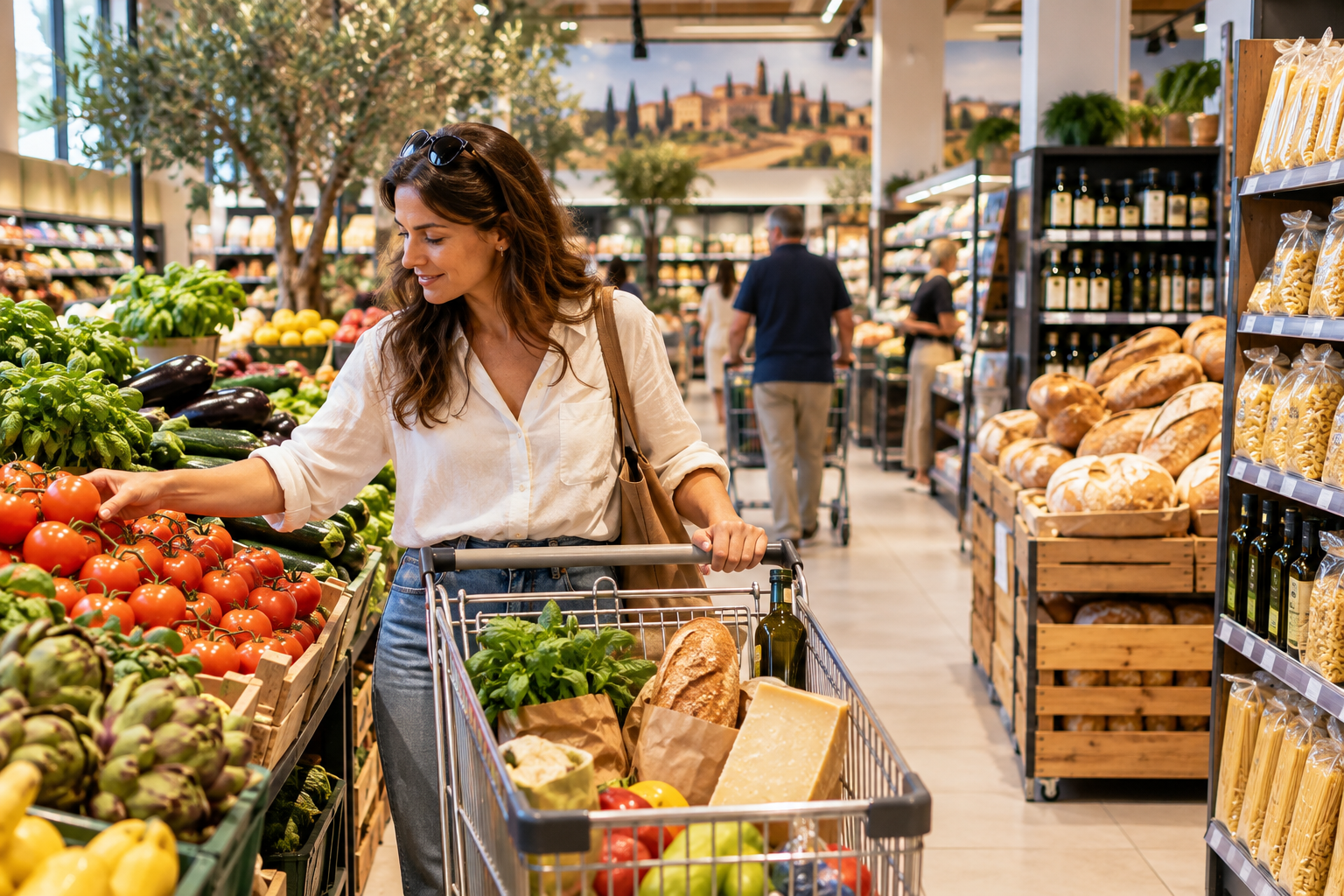
 Shopping for groceries is one of the quickest ways to understand everyday life in Italy. Supermarkets may look familiar to anyone arriving from the United States, Britain or elsewhere in Europe, but the way Italians shop can be surprisingly different.
Large weekly shopping trips certainly exist, but many households combine supermarkets with neighborhood fruit and vegetable shops, bakeries, butchers and open-air markets. Product selection can also be highly regional: the cheese, cured meats, bread, pasta, wine and even bottled water occupying the shelves in Tuscany may differ considerably from what you find in Sicily or Piedmont.
For foreigners who have recently moved to Italy, understanding the major supermarket chains, discount stores, loyalty programs and shopping habits can make everyday life easier — and considerably cheaper.
The Main Supermarket Chains in Italy
Italy does not have one supermarket chain that completely dominates the country. Instead, several large groups operate alongside regional chains, cooperatives and independent stores.
Coop
Coop is one of Italy’s best-known supermarket names and has a particularly strong presence in central and northern Italy.
Stores range from relatively small neighborhood supermarkets to large shopping centers. Coop also sells an extensive selection of own-brand products, including organic and environmentally oriented ranges.
Because Coop developed from Italy’s consumer cooperative movement, its organization differs from that of a conventional supermarket corporation. Customers can generally shop without membership, while becoming a socio — a cooperative member — can provide additional offers and benefits depending on the local cooperative.
Conad
Conad has an extensive presence throughout Italy and operates stores in several formats, from small neighborhood shops to large supermarkets and hypermarkets.
You may encounter names such as Conad City, Conad, Spazio Conad and other formats depending on the location.
For someone living in a smaller Italian town, Conad is often among the most visible grocery retailers.
Esselunga
Esselunga is especially important in northern and parts of central Italy and has long been associated with large, well-stocked supermarkets.
Its stores typically combine conventional groceries with substantial fresh-food departments. Many locations offer prepared meals, bakeries and extensive fruit, vegetable, meat and fish selections.
Esselunga also has a well-developed loyalty program and online grocery service in the areas it serves.
Eurospin
Eurospin is one of Italy’s major discount supermarket chains.
Instead of emphasizing a huge selection of famous brands, discount supermarkets generally concentrate on private-label products and lower prices.
For residents trying to control their monthly grocery budget, Eurospin can be particularly useful for staples such as pasta, canned tomatoes, milk, household products, frozen food and cleaning supplies.
Lidl
The German discount chain Lidl has become a familiar part of Italian grocery shopping.
Although it retains the discount-supermarket model, Italian stores carry many products specifically designed for the local market, including pasta, cheeses, cured meats, olive oil and regional specialties.
Its rotating weekly promotions on household goods, tools, clothing and kitchen equipment are also popular.
Other Supermarkets You Will Encounter
The supermarket landscape varies significantly by region. Depending on where you live, you may also encounter chains and groups such as Carrefour, Pam Panorama, Despar, MD, Bennet, Famila and others.
This regional variation means that asking “Which is the best supermarket in Italy?” is not particularly useful. The answer often depends on where you live, what you buy and which promotions are available that week.
A family living in Milan may have very different choices from someone living in a small town in Calabria.
Supermarket, Discount Store or Local Shop?
Price is only one factor when Italians decide where to shop.
A typical household might purchase packaged groceries and household supplies at a supermarket or discount store while buying bread from a panificio, meat from a macelleria and vegetables from a local market.
These options do not necessarily compete with one another. They often complement each other.
Supermarkets
Traditional supermarkets generally provide the widest balance between branded products, private labels, fresh food and household goods.
They are convenient when you want to complete most of your shopping in one place.
Discount Supermarkets
Discount chains such as Eurospin, Lidl and MD can significantly reduce the cost of staples.
The assumption that discount automatically means poor quality is increasingly outdated. Many discount products are manufactured in Italy, and some consumers deliberately combine discount shopping with purchases of premium products elsewhere.
Neighborhood Stores
Small alimentari and specialist food shops remain important, particularly in historic centers and smaller communities.
Prices may sometimes be higher, but these shops offer convenience, personal service and products selected for local customers.
They can also be invaluable when you only need bread, milk, cheese or a few ingredients rather than a week’s groceries.
Don’t Ignore Italian Food Markets
One of the pleasures of living in Italy is shopping at a mercato.
Many towns have a weekly outdoor market, while larger cities may have permanent covered markets as well.
Fruit and vegetables are often sold according to season, and shopping this way can introduce newcomers to ingredients they might otherwise overlook.
Markets are also an excellent place to learn about regional food.
In Sicily you might encounter produce and ingredients rarely seen in northern Italy, while markets in Tuscany, Liguria, Piedmont or Puglia reflect completely different culinary traditions.
If you’re interested in understanding Italian food beyond restaurants, regular visits to a local market are one of the best places to start.
Understanding Prices in Italian Supermarkets
Price labels usually show both the selling price and the price per kilogram or liter.
The second figure is particularly useful.
A larger package isn’t automatically cheaper, so comparing the price per kilogram — prezzo al kg — can reveal which product actually offers better value.
Fresh fruit and vegetables are normally priced by weight unless they are sold in packages.
Depending on the supermarket, customers may weigh produce themselves and attach a printed label, while other stores weigh it automatically at checkout.
Watch what other shoppers do. If everyone is taking their bag of tomatoes to a scale before leaving the produce department, you probably need to do the same.
How Much Are Grocery Prices Increasing?
Grocery costs change continually, which is why fixed “average shopping basket” figures quickly become misleading.
The latest official ISTAT data available when this guide was prepared show that in August 2026 prices for the category commonly described as the Italian “shopping basket” — food plus household and personal-care products — were 0.9% higher than a year earlier. Overall Italian consumer inflation was 3.3% year-on-year.
Rather than relying on a single national estimate for what groceries “should” cost each month, newcomers should track their own spending for several weeks. Household size, diet, location, preferred brands and the balance between supermarkets and specialist shops can change the total dramatically.
Use Loyalty Cards
If you regularly use the same supermarket, joining its loyalty program is usually worthwhile.
Italian supermarket promotions frequently have two prices: the standard price and a reduced price reserved for customers with the loyalty card.
Depending on the chain, loyalty programs may also provide points, personalized discounts, digital coupons or special promotions.
If you’ve recently moved to Italy, ask at the customer-service desk:
“Come posso fare la carta?”
In other words: “How can I get the loyalty card?”
Some programs can also be managed through the supermarket’s mobile app.
Read the Weekly Flyers
The humble supermarket volantino remains an important part of Italian shopping.
Weekly or periodic promotional flyers advertise discounted products, multi-buy offers and loyalty-card specials.
You don’t necessarily need the paper version. Most chains publish current promotions on their websites and apps.
If you have several supermarkets within a short distance of your home, checking promotions before shopping can save a surprising amount over the course of a year.
Learn the Italian Private Labels
Buying the supermarket’s own brand is another straightforward way to reduce costs.
Most major chains now offer several levels of private-label products rather than a single generic range.
You may find basic products, standard supermarket brands, premium Italian specialties, organic foods, environmentally focused products and regional selections all under different house labels.
For everyday ingredients such as pasta, passata, canned beans, flour, rice and milk, comparing the private-label version with the national brand is worthwhile.
Seasonal Shopping Still Matters
Italy’s modern supermarkets sell strawberries in winter and tomatoes throughout much of the year, but seasonal eating remains deeply embedded in Italian food culture.
Seasonal fruit and vegetables are often better value and better tasting.
Artichokes, asparagus, cherries, peaches, figs, chestnuts, porcini mushrooms and citrus fruits all have periods when they suddenly become abundant.
This seasonality is even more obvious at outdoor markets.
Learning what is in season is therefore both a culinary lesson and a money-saving strategy.
Check the Discount Counter
Many Italian supermarkets reduce products approaching their use-by date.
Depending on the store, you may find discounted meat, dairy products, prepared meals, bread and packaged foods grouped together or marked individually.
These products can offer substantial savings if you intend to eat or freeze them quickly.
As elsewhere, distinguish between “da consumarsi entro” — essentially a use-by date — and “da consumarsi preferibilmente entro,” which indicates a best-before date.
Bring Your Own Shopping Bags
Disposable shopping bags are normally charged separately.
Most regular shoppers therefore bring reusable bags from home.
Keep a couple in your car, backpack or handbag and the habit quickly becomes automatic.
At checkout you may hear:
“Vuole un sacchetto?”
The cashier is simply asking whether you want a bag.
Bagging Your Own Groceries
If you’re accustomed to American supermarkets, there is another small cultural adjustment waiting at the checkout.
In most Italian supermarkets, you should expect to pack your own groceries.
Cashiers can scan items quickly, so having your bags ready before your shopping reaches the scanner makes life easier for everyone.
It is one of those tiny routines that quickly makes you feel less like a visitor and more like a local shopper.
Supermarket Opening Hours
Opening hours vary enormously by chain, municipality and individual store.
Large supermarkets in cities and shopping centers commonly stay open into the evening, and Sunday opening is widespread. Smaller supermarkets and independent food shops may have shorter hours or close for part of the afternoon.
Public holidays are different again.
Christmas Day, New Year’s Day, Easter and other holidays can bring closures or sharply reduced hours.
Rather than relying on a general rule, check the individual store’s website or Google listing before making a special trip.
Grocery Delivery in Italy
Online grocery shopping has expanded considerably in Italy.
Major supermarket groups offer home delivery or click-and-collect in many areas, although availability varies by postcode.
This can be particularly useful if you live without a car, are buying heavy items such as bottled water, or live some distance from a large supermarket.
Delivery availability is considerably better in large metropolitan areas than in some rural communities.
Bottled Water: An Italian Supermarket Institution
Foreign residents are sometimes surprised by the enormous bottled-water sections in Italian supermarkets.
Italy has a strong culture of drinking bottled mineral water, with shelves divided between naturale (still), frizzante (sparkling) and lightly sparkling varieties.
That doesn’t automatically mean you need to buy it.
Tap water supplied through public networks is subject to drinking-water regulations, although taste and mineral composition vary considerably around the country. Residents concerned about their particular building or local supply can check information from their municipality or water utility.
Avoiding unnecessary bottled water can reduce both grocery costs and the amount of plastic you carry home.
What About Organic Food?
Look for the word “biologico,” often shortened to “bio.”
Organic products are now common in mainstream Italian supermarkets rather than being confined to specialist health-food stores.
You’ll find organic pasta, eggs, milk, vegetables, olive oil, biscuits, baby food and many other products.
Specialist organic supermarket chains and independent shops are also available in larger cities.
Gluten-Free and Special Diets
Italian supermarkets are generally well equipped for customers requiring gluten-free foods.
Look for “senza glutine.”
Larger supermarkets frequently have dedicated sections containing gluten-free pasta, bread, biscuits and baking products.
Vegetarian foods are easy to find simply because traditional Italian cooking already includes countless dishes based on vegetables, legumes, grains and cheese.
Vegan-specific packaged products have also become increasingly common, particularly in larger supermarkets.
A Simple Strategy for Spending Less
You don’t need to visit five supermarkets every week to save money.
A practical approach is to choose one convenient supermarket as your main store, get its loyalty card and learn its private-label products.
Then use a nearby discount supermarket for basic household goods and pantry staples when the savings justify it.
Buy seasonal fruit and vegetables, compare prices per kilogram rather than package prices, check weekly promotions and avoid shopping when hungry.
Most importantly, don’t assume that famous brands are always superior.
Experiment.
Finding a €1 supermarket product that you prefer to a €2 branded equivalent is one of the small victories of learning how to live in Italy.
Shopping Like a Local
The biggest change comes when grocery shopping stops feeling like a special Italian experience.
You know which supermarket has the fish you like. You know which market stall sells good tomatoes. You recognize when Parmigiano Reggiano is genuinely on sale rather than merely wearing a bright promotional sign.
You bring your bags without thinking about it, understand the cashier when you’re asked for your loyalty card and know exactly where to buy the bread you prefer.
These routines may seem insignificant, but they’re an important part of settling into everyday Italian life.
If you’re planning a longer move, continue with our Italiamia guides to the Cost of Living in Italy, Renting an Apartment in Italy, Opening a Bank Account in Italy, Setting Up Utilities in Italy, and How to Obtain a Codice Fiscale.
Together, these practical details make the difference between simply staying in Italy and actually living here.
External Sources
For current consumer-price statistics and changes in the Italian “shopping basket,” consult ISTAT – Italian National Institute of Statistics.
For information about food labeling, food policy and consumer information, consult the Italian Ministry of Agriculture, Food Sovereignty and Forestry.
For European information on food safety and consumer protection, see the European Commission – Food Safety.