

Italy is a maritime country, surrounded by the Mediterranean Sea and shaped by nearly 8,000 kilometers of coastline. Seagulls have always been part of its coastal scenery, circling above fishing boats, ports, beaches and rocky islands.
What is more surprising is how successfully gulls have moved inland and made themselves at home in Italian cities.
Today they can be seen gliding above Rome’s ancient monuments, nesting on Venetian rooftops, calling from balconies in Naples and searching for food around markets, rivers and railway stations. Some urban gulls may spend their entire lives without depending on the sea.
Their presence is not simply a picturesque feature of modern Italy. It is a remarkable example of wildlife adapting to the opportunities—and problems—created by human settlements.
Are They Really Seagulls?
“Seagull” is the familiar everyday name, but it is not a precise scientific classification. Several gull species can be observed in Italy, particularly along the coast and during migration.
The large gull most often encountered in Italian cities is the yellow-legged gull, known in Italian as the gabbiano reale zampegialle. Its scientific name is Larus michahellis.
Older sources sometimes classified Mediterranean yellow-legged gulls as a form or subspecies of the herring gull, Larus argentatus. This explains why older articles—including the original version of this page—often called Italy’s urban birds “herring gulls.”
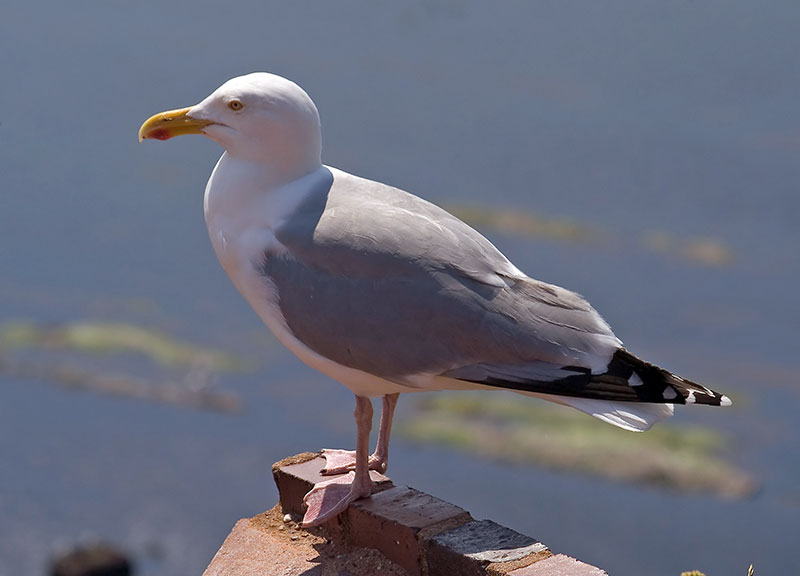
Modern ornithology generally treats the yellow-legged gull as a separate species. Adult birds are recognizable by their white head and body, grey wings, black wingtips, powerful yellow bill with a red spot and, as their name suggests, yellow legs.
They are large birds. Adults may approach 60 centimeters in length, with a wingspan of approximately 110–140 centimeters.
From a Rare Visitor to a Familiar Roman Bird
The history of gulls in Rome illustrates just how dramatically their relationship with Italian cities has changed.
A historical account records that the sighting of a single gull over Rome on March 7, 1912, was notable enough to be documented by local birdwatchers. At the time, seeing one of these large coastal birds above the capital was still considered unusual.
The first recorded urban colony of yellow-legged gulls in Italy dates to 1971 in Rome. A pair successfully nested at the city’s zoological garden in Villa Borghese, approximately 30 kilometers from the coast.
The phenomenon remained limited for several years. By 1996, researchers counted approximately 40–50 permanent nesting pairs in Rome. During the following decades, however, the population expanded considerably, and gulls became a familiar presence across the capital.
Rome was only the beginning. Rooftop nesting was subsequently recorded in:
- Sanremo in 1982
- Livorno in 1984
- Genoa in 1986
- Trieste in 1987
- Naples in 1990
Urban nesting has since become established in many coastal and inland communities.
The sight of gulls flying above the Roman Forum or resting near the Tiber may seem natural today, but it represents a relatively recent transformation in the city’s wildlife.
Why Did Seagulls Move into Italian Cities?
Yellow-legged gulls are intelligent, adaptable and opportunistic feeders. They can eat fish, insects, worms, eggs, small animals and carrion, but they also take advantage of food discarded by people.
During the twentieth century, changes in fishing and waste disposal provided gulls with increasingly reliable sources of food. Fishing vessels discarded unwanted fish and offal, while open rubbish dumps and poorly contained urban waste offered enormous quantities of edible material.
An abundant food supply supported population growth. As traditional coastal colonies became crowded, rooftops and other artificial structures offered alternative nesting sites.
Italian cities provide gulls with several advantages:
- Flat roofs, terraces and chimneys resemble protected cliffs and rocky ledges.
- Tall buildings provide excellent observation points.
- Urban areas contain relatively few natural predators.
- Household rubbish and discarded food are available throughout the year.
- Rivers, canals, parks and fountains provide water and additional feeding grounds.
- Cities are often warmer than the surrounding countryside.
To a gull, an old palace, apartment roof or church tower can function much like a coastal cliff—except that food may be easier to find nearby.
Seagulls in Venice
Venice offers an especially interesting example because the city combines a marine lagoon, densely packed historic buildings and intense human activity.
Yellow-legged gulls nest on rooftops and artificial structures throughout the historic center and lagoon. Research has documented substantial population growth around Venice during recent decades.
The birds are highly visible around canals, squares, outdoor restaurants and waterfront areas. They have learned that food carried by visitors may be easier to obtain than fish captured naturally.
Venice’s waste-collection system has also demonstrated that human behavior can influence gull populations. Research into the city’s door-to-door rubbish collection found evidence that reducing the amount of accessible waste could affect the distribution and nesting success of urban gulls.
Visitors should therefore avoid feeding them. Feeding encourages birds to approach people, reinforces aggressive food-seeking behavior and can create problems for residents and local wildlife.
If you are planning to explore the lagoon city, see Italia Mia’s guide to Italy’s great art cities and the wider collection of Italy travel articles.
What Do Urban Gulls Eat?
Yellow-legged gulls are natural scavengers, but describing them only as rubbish eaters would be misleading. Their diet is extremely varied.
Depending on the location and season, they may eat:
- Fish and marine invertebrates
- Insects and earthworms
- Small mammals and reptiles
- Eggs and chicks of other birds
- Carrion
- Food discarded outside restaurants
- Household rubbish
- Food deliberately offered by people
This flexibility is one of the main reasons they thrive in cities.
Gulls also move considerable distances when searching for food. A bird nesting on a Roman rooftop may feed along the Tiber, visit a landfill, forage in a park or travel beyond the urban center. A city-dwelling gull is not necessarily confined to the neighborhood where its nest is located.
Rooftop Life and the Breeding Season
Yellow-legged gulls commonly build nests on flat roofs, terraces, chimneys, ledges and other elevated structures. These locations offer shelter and make it difficult for many predators to approach.
A breeding pair generally lays two or three eggs. The adults become particularly watchful once the eggs hatch and may react defensively when people enter the area surrounding the nest.
Young gulls sometimes leave the nest before they can fly properly. A chick found on a roof or quiet terrace may not have been abandoned: its parents are often nearby and continue to feed and protect it.
People should not pick up a young gull unless it is clearly injured or in immediate danger. If help is needed, contact a local wildlife rescue center, veterinary service or municipal authority for instructions.
Gulls and their active nests are protected by Italian and European wildlife legislation. Eggs, chicks and occupied nests should not be removed or harmed without authorization.
Preventive measures are most effective when taken before nesting begins. Property owners who repeatedly experience rooftop nesting can seek advice about lawful deterrents and maintenance practices during the non-breeding period.
Do Seagulls Attack People?
Gulls do not normally regard humans as prey. Most confrontations happen because a bird is defending its nest or chicks, or because it has learned to associate people with food.
A defensive adult may call loudly, circle overhead or swoop toward an intruder. Although the display can be intimidating, the bird is usually trying to make the person leave the nesting area.
If a gull begins swooping:
- Walk away calmly from the nest or chick.
- Do not wave your arms or try to strike the bird.
- Protect your head with a hat, umbrella or bag if necessary.
- Keep children and pets away from the area.
- Never offer food to distract the bird.
Aggressive food snatching is more likely in heavily visited locations where tourists regularly feed gulls. Holding food close to the body and eating away from congregations of birds reduces the risk.
Noise, Droppings and Urban Conflicts
For residents and travelers, noise is one of the most noticeable consequences of rooftop nesting.
Yellow-legged gulls have a wide range of calls used to communicate with partners, warn of danger, defend territory and interact with their chicks. During the breeding season, calling can begin early in the morning and may continue at night in brightly illuminated urban areas.
Other common complaints include:
- Droppings on buildings, vehicles and monuments
- Torn rubbish bags and scattered waste
- Blocked gutters or damage to roof materials
- Defensive behavior near nests
- Food being taken from outdoor tables
- Competition with other urban birds
These problems can be frustrating, but indiscriminate removal does not address the main reasons gulls colonize cities. Better waste containment, responsible food disposal and preventing access to nesting sites before eggs are laid are generally more effective long-term strategies.
Seagulls, Swifts and Other Urban Birds
The original version of this article drew attention to the relationship between gulls and swifts, called rondoni in Italian.
Swifts are among the most characteristic birds of an Italian summer. They spend much of their lives in flight and nest in cavities beneath roof tiles, inside walls and under building eaves.
Large gulls are capable of preying on eggs, chicks and occasionally adult birds. They may also compete with other species for rooftop space. However, gull predation is not the only threat facing Italian swifts.
Renovation work that seals traditional nesting cavities can remove sites used by generations of swifts. Building restoration should therefore be planned carefully, particularly during the nesting season. Specially designed nest boxes and swift-friendly roof openings can help preserve urban colonies.
The relationship between gulls and other birds is complex. Yellow-legged gulls are part of Italy’s natural fauna, but unusually high concentrations supported by human food waste can affect vulnerable species and create imbalances in certain locations.
Are Urban Seagulls Useful?
Despite the conflicts they create, gulls also perform an ecological service by consuming carrion, discarded food and organic waste.
Historically, this scavenging role helped remove decomposing material from streets, rivers, fishing ports and rubbish dumps. Their chicks grow quickly during the breeding season, requiring adults to collect large quantities of food.
Yet this benefit should not be used as an excuse for poor waste management. When food remains easily accessible, gull populations can become unnaturally concentrated. The same waste that feeds gulls may also attract rats, pigeons and other opportunistic animals.
Cleaner streets and secure rubbish containers benefit both people and wildlife.
How Travelers Should Behave Around Gulls in Italy
Gulls are part of the experience in many Italian destinations, from the beaches of Sardinia and Puglia to the rooftops of Rome, Naples, Genoa and Venice.
A few simple precautions make encounters safer:
- Do not feed gulls, even for a photograph.
- Keep sandwiches, ice cream and other exposed food close to you.
- Do not approach nests or chicks.
- Dispose of rubbish in closed containers.
- Keep dogs away from young birds.
- Observe gulls from a respectful distance.
- Contact a wildlife rescue service if a bird appears seriously injured.
Travelers interested in Italy’s coastal landscapes can also explore Italia Mia’s guide to the best beaches and coastlines in Italy and its overview of Italy’s regions.
Frequently Asked Questions
Why are there so many seagulls in Rome?
Rome offers abundant food waste, rivers, open spaces and thousands of elevated nesting sites. Yellow-legged gulls began nesting in the city in 1971 and expanded as they adapted to rooftops and urban food sources.
How far is Rome from the sea?
Central Rome is roughly 25–30 kilometers from the Tyrrhenian coast. Yellow-legged gulls can fly considerable distances, but many Roman birds obtain much of their food within or around the city.
What species are Rome’s seagulls?
The large urban gull most commonly seen in Rome is the yellow-legged gull, Larus michahellis. It was historically classified in some sources as a form of the herring gull.
Why do gulls nest on rooftops?
Rooftops resemble cliffs and rocky ledges. They provide height, warmth, visibility and protection from many ground-based predators.
Is it illegal to remove a seagull nest in Italy?
Gulls are protected wild birds. Active nests, eggs and chicks must not be destroyed or removed without the required authorization. Preventive work should be undertaken outside the nesting season and in accordance with local wildlife rules.
Should tourists feed seagulls?
No. Feeding makes gulls more likely to approach people, steal food and depend on human activity. It can also contribute to excessive urban populations.
Seagulls as Part of Modern Italy
The story of seagulls over Italy is ultimately a story about adaptation.
A bird noteworthy enough to be recorded as a rare visitor over Rome in 1912 became an urban breeder in 1971. Over the following decades, yellow-legged gulls colonized rooftops in cities throughout the country.
They did so because Italian cities unintentionally provided what they needed: food, warmth, shelter and secure nesting places.
Gulls can be noisy, messy and intimidating during the nesting season. They may also place pressure on other birds. At the same time, they are intelligent, resourceful animals responding to an environment transformed by people.
Managing their presence requires more than attempting to frighten them away. Secure waste collection, responsible tourism, protection of other nesting birds and humane prevention are essential to creating a workable balance between people and urban wildlife.
Originally written by Gerry Firth; revised and updated by Italia Mia.
External Sources
ISPRA — Guidelines for the Management of Yellow-Legged Gull Populations
LIPU — Yellow-Legged Gull Species Profile
Roma Capitale — Information About Urban Gull Nesting
Urban Ecosystems — Yellow-Legged Gulls and Waste Collection in Venice
IUCN Italy — Larus michahellis Conservation Assessment