

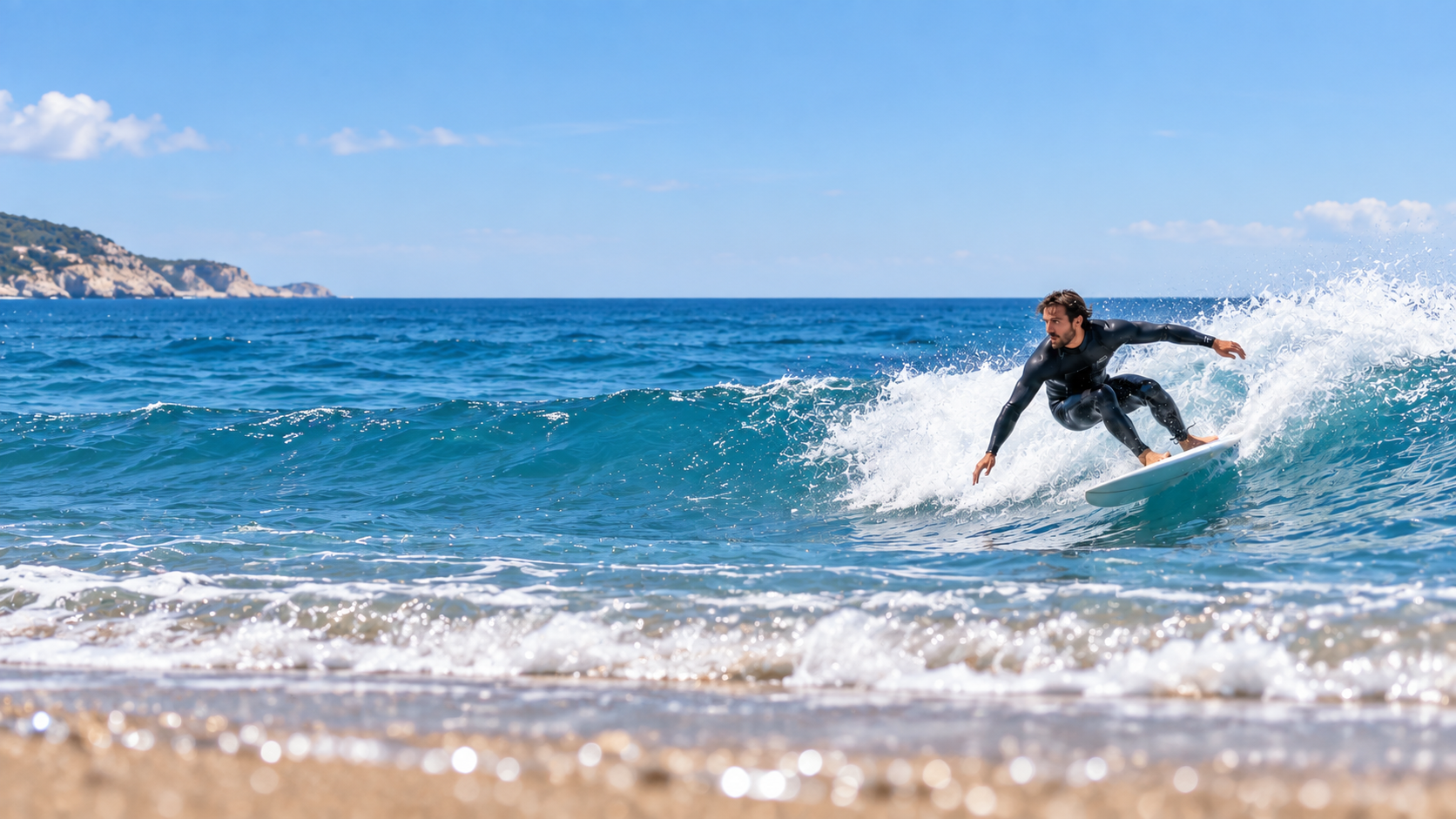
 Italy may not be the first country that comes to mind when planning a surfing trip, but its long coastline offers a surprising variety of waves. From the exposed shores of Sardinia to the reef breaks of Lazio and the beach breaks of Tuscany, Italy has surf spots suitable for beginners, experienced surfers and anyone willing to follow Mediterranean weather systems.
Surfing in Italy differs from surfing on an ocean coast. Swells are less consistent, forecasts can change quickly and good conditions sometimes last only a few hours. Flexibility is therefore more important than choosing a famous beach months in advance.
Autumn and winter generally produce the most reliable waves, while summer is better suited to beginners, longboards and occasional wind-driven sessions. Local access rules also vary by municipality, bathing season and protected area, so surfers should always check signs and current ordinances before entering the water.
When Is the Best Time to Surf in Italy?
The Italian surf season usually runs from September through April, although conditions vary considerably among regions.
Autumn: September to November
Autumn is one of the best periods for a surfing trip. The sea remains relatively warm after summer, while the first Mediterranean low-pressure systems begin generating more frequent swells.
September can still be inconsistent, but October and November often bring better conditions to Sardinia, Liguria, Tuscany and Lazio. Crowds on ordinary bathing beaches also become smaller after the summer season.
Winter: December to February
Winter generally provides the most powerful and consistent surf, especially along Italy’s western coastline and in Sardinia.
This is also the most demanding season. Water temperatures fall, storms can produce strong currents and waves may arrive with considerable wind. Depending on the region, surfers normally need a 4/3 mm or 5/4 mm wetsuit, with boots and possibly gloves or a hood during colder spells.
Beginners should take lessons or choose a sheltered beach break rather than entering unfamiliar reef or rock-bottom spots during a winter swell.
Spring: March to May
Spring can provide excellent sessions, particularly in March and April. Swells become less regular as summer approaches, but the combination of milder weather, fewer tourists and occasional storm systems makes this an attractive period.
May is frequently calm, although short-lived waves can still develop following changes in wind or atmospheric pressure.
Summer: June to August
Summer is Italy’s least dependable season for conventional surfing. Extended periods of calm weather are common, particularly in July.
Small waves occasionally develop after local winds or passing storms, but anyone visiting specifically to surf should not rely on summer conditions. On the positive side, smaller waves and warm water can be suitable for supervised beginner lessons.
Summer also brings the strictest separation between swimmers, boats and water sports. Many busy beaches allow boards only in designated areas or outside established bathing hours.
Italy’s Main Surfing Regions at a Glance
| Region | Principal areas | Most promising period | Typical conditions |
|---|---|---|---|
| Sardinia | Capo Mannu, Putzu Idu, Buggerru, Porto Ferro | September–April | Italy’s most exposed and consistent coastline |
| Lazio | Santa Marinella, Banzai, Ostia, Anzio, Gaeta | October–March | Reef, point and beach breaks near Rome |
| Tuscany | Versilia, Viareggio, Forte dei Marmi, Livorno coast | Autumn–spring | Accessible beach breaks and occasional reef waves |
| Liguria | Levanto, Varazze, Recco | Autumn–winter | Short, powerful Mediterranean swells |
| Sicily | Northern and western coasts | Autumn–spring | Highly dependent on wind and swell direction |
| Adriatic coast | Veneto, Emilia-Romagna, Marche and Abruzzo | Mainly autumn–winter storms | Short-period, wind-generated waves |
Sardinia: Italy’s Most Reliable Surf Destination
Sardinia is generally considered Italy’s leading surfing region. Its position in the western Mediterranean exposes different parts of the island to mistral, westerly, southwesterly and northerly weather systems.
The island is large, however, and conditions can differ dramatically between the west, north and south coasts. Renting a car is usually the most practical option because many surf spots are distant from towns and public transportation.
Capo Mannu and the Sinis Peninsula
Capo Mannu, on the central-western coast near Putzu Idu, is one of the best-known surf areas in Italy. Its exposed position allows it to receive swell from several directions.
The area contains multiple breaks rather than one universal surfing beach. Some have shallow rock or reef bottoms and should be approached only by experienced surfers. Conditions, entry points and safe takeoff zones should be checked locally.
Nearby Putzu Idu can offer more approachable conditions when the swell is moderate, although suitability depends on the day rather than the name of the beach.
Buggerru
The former mining town of Buggerru provides access to several west-coast beaches exposed to Mediterranean swell. Sandy sections can offer an alternative to Sardinia’s reef breaks, but strong currents and rapidly changing conditions remain possible.
Buggerru is a convenient base for surfers who also want restaurants, accommodation and a small-town atmosphere.
Porto Ferro
Northwest of Alghero, Porto Ferro is a broad, exposed beach that can receive powerful northwesterly swell. Its sandy bottom may appear inviting, but large surf can create strong currents and difficult paddle-outs.
Beginners should visit only in manageable conditions and preferably with a local instructor.
Southern Sardinia
The coastline around Cagliari, Chia and the southwest can produce waves when southern or southwestern systems enter the Mediterranean. Conditions are generally less consistent than on the central-western coast, but southern Sardinia can work when western spots are too exposed.
Some coastal waters are within or close to marine protected areas. Capo Carbonara near Villasimius, for example, is divided into zones with different levels of protection. Check the official zoning map and permitted activities before using any protected stretch of coast.
For more information about traveling around the island, read our complete Sardinia travel guide.
Lazio: Reef Breaks and Surfing Near Rome
Lazio has one of Italy’s most established surfing communities. The coastline north and south of Rome can receive waves generated by western and southwesterly weather systems, particularly from autumn through early spring.
Santa Marinella
Santa Marinella is the historic center of Lazio surfing. Its coastline contains several breaks over rock or reef, including the well-known Banzai area.
Banzai can produce powerful waves, but it is not automatically suitable for beginners. The bottom is irregular, entry and exit points require attention, and the lineup can become crowded when a good swell arrives.
La Roccetta and other nearby breaks also require local knowledge. Contrary to descriptions sometimes found online, these are Mediterranean rock or reef environments—not tropical coral reefs.
Visitors should observe the water before entering, speak to a local surf school and avoid paddling directly into a crowded peak beyond their ability.
Ostia
Ostia is one of the easiest surf areas to reach from Rome. Its sandy beaches can develop waves during active weather, and several schools operate along the coast.
The convenience of the location also means that lineups and beaches can become busy. Summer bathing restrictions, concessions and designated water-sports corridors must be respected.
Anzio and Lido Garda
Anzio has a mixture of sandy areas, harbour structures and locally known peaks. Lido Garda can produce right- and left-breaking waves under favorable conditions.
Wave quality varies greatly with swell direction and wind. Surfers should avoid entering close to harbour traffic, breakwaters or prohibited navigation areas.
Gaeta and Serapo
Serapo Beach at Gaeta can receive surf during suitable southwesterly or westerly conditions. Smaller days may be suitable for improving surfers, while storm conditions can create stronger currents and shore break.
It should be treated as an occasional Mediterranean surf location rather than a beach with guaranteed daily waves.
Explore the coast and other attractions in our guide to the Lazio region.
Tuscany: Accessible Surfing Along the Versilia Coast
Northern Tuscany has a long surfing tradition, particularly along Versilia and the coast surrounding Livorno.
Viareggio and Versilia
Viareggio, Marina di Pietrasanta and neighboring beaches can produce surf when low-pressure systems send waves into the northern Tyrrhenian Sea.
Many sections have sandy bottoms, but piers, breakwaters and coastal structures influence the currents and shape of the waves. These structures should be given a wide margin, especially in rough water.
Viareggio is comparatively easy to reach by train, although moving between different breaks is much easier with a car.
Forte dei Marmi
The beaches around Forte dei Marmi can work during autumn, winter and spring swells. Conditions are often wind-sensitive, and the surf may deteriorate quickly when onshore wind increases.
During summer, the beaches are heavily occupied by bathing establishments. Surfing may be limited to designated corridors, particular sections or times when swimmers are absent.
Livorno Coast
The rocky coast around Livorno contains more advanced breaks that can produce faster and heavier waves than the sandy beaches farther north. Entry points, submerged rocks and currents make local guidance particularly important.
Travelers can combine a surf trip with our broader Tuscany travel guide.
Liguria: Powerful Waves in a Narrow Coastal Region
Liguria’s mountains, headlands and deep nearshore water can help shape short but powerful swells. The region is highly sensitive to wind direction, and the best conditions often occur during or immediately after Mediterranean storms.
Levanto
Levanto has one of Liguria’s most recognizable surfing beaches. The bay contains several peaks and can accommodate different abilities when conditions are moderate.
Large swells are another matter. Waves can become powerful, currents can intensify and sections near rocks or harbour structures require caution. Parking is limited and particularly difficult during weekends and holidays.
Levanto is reachable by train, making it one of the more practical Italian surf destinations for travelers without a car.
Varazze
Varazze is known for high-quality waves breaking over rock and reef. It is primarily a destination for experienced surfers who understand priority, positioning and reef-break entry procedures.
The lineup can be competitive when conditions are good. Visitors should respect local surfers, wait their turn and avoid entering a crowded peak if they cannot control their board confidently.
Recco
Recco, east of Genoa, can receive surf during strong southern weather systems. The waves are intermittent and conditions change quickly, but the town is accessible by rail and provides a useful base for exploring the eastern Ligurian coast.
Our Liguria regional guide provides additional information about transportation and coastal destinations.
Sicily: Surfing Around a Large and Varied Island
Sicily has an extensive coastline exposed to several different swell and wind directions. The challenge is determining which coast will work during a particular weather system.
The northern and northwestern coasts can receive swell generated across the Tyrrhenian Sea, while the western and southern coasts respond to different storm tracks. Conditions are usually most promising from autumn through spring.
Areas around Palermo, including Isola delle Femmine and the surrounding coast, have an established surf community. Western Sicily also contains exposed beaches where waves may develop during active weather.
Do not assume that a beautiful sandy beach is safe simply because it looks calm from the road. Rocks, currents, sudden wind changes and limited exits can all be factors.
Because distances are substantial and conditions vary around the island, local forecasts and surf schools are especially valuable. See our complete Sicily travel guide when planning the rest of your trip.
Can You Surf on Italy’s Adriatic Coast?
Yes, but the Adriatic is less consistent than Sardinia or the Tyrrhenian coast.
Most Adriatic surf is generated by regional winds rather than long-traveling ocean swell. Waves may be short-period, choppy and brief. The best opportunities usually occur during autumn and winter storms involving bora, sirocco or other strong weather systems.
Veneto, Emilia-Romagna, Marche and Abruzzo all have local surfing communities. Sandy beaches can be approachable in moderate conditions, but piers, rock groynes and harbour entrances present hazards.
On this coast, checking the forecast shortly before traveling is particularly important. A promising forecast several days in advance may weaken or shift considerably.
Surf Schools, Rentals and Traveling With a Board
Surf schools and rentals are most readily available near established areas such as Santa Marinella, Ostia, Versilia, Levanto and several Sardinian surf towns.
Reserve lessons in advance when possible, but confirm conditions shortly before the scheduled session. A reputable school may postpone a lesson if the sea is flat or unsafe.
Traveling with your own board requires additional planning:
- Verify airline sporting-equipment charges and maximum board-bag dimensions.
- Do not assume a small rental car will accept a longboard.
- Use proper roof-rack straps rather than elastic luggage cords.
- Never leave boards or valuables visible in an unattended vehicle.
- Check whether accommodations provide secure board storage.
- Rinse the board, leash and wetsuit after sessions in sandy or polluted water.
Local Restrictions and Beach Access
There is no single rule that covers every Italian surf beach throughout the year. Coastal safety is regulated through ordinances issued by the relevant maritime authority, while municipalities, bathing establishments, parks and marine protected areas may impose additional restrictions.
During the official bathing season, boards may be excluded from crowded swimming zones or required to use marked launch corridors. Rules can vary between neighboring municipalities.
Before entering the water:
- Read every sign posted at the beach entrance.
- Look for marked swimming zones and water-sports corridors.
- Keep clear of swimmers, boats, fishing equipment and harbour entrances.
- Check the current local ordinanza di sicurezza balneare.
- Verify whether the beach lies inside a marine protected area.
- Respect temporary closures caused by pollution, dangerous weather or rescue operations.
- Never cross private concessions when a legal public-access route is provided elsewhere.
Marine protected areas may be divided into zones with substantially different rules. An activity permitted in one zone may be restricted in another. Consult the managing authority rather than relying on an old blog post or map.
Essential Safety Advice
Mediterranean surf can change more quickly than visitors expect. A session that begins with small waves may become hazardous when wind increases or a new swell arrives.
Every surfer should:
- Know how to swim confidently without relying on the board or leash.
- Use a leash appropriate for the board and wave size.
- Choose conditions appropriate to their experience.
- Avoid surfing alone at an unfamiliar location.
- Study the entry, exit, rocks and currents before paddling out.
- Wear adequate thermal protection outside summer.
- Leave the water before darkness or severe weather arrives.
- Avoid drainage outlets and visibly polluted water after heavy rain.
- Keep a safe distance from swimmers and less experienced surfers.
- Ask a local school or lifeguard about hazards that are not visible from shore.
A leash is a piece of safety equipment, but it is not a substitute for swimming ability. Leashes can break, detach or become caught around rocks and underwater structures.
If someone is in immediate danger at sea in Italy, call 112 or contact the Coast Guard emergency service on 1530.
Surf Etiquette in Italy
The same basic rules followed at international surf destinations apply in Italy:
- The surfer closest to the breaking part of the wave normally has priority.
- Do not drop in on someone already riding.
- Paddle toward the broken-water side rather than into another surfer’s path.
- Keep control of the board instead of releasing it toward people behind you.
- Do not repeatedly take every available wave.
- Give beginners space, but do not learn in an advanced or crowded lineup.
- Respect local residents without treating public waves as private property.
- Remove rubbish and avoid damaging dunes, vegetation or coastal access paths.
Italian surf spots can become crowded because good conditions are often brief. Patience and respectful behavior make a considerable difference.
How to Read an Italian Surf Forecast
Wave height alone does not determine whether a spot will work. Surfers should examine:
- Swell direction
- Wave period
- Wind direction and strength
- Local exposure
- Bottom type
- Weather warnings
- Changes expected during the session
Longer-period swell generally carries more energy than short, locally generated wind waves of the same stated height. However, each Italian break responds differently, and a direction that works at one beach may miss another only a few kilometers away.
Use more than one forecast, compare it with live webcams when available and confirm conditions with local surfers or schools. The Italian Coast Guard’s weather and safety information should take priority whenever official warnings are issued.
Is Italy Worth a Dedicated Surf Trip?
Italy can be an excellent surf destination for travelers who understand its limitations. It is less suitable for someone expecting guaranteed waves every day, but highly rewarding for surfers prepared to move between coasts and combine surfing with food, history and regional travel.
For the best chance of success, choose Sardinia between autumn and spring, allow several days of flexibility and rent a car. Lazio, Tuscany and Liguria are easier to combine with major cities and rail travel, while Sicily offers extensive possibilities for surfers prepared to follow changing conditions around the island.
The most important rule is simple: arrive with a flexible itinerary. In Italy, the best surf trip is rarely built around one beach. It is built around the weather.
External Resources
- Italian Coast Guard — maritime safety notices, local offices and bathing ordinances
- Meteomar Marine Forecasts — official Italian marine weather information
- Italian Surfing Federation — national federation information and recognized disciplines
- Capo Carbonara Marine Protected Area — zoning, maps and permitted activities around Villasimius
- Surfline — international surf forecasts and webcams
- Surf-Forecast — spot forecasts, swell direction and wind information