
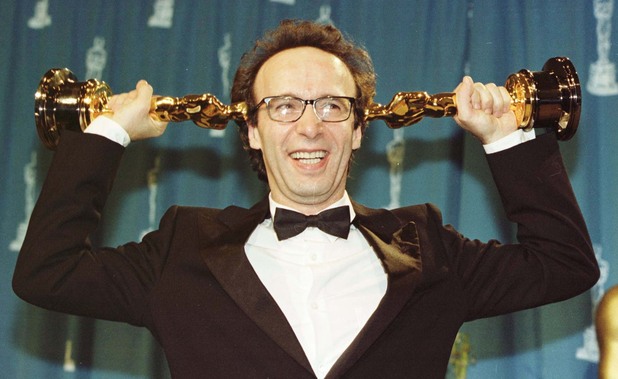
Roberto Benigni is one of the most recognizable figures in Italian entertainment: an actor, comedian, director, screenwriter and public performer whose work moves between popular comedy, poetic storytelling, political satire and literary interpretation.
International audiences know him primarily for Life Is Beautiful, the 1997 film that won three Academy Awards. In Italy, however, his career encompasses much more. He emerged from experimental theatre, disrupted the conventions of Italian television, created several enormously successful comedies, worked with Federico Fellini and Jim Jarmusch, and later introduced millions of viewers to Dante, the Italian Constitution and biblical texts.
His performance style is deliberately physical and unpredictable. Benigni can appear to overflow the stage, speaking rapidly, changing direction in mid-sentence and addressing institutions with a mixture of admiration and irreverence. Yet beneath the exuberance lies a consistent fascination with language, imagination, love and the ability of ordinary people to retain their dignity in difficult circumstances.
Childhood in Tuscany
Roberto Remigio Benigni was born on October 27, 1952, in Manciano La Misericordia, a small community in the municipality of Castiglion Fiorentino, in Tuscany’s province of Arezzo. He was the youngest of four children in a farming family.
The Tuscan countryside and its oral traditions had a lasting influence on him. His later performances would draw upon the rhythms of local speech, popular storytelling, improvised poetry and the irreverent humor associated with rural Tuscany.
The family eventually moved to the Prato area, where Benigni attended school. For a period, he studied in a seminary, but he did not pursue a religious vocation. After completing his education, his interest increasingly turned toward performance.
He began appearing onstage in the early 1970s, initially participating in experimental and avant-garde theatre. These early experiences helped him develop a comic identity based on physical energy, verbal invention and the ability to move rapidly between innocence, provocation and social commentary.
The breakthrough with Cioni Mario
A decisive moment arrived when Benigni began working with writer and director Giuseppe Bertolucci, the younger brother of filmmaker Bernardo Bertolucci.
Bertolucci wrote Cioni Mario di Gaspare fu Giulia for him in 1975. The monologue introduced audiences to a restless, impoverished and outspoken Tuscan character whose complaints about family, sexuality, politics and rural life were both comic and uncomfortable.
Cioni Mario was not a conventional television comedian. His language was earthy and his behavior unpredictable, but the character also expressed loneliness and social frustration. Benigni’s comedy was therefore never based only on shock. It used exaggeration and vulgarity to give a voice to people who rarely appeared at the center of Italian cultural life.
The character was transferred to cinema in Giuseppe Bertolucci’s Berlinguer, I Love You (Berlinguer ti voglio bene, 1977), Benigni’s first leading film role. The movie combined political satire, provincial life and surreal humor, establishing many of the themes that would return throughout his career.
Television, satire and comic rebellion
Benigni became nationally known through appearances on Italian television, particularly through his collaboration with Renzo Arbore. On programs such as L’altra domenica, his impulsive behavior and rapid monologues challenged the usually controlled atmosphere of television entertainment.
Some of his early appearances prompted controversy because of his language, political satire and irreverent treatment of public figures. These episodes should be understood within the culture of Italian television during the 1970s and 1980s, when broadcasting was more centralized and institutional conventions were comparatively strict.
Benigni’s comedy often depended on overturning those conventions. He treated politicians, television presenters and even religious authority with the familiarity of characters in a village comedy. Although his interventions sometimes tested the limits of live television, their lasting importance lies in the way he loosened the relationship between performers and public institutions.
As his career developed, the rebellious comedian gradually became a different kind of public figure: still unpredictable, but increasingly invited to interpret national literature, history and civic values.
Becoming a filmmaker
Benigni made his feature-film directing debut with Tu mi turbi in 1983. The film is composed of several comic episodes involving love, religion and everyday absurdity.
It also marked the beginning of his enduring personal and artistic partnership with actress Nicoletta Braschi. They married in 1991, and Braschi became a central presence in the films he directed, frequently playing the grounded but independent counterpart to his impulsive characters.
In 1984 Benigni worked with Massimo Troisi on Nothing Left to Do but Cry (Non ci resta che piangere). The two comedians play modern schoolteachers accidentally transported to the late 15th century. Their attempts to understand the past—and prevent Christopher Columbus from reaching the Americas—combine historical fantasy with the contrasting styles of two beloved Italian performers.
The film remains a classic of Italian comedy. Benigni’s restless physicality works against Troisi’s hesitant, understated delivery, creating a partnership audiences still remember with affection. The movie also occupies an important place in ItaliaMia’s overview of Italian cinema during the 1980s.
Jim Jarmusch, Federico Fellini and international cinema
Benigni’s career expanded beyond Italy through his collaboration with American independent filmmaker Jim Jarmusch.
In Down by Law (1986), he played Bob, an optimistic Italian imprisoned in Louisiana alongside characters played by Tom Waits and John Lurie. Bob’s imperfect English, openness and capacity for wonder disrupt the cynicism of the other prisoners. Nicoletta Braschi also appears in the film as Nicoletta, the woman with whom Bob begins a new life.
Benigni later appeared in Jarmusch’s Night on Earth (1991), playing a Roman taxi driver whose increasingly improbable confessions distress his passenger, a priest. He also appeared with Steven Wright in a segment included in Jarmusch’s anthology Coffee and Cigarettes (2003).
Another important role came in The Voice of the Moon (La voce della luna, 1990), the final film directed by Federico Fellini. Benigni played Ivo Salvini, a gentle and bewildered man wandering through a noisy, dreamlike Italian landscape. The role revealed the more melancholic dimension of his screen personality and connected him with one of the defining masters of Italian cinema. More about the director can be found in ItaliaMia’s biography of Federico Fellini.
Benigni also appeared in Blake Edwards’ Son of the Pink Panther (1993). The film was conceived as a continuation of the Inspector Clouseau series, with Benigni playing Jacques Gambrelli, Clouseau’s supposed son. Although it did not recreate the international success of the earlier Pink Panther films, it demonstrated the industry’s interest in presenting Benigni as a successor to the tradition of physically inventive European screen comedy.
The comedies with Vincenzo Cerami
Benigni’s most important screenwriting partnership was with Vincenzo Cerami, the novelist and screenwriter who had previously worked with Pier Paolo Pasolini.
Together they developed several of Benigni’s greatest Italian popular successes. In The Little Devil (Il piccolo diavolo, 1988), Benigni played a mischievous demon opposite Walter Matthau. Johnny Stecchino (1991) cast him in a double role as an innocent bus driver and the Mafioso he resembles. The film used mistaken identity to satirize criminal mythology and became a major box-office success in Italy.
In The Monster (Il mostro, 1994), a series of misunderstandings leads the police to suspect an eccentric man of being a serial criminal. The comedy depends on elaborate physical set pieces and on the difference between the protagonist’s harmless intentions and the threatening meanings other people assign to his behavior.
These films established a recognizable Benigni universe: a naïve or socially awkward protagonist, a misunderstanding that grows beyond control, an expressive female character played by Braschi, and a story in which imagination provides an escape from fear or humiliation.
That formula reached a far more ambitious form in Life Is Beautiful.
Life Is Beautiful: comedy in the shadow of the Holocaust
Life Is Beautiful (La vita è bella, 1997), written by Benigni and Vincenzo Cerami, is divided into two markedly different movements.
The first is a romantic comedy set in Fascist-era Italy. Guido Orefice, a Jewish waiter who dreams of opening a bookshop, courts schoolteacher Dora with elaborate coincidences, jokes and declarations of love. Nicoletta Braschi plays Dora, while Giorgio Cantarini plays their young son, Giosuè.
The early scenes are playful, but antisemitism gradually enters the story. Racist bureaucracy, propaganda and persecution are initially visible at the margins before becoming impossible to ignore.
In the second half, Guido and Giosuè are deported to a Nazi concentration camp. Dora, who is not Jewish, chooses to board the transport carrying her family. Inside the camp, Guido tells his son that their imprisonment is an elaborate competition. If Giosuè follows the rules, remains hidden and earns enough points, he will win a real tank.
The game is not presented as a denial of the Holocaust for the audience. Viewers can see the terror that Guido attempts to conceal. His invention is an act of parental protection: he cannot free his son, but he tries to preserve the child’s hope and prevent the camp from taking complete possession of his imagination.
This distinction is essential to understanding the film. Life Is Beautiful does not suggest that humor can erase historical horror. Its comedy belongs primarily to the relationship between father and son, while the violence surrounding them remains real and ultimately fatal.
The film’s approach nevertheless produced debate. Some critics believed that the use of fable, comedy and sentiment risked simplifying the Holocaust. Others argued that Benigni had found a legitimate way to explore love, sacrifice and survival without pretending to make a documentary reconstruction.
That debate remains part of the film’s significance. Its emotional power comes from the tension between Guido’s invented game and what the audience understands is happening beyond the child’s view. The conclusion transforms the earlier comedy into the story of a father who sacrifices himself so that his son can survive.
Cannes and the Academy Awards
Life Is Beautiful received the Grand Prix at the 1998 Cannes Film Festival and became an extraordinary international success.
At the 71st Academy Awards, it received seven nominations, including Best Picture and Best Director. It won three Oscars: Best Actor for Roberto Benigni, Best Foreign Language Film—now called Best International Feature Film—and Best Original Dramatic Score for composer Nicola Piovani.
Benigni became only the second performer to win the Best Actor Oscar for a role principally performed in a language other than English, following Sophia Loren’s victory for Two Women. His exuberant reaction, including his progress across the backs of the auditorium seats, became one of the ceremony’s most frequently replayed moments.
The excitement of that appearance should not overshadow the achievement itself. Benigni had directed, co-written and starred in a non-English-language film that crossed cultural boundaries while retaining a specifically Italian setting and sensibility.
Life Is Beautiful remains one of the most internationally recognized Italian films of the modern era and is included in ItaliaMia’s selection of the top Italian movies of all time.
Pinocchio and The Tiger and the Snow
Benigni next directed an ambitious adaptation of Carlo Collodi’s Pinocchio in 2002, playing the wooden puppet himself. The production was visually elaborate and performed strongly in Italy, but its English-dubbed American release received poor reviews.
The film remains an intriguing part of his career because Collodi’s story is closely connected to Benigni’s recurring themes: disobedience, transformation, parental love and the blurred boundary between fantasy and reality. Its reception also demonstrated how difficult it could be to translate Benigni’s verbal and physical style for audiences encountering it through dubbing.
In The Tiger and the Snow (La tigre e la neve, 2005), Benigni played a poet who travels to war-torn Baghdad in an attempt to save the woman he loves. Once again, he placed an imaginative and romantic protagonist inside a violent historical setting. The film did not repeat the impact of Life Is Beautiful, but it continued his exploration of love as a form of resistance.
After a period away from leading film roles, Benigni appeared in Woody Allen’s To Rome with Love (2012). He later returned to Collodi’s world in Matteo Garrone’s Pinocchio (2019), this time playing Geppetto. Garrone’s visually detailed adaptation gave Benigni a quieter, more vulnerable role than the puppet he had played in his own version. His Geppetto is poor, lonely and completely devoted to the child he creates.
Dante and a new role on Italian television
During the later stages of his career, Benigni increasingly devoted himself to public performances about literature, religion and civic identity.
His best-known cultural project is TuttoDante, a series of live readings and explanations of Dante Alighieri’s Divine Comedy. Beginning with major performances in Florence’s Piazza Santa Croce, the project expanded into television broadcasts and an international tour.
Benigni approaches Dante as both an actor and a popular interpreter. His introductions combine jokes, contemporary references and explanations of the poem before he recites each canto from memory. The performances helped present Dante not as a remote monument of Italian literature but as a poet concerned with recognizable human experiences: desire, betrayal, political conflict, moral responsibility and love.
He later applied a similar approach to the Italian Constitution in La più bella del mondo and to biblical tradition in The Ten Commandments. These programs demonstrated his ability to attract large television audiences to subjects more often associated with classrooms, churches or official ceremonies.
The transformation from irreverent television disruptor to interpreter of national texts is not as contradictory as it may appear. Throughout his career, Benigni has treated language as a living performance. Whether he is satirizing authority or reciting Dante, his objective is to remove distance between the words and the audience.
The Golden Lion and public appearances
In 2021, the Venice International Film Festival awarded Benigni the Golden Lion for Lifetime Achievement, recognizing his work as an actor, director and screenwriter. During the ceremony, he delivered an affectionate tribute to Nicoletta Braschi, emphasizing her importance to his life and films.
At the 2023 Sanremo Music Festival, in the presence of Italian President Sergio Mattarella, Benigni marked the 75th anniversary of the Italian Constitution with a performance devoted to freedom, democracy and peace.
On May 26, 2024, he appeared in St. Peter’s Square at the conclusion of the first World Children’s Day. Speaking after Mass celebrated by Pope Francis, he addressed children through a characteristic mixture of humor, storytelling and appeals for peace.
Benigni returned to the Sanremo stage in February 2025. The following month, he presented Il Sogno, a live prime-time Rai 1 performance about Europe, democracy, war and the political ideals that emerged from the devastation of the Second World War. Rather than offering a conventional history lesson, he used personal reflection and comic digression to ask what Europe represents and what might be lost if its founding ideals are taken for granted.
Later in 2025, he published a book based on the project and appeared on Italian television to discuss its themes.
In December 2025, Benigni presented Pietro – Un uomo nel vento, a monologue devoted to the life of Saint Peter. Filmed in the Vatican Gardens and produced in collaboration with Vatican Media, the program combined scripture, historical storytelling and Benigni’s highly personal performance style.
Before its Rai 1 broadcast, Benigni met Pope Leo XIV and showed him excerpts from the production. The program reached nearly four million viewers and became another example of Benigni’s later career as a performer capable of bringing literary, spiritual and historical subjects to a mass audience.
Roberto Benigni’s style and legacy
Benigni belongs to several Italian traditions at once. His physicality recalls silent-film comedy and the improvisational energy of the commedia dell’arte. His Tuscan speech connects him to regional oral culture, while his political irreverence belongs to the tradition of the court jester who can say what formal speakers cannot.
His characters are often innocent without being passive. They misunderstand the world, but their misunderstanding sometimes exposes the cruelty, vanity or absurdity of supposedly respectable people. Language becomes their defense: a joke, a love declaration, a false identity, a poem or an invented game.
His career also contains striking contrasts. He moved from experimental theatre to mainstream television, from provocative satire to national ceremonies, and from broad comedy to one of the most discussed films about memory and the Holocaust.
Not every project has been equally successful, and his work has frequently divided critics. Yet his willingness to combine popular entertainment with difficult material distinguishes him from most contemporary performers.
For international audiences, Roberto Benigni may always be associated most closely with Guido Orefice and the emotional force of Life Is Beautiful. In Italy, his legacy is broader. He is also Cioni Mario, the companion of Massimo Troisi, Jim Jarmusch’s optimistic prisoner, Fellini’s dreamer, Geppetto, a reader of Dante and a performer who continues to turn television into a public stage for poetry, history, faith and civic reflection.
Essential Roberto Benigni films
- Berlinguer, I Love You (1977): The cinematic introduction to Cioni Mario and Benigni’s provocative early comic style.
- Nothing Left to Do but Cry (1984): A much-loved historical comedy made with Massimo Troisi.
- Down by Law (1986): Benigni’s breakthrough collaboration with Jim Jarmusch.
- The Little Devil (1988): A supernatural comedy featuring Walter Matthau.
- The Voice of the Moon (1990): Federico Fellini’s final film and one of Benigni’s most delicate performances.
- Johnny Stecchino (1991): A hugely successful mistaken-identity comedy.
- The Monster (1994): Physical comedy built around suspicion and misunderstanding.
- Life Is Beautiful (1997): His most acclaimed work as actor, director and co-writer.
- The Tiger and the Snow (2005): A romantic fable set during the Iraq War.
- Pinocchio (2019): Matteo Garrone’s adaptation, featuring Benigni as Geppetto.
External links and official resources
- Roberto Benigni’s awards and films at the Cannes Film Festival
- The 71st Academy Awards: winners and nominees
- Roberto Benigni receives the Golden Lion for Lifetime Achievement
- Rai’s presentation of Il Sogno
- Watch Pietro – Un uomo nel vento on RaiPlay
- Vatican News: Pope Leo XIV meets Roberto Benigni