

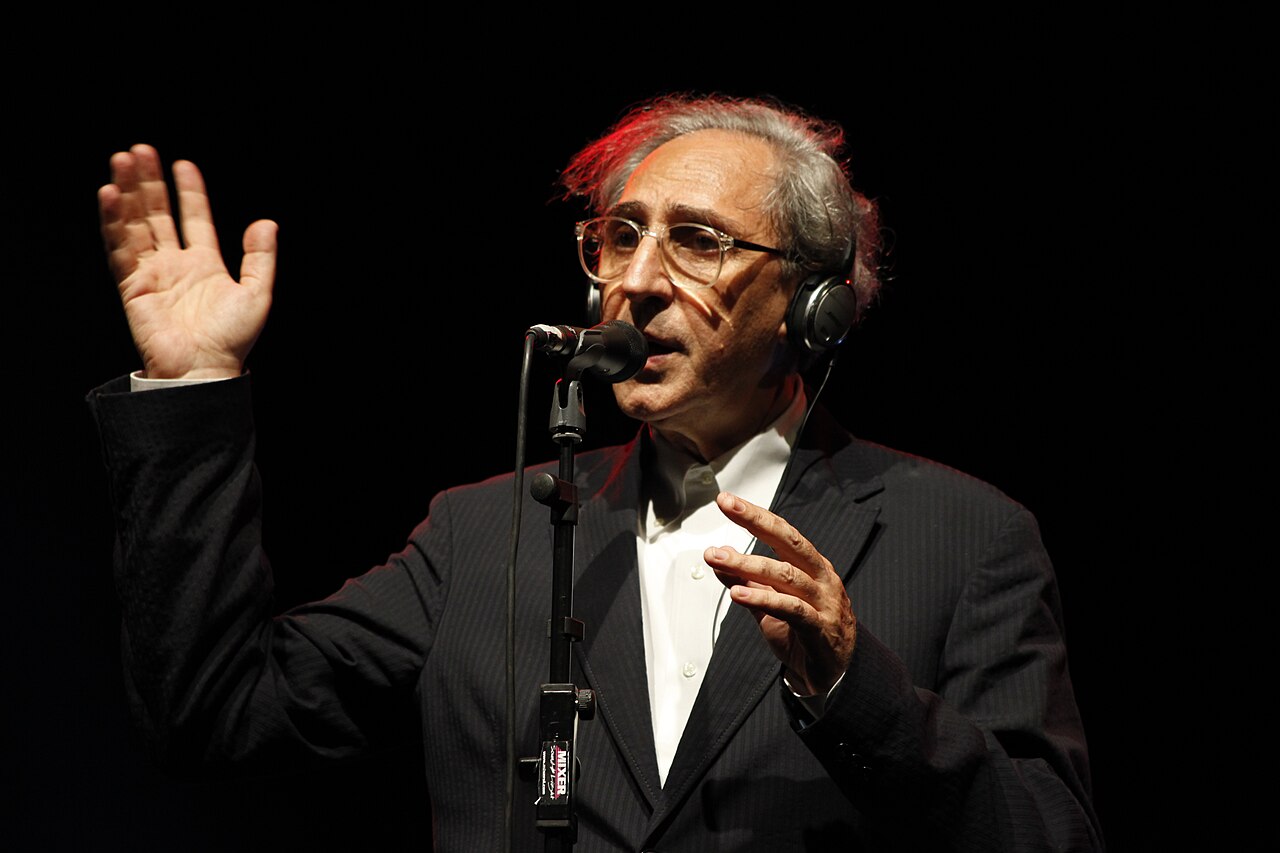
 Franco Battiato was one of the most original and intellectually adventurous figures in modern Italian music. Singer, composer, electronic-music pioneer, filmmaker and painter, he moved freely between popular songs and the avant-garde, combining memorable melodies with philosophy, mysticism, social criticism and references drawn from cultures across the world.
To many Italians, Battiato was simply “Il Maestro”—the Master. Yet this affectionate title can be misleading if it suggests a solemn or distant personality. His music could be spiritual, experimental and deeply serious, but it could also be witty, playful and irresistibly catchy. Few artists have made the passage from radical electronic composition to mainstream pop success without sacrificing their creative identity.
Early Life in Sicily
Francesco Battiato was born on March 23, 1945, in Jonia, a Sicilian municipality later renamed Riposto, on the Ionian coast near Catania. His father died when he was young, and Battiato grew up in a modest household with his mother, Grazia, and other family members.
Sicily remained central to his identity throughout his life. Its combination of Mediterranean cultures, ancient history, religious traditions and proximity to the Arab world can be felt in much of his work. Although he spent important years in Milan, he eventually returned to eastern Sicily and settled in Milo, on the slopes of Mount Etna.
As a young man, Battiato left Sicily for Milan, then the center of the Italian recording industry. His first recordings during the 1960s belonged to the conventional world of romantic popular song. He performed in clubs, recorded singles and attempted to find a place in the competitive music business.
These early experiences gave him practical knowledge of songwriting and performance, but commercial pop did not satisfy his curiosity. By the beginning of the 1970s, he had abandoned the traditional singer-songwriter formula and entered a period of fearless experimentation.
From Progressive Rock to Electronic Experimentation
Battiato’s first major albums appeared on the independent Bla Bla label. Fetus, released in 1972, introduced a striking mixture of progressive rock, primitive synthesizers, electronic effects and unconventional lyrics. Pollution followed later that year, while Sulle corde di Aries, Clic and M.elle le “Gladiator” continued his exploration of repetition, sound manipulation and minimalist composition.
These albums placed Battiato within the experimental European music scene rather than the conventional Italian pop market. His compositions reflected an interest in electronic pioneers, contemporary classical music and the possibilities of the human voice as sound.
During the second half of the 1970s, he moved even further away from traditional song structures. Works such as Battiato, Juke Box and L’Egitto prima delle sabbie were austere and challenging. The title composition of the latter received the Karlheinz Stockhausen Prize in 1978.
This experimental period was not an abandoned detour. The lessons Battiato learned about repetition, electronic textures, silence and musical structure later became essential elements of his popular songs.
The Reinvention of Italian Pop
Battiato’s career changed direction with L’era del cinghiale bianco in 1979. The album brought melody and recognizable song forms back into his music without giving up experimentation. Synthesizers, violins, classical references and unusual rhythms were combined with lyrics that seemed to move between private memories, historical images and spiritual symbols.
The transition continued with Patriots in 1980. Songs such as “Up Patriots to Arms” presented cultural criticism through energetic arrangements and memorable refrains. Battiato was learning how to place complex ideas inside accessible pop music.
His decisive breakthrough came in 1981 with La voce del padrone. The album included “Centro di gravità permanente,” “Bandiera bianca,” “Cuccurucucù,” “Summer on a Solitary Beach” and “Gli uccelli.” It remained at the top of the Italian charts for an extraordinary period and sold more than one million copies.
La voce del padrone became a landmark in Italian popular culture. The songs were immediately recognizable, yet their lyrics contained references to philosophy, literature, history, foreign languages and contemporary consumer society. Instead of explaining every allusion, Battiato allowed disconnected images to coexist, inviting listeners to build their own meanings.
“Centro di gravità permanente” became one of the defining Italian songs of the 1980s. Its search for an inner point of balance was presented through an infectious melody, danceable rhythm and a surreal collection of cultural references. “Bandiera bianca,” meanwhile, transformed criticism of superficiality and moral decline into elegant, ironic pop.
For a broader introduction to this tradition, read Italia Mia’s guide to the Italian cantautori who changed popular music.
Songs, Collaborations and International Success
Battiato’s influence extended far beyond his own recordings. His collaboration with violinist and composer Giusto Pio helped define the refined sound of his early-1980s albums. He also wrote, arranged or produced important music for other Italian performers.
His partnership with Alice was particularly successful. “Per Elisa,” written by Battiato, Alice and Giusto Pio, won the Sanremo Music Festival in 1981. In 1984, Battiato and Alice represented Italy at the Eurovision Song Contest with “I treni di Tozeur,” finishing in fifth place. The song’s combination of electronic pop, historical imagery and a quotation from Mozart demonstrated his ability to bring unconventional ideas to an international audience.
Battiato also worked closely with Giuni Russo, whose remarkable vocal range found an ideal setting in songs including “Un’estate al mare.” His collaborations with Milva revealed another side of his writing, adapting his musical language to one of Italy’s most distinguished theatrical singers.
Albums including L’arca di Noè, Orizzonti perduti and Mondi lontanissimi confirmed Battiato’s position as one of Italy’s most successful artists. Songs such as “Voglio vederti danzare,” “No Time No Space” and “La stagione dell’amore” combined electronic arrangements with reflections on memory, desire, civilization and the passage of time.
Philosophy, Spirituality and the Search for Meaning
Battiato’s spiritual interests were not decorative additions to his music. They formed one of the central threads of his life and work.
He studied Western and Eastern philosophy, Sufism, meditation, Buddhism, Christianity and the teachings of figures including George Gurdjieff. His lyrics refer to reincarnation, inner discipline, transcendence and the struggle to escape automatic patterns of thought.
However, he never presented himself as the spokesman for a single religion. His work was a continuing search rather than a fixed doctrine. Sacred language could appear beside everyday observations, scientific concepts or ironic comments about modern life.
“E ti vengo a cercare,” released on Fisiognomica in 1988, is among his clearest expressions of spiritual longing. It can be heard as a love song, a prayer or a meditation on the desire to encounter a higher state of being.
“L’ombra della luce” and “Come un cammello in una grondaia” continued this inward journey. “Povera patria,” released in 1991, turned outward to condemn corruption, abuse of power and the degradation of public life. Its restrained arrangement made its criticism more powerful.
Manlio Sgalambro and a New Creative Period
A decisive new phase began through Battiato’s collaboration with Sicilian philosopher Manlio Sgalambro. Their partnership united Sgalambro’s philosophical and frequently provocative texts with Battiato’s musical imagination.
The albums Caffè de la Paix, L’ombrello e la macchina da cucire, L’imboscata, Gommalacca and Ferro battuto moved between orchestral writing, electronic music, rock and reflective song. Sgalambro’s presence encouraged a colder, more paradoxical lyrical style, while Battiato continued to search for musical forms capable of reaching a large audience.
L’imboscata, released in 1996, included “La cura,” one of the most beloved Italian songs of recent decades. The song promises protection from fear, illness, injustice and emotional pain. It is frequently interpreted as a declaration of romantic love, but its language suggests something broader: spiritual care, unconditional devotion and the protection of one human consciousness by another.
Gommalacca, released in 1998, showed that Battiato remained attentive to contemporary music. Songs such as “Shock in My Town” introduced distorted guitars and harder electronic textures, proving that he had no desire to become a monument to his earlier success.
Classical Music and Opera
Popular songs represented only one part of Battiato’s work. He composed operas and large-scale works that brought together classical voices, orchestral writing, electronic sound and sacred or mythological subjects.
Genesi received its first complete theatrical production in Parma in 1987. Gilgamesh, inspired by the ancient Mesopotamian epic, was performed at the Teatro dell’Opera di Roma in 1992. Other compositions included Messa arcaica, Il cavaliere dell’intelletto and Telesio.
These projects demonstrate the unity behind Battiato’s apparently diverse career. Whether writing a four-minute pop song or a theatrical work, he returned to the same fundamental questions: What is consciousness? Can human beings transform themselves? What lies beyond ordinary perception?
Battiato as Filmmaker and Painter
Battiato also expressed his ideas through cinema. His first feature film as director, Perdutoamor, appeared in 2003 and received the Nastro d’Argento for best debut director. He later directed Musikanten, centered partly on Beethoven, and Niente è come sembra, a philosophical work exploring spiritual questions and the limitations of ordinary reality.
His films were highly personal and deliberately resistant to conventional storytelling. Like his music, they combined memory, symbolism, history and metaphysical inquiry.
Battiato was also a painter. Working for a time under the name Süphan Barzani, he produced portraits and other figurative works using oil, earth and pure pigments, sometimes on gold backgrounds. His paintings were shown in exhibitions in Italy and abroad, and several were used for his album covers.
The Return to Sicily
Despite his international interests, Battiato’s emotional geography repeatedly returned to Sicily. He made his home in Milo, a quiet town surrounded by forests, vineyards and the volcanic landscape of Mount Etna.
The setting offered the privacy and concentration he needed. It also placed him near a landscape where European, Greek, Byzantine, Arab and Norman histories overlap. Sicily was not merely the picturesque background to his work. It was a living example of the cultural encounters that shaped his musical imagination.
His relationship with the island could also be heard in his use of the Sicilian language. “Stranizza d’amuri,” one of his most moving songs, places the memory of young love against the frightening atmosphere of wartime Sicily.
Final Years and Death
Battiato continued recording and performing into the 2010s. His later projects included new compositions, reinterpretations of earlier work and concerts with orchestral arrangements.
Health problems eventually forced him to withdraw from public performance. Torneremo ancora, released in 2019, became his final album. Its title song sounds like a farewell, although its central idea is continuity rather than disappearance: life as transformation and consciousness as part of a journey that does not end with the individual body.
Franco Battiato died at his home in Milo on May 18, 2021, at the age of 76. His death prompted tributes from musicians, filmmakers, writers, political figures and listeners across Italy.
Why Franco Battiato Still Matters
Battiato demonstrated that popular music could be intellectually ambitious without losing emotional immediacy. He could place Sanskrit, Arabic, German, philosophical speculation, dance rhythms and fragments of classical music inside songs that millions of people remembered and sang.
His influence can be heard in Italian electronic music, alternative rock, sophisticated pop and contemporary cantautorato. More importantly, he gave listeners permission to be curious. His songs encouraged them to investigate unfamiliar books, spiritual traditions, historical figures and musical forms.
Battiato’s work resists simple categories because he treated artistic identity as something that should remain in motion. He was never only a pop singer, experimental composer, mystic, intellectual or entertainer. He could inhabit all those roles while remaining unmistakably himself.
Franco Battiato: Correnti Gravitazionali – Essential YouTube Playlist
For more Italian music, visit Italia Mia’s introduction to Italian music and its collection of beautiful Italian songs.
External Sources
Franco Battiato Official Website – Biography
Franco Battiato Official Website – Paintings
Franco Battiato Official Website – L’Ottava
RAI Cultura – Franco Battiato archive and programs
RSI – Interview with Franco Battiato about music, creativity and spirituality