

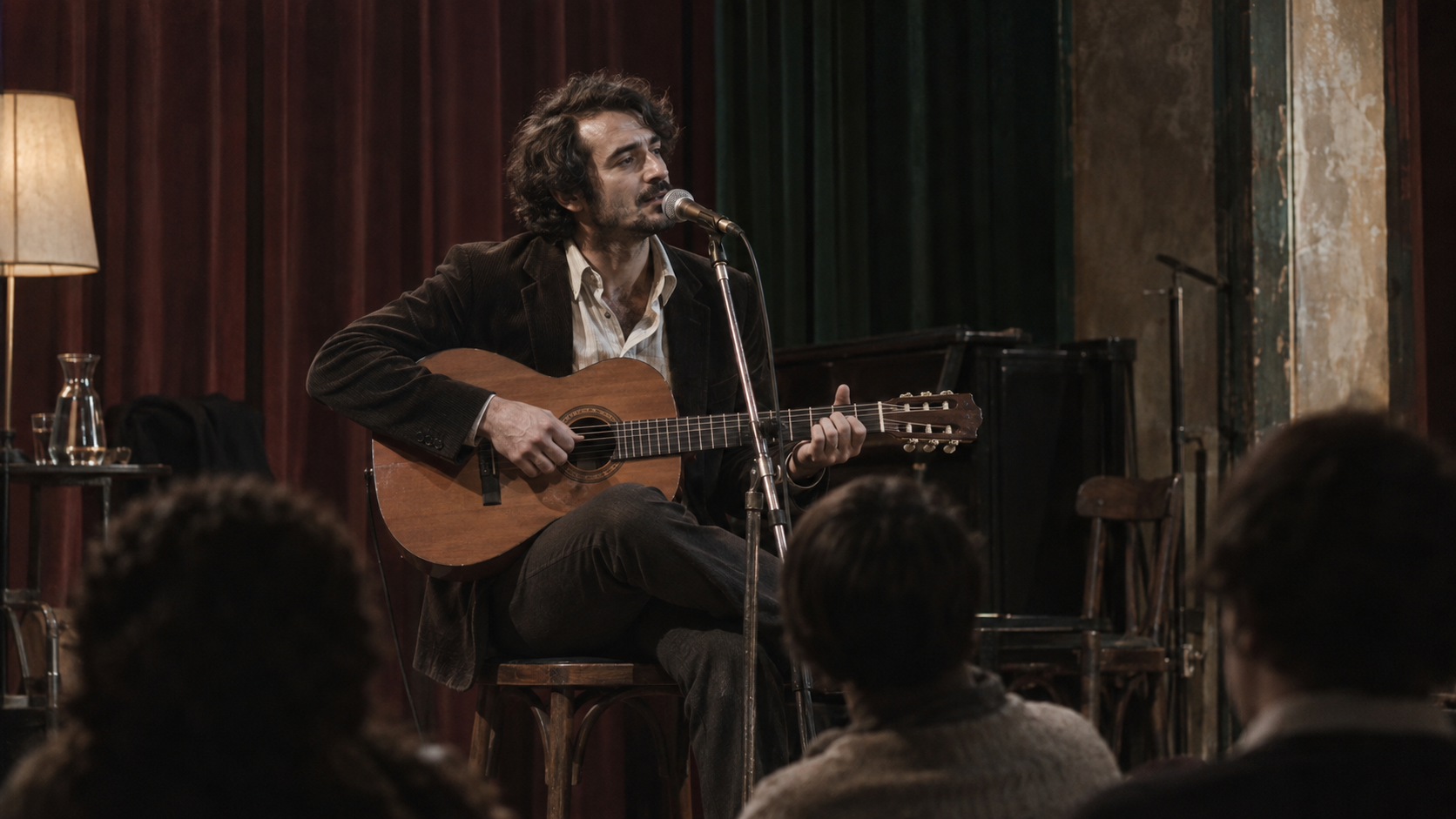
 In Italy, a successful singer may entertain an audience, but a great cantautore is expected to do something more: create a personal world through words and music. The finest Italian singer-songwriters have written about desire, war, religion, politics, provincial life, social exclusion and the uncertainties of ordinary people. Their songs can be intimate or theatrical, immediately melodic or deliberately difficult, but the author’s individual voice remains at the center.
The word cantautore combines cantante, meaning singer, with autore, meaning author. Its literal translation—singer-songwriter—is accurate but incomplete. In Italian culture, the term often implies artistic independence, literary ambition and a recognizable way of interpreting society. A cantautore does not merely perform a song. He or she assumes responsibility for its point of view.
From the Genoese pioneers of the early 1960s to today’s independent and urban artists, the cantautori transformed Italian popular music into a form capable of standing beside poetry, cinema and literature.
What Makes a Singer a Cantautore?
The simplest definition of a cantautore is a performer who writes or co-writes the songs he or she sings. Yet Italian usage carries additional cultural weight.
A cantautore is generally associated with a coherent body of work rather than a single hit. Lyrics matter, albums often have thematic unity, and even a love song may contain social observation, irony or philosophical reflection. The music can draw from French chanson, American folk, rock, jazz, regional traditions, electronic experimentation or Mediterranean melody.
Authorship does not necessarily mean working alone. Some of Italy’s most important singers collaborated closely with lyricists, composers, arrangers and producers. Lucio Battisti’s famous partnership with lyricist Mogol is the clearest example. Battisti did not write the celebrated words of their classic songs, yet his compositional imagination and intensely personal performances made him central to the broader history of Italian songwriting.
The boundaries of the term therefore remain flexible. What matters is the presence of a distinctive artistic identity.
Before the Cantautori
Italian popular song did not begin with the cantautori. Its roots include Neapolitan song, opera, regional folk traditions, café entertainment, radio and the polished melodies promoted by the Festival di Sanremo.
During the 1950s, much commercial music followed a division of labor: composers wrote the melodies, lyricists supplied the words and professional singers interpreted the finished songs. The system produced gifted performers and enduring classics, but it left limited space for the idea of the singer as a complete author.
Domenico Modugno helped change that perception. “Nel blu dipinto di blu,” commonly known as “Volare,” was not simply a successful festival song. Its surreal opening image, physical performance and unusual sense of liberation presented a more modern kind of Italian popular artist. Modugno wrote or co-wrote much of his material and performed it with a forceful personality that anticipated the cantautori.
At approximately the same time, Italian listeners were discovering French chansonniers such as Georges Brassens, Jacques Brel, Charles Aznavour and Léo Ferré. These artists demonstrated that a popular song could be witty, political, philosophical and literary without losing its emotional immediacy.
The Genoese School
The first great center of Italian cantautorato was Genoa. The port city’s cultural openness, melancholy atmosphere and contact with French music helped produce an extraordinary group of writers: Gino Paoli, Luigi Tenco, Fabrizio De André, Bruno Lauzi and Umberto Bindi.
They were never a formal organization with a shared manifesto. The expression “Genoese School” describes a loose circle of artists connected by geography, friendships and a desire to move beyond the conventions of traditional popular song.
Gino Paoli brought conversational intimacy to love songs. In works such as “Il cielo in una stanza” and “Senza fine,” private emotion appears through simple but memorable images. His writing could sound spontaneous while being carefully constructed.
Umberto Bindi combined sophisticated melodies with an emotionally exposed performance style. Bruno Lauzi moved easily between tenderness, humor and observation, becoming both an accomplished performer and a prolific writer for other singers.
Luigi Tenco gave Italian songwriting one of its most vulnerable voices. His songs often express alienation, disappointed love and resistance to social conformity. His death during the 1967 Sanremo Festival became inseparable from his public memory, but concentrating only on the tragedy obscures the intelligence and modernity of his work.
Fabrizio De André developed the most ambitious narrative universe of the Genoese group. He wrote about prostitutes, prisoners, rebels, Indigenous peoples, religious figures and those condemned by respectable society. Influenced by Brassens, medieval ballads, anarchist thought and regional musical traditions, De André created songs that often resemble short stories.
Albums such as La buona novella, Storia di un impiegato, Crêuza de mä and Anime salve demonstrated how the Italian language—and regional languages such as Genoese—could carry complex poetic and political ideas within popular music.
Milan: Jannacci, Gaber and the Theater of Song
Milan produced a different form of songwriting, more urban, theatrical and satirical.
Enzo Jannacci wrote about people rarely placed at the center of popular entertainment: the poor, the eccentric, immigrants from southern Italy, barroom philosophers and defeated dreamers. His use of Milanese dialect, jazz, cabaret and surreal comedy allowed him to move between laughter and sadness within the same song.
Giorgio Gaber began as a conventional recording artist but eventually transformed his career through teatro-canzone, or song theater. Working closely with Sandro Luporini, Gaber combined monologues and songs to examine consumerism, politics, personal responsibility, ideological conformity and the contradictions of the Italian middle class.
His performances asked audiences to think rather than simply agree. Gaber was politically engaged, but he distrusted slogans and easy affiliations. This independence helped make teatro-canzone one of Italy’s most original contributions to modern performance.
Dario Fo, Franca Rame, cabaret culture and Milan’s politically active theatrical scene formed part of the same creative environment. Here, song became a tool for character, satire and public argument.
Bologna and the Art of Storytelling
Bologna emerged as another important center of Italian songwriting. Its university, political culture, taverns and active music scene encouraged artists who combined storytelling with intellectual inquiry.
Francesco Guccini became one of Italy’s great musical narrators. His long, densely written songs explore political memory, generational disappointment, friendship, travel and the passage of time. “La locomotiva” turns a historical episode into a modern political ballad, while “Radici” and “Canzone delle osterie di fuori porta” transform personal memory into collective experience.
Lucio Dalla followed a less predictable path. A jazz-trained clarinetist with an unconventional voice, he initially worked with lyricists including Roberto Roversi before taking full control of his words. Songs such as “Anna e Marco,” “L’anno che verrà,” “Futura” and “Caruso” combine theatrical characters, melodic invention and emotional ambiguity.
Dalla could be playful, mysterious or heartbreaking. His songs often begin with an ordinary detail and gradually open into a much larger emotional landscape. His ability to unite experimentation with enormous popular appeal made him one of the most widely loved Italian musicians of his generation.
Bologna also nurtured Pierangelo Bertoli, Samuele Bersani and Luca Carboni, each of whom found a distinct way to connect personal writing with contemporary Italian life.
Rome: Politics, Poetry and the City
Rome’s cantautori developed another recognizable tradition. Francesco De Gregori, Antonello Venditti and Rino Gaetano wrote about the capital, but their songs reached far beyond it.
De Gregori brought elliptical imagery and literary allusion into mainstream music. His narrators are not always easy to identify, and his songs resist a single interpretation. “Rimmel,” “La donna cannone,” “Generale” and “Viva l’Italia” entered the national repertoire without surrendering their ambiguity.
Venditti’s writing is more direct and autobiographical. Rome, school, friendship, football, politics and romantic memory recur throughout his work. Songs such as “Roma capoccia,” “Notte prima degli esami” and “Ci vorrebbe un amico” became part of the emotional biography of several Italian generations.
Rino Gaetano used absurdity and apparently playful language to expose corruption, inequality and hypocrisy. His lyrics are full of lists, strange juxtapositions and memorable refrains, but their humor often conceals sharp social criticism. His work has enjoyed a particularly strong revival among listeners born after his death.
The Roman scene also included Stefano Rosso, Mimmo Locasciulli and Claudio Baglioni. Although Baglioni was sometimes treated dismissively by critics because of his enormous commercial success and romantic subject matter, his carefully structured albums and narrative songwriting earned him an important place in Italian popular culture.
Lucio Battisti and the Reinvention of Italian Pop
Lucio Battisti occupies a special position. He was not a traditional cantautore in the strictest sense during his famous collaboration with Mogol, who wrote the lyrics. Nevertheless, Battisti transformed the sound, vocal style and emotional vocabulary of Italian popular music.
Together, Battisti and Mogol created songs that placed everyday relationships within adventurous musical arrangements. “Acqua azzurra, acqua chiara,” “Emozioni,” “I giardini di marzo,” “Il mio canto libero” and “La canzone del sole” became national standards.
Battisti absorbed soul, rock, progressive music, funk and electronic sounds without merely imitating foreign models. His voice was imperfect in a conventional sense, but its urgency made emotional hesitation sound more convincing than polished virtuosity.
His later partnership with lyricist Pasquale Panella produced far more experimental albums. Their fragmented language and electronic textures rejected the accessibility that had made Battisti famous, demonstrating his refusal to remain trapped by public expectations.
Paolo Conte, Ivano Fossati and Franco Battiato
By the late 1970s and 1980s, Italian songwriting had expanded far beyond the image of a solitary performer with an acoustic guitar.
Paolo Conte brought jazz, cabaret and cinematic imagination into songs populated by dancers, motorists, musicians, travelers and enigmatic women. A former lawyer from Asti, Conte created a sophisticated musical geography stretching from provincial Piedmont to imaginary versions of Paris, Havana and the American jazz age. His gravelly voice and restrained piano style became recognizable far beyond Italy.
Ivano Fossati united poetic writing with meticulous musical craftsmanship. His work frequently explores travel, emotional distance, power and the difficulty of communication. He also wrote important songs for other performers, demonstrating how the history of cantautori intersects with Italy’s tradition of great interpreters.
Franco Battiato was one of the most original figures in European popular music. His career moved through experimental electronics, progressive rock, elegant pop, classical composition and spiritual reflection. On La voce del padrone, philosophical fragments, consumer culture and irresistible melodies coexist without explanation.
Battiato showed that intellectual ambition and commercial success were not necessarily opposites. Songs such as “Centro di gravità permanente,” “Bandiera bianca” and “La cura” became popular classics while preserving his unmistakable mixture of irony, mysticism and formal discipline.
Naples and the Mediterranean Voice
The Neapolitan contribution to cantautorato is inseparable from the city’s older musical tradition, but artists such as Edoardo Bennato and Pino Daniele created distinctly modern languages.
Bennato combined folk, blues and rock with satire. Using fairy-tale characters and apparently simple narratives, he criticized authority, political opportunism and the entertainment business.
Pino Daniele fused Neapolitan language with blues, jazz, rock, funk and Mediterranean music. His early albums described unemployment, urban hardship, dignity and contradiction in Naples without reducing the city to folklore. “Napule è,” “Je so’ pazzo,” “Quanno chiove” and “Terra mia” created a sound that was local in language but international in musical imagination.
Later Neapolitan songwriters inherited this freedom to combine dialect with contemporary genres. The result is not a single “Neapolitan sound” but a continuing conversation between local identity and the wider world.
The Women Who Expanded Italian Songwriting
Accounts of cantautorato have too often been organized around male artists. Women were frequently categorized as interpreters even when they wrote, composed or exercised substantial creative control over their recordings.
Several pioneering figures challenged this division. Maria Monti participated in the earliest singer-songwriter circles before developing an experimental career that crossed folk music, theater and the avant-garde. Giovanna Marini collected and reworked oral traditions while composing politically engaged narrative music. Giuni Russo combined an exceptional voice with fearless experimentation, moving between commercial pop, sacred music and avant-garde influences.
Nada evolved from a teenage Sanremo star into an independent songwriter with a raw, personal style. Alice worked with Franco Battiato and other important composers while developing an increasingly sophisticated artistic identity. Gianna Nannini brought a female authorial voice into Italian rock, writing about sexuality and autonomy with a physical vocal intensity rarely heard in mainstream Italian music.
During the 1990s, Carmen Consoli, Cristina Donà, Marina Rei, Elisa and Paola Turci helped make the cantautrice a more visible figure. Consoli’s sharp Sicilian storytelling, Donà’s atmospheric alternative rock and Elisa’s bilingual, internationally influenced songwriting demonstrated that there was no single female tradition.
Later artists including Levante, Malika Ayane, Joan Thiele, Madame and Margherita Vicario continued to challenge the line separating canzone d’autore, pop, indie music, electronic production and performance art.
The Tenco Legacy
The suicide of Luigi Tenco in 1967 became a traumatic moment in Italian musical history. In 1972, a group of enthusiasts founded the Club Tenco in Sanremo, and the first Rassegna della Canzone d’Autore was held in 1974.
Unlike the competitive Sanremo Festival, the Tenco event was conceived as a meeting place for songwriters, critics and international artists. Its awards, archives and performances helped give canzone d’autore a recognized cultural history.
The Club Tenco also encouraged Italians to look beyond national borders, honoring artists associated with French chanson, Latin American nueva canción and international singer-songwriter traditions. At the same time, it documented lesser-known Italian writers who might otherwise have disappeared from public memory.
The institution contributed to a lasting idea: songs deserve serious criticism, preservation and discussion, just as films and books do.
From the 1990s to the Indie Generation
The decline of the classic record industry did not end the cantautore tradition. It changed its settings and vocabulary.
Artists such as Samuele Bersani, Daniele Silvestri, Max Gazzè, Niccolò Fabi and Carmen Consoli emerged during the 1990s with intelligent writing that remained accessible to large audiences. They addressed emotional instability, social behavior, technology and political disillusionment without simply copying the political cantautori of the 1970s.
Vinicio Capossela created theatrical worlds influenced by folk music, literature, mythology and cabaret. Gianmaria Testa wrote understated songs about migration, work and displacement. Pacifico, Cristina Donà and others developed more intimate forms of alternative songwriting.
The 2000s and 2010s brought the loosely defined phenomenon known as indie italiano. Artists including Dente, Brunori Sas, Levante, Motta, Colapesce and Dimartino modernized the author-performer tradition through new production styles, irony and detailed accounts of precarious work, relationships and provincial life.
Streaming then weakened many of the old boundaries. Contemporary artists may move between songwriting, rap, electronic music and mainstream pop within the same album. The cantautore is no longer necessarily a man with a guitar, and canzone d’autore is no longer defined by a particular arrangement or vocal style.
Essential Italian Cantautori and Songs
A useful introduction to the tradition might include:
- Domenico Modugno – “Nel blu dipinto di blu”
- Gino Paoli – “Il cielo in una stanza”
- Luigi Tenco – “Vedrai, vedrai”
- Fabrizio De André – “Bocca di Rosa”
- Enzo Jannacci – “Vengo anch’io. No, tu no”
- Giorgio Gaber – “La libertà”
- Francesco Guccini – “La locomotiva”
- Lucio Battisti – “I giardini di marzo”
- Lucio Dalla – “L’anno che verrà”
- Francesco De Gregori – “Rimmel”
- Antonello Venditti – “Notte prima degli esami”
- Rino Gaetano – “Mio fratello è figlio unico”
- Roberto Vecchioni – “Luci a San Siro”
- Edoardo Bennato – “Il gatto e la volpe”
- Pino Daniele – “Napule è”
- Paolo Conte – “Via con me”
- Ivano Fossati – “La costruzione di un amore”
- Franco Battiato – “Centro di gravità permanente”
- Gianna Nannini – “Bello e impossibile”
- Carmen Consoli – “Confusa e felice”
- Samuele Bersani – “Giudizi universali”
- Cristina Donà – “Stelle buone”
- Daniele Silvestri – “Salirò”
- Brunori Sas – “La verità”
- Levante – “Alfonso”
These selections are starting points rather than a definitive ranking. The history of Italian songwriting is too broad—and too regional—to be reduced to a single list.
For a wider view of the country’s current musical landscape, continue with Top Italian Singers and Bands Shaping the Sound of Italy Today.
Why the Cantautori Still Matter
The classic cantautori changed the relationship between Italians and popular song. They proved that a three- or four-minute composition could portray a marginalized person, challenge a political certainty, preserve a dialect or capture a private memory with the force of literature.
Their songs also form an informal social history of modern Italy. Through them, listeners encounter postwar reconstruction, the economic boom, political conflict, feminism, migration, changing sexual attitudes, regional identities and the disappointments of consumer society.
The tradition survives because it is not really a genre. It is an approach to authorship: the belief that a popular song can be immediately enjoyable while still expressing a complex, unmistakably personal view of the world.
External Sources
Treccani – La canzone d’autore in Italia
Treccani – La canzone d’autore
Club Tenco – History of the Club
Club Tenco – Premio Tenco and Songwriting Archives
RAI Teche – Francesco De Gregori
Rockit – A Brief History of Female Italian Songwriting