
Paolo Sorrentino’s Parthenope follows a woman whose name, beauty and contradictions echo the city where she was born. Beginning in Naples in 1950, the film moves through youth, desire, grief and intellectual discovery, asking what remains when the confidence of early adulthood gives way to experience.
Released in Italy in 2024 and in the United States in 2025, this Italian-French production stars Celeste Dalla Porta, Stefania Sandrelli, Silvio Orlando and Gary Oldman. Its leisurely pace and extravagant imagery make it unmistakably Sorrentino: a film in which an encounter, a face or a view across the water can carry as much weight as a decisive event.
For readers following our coverage of Italian cinema, Parthenope offers a contemporary example of filmmaking that places atmosphere, memory and ambiguity at the center of the experience.
The Story
This overview discusses the premise and early relationships without revealing the film’s major tragedy or ending.
Parthenope is born into a prosperous Neapolitan family in 1950. As a young woman, she attracts attention almost everywhere she goes, but admiration offers little guidance about what she should do with her life.
An apparently carefree summer in Capri brings her together with her brother Raimondo and their friend Sandrino. The pleasures of youth coexist with feelings that are harder to name: longing, jealousy, emotional dependence and uncertainty about the future.
The story subsequently follows Parthenope through encounters with writers, performers, academics and religious figures. Anthropology becomes an increasingly important part of her life, giving her a way to study the people and customs that surround her.
Her name recalls the siren associated with the legendary origins of Naples. The connection is symbolic rather than a literal retelling of Greek mythology. Sorrentino links the woman and the city through their capacity to fascinate, resist explanation and leave others unsettled.
One useful way to read the film is as a gradual change in perspective. At first, Parthenope is constantly observed. Over time, her own attempts to understand other people become more important. That movement from being looked at to looking closely gives the story a thread beneath its apparently wandering structure.
Cast and Characters
Celeste Dalla Porta plays the young Parthenope, whose outward composure leaves many of her feelings unspoken. Her performance suits a character who attracts interpretations from others while revealing relatively little herself.
Stefania Sandrelli plays Parthenope later in life. Her presence brings a different sense of time to the film, allowing the character’s youth to be seen from a greater distance.
Silvio Orlando plays Professor Devoto Marotta, the academic associated with Parthenope’s studies in anthropology. His character introduces a sterner intellectual presence into a world often governed by appearances.
Gary Oldman appears as the American writer John Cheever, whom Parthenope encounters during her youth. He plays a fictionalized version of the real author.
Luisa Ranieri plays Greta Cool, an actress whose relationship with Naples is charged with resentment. Isabella Ferrari plays Flora Malva, another performer Parthenope meets while considering acting. Peppe Lanzetta plays the ecclesiastical figure involved in one of the film’s most provocative episodes.
These characters form a succession of encounters rather than a conventional supporting ensemble. Each introduces another possible way of living—and another reason to question the promises made by beauty, fame, knowledge or power.
Awards and Recognition
Parthenope competed for the Palme d’Or at the 2024 Cannes Film Festival. It did not win that prize, but cinematographer Daria D’Antonio received the CST Award for Best Artist-Technician for her work on the film.
At the 2025 David di Donatello Awards, the film received 15 nominations but won no awards. That distinction matters: its substantial nomination tally should not be confused with a list of victories.
It subsequently won three Nastri d’Argento: cinematography for Daria D’Antonio, editing for Cristiano Travaglioli—also recognized for Familia—and score for Lele Marchitelli. Celeste Dalla Porta additionally received a Guglielmo Biraghi Award recognizing emerging acting talent.
The recognition for photography, editing and music reflects how much the film communicates through its audiovisual construction.
How the Film Was Made
Sorrentino wrote and directed Parthenope, an Italian-French coproduction involving The Apartment and Pathé, with partners including Numero 10, PiperFilm and Saint Laurent by Anthony Vaccarello. Its principal creative collaborators include cinematographer Daria D’Antonio, editor Cristiano Travaglioli, composer Lele Marchitelli and production designer Carmine Guarino.
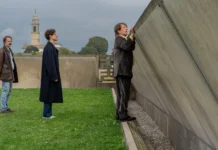
Filming took place in Naples and Capri. Those locations give the story its physical world: waterfront houses, terraces, streets and expanses of sea become places where pleasure and unease can occupy the same frame.
The images invite admiration, but their beauty also raises a question central to the film: how much can an attractive surface tell us about the life beneath it?
The editing allows encounters to linger and then moves across stretches of time. Rather than explaining every transition, the film asks viewers to notice changes in Parthenope’s manner, circumstances and relationships. Music helps connect episodes that might otherwise seem detached from one another.
Why It Still Matters
Parthenope gives viewers several subjects to consider beyond its visual pleasures: the freedom available to a woman whom everyone thinks they understand, the relationship between education and experience, and the difficulty of belonging to a place that also causes pain.
Anthropology provides a particularly interesting thread. Parthenope’s studies suggest that attention can become a form of independence. Understanding people requires more than attracting them; it requires patience, curiosity and a willingness to encounter what is uncomfortable.
The film also invites criticism. Its prolonged attention to its heroine’s appearance can be read as part of its examination of beauty, but viewers may reasonably feel that it reproduces the fascination it seeks to question. The distinction between giving a character mystery and keeping her at a distance remains an open point of debate.
For that reason, Parthenope is best approached with room for disagreement. Its appeal depends partly on whether Sorrentino’s images and digressions draw you closer to the character or leave you outside her experience.
Alongside the other films in our Italian movies collection, it offers an opportunity to consider how contemporary Italian directors continue to connect individual lives with the places that shape them.
Where to Watch or Buy
Availability checked for this rewrite on September 30, 2026. Catalogs, prices and editions can change.
United States: subscription streaming
Current U.S. listings identify HBO Max and the HBO Max Amazon Channel as subscription options. The Amazon channel requires the relevant subscription; the film is not automatically included with a standard Prime membership. See the U.S. viewing options.
United States: digital rental or purchase
A24’s official film page links to digital viewing services including Amazon, Apple TV and Fandango at Home. You can check Parthenope on Amazon.com for the options offered to your account. Rental and purchase are separate from subscription access.
Italy: subscription streaming and digital editions
Current Italian listings identify TIMVISION for subscription streaming, with rental and purchase options through Amazon Video, Apple TV Store and Rakuten TV. Check the Italian viewing options before subscribing or paying.
Physical editions
A U.S. Blu-ray edition is listed, while Italian home-video releases include DVD, Blu-ray and a 4K Ultra HD/Blu-ray edition. Browse Parthenope physical editions on Amazon.com or Parthenope editions on Amazon.it. These are search links so you can compare the editions currently offered. Confirm subtitles, audio languages and disc compatibility before ordering an imported copy.
For readers who use a VPN while traveling, NordVPN is an option to consider. Access to a particular streaming catalog remains subject to the service’s location rules, account requirements and VPN restrictions.
Affiliate disclosure: Italia Mia may earn a commission from qualifying purchases or subscriptions through the Amazon and NordVPN links above, at no additional cost to you.
External Sources
Festival de Cannes: Parthenope, synopsis and credits
Pathé Films: production information
A24: official film page and digital viewing links
Rai News: David di Donatello results
Cinemagazine: Nastri d’Argento winners
JustWatch: United States availability
JustWatch: Italian availability