 Fast food chains have become an established part of Italy’s restaurant landscape. Their expansion raises reasonable questions about convenience, food marketing and nutrition. But restaurant growth and obesity statistics do not, by themselves, demonstrate that one has caused the other.
Italy’s culinary traditions offer many nutritious foods, yet an Italian meal is not automatically balanced. Equally, eating at a fast food restaurant does not inevitably lead to disease. A useful discussion needs to consider the composition of meals, portion sizes, frequency of consumption and the wider circumstances that influence health.
Fast Food Expansion: What Is Documented?
Company announcements provide evidence that major chains are investing in Italy. In August 2025, McDonald’s Italia announced a plan to reach approximately 800 restaurants nationwide by the end of that year, alongside investments in new openings and refurbishment.
That announcement documents a business expansion plan. It does not measure how frequently Italians eat fast food, establish that those meals replace home cooking, or demonstrate a resulting change in obesity prevalence. Planned openings should also be distinguished from confirmed restaurant totals.
Convenience, pricing, delivery and marketing are plausible influences on restaurant choices. However, claims that Italians are abandoning family meals, working longer hours or universally choosing chains because they are cheaper require separate evidence.
What Italy’s Obesity Statistics Show
Adult and childhood statistics describe different populations and should not be combined into a single national figure.
For adults aged 18–69, national PASSI figures for 2023–2024 indicate that approximately 33% were classified as overweight, excluding obesity, and 10% as living with obesity: about 43% combined. These estimates use self-reported height and weight, which can underestimate prevalence. They do not cover all adults, including those aged 70 and over.
For children, the Istituto Superiore di Sanità’s OKkio alla SALUTE survey provides a more specific picture. In 2023, among surveyed third-year primary-school pupils, predominantly aged eight and nine:
19% were classified as overweight, excluding obesity.
9.8% were classified as living with obesity, including 2.6% with severe obesity.
The combined proportion was therefore 28.8%. These findings should not be presented as a statistic for every Italian child or teenager.
The trend also matters. Childhood overweight declined from 23.2% in 2008–2009 to 19% in 2023, while obesity declined from 12% to 9.8%. ISS describes obesity prevalence from 2014 to 2023 as broadly stable, with small fluctuations that were not statistically significant. The survey also found higher prevalence in southern regions and among socioeconomically disadvantaged families.
These figures show a substantial public-health concern. They do not support a blanket description of childhood obesity as continuously rising, nor establish that fast food chains caused the observed patterns.
Why Obesity Cannot Be Explained by One Type of Restaurant
The World Health Organization describes obesity as a chronic, relapsing disease arising from interactions between genetics, neurobiology, eating behaviours, access to nutritious food and the broader environment.
Physical activity, socioeconomic circumstances and, for some people, medications or other medical conditions can also affect weight and health. Obesity should therefore be discussed without reducing it to a failure of willpower or a preference for particular restaurants.
Meals that make it easy to consume large amounts of energy can contribute to excess energy intake when eaten frequently. Nevertheless, calculating the contribution of fast food to Italy’s obesity trends would require research measuring consumption and accounting for other influences.
The national surveillance figures cited here cannot answer that causal question. Counting restaurants and comparing obesity percentages is insufficient.
Traditional Italian Food and Fast Food: Assess the Meal
The Mediterranean dietary pattern emphasizes vegetables, fruit, legumes, whole grains, nuts and olive oil. Many Italian dishes can fit comfortably within that pattern. But “Italian cuisine” includes an enormous variety of meals, and the name of a dish does not establish its nutritional quality.
Vegetable soups, bean dishes and modest portions of pasta with vegetables differ considerably from large meals dominated by cured meats, fried foods, rich sauces and desserts. Preparation, quantities and accompanying foods matter.
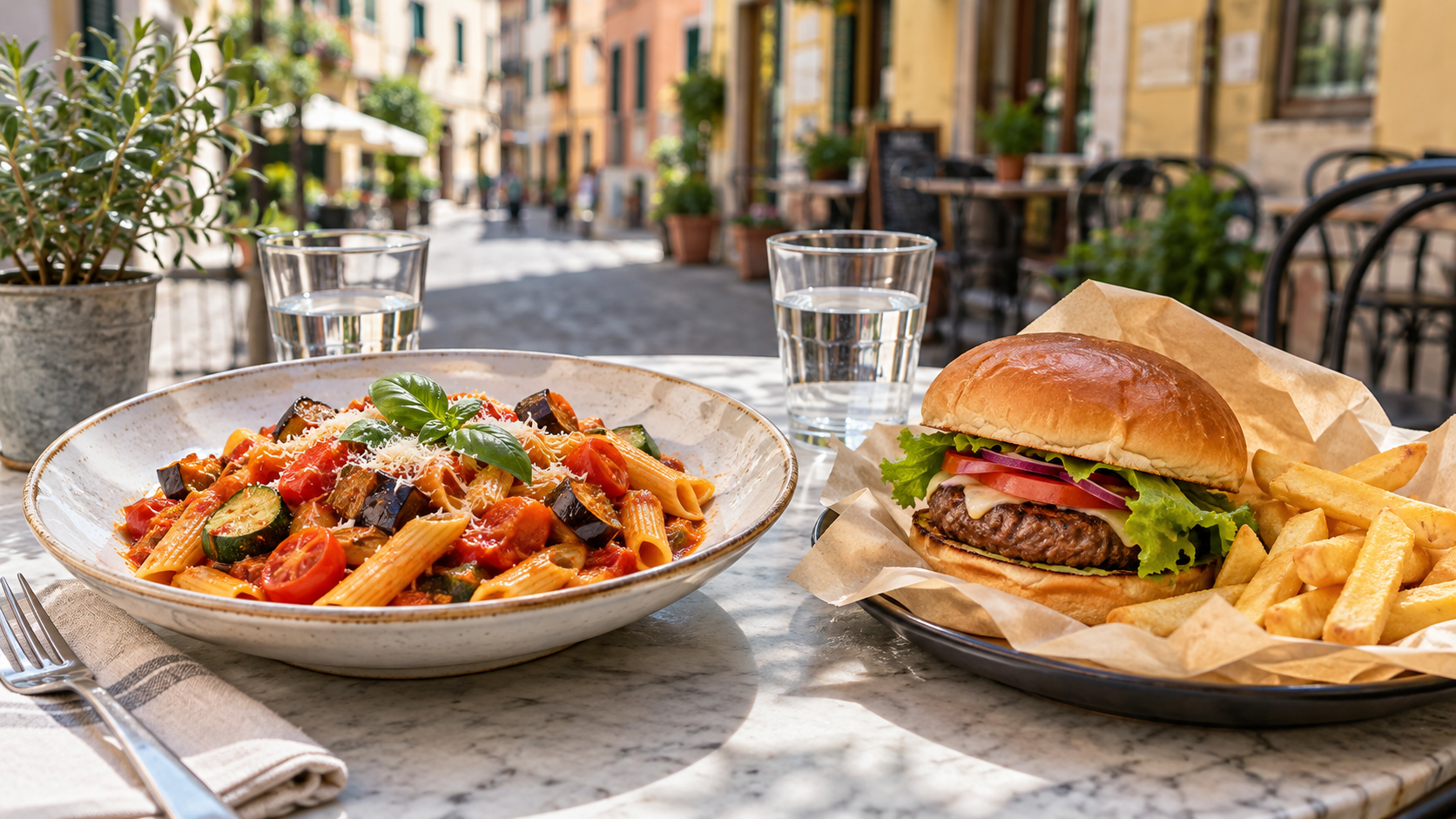
Fast food menus also vary. A smaller meal with water has a different nutritional profile from a large combination including fries, a sugary drink and dessert.
WHO guidance emphasizes dietary variety, balance and moderation, with plenty of vegetables, fruit, pulses and whole grains, while limiting foods high in free sugars, sodium and unhealthy fats. These principles apply to home cooking, traditional restaurants and international chains alike.
Organic certification, local sourcing and traditional recipes may matter for other reasons, but none guarantees that a meal is nutritionally balanced.
What Government Policy Actually Says
Italy’s policies need to be described individually, with clear dates and a distinction between legislation and implementation.
Sugar tax
The original article presents a sugary-drink tax as an operating measure. Parliamentary documentation for the 2026 budget records a postponement of its application to January 1, 2027. As of September 30, 2026, it should therefore be described as legislated but deferred, rather than as an existing tax already reducing consumption.
Food labelling
Nutrition information on most prepacked foods is governed by EU rules. The obligation to provide a nutrition declaration has applied since December 13, 2016. This is an established European requirement, rather than evidence of a recent Italian crackdown on fast food restaurants.
Obesity prevention and care
Italy’s Law No. 149 of October 3, 2025 establishes provisions for obesity prevention and treatment and recognizes obesity as a progressive, relapsing disease. A ministerial decree published in July 2026 defines the composition of the national obesity observatory. These are documented measures; their existence alone does not establish their effectiveness.
School initiatives
OKkio alla SALUTE reported that 84% of sampled schools included nutrition education in their curriculum in 2023. This documents reported school activity, rather than a single nationwide school-lunch reform or a proven reduction in obesity attributable to it.
There is no evidence in the sources cited here to support blaming policy enforcement problems on the power of fast food companies.
A More Useful Conversation About Food and Health
Italy can value its culinary heritage while examining the nutritional quality of all food settings. Practical questions include whether balanced meals are affordable, how portions and promotions influence purchases, and whether schools, workplaces and neighbourhoods support healthier routines.
For individuals, the overall eating pattern matters more than a restaurant’s nationality or reputation. For public policy, monitoring outcomes matters more than announcing measures.
Fast food expansion is a documented commercial development. Overweight and obesity are documented health concerns. Understanding the relationship between them requires evidence beyond the assumption that traditional food protects everyone and fast food inevitably causes disease.
External Sources
McDonald’s Italia: August 2025 expansion announcement
Istituto Superiore di Sanità: PASSI overweight and obesity surveillance and methodology
ASL Roma 3: PASSI 2023–2024 report with national comparison figures
Istituto Superiore di Sanità: OKkio alla SALUTE national results for 2023
World Health Organization: Obesity and overweight
World Health Organization: Healthy diet
Italian Parliament: 2026 budget provisions, including the sugar-tax postponement
European Commission: Food information to consumers legislation
Gazzetta Ufficiale: Law No. 149 on obesity prevention and care