

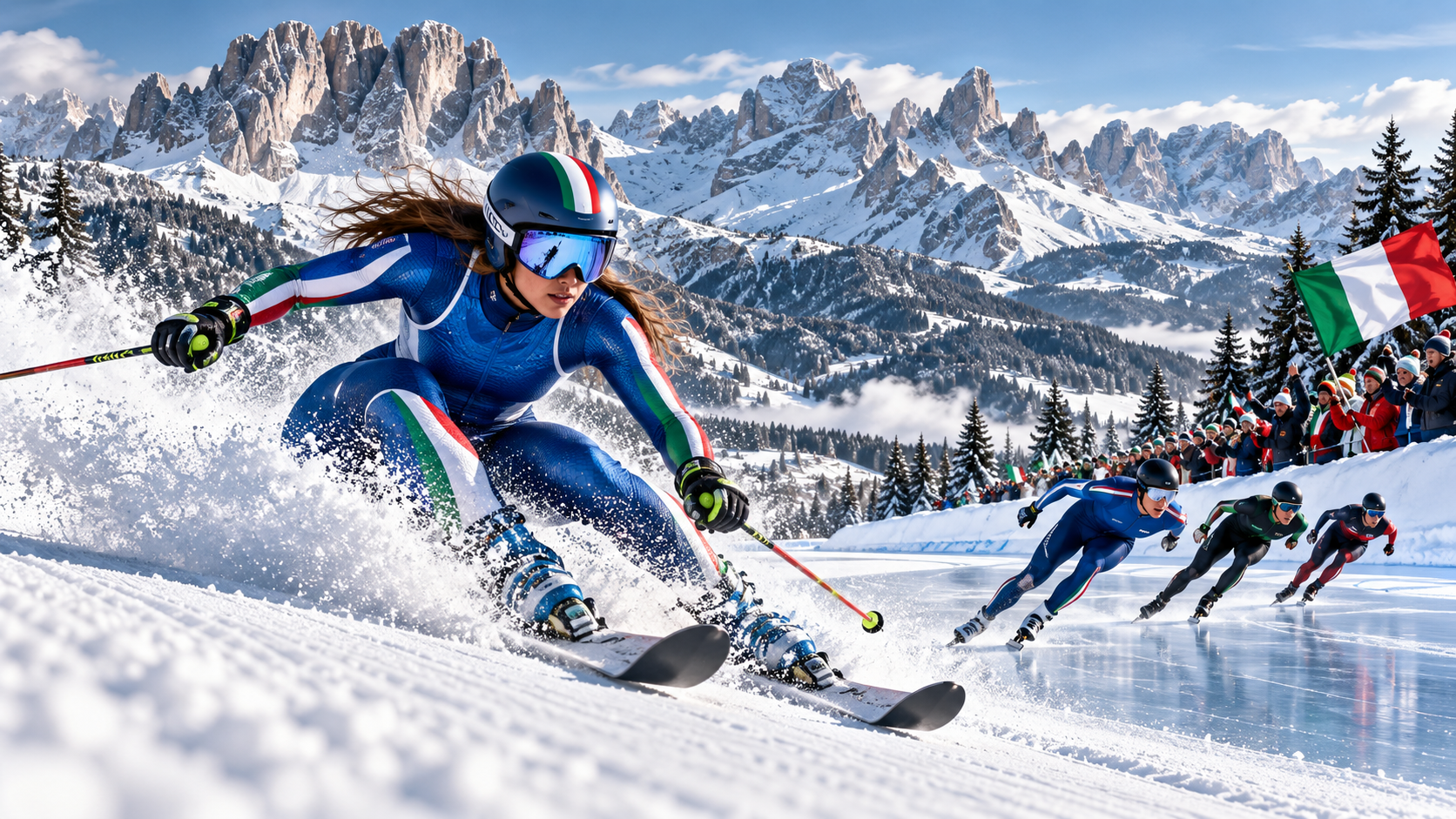
 Milano–Cortina 2026 brought the Winter Olympics back to Italy and produced the country’s most successful Winter Games medal tally. Across the ice arenas and mountain venues of northern Italy, Italian athletes won 30 medals: 10 gold, six silver and 14 bronze.
The sporting results are now part of Olympic history. The longer-term legacy—from infrastructure use to environmental impact—requires a more measured assessment.
Updated September 30, 2026.
When the Games Took Place and How Many Events Were Held
The XXV Olympic Winter Games took place from February 6 to 22, 2026. They were Italy’s third Winter Olympics, following Cortina d’Ampezzo in 1956 and Turin in 2006.
The programme comprised 116 medal events across eight sports and 16 disciplines: 54 men’s events, 50 women’s events and 12 mixed events. “Sports,” “disciplines” and “events” describe different levels of the programme and should not be used interchangeably.
The 16 disciplines were Alpine skiing, biathlon, bobsleigh, cross-country skiing, curling, figure skating, freestyle skiing, ice hockey, luge, Nordic combined, short track speed skating, skeleton, ski jumping, ski mountaineering, snowboard and speed skating.
Ski mountaineering made its Olympic debut, adding another mountain discipline to the Winter Games.
Italy’s Record Medal Haul
Italy finished fourth in the medal table, which ranks countries first by gold medals, then silver and bronze. Its 30 medals exceeded the previous Italian Winter Olympic record of 20, established at Lillehammer in 1994.
Norway led the table with 18 gold medals and 41 medals overall. The United States finished second with 12 gold and 33 overall. The Netherlands placed third with 10 gold, seven silver and three bronze; Italy followed with the same number of gold medals but one fewer silver.
For readers interested in the wider sporting context, our guide to sports in Italy looks at the disciplines and athletes that have shaped the country’s sporting identity.
The Italian Athletes Who Delivered
Federica Brignone won gold in both super-G and giant slalom. Her double triumph followed a serious injury in 2025 and made her one of the defining figures of Italy’s home Games.
Francesca Lollobrigida also secured two gold medals, winning the women’s 3,000 metres and 5,000 metres in speed skating.
Other confirmed Italian highlights included:
• Arianna Fontana: gold in the short track mixed relay, plus silver in the women’s 500 metres and 3,000-metre relay. Her career Olympic total reached 14 medals, an Italian record across Summer and Winter Games.
• Lisa Vittozzi: gold in the women’s biathlon pursuit, Italy’s first Olympic biathlon title.
• Sofia Goggia: bronze in the women’s downhill.
• Dorothea Wierer: silver in the biathlon mixed relay alongside Tommaso Giacomel, Lukas Hofer and Lisa Vittozzi.
• Michela Moioli: bronze in women’s snowboard cross and silver in mixed team snowboard cross with Lorenzo Sommariva.
• Simone Deromedis and Federico Tomasoni: gold and silver respectively in men’s ski cross.
• Andrea Voetter and Marion Oberhofer: gold in women’s luge doubles.
• Emanuel Rieder and Simon Kainzwaldner: gold in men’s luge doubles.
These results replace the pre-Games descriptions of “medal hopes” and “athletes to watch.”
Where the Olympic Competitions Took Place
Milano–Cortina used a network of venues across Lombardy, Veneto and Trentino–Alto Adige/Südtirol. The name referred to the two principal hosts, but competition extended well beyond them.
Milan and its surrounding area hosted the Olympic ice competitions. The Milano Ice Skating Arena staged figure skating and short track. Ice hockey used the Santa Giulia arena and Milano Ice Park, while speed skating also took place at Milano Ice Park.
Cortina d’Ampezzo hosted women’s Alpine skiing at the Tofane Alpine Skiing Centre; bobsleigh, skeleton and luge at the Cortina Sliding Centre; and curling at the Cortina Curling Olympic Stadium.
Bormio hosted men’s Alpine skiing and ski mountaineering at the Stelvio Ski Centre.
Livigno hosted snowboard and freestyle skiing, using the Snow Park and the Aerials & Moguls Park.
Anterselva, also known as Antholz, hosted biathlon.
Val di Fiemme divided Nordic competition between Predazzo for ski jumping and the jumping component of Nordic combined, and Tesero for cross-country skiing and the cross-country component of Nordic combined.
Cortina’s curling assignment included the men’s, women’s and mixed doubles tournaments. It was not limited to women’s curling.
International Performances That Defined the Games
Norway’s Johannes Høsflot Klæbo delivered an extraordinary cross-country skiing performance, winning gold in all six men’s events. He completed that sweep with victory in the 50-kilometre mass start classic race at Tesero.
His achievement helped explain Norway’s commanding position in the final medal table. Italy’s record results formed another major sporting story, giving the host nation successes across both mountain and ice disciplines.
The Opening and Closing Ceremonies
The opening ceremony took place on February 6, with Milan’s San Siro Stadium as its principal stage and athlete celebrations also held in Cortina, Livigno and Predazzo.
Laura Pausini sang the Italian national anthem, Mariah Carey performed “Volare,” and Andrea Bocelli sang “Nessun dorma.” President Sergio Mattarella formally declared the Games open.
Two Olympic cauldrons burned during the Games: one in Milan and one in Cortina. Alberto Tomba and Deborah Compagnoni lit the Milan cauldron, while Sofia Goggia lit the Cortina cauldron.
The Olympic closing ceremony took place at the Arena di Verona on February 22, concluding the Games and handing over to the French Alps hosts for 2030.
Sustainability: What Was Promised and What Was Documented
Before the Games, organisers promoted venue reuse, temporary facilities, renewable electricity and lasting benefits for host communities. These were commitments and planning objectives. Their inclusion in a sustainability strategy does not establish that every objective was achieved.
Electricity procurement provides one documented example. Reporting during the Games described Enel’s use of renewable-energy guarantees of origin to cover the electricity supplied. These certificates support a renewable electricity purchasing claim; they do not mean that the entire event, including construction and travel, had zero emissions.
Infrastructure records also show why the legacy needs continued scrutiny. The Cortina Sliding Centre hosted Olympic competition, but SIMICO announced in May 2026 that construction work would resume to finish outstanding elements. In July, the agency reported 98% completion and scheduled tree planting for autumn. Those statements distinguish a venue ready for competition from a fully completed infrastructure and landscaping project.
The dispersed venue model presents a further trade-off. Reusing established sporting locations can reduce the need for entirely new facilities, but distances between locations create transport demands. Travel emissions remained an important environmental concern during the Games.
The evidence reviewed for this article does not establish a final, independently verified whole-Games carbon footprint or a demonstrated reduction against previous Winter Olympics. Claims that Milano–Cortina was “carbon neutral” or conclusively more sustainable than earlier editions would therefore go beyond the evidence presented here.
Long-term success will depend on how facilities are used, maintained and financed, alongside the environmental effects of construction and operation.
The Paralympics Were a Separate Competition
The Milano–Cortina Paralympic Winter Games followed from March 6 to 15, 2026, with 79 medal events across six sports.
Italy won a record 16 Paralympic medals: seven gold, seven silver and two bronze. Giacomo Bertagnolli, competing with guide Andrea Ravelli, won five medals in five Alpine skiing events, including gold in Alpine combined and slalom.
The 79-event figure belongs to the Paralympic programme. It should not be substituted for the Olympics’ 116 medal events, and the two Italian medal totals should be reported separately.
What Milano–Cortina 2026 Left Behind
Italy’s sporting achievement is clear: a record Olympic medal haul, outstanding individual performances and a record Paralympic campaign.
The broader legacy remains a developing story. Hosting competitions across northern Italy put established winter-sport communities at the centre of the Games, while infrastructure completion and future venue use extended beyond the closing ceremonies.
Milano–Cortina 2026 can already be remembered for its athletes. Its lasting economic, social and environmental value will require evidence gathered over a longer period.
External Sources
CONI: Final Olympic medal table
CONI: Italy’s Milano–Cortina results and medal winners
FIS: Klæbo’s six Olympic gold medals
Associated Press: Renewable electricity and the Games’ environmental challenges