Sport in Italy is about far more than competition. It is part of the national conversation, a source of local identity and one of the ways Italians express pride in their cities, regions and country.
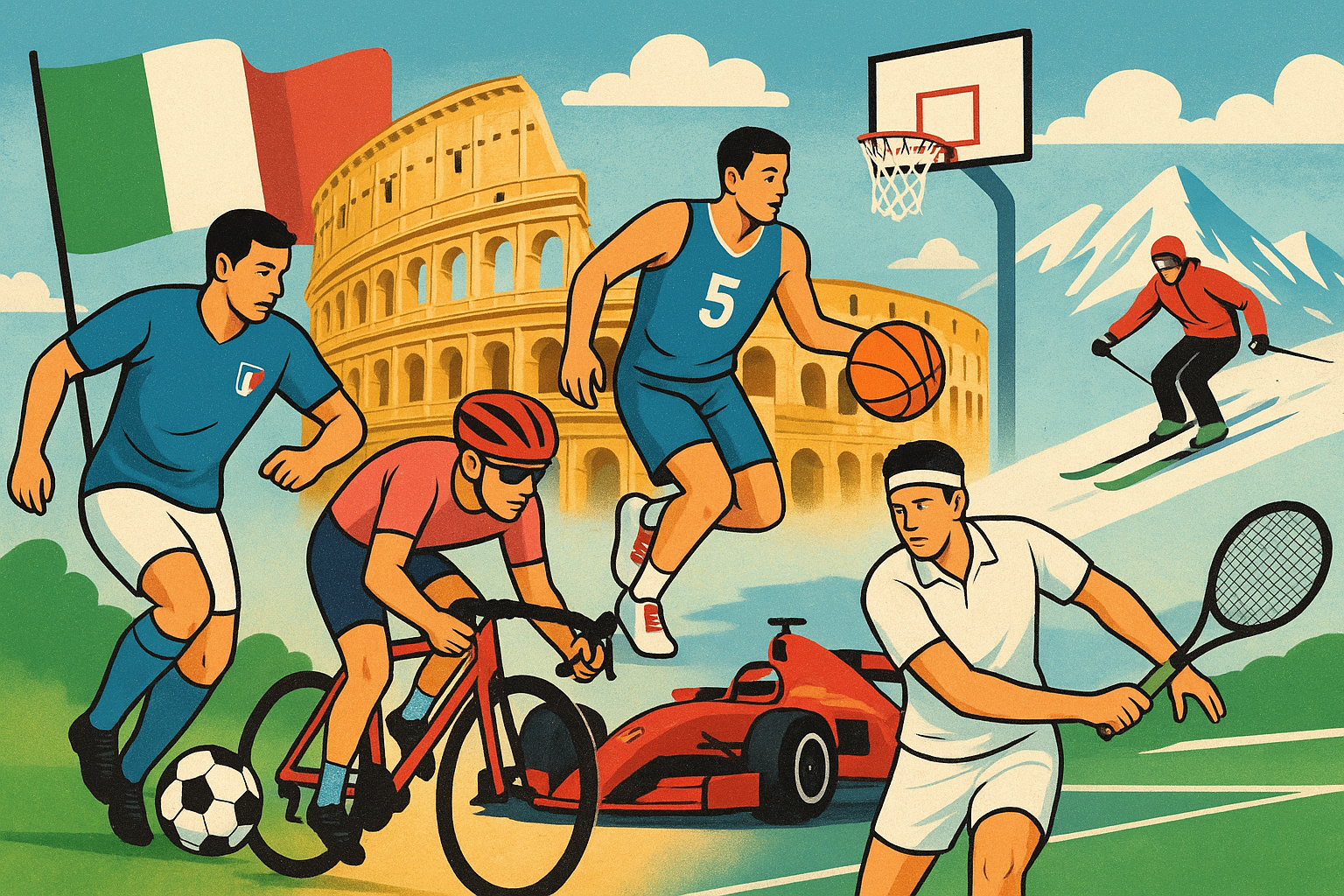
Football dominates television schedules and Monday-morning conversations, but Italy’s sporting culture is remarkably diverse. Cycling races transform mountain roads into open-air stadiums. Tennis clubs fill up after an Italian victory. Formula One fans wear Ferrari red as though it were another national color. In the Alps, winter weekends revolve around skiing, while beaches and lakes encourage swimming, sailing and other water sports.
According to Italy’s national statistics institute, more than 21.5 million people aged three and over practiced at least one sport during their free time in 2024. That represented 37.5% of the population in that age group, including 28.7% who participated regularly. The figures show that Italy is not simply a nation of spectators: millions of Italians actively exercise, train and compete.
Football: Italy’s National Obsession
Football, known universally in Italy as
calcio, remains the country’s most popular and culturally important sport.
The Italian national team is called the
Azzurri because of its traditional blue shirts. Italy has won the FIFA World Cup four times—in 1934, 1938, 1982 and 2006—and each triumph became part of the country’s collective memory.
At the club level, Serie A has given world football some of its most recognizable teams:
- Juventus
- Inter Milan
- AC Milan
- AS Roma
- Lazio
- Napoli
- Fiorentina
- Atalanta
Supporting a club is often a family tradition passed from one generation to the next. Loyalty may be connected to a birthplace, neighborhood or family history rather than a team’s current success.
Rivalries can be intensely local. Matches between teams from the same city are called
derby. The Derby della Madonnina between Inter and AC Milan, the Derby della Capitale between Roma and Lazio, and the Derby della Mole between Juventus and Torino are among the best known.
Football is also deeply embedded in everyday Italian language. People discuss transfers, refereeing decisions and tactics in cafés, workplaces and family homes. Expressions borrowed from football frequently appear in political and social conversations.
Travelers interested in experiencing this passion firsthand can read
How to Attend a Soccer Match in Italy, including practical information about tickets, identification requirements and stadium behavior.
Cycling: A Sport Written Across the Landscape
Cycling occupies a special place in Italian history because it connects sport with geography.
The Giro d’Italia, first held in 1909, crosses cities, villages, coastlines and mountain passes throughout the country. Its pink leader’s jersey, the
maglia rosa, is one of the most recognizable symbols in international cycling.
Unlike an event confined to a stadium, the Giro comes directly to the public. Families gather beside country roads, spectators climb Alpine passes and entire towns decorate their streets to welcome the race.
Italian cycling legends include:
- Gino Bartali
- Fausto Coppi
- Alfredo Binda
- Felice Gimondi
- Marco Pantani
- Francesco Moser
The rivalry between Bartali and Coppi became especially significant in postwar Italy. Their contrasting personalities and racing styles seemed to represent two different visions of the country.
Cycling is also popular as a recreational activity. Italy offers extraordinary routes through the Dolomites, Tuscany, the hills of Piedmont, the lakes of Lombardy and the coastlines of Sardinia and Sicily. On weekends, groups of amateur cyclists are a common sight on provincial roads.
Tennis: Italy’s Modern Sporting Renaissance
Tennis has experienced an extraordinary rise in visibility throughout Italy. International successes by Italian players have attracted new audiences, encouraged children to join tennis clubs and made major tournaments national television events.
Italian tennis has a long history, but its modern popularity is associated with a generation of internationally successful players, including Jannik Sinner, Matteo Berrettini, Lorenzo Musetti, Jasmine Paolini and the accomplished doubles partnership of Sara Errani and Paolini.
Rome hosts the Internazionali BNL d’Italia at the Foro Italico, one of the most prestigious clay-court tournaments outside the four Grand Slams. Turin has also strengthened Italy’s position on the international tennis calendar by hosting the ATP Finals.
The growth of tennis has been accompanied by the rapid spread of padel. Padel courts now appear in large cities, suburban sports centers and holiday resorts. The game’s social character and relatively accessible learning curve have helped it attract players who may never have joined a traditional tennis club.
Motorsport: Ferrari, Monza, Ducati and Italian Speed
Few countries connect machinery, design and competition as emotionally as Italy.
Ferrari is the most famous symbol of Italian motorsport. Its Formula One supporters are known as the
tifosi, a word that suggests an almost feverish level of devotion. At the Italian Grand Prix in Monza, grandstands become a sea of red.
The Monza circuit is often called the Temple of Speed. Its long straights and historic atmosphere make it one of the most celebrated venues in international motor racing.
Italy’s motorsport culture extends well beyond Ferrari. Alfa Romeo, Maserati, Lamborghini and Abarth have all contributed to the country’s performance-car tradition.
Motorcycle racing inspires comparable enthusiasm. Ducati and Aprilia compete internationally, while riders such as Giacomo Agostini and Valentino Rossi became sporting icons. Mugello and Misano host major motorcycle events and draw fans from across Europe.
This enthusiasm is closely related to Italy’s broader two-wheel culture, explored in
Italy Scooters and Motorcycles: A Rich Legacy.
Volleyball: A Major Sport at Every Level
Volleyball does not always receive the same international attention as Italian football, but it is one of the country’s most important organized sports.
Both the men’s and women’s national teams have achieved exceptional results in European and world competitions. Italy’s professional leagues also attract leading international players and are widely considered among the strongest in the sport.
Volleyball is particularly visible in schools, community sports halls and smaller cities. It requires less space and equipment than many outdoor sports, making it accessible to young people across the country.
Beach volleyball is naturally popular during summer, especially along the Adriatic coast and in beach destinations throughout Emilia-Romagna, Veneto, Tuscany, Puglia, Calabria, Sicily and Sardinia.
Basketball: Strong Clubs and Passionate Cities
Basketball, or
pallacanestro, has a loyal Italian following and a respected professional tradition.
The top domestic competition is Lega Basket Serie A. Historic clubs such as Virtus Bologna, Olimpia Milano, Pallacanestro Varese and Victoria Libertas Pesaro have helped establish strong basketball cultures in their respective cities.
Bologna has an especially important relationship with the sport and is sometimes called “Basket City.” Major matches there can create an atmosphere every bit as intense as football.
The Italian national team, known as the
Azzurri just like the football team, has won European titles and Olympic medals. Italian players have also competed successfully in the NBA and other international leagues.
Winter Sports in the Italian Alps
Northern Italy’s geography makes winter sports an essential part of life in many Alpine communities.
Skiing and snowboarding are popular in:
- Trentino-Alto Adige
- Valle d’Aosta
- Lombardy
- Piedmont
- Veneto
- Friuli-Venezia Giulia
Cortina d’Ampezzo, Cervinia, Madonna di Campiglio, Livigno, Bormio, Sestriere and Val Gardena are among the country’s best-known winter destinations.
Italy has produced celebrated Alpine skiing champions such as Alberto Tomba, Deborah Compagnoni, Gustav Thöni, Federica Brignone and Sofia Goggia. The country also has strong traditions in cross-country skiing, speed skating, biathlon, luge and bobsleigh.
The Milan–Cortina Winter Olympic and Paralympic Games further highlighted northern Italy’s long relationship with snow and ice sports.
For a closer look at one of the country’s principal mountain regions, visit the
Italia Mia guide to Trentino-Alto Adige.
Swimming and Water Sports
With thousands of kilometers of coastline, numerous lakes and a warm summer climate, Italy provides an ideal setting for water sports.
Swimming is widely practiced by children and adults, both recreationally and competitively. Italian swimmers have achieved considerable success at the Olympic Games, World Championships and European Championships.
Water polo also has a proud tradition. Italy’s men’s national team is known as the
Settebello, while the women’s team is called the
Setterosa.
Popular recreational activities include:
- Sailing
- Windsurfing
- Kitesurfing
- Canoeing
- Rowing
- Diving
- Stand-up paddleboarding
Lake Garda is internationally known for sailing and windsurfing, while Sardinia, Sicily and Puglia offer outstanding conditions for diving and other sea-based activities.
Rugby: Tradition and Growing National Interest
Rugby has a smaller following than football, but its Italian fan base is dedicated and continues to grow.
The sport is particularly established in Veneto, Lombardy and parts of Emilia-Romagna. Clubs such as Benetton Rugby Treviso and Zebre Parma compete internationally, while the national team participates in the annual Six Nations Championship.
Six Nations weekends bring a distinctive atmosphere to Rome. Italian and visiting supporters often mix more freely than rival football fans, making rugby matches appealing to international travelers.
Athletics, Running and the Italian Outdoors
Running has become increasingly visible in Italian cities. Local 5K and 10K events, half-marathons and major city marathons attract both competitive athletes and recreational runners.
Among the best-known events are the marathons of Rome, Florence, Milan and Venice. Rome offers the most dramatic historical setting, while the Venice Marathon finishes after a memorable approach across bridges and waterways.
Italy also has a strong tradition in athletics, race walking and fencing. Fencing deserves special recognition because it has historically been one of Italy’s most successful Olympic sports.
Outside formal competition, millions of Italians remain active through walking, hiking and cycling. The Alps, Dolomites, Apennines, national parks and coastal trails turn physical activity into a way of exploring the landscape.
Golf, Padel and Other Growing Sports
Golf has an established presence in Italy, with courses located near major cities, lakes, mountains and resort destinations. The 2023 Ryder Cup near Rome significantly raised the sport’s profile in the country.
Padel has grown even faster. Its compact courts, doubles format and social atmosphere make it particularly suited to urban sports clubs. Many facilities now offer both tennis and padel, frequently with online reservation systems and evening play.
Other sports with active Italian communities include:
- Baseball and softball
- Futsal
- Roller hockey
- Field hockey
- Equestrian sports
- Boxing
- Martial arts
- Cricket
- American football
Some have strong regional concentrations. Baseball, for example, has deep roots in parts of Emilia-Romagna, while roller hockey is especially popular in several Tuscan and Veneto communities.
Regional Differences in Italian Sport
Sporting habits vary considerably across Italy.
Northern regions generally offer more sports facilities and higher participation rates. Alpine areas naturally emphasize skiing, hiking and cycling, while coastal regions have strong swimming, sailing and beach-sport traditions.
Football is popular everywhere, but other sports may become equally important at the local level. Basketball has historic strongholds in Bologna, Varese and Pesaro. Volleyball thrives in numerous provincial cities. Rugby has a particularly strong presence in Veneto.
Official statistics also reveal a continuing participation gap between northern and southern Italy. In 2024, 43.9% of people in northeastern Italy practiced sport, compared with 27.9% in southern Italy and the islands. Differences in income, facilities, transportation and access to organized programs all contribute to this divide.
Sport as a Social Experience
To understand sport in Italy, it helps to look beyond results and trophies.
A local sports club may serve as a community center. Parents volunteer, children form lifelong friendships and amateur teams become part of a town’s identity. Bars show major matches, newspapers devote entire sections to sport and public celebrations fill city squares after important victories.
Sport also provides a common language in a country with powerful regional identities. An Italian may passionately support a club from Naples, Turin, Milan or Rome, yet celebrate beside the entire nation when an Italian athlete or national team succeeds internationally.
This combination of local rivalry and national pride gives Italian sport its unmistakable character.
Experiencing Italian Sport as a Visitor
Travelers can easily include a sporting experience in an Italian itinerary.
Depending on the destination and season, visitors can:
- Attend a Serie A, Serie B or lower-division football match
- Watch a stage of the Giro d’Italia from the roadside
- Visit Monza, Imola, Mugello or Misano
- Attend the Italian Open tennis tournament in Rome
- See a professional basketball or volleyball game
- Ski or snowboard in the Alps and Dolomites
- Cycle through Tuscany or around the Italian lakes
- Sail, swim or dive along the coast
- Join a city marathon or local running event
Always purchase tickets through official organizers or authorized sellers. Major football matches may require identification, and the name on the ticket must generally match the spectator’s identity document.
Why Sport Matters So Much in Italy
Italian sport combines emotion, history, community and spectacle.
Football may command the largest audience, but Italy’s identity is also shaped by cyclists climbing mountain roads, tennis players competing on clay, skiers racing through Alpine gates, motorcyclists leaning into corners and Ferrari cars roaring through Monza.
These sports reveal different sides of the country: its local loyalties, engineering tradition, varied geography, competitive spirit and love of shared public experiences.
For Italians, sport is rarely just something happening on a field, court or racetrack. It becomes conversation, ritual and memory—and sometimes a moment when an intensely regional nation feels completely united.
Frequently Asked Questions
1What is the most popular sport in Italy?
Football, known as calcio, is Italy’s most popular spectator sport and has the widest national following.2What are the other major sports in Italy?
Tennis, cycling, volleyball, basketball, swimming, motorsport and skiing are among Italy’s most important sports.3What is Italy’s most famous cycling race?
The Giro d’Italia is the country’s premier stage race and one of professional cycling’s three Grand Tours.4Where can visitors watch Formula One in Italy?
The Italian Grand Prix is traditionally held at the Monza circuit near Milan. Event dates and ticket availability should always be checked on the official Formula One website.5Is skiing popular in Italy?
Yes. Skiing is particularly popular in the Alps and Dolomites, with major resorts in Trentino-Alto Adige, Valle d’Aosta, Lombardy, Piedmont and Veneto.6Is tennis becoming more popular in Italy?
Yes. International success by Italian players, combined with major tournaments in Rome and Turin, has substantially increased public interest and participation.
Related Italia Mia Guides
External Links