

Italy’s sporting identity is usually associated with Serie A football, the Giro d’Italia, Formula One and tennis. Beyond these internationally famous competitions, however, another sporting Italy survives in Renaissance squares, rural roads, village festivals and purpose-built courts known as sferisteri.
Traditional Italian sports are intensely regional. Calcio Storico belongs to Florence and its historic neighborhoods. Pallapugno remains closely associated with Piedmont and western Liguria. Ruzzola is rooted in central Italy, while ancient horse races and jousting tournaments continue in Tuscany, Umbria, the Marche and Sardinia.
Some of these traditions are organized as modern competitive sports. Others are annual historical spectacles combining athletic skill, ceremony and local identity. Together, they reveal a side of Italian culture in which playing a game can also mean representing a neighborhood, preserving a dialect and carrying centuries of collective memory.
For a broader view of contemporary competition, see our guide to the most popular sports in Italy.
Calcio Storico Fiorentino: Florence’s Fiercest Tradition
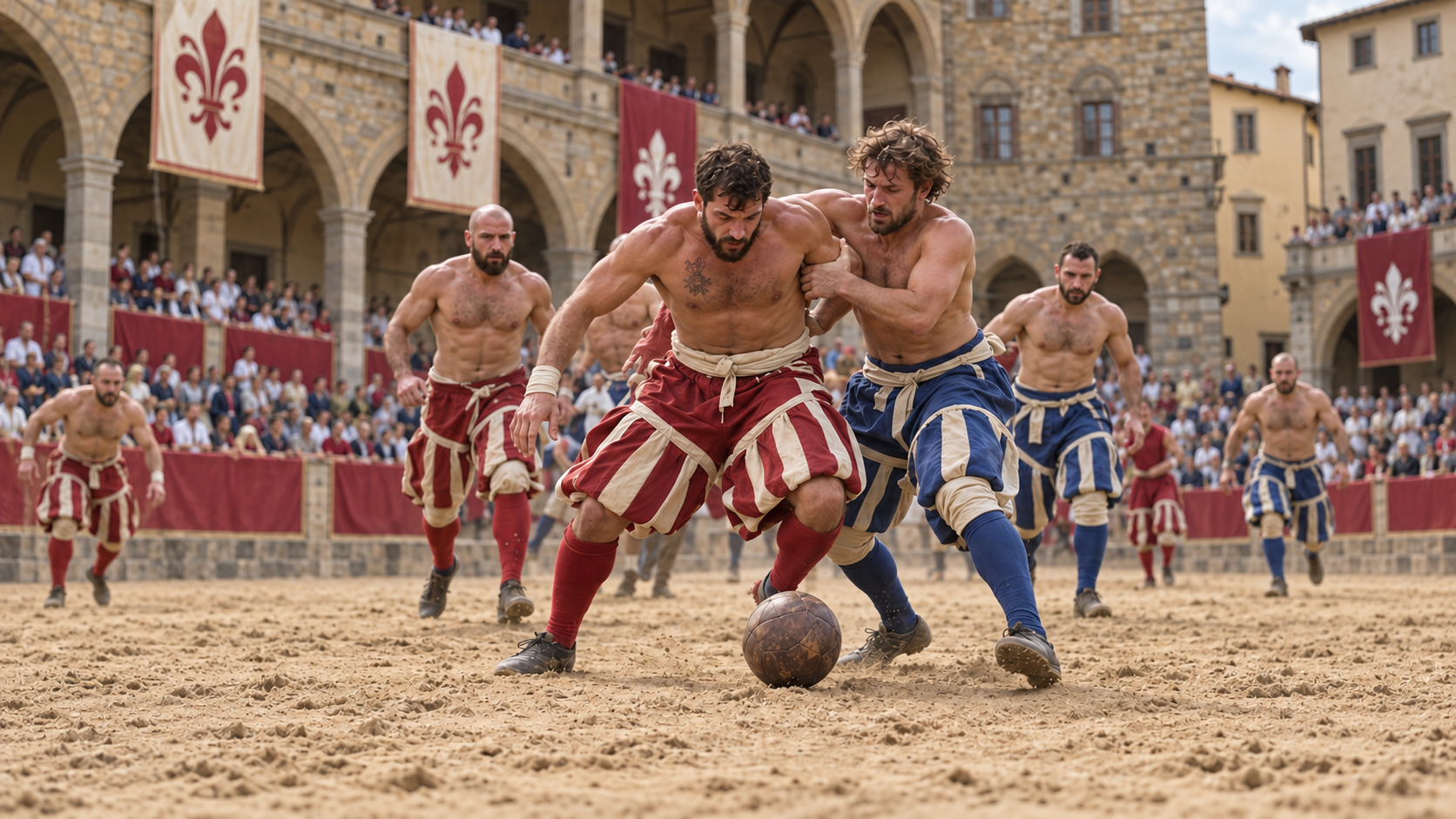
Few traditional European games are as visually dramatic as Calcio Storico Fiorentino. Every June, Piazza Santa Croce in Florence is covered with sand and transformed into an open-air arena. Players dressed in colorful Renaissance-style clothing compete in a contest that appears to combine football, rugby and wrestling.
The game is not a direct ancestor of modern association football in any simple sense. It developed from a much broader family of European ball games in which players could carry, throw and kick the ball. These contests were often rough, loosely regulated and closely connected with public celebrations.
The most famous historical match was played in Piazza Santa Croce on February 17, 1530. Florence was under siege by imperial forces supporting the Medici, yet the Florentines staged a game within sight of the enemy. The match became a symbol of civic pride and defiance.
The tradition later declined and was revived in its modern ceremonial form in 1930. Today it is one of Florence’s best-known annual events.
The Four Colors of Florence
Calcio Storico is contested by four teams representing Florence’s historic quarters:
Azzurri, or Blues, represent Santa Croce.
Bianchi, or Whites, represent Santo Spirito.
Rossi, or Reds, represent Santa Maria Novella.
Verdi, or Greens, represent San Giovanni.
Loyalty to these teams is deeply local. Players, known as calcianti, are not simply athletes wearing historical costumes. They represent particular neighborhoods, families and social networks.
The procession before the match is an essential part of the experience. Musicians, flag throwers, soldiers and costumed participants move through Florence in Renaissance dress before entering Piazza Santa Croce. The spectacle connects the competition with the pageantry of the Florentine Republic.
How Calcio Storico Is Played
Each team fields 27 players. A match lasts 50 minutes, and substitutions are not normally permitted.
The objective is to carry, throw or kick the ball into the scoring area extending across the opponent’s end of the field. A successful score is called a caccia. If a player sends the ball too high and misses the target, the opposing team receives half a caccia.
The ball is only part of the contest. Players grapple with opponents and attempt to create open space for teammates carrying the ball. Physical confrontation is therefore a central tactical element rather than an accidental interruption.
Modern rules restrict some of the most dangerous actions, but Calcio Storico remains extremely demanding. Players need strength, speed, endurance and considerable tolerance for physical contact. Injuries are common, and the intensity of the matches has occasionally led organizers to revise regulations or suspend teams.
Although visitors sometimes describe it as “the world’s most violent football,” that label misses much of its meaning. For Florentines, it is a ritual of neighborhood belonging framed by ceremony, historical memory and a strong code of participation.
The final is traditionally connected with the feast of Florence’s patron saint, San Giovanni Battista, on June 24. Anyone hoping to attend should consult the official Florence information channels, as dates, ticketing arrangements and access rules can change.
Pallapugno: The Ball Game of Piedmont and Liguria
If Calcio Storico is an annual civic spectacle, pallapugno is a continuing regional sport with organized clubs, leagues and championships.
Formerly known widely as pallone elastico, pallapugno is especially associated with the Langhe, Monferrato and other areas of southern Piedmont, as well as parts of western Liguria. Matches are played in a long court called a sferisterio, although older versions were also played against village walls or in public spaces.
The name means “fist ball.” Players strike a small rubber ball with a fist protected by leather and layers of wrapping. The protective covering is essential because the ball can travel at considerable speed.
A standard team has four players with different responsibilities. The battitore begins play and usually provides much of the power, while the other players cover different areas of the court. Strength matters, but so do positioning, anticipation and the ability to control the direction of the ball.
Scoring uses the familiar sequence of 15, 30, 40 and game, reflecting pallapugno’s place within the old European family of handball and court games. Matches can include exchanges in which territory and the location of the ball become tactically important.
The Cultural World of the Sferisterio
Pallapugno once attracted large local crowds, particularly in farming communities where matches were important social occasions. Stories about great players became part of village folklore, and spectators closely analyzed technique, rivalries and playing conditions.
The sport’s vocabulary also reflects local culture. In Piedmont it may be called balon, using the regional form of the Italian word pallone. Historic courts remain visible in several towns, sometimes occupying prominent spaces close to civic buildings and churches.
Unlike a costumed reenactment, pallapugno has continued to evolve. It is governed by the Italian Pallapugno Federation, and contemporary versions include youth activities and lighter forms intended to introduce the game safely in schools.
Its survival nevertheless faces familiar challenges. Small-town depopulation, changing leisure habits and the dominance of globally televised sports have reduced the audience available to many local disciplines. The continued existence of clubs, championships and sferisteri is therefore an important form of cultural preservation.
Pallone col Bracciale and Pallatamburello
Pallapugno belongs to a larger Italian family of traditional ball games.
Pallone col bracciale was once one of the country’s leading spectator sports. Players struck the ball using a heavy wooden cylinder fitted over the forearm. During the 18th and 19th centuries, celebrated players could become public figures, and specialized arenas were constructed in several Italian cities.
The game declined as modern sports became more popular, but exhibitions and local competitions still preserve its techniques and history.
Pallatamburello developed from related traditions. Instead of using the bare or protected hand, competitors strike the ball with a circular implement resembling a tambourine. The sport remains active in several regions and exists in outdoor, indoor and wall-based forms.
These games remind us that Italy possessed a sophisticated sporting culture long before football clubs and national leagues became dominant.
Ruzzola: Rolling Through the Italian Countryside
Ruzzola is a traditional throwing game found particularly in Umbria, Tuscany, Emilia-Romagna, Lazio and the Marche. Players wind a cord around a wooden disc and release it with a powerful motion, sending the disc rolling along a road or prepared course.
The winner is generally the player or team completing the route with the fewest throws. Skill depends on judging the road surface, curves, gradients and the amount of force needed for each launch.
The wooden disc is also called a ruzzola or ruzzolone, depending on its size and the local discipline. Historical accounts and popular memory connect the game with wheels of cheese, which were sometimes rolled instead of wooden equipment. Cheese-rolling versions are still demonstrated during certain celebrations.
Ruzzola turns an ordinary country road into a playing field. That simplicity helps explain its long life: the landscape itself becomes part of the contest.
Morra: Speed, Numbers and a Loud Voice
Morra requires almost no equipment. Two players simultaneously reveal between one and five fingers while shouting the number they believe will equal the combined total shown by both players. A correct prediction wins the point.
The movements are extremely fast, and experienced players develop an ability to recognize patterns in an opponent’s choices. A game may sound like an argument to an unprepared visitor because numbers are shouted loudly and rhythmically.
Morra has been played in many parts of Italy, frequently in taverns, village squares and rural communities. At different times, authorities restricted it because games could encourage gambling, drinking and disputes.
Organized associations now present morra as a game of mental speed and cultural heritage. Regional vocabulary and gestures remain part of its character.
Bocce: From Village Squares to International Competition
Bocce is far more widely known than many of Italy’s traditional games. Its basic principle is simple: players try to place their balls closer than their opponents’ balls to a smaller target ball, the pallino.
Behind that simple objective lies considerable strategy. A player may attempt a precise placement shot or use force to dislodge an opponent’s ball. Different disciplines have their own equipment, surfaces and throwing techniques.
Bocce has moved successfully between informal recreation and regulated competition. It can be played by friends beneath village trees, in specialized clubs or at elite level. Italian migration also helped spread its culture to communities in the United States, Canada, Australia, Argentina and elsewhere.
Historic Horse Races and Jousting Tournaments
Italy’s historic games are not limited to ball sports. Numerous cities preserve competitive festivals inspired by medieval and Renaissance customs.
The Palio di Siena is the best known. Horses representing Siena’s contrade race around Piazza del Campo on July 2 and August 16. The race itself lasts only a short time, but the surrounding ceremonies, trials, blessings, communal dinners and neighborhood loyalties extend far beyond the moments on the track.
The Palio should not be treated merely as entertainment staged for tourists. The contrade are enduring civic institutions, and participation is connected with baptismal traditions, local governance, charitable activity and social life.
Arezzo’s Giostra del Saracino is a jousting contest in which riders representing the city’s four quarters charge toward a rotating target. Foligno’s Giostra della Quintana is another major equestrian competition, accompanied by elaborate historical processions.
Ascoli Piceno holds its own Quintana, while Sardinia’s Sartiglia in Oristano combines horsemanship, masked riders and attempts to spear a suspended star. Asti, Ferrara and several smaller towns also preserve historic palio traditions.
Although these events use historical imagery, they are not all unchanged survivals from the Middle Ages. Many were discontinued, reorganized or revived in later periods. Their authenticity rests less on an unbroken set of rules than on the meaning communities continue to give them.
Flag Throwing as Athletic Performance
Sbandieratori, or flag throwers, are a familiar sight at Italian historical festivals. Their performances combine choreographed movement, drumming, costume and the controlled throwing of large flags.
Modern flag throwing is both a spectacle and a disciplined competitive activity. Teams practice synchronized routines, individual techniques and exchanges in which flags are thrown between performers.
The connection with medieval military signaling is often emphasized during festivals, although today’s complex choreography belongs largely to a later performance tradition. Whatever its precise origins, flag throwing requires timing, coordination, strength and many hours of practice.
Preserving Italy’s Playful Heritage
Traditional sports can disappear surprisingly quickly. They depend on knowledgeable players, suitable public spaces, volunteer associations and young people willing to learn unfamiliar rules.
The Tocatì program, created around the international festival of street games in Verona, has become an important example of safeguarding this heritage. In 2022, UNESCO included “Tocatì, a shared programme for the safeguarding of traditional games and sports” in its Register of Good Safeguarding Practices.
The program does more than place old games on display. It brings players together, encourages participation and treats traditional sports as living forms of cultural expression. Italy’s national federations and local associations also organize championships, demonstrations and school programs for disciplines ranging from ruzzola and morra to tug-of-war and spinning tops.
Watching Traditional Sports in Italy
Travelers should distinguish between regularly practiced sports and historic events held only once or twice a year.
Pallapugno and pallatamburello have competitive seasons, clubs and published match calendars. Calcio Storico, the Palio di Siena and major jousting festivals take place on specific annual dates and may require tickets or advance planning. Smaller village games are often incorporated into religious feasts and local sagre.
Visitors should always verify dates with an official organizer or municipal tourism office. Programs may change because of weather, safety requirements or local decisions.
Major events also deserve respectful behavior. Neighborhood colors, songs and rivalries are meaningful to residents. At horse races and highly physical contests, spectators should follow safety instructions and avoid entering restricted areas.
Our guide to Italian festivals and cultural celebrations offers more ideas for experiencing local traditions.
More Than a Game
Traditional Italian sports survive because they perform several roles at once. They are physical contests, public ceremonies, social gatherings and expressions of local identity.
Calcio Storico transforms Florence’s neighborhood rivalries into a fierce Renaissance spectacle. Pallapugno keeps the sferisteri of Piedmont and Liguria active. Ruzzola turns rural roads into courses, while morra transforms numbers and gestures into a contest of speed. Palios, jousts and flag-throwing competitions bring entire communities into the performance.
These traditions show that Italian sport did not begin with the modern stadium. Its older playing fields were city squares, village walls, taverns and country roads—and in many parts of Italy, they still are.
External Sources
Calcio Storico Fiorentino – Visit Tuscany
Italian Federation of Traditional Games and Sports
Tocatì: Safeguarding Traditional Games and Sports – UNESCO
Tocatì International Festival of Street Games