

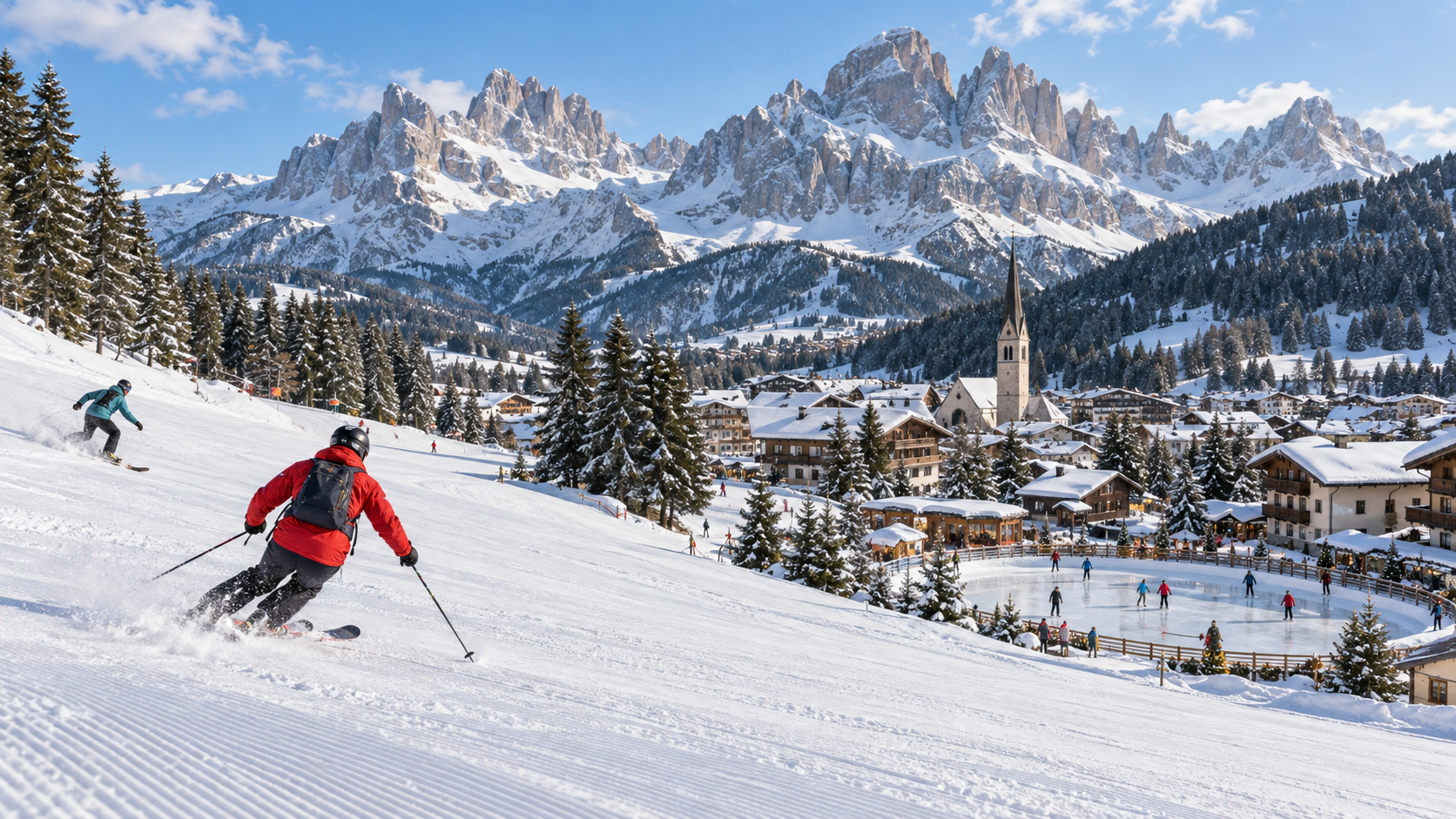
 Italy may be celebrated for Renaissance cities, Mediterranean beaches and extraordinary food, but winter reveals an entirely different side of the country. From the high-altitude resorts of the Alps to the quieter ski areas of the Apennines, Italy offers skiing, snowboarding, cross-country trails, ice skating, snowshoeing and winter activities for almost every ability and budget.
The best-known resorts are concentrated across Valle d’Aosta, Piedmont, Lombardy, Trentino-Alto Adige, Veneto and Friuli-Venezia Giulia. However, travelers can also find substantial winter-sports areas in Abruzzo and smaller mountain destinations farther south.
I love the contrast that defines an Italian winter holiday. A day may begin on a panoramic mountain piste, continue with lunch in a traditional rifugio and end with a walk through a historic village. The experience is rarely limited to sport alone: local cuisine, Alpine culture, spas, Christmas markets and dramatic landscapes are integral parts of the trip.
When Is the Winter-Sports Season in Italy?
The main Italian ski season normally runs from December through March. High-altitude resorts may open in November and continue into April, depending on snowfall, temperature and lift operations.
January and early February generally offer reliable winter conditions, while March brings longer days and often milder temperatures. Christmas, New Year, Carnival weeks and school holidays are among the busiest and most expensive periods.
Exact opening dates should never be assumed. Snow cover, wind, maintenance and competitions can affect individual lifts and pistes, so check the resort’s official website shortly before traveling.
A few high-altitude areas offer skiing beyond the traditional winter season. Breuil-Cervinia, for example, is connected with Zermatt and its glacier terrain, although summer and autumn access can change because of weather and maintenance. Never describe glacier skiing as guaranteed throughout the year without checking current operations.
The Dolomites: Italy’s Largest Winter Playground
The Dolomites provide Italy’s most extensive concentration of interconnected winter-sports destinations. The Dolomiti Superski network covers 12 ski areas and advertises more than 1,200 kilometers of pistes accessible through a single ski-pass system.
It is important to understand that all 1,200 kilometers are not connected directly by lifts. Some areas require a bus or car transfer. Within the network, however, travelers can choose among celebrated destinations such as Cortina d’Ampezzo, Val Gardena, Alta Badia, Arabba, Val di Fassa, Kronplatz and the Three Peaks Dolomites.
Cortina d’Ampezzo
Cortina combines dramatic scenery, historic prestige and a sophisticated town center. It suits travelers who want excellent skiing without sacrificing restaurants, boutiques and evening atmosphere.
The surrounding ski areas include terrain at Tofana, Faloria-Cristallo and Lagazuoi–5 Torri. Beginners have access to ski schools and easier slopes, while experienced skiers can seek out steeper descents and longer mountain itineraries.
Cortina also offers cross-country skiing around Fiames, snowshoe excursions, curling and seasonal ice skating. It is one of Italy’s strongest choices for a mixed group in which not everyone wants to ski.
Read more about the area in Italia Mia’s guide to the Veneto region.
Val Gardena
Val Gardena includes Ortisei, Santa Cristina and Selva di Val Gardena. It is particularly attractive to intermediate and advanced skiers because of its access to the Sellaronda, the famous circuit around the Sella massif.
Selva provides convenient slope access and an energetic ski-resort atmosphere. Ortisei has an appealing historic center and direct access to areas including Alpe di Siusi and Seceda. Santa Cristina offers a quieter position between the two.
The Pranives Ice Stadium in Selva remains an important skating facility, but it should not be presented as continuously open throughout the year. Current tourism information describes public sessions from approximately mid-July to mid-September and again from mid-December to April. Times vary weekly and the rink is also used by clubs and hockey teams.
Alta Badia
Alta Badia is known for well-maintained slopes, exceptional mountain scenery and some of the best dining in the Italian Alps. Its terrain is particularly welcoming to intermediate skiers, although beginners and advanced visitors are also well served.
Corvara is the most convenient base for direct access to the Sellaronda. Colfosco sits beneath spectacular peaks, while San Cassiano and La Villa provide a slightly quieter atmosphere.
Alta Badia has approximately 130 kilometers of slopes served by more than 50 lifts, according to Italy’s official tourism portal. The Gran Risa piste at La Villa is its best-known challenge.
Val di Fassa and Arabba
Val di Fassa provides several village bases, including Canazei, Campitello, Pozza and Vigo di Fassa. Canazei is especially convenient for reaching the Sellaronda, while families may prefer smaller and quieter communities.
Arabba is a better choice for confident skiers. Its higher, more demanding terrain connects toward the Marmolada area and the Sellaronda. Weather and wind can affect the highest lifts, so check daily conditions before committing to a long circuit.
Madonna di Campiglio: Skiing and Alpine Style
Madonna di Campiglio is one of Italy’s most polished winter resorts. Its connected ski area extends through Pinzolo and Folgarida-Marilleva, providing more than 150 kilometers of pistes. The destination also offers cross-country skiing, ski schools and ice skating.
Beginners benefit from dedicated learning areas, while intermediate skiers have a wide selection of groomed red and blue runs. More experienced visitors can try celebrated pistes such as the Canalone Miramonti.
Snowboarders and freestyle skiers should look at the Ursus Snowpark in the Grostè area. Other winter activities include snowshoeing, dog sledding and excursions through the Adamello-Brenta landscape.
The resort usually aims to operate from late November or early December until around mid-April, but individual openings remain dependent on conditions.
For more regional ideas, see the Italia Mia guide to Trentino-Alto Adige.
Breuil-Cervinia: High-Altitude Skiing Beneath the Matterhorn
Breuil-Cervinia is one of Italy’s strongest choices for altitude, long pistes and an extended season. The resort sits beneath the Matterhorn—known in Italian as Monte Cervino—and connects with Valtournenche and Zermatt in Switzerland.
The wider international ski domain offers roughly 350 kilometers of pistes when the cross-border links are operating.
Cervinia’s broad slopes are generally well suited to beginners and intermediate skiers. Advanced visitors may prefer to explore the full international area or descend toward Valtournenche. Because the terrain reaches very high elevations, wind and poor visibility can sometimes interrupt connections.
Anyone planning to ski into Switzerland should purchase the correct international pass, carry suitable identification and allow enough time to return before the connecting lifts close.
The Matterhorn Alpine Crossing also allows pedestrians to travel between Breuil-Cervinia and Zermatt by lift, making the area appealing to non-skiers who want a high-mountain experience.
Explore more of the region through Italia Mia’s Aosta Valley guide.
Courmayeur: Mont Blanc Scenery and Refined Atmosphere
Courmayeur lies near the Italian side of Mont Blanc and offers a more intimate ski domain than Cervinia. Its strengths include impressive scenery, attractive mountain restaurants and a lively historic center.
The local slopes are best suited to intermediates, although beginners have learning areas and experienced skiers can arrange guided off-piste excursions. The Skyway Monte Bianco provides a spectacular high-altitude sightseeing experience, but it is not an ordinary ski lift connecting a network of marked pistes.
Courmayeur is a particularly good choice for couples and mixed-interest groups. Non-skiers can enjoy winter walking, spas, shopping and mountain dining. Off-piste skiing around Mont Blanc requires professional guidance, appropriate equipment and careful assessment of avalanche conditions.
Livigno: Italy’s Snowboarding and Freestyle Capital
Livigno sits at approximately 1,800 meters in a high valley near the Swiss border. Its altitude, cold climate and extensive snowmaking contribute to a relatively long winter season.
The ski area offers approximately 115 kilometers of pistes across the Mottolino and Carosello 3000 sides of the valley. Its official tourism organization lists terrain for every level, including blue, red and black runs.
Livigno is especially attractive to snowboarders and freestyle skiers. The Mottolino Snowpark includes multiple jump lines and obstacles designed for different ability levels. The resort’s freestyle credentials were strengthened further when Livigno hosted snowboard and freestyle skiing events during the Milano Cortina 2026 Winter Olympics.
Beyond downhill skiing, visitors can try cross-country skiing, fat biking, snowshoeing and seasonal ice skating. Livigno is also known for its duty-free status, which contributes to a busy shopping and après-ski scene.
The town is spread along a long valley, so check the location of your accommodation in relation to the lifts you expect to use.
Bormio: Challenging Skiing and Thermal Baths
Bormio offers one of the most distinctive combinations in the Italian Alps: demanding skiing followed by naturally warm thermal water.
The resort is famous for the Stelvio piste, used in international downhill racing. Its long vertical descent makes Bormio particularly rewarding for strong intermediate and advanced skiers. Beginners can still find suitable terrain, but families seeking a very gentle, compact ski area may prefer nearby Santa Caterina Valfurva.
After skiing, visitors can choose between modern public thermal facilities and historic spa experiences. This makes Bormio an excellent base for travelers who want a winter holiday that balances activity and relaxation.
The surrounding Alta Valtellina area also includes Santa Caterina and Cima Piazzi–San Colombano, allowing visitors to vary their skiing during a longer stay.
Sestriere and the Via Lattea
Sestriere is the highest-profile Italian base in the Via Lattea, or Milky Way, ski domain. The wider area extends across several Piedmontese resorts and into Montgenèvre in France.
Purpose-built Sestriere provides convenient access to the slopes, dependable resort services and terrain suitable for different abilities. Sauze d’Oulx has a more traditional village atmosphere and a livelier après-ski scene, while Sansicario and Claviere can appeal to families and visitors seeking quieter surroundings.
The Via Lattea’s size is a major advantage, but not every sector is equally convenient in all conditions. Study the piste map and lift status before attempting a long journey across the domain.
See Italia Mia’s guide to the Piedmont region for ideas beyond the slopes.
Skiing in the Central and Southern Apennines
Italy’s winter-sports geography does not end at the Alps. The Apennines offer smaller resorts, easier access from Rome and Naples, and a more local atmosphere.
Snow conditions can be less predictable than at the highest Alpine resorts. Travelers should therefore book flexibly and check live snow reports before departure.
Roccaraso and Alto Sangro
Roccaraso is the principal winter-sports center in Abruzzo and one of the most substantial ski destinations in central and southern Italy.
The wider Alto Sangro area connects sectors including Aremogna, Monte Pratello and Pizzalto. Official local information lists extensive downhill terrain supported by gondolas, chairlifts, ski lifts and beginner conveyors.
Roccaraso is popular with visitors from Rome, Naples and southern Italy. It offers ski schools, equipment rental, cross-country skiing and family activities. Weekends can become crowded, so a midweek visit is usually more relaxed.
Read more in Italia Mia’s Abruzzo travel guide.
Campo Imperatore and Ovindoli
Campo Imperatore provides a dramatic high plateau beneath the Gran Sasso massif. The landscape is one of its greatest attractions, but road, cable-car and weather conditions require careful checking.
Ovindoli is another accessible Abruzzo option, particularly for travelers coming from Rome. It offers downhill skiing, snowboard facilities and beginner services in a compact setting.
Neither destination should be treated as a guaranteed-snow alternative to the high Alps. Their appeal lies in accessibility, scenery and the possibility of combining winter sport with historic Abruzzo towns.
Etna and Southern Ski Areas
When snow and volcanic conditions permit, skiing is possible on Mount Etna in Sicily. The experience can include extraordinary views toward the Mediterranean, but operations are highly dependent on snowfall, wind and volcanic activity.
Etna should be considered an unusual seasonal opportunity rather than the basis for a tightly scheduled ski holiday. Calabria and Basilicata also have small winter areas, but conditions and services vary considerably from season to season.
Where to Go Ice Skating in Italy
Ice skating in Italy falls into three broad categories:
- indoor ice stadiums used by hockey teams, figure-skating clubs and the public;
- seasonal outdoor rinks in Alpine resorts;
- temporary Christmas rinks in city centers.
Visitors should not assume that an indoor rink is open to the public every day—or throughout the year. Training, hockey matches, maintenance and ice preparation can limit public access.
Reliable mountain options may include Pranives in Selva di Val Gardena, the Olympic Ice Stadium in Cortina, resort rinks in destinations such as Madonna di Campiglio and seasonal facilities in Livigno. Always consult the rink or local tourism office for the current public-skating calendar.
Temporary rinks also appear in cities such as Milan, Turin, Rome, Florence and Genoa during the Christmas period. Their dates and locations can change annually.
The rink at Genoa’s Porto Antico, for example, is a seasonal winter attraction. It should not be confused with a permanently operating year-round facility.
Best Destinations by Type of Traveler
Best for beginners
Alta Badia, Cervinia, Livigno and parts of the Dolomiti Superski network provide abundant gentle terrain, ski schools and convenient rental services.
Best for intermediate skiers
Val Gardena, Alta Badia, Madonna di Campiglio and Livigno offer enough variety for several days without requiring expert technique.
Best for advanced skiers
Arabba, Bormio, parts of Cortina and the wider Cervinia–Zermatt area offer challenging pistes and substantial vertical descents.
Best for snowboarders and freestyle skiers
Livigno is the outstanding choice, followed by Madonna di Campiglio and resorts with established snowparks in the Dolomites.
Best for non-skiers
Cortina, Courmayeur, Madonna di Campiglio and Ortisei combine attractive town centers with cable-car excursions, winter walks, dining and wellness options.
Best for travelers based in Rome or Naples
Roccaraso, Ovindoli and Campo Imperatore are more practical than the Alps for a short trip, although snow reliability varies.
Best for a combination of skiing and wellness
Bormio leads this category because of its thermal baths. Several resorts in South Tyrol and Trentino also have excellent spa hotels.
Planning a Winter-Sports Holiday in Italy
Choose your base carefully
A large ski domain does not mean every hotel is close to every lift. Check the walking distance, ski-bus route and altitude of your accommodation before booking.
Visitors traveling without a car should favor towns with strong rail or bus connections and reliable local ski transport. Bolzano, Trento, Turin, Milan and Verona are useful gateways, but the final mountain transfer may require a bus, private shuttle or rental car.
Reserve equipment and lessons
During Christmas, New Year and school-holiday periods, reserve ski lessons and rental equipment before arrival. Beginners should not assume that English-language group lessons will always be available at short notice.
Understand ski-pass coverage
Some destinations sell local, regional and international passes. Buy only the coverage you need. A beginner spending two days in one sector may gain little from the most expensive multi-area pass.
Prepare for mountain driving
Winter tires or approved traction equipment may be legally required on designated roads during specified periods. Mountain roads can be affected by snow, ice and temporary closures.
Do not rely exclusively on the legal minimum. Check forecasts, carry the required equipment and avoid unfamiliar mountain roads during severe weather.
Follow Italy’s slope-safety rules
Liability insurance is required for downhill skiers and snowboarders using Italian ski areas. It may be included with certain travel-insurance policies or offered with the ski pass, but travelers should verify the actual coverage.
Helmet requirements have also expanded. Current Italian police guidance indicates that helmets are compulsory for slope users, so bring or rent an approved helmet rather than relying on older advice aimed only at minors.
Observe posted signs, control your speed and never enter a closed piste. Anyone considering ski touring or freeriding should consult the official Meteomont avalanche bulletin and use a qualified mountain guide.
What to Pack
Essential items include:
- waterproof ski jacket and trousers;
- thermal base layers;
- insulated gloves;
- ski socks;
- goggles and sunglasses;
- sunscreen and lip protection;
- an approved helmet;
- suitable footwear for icy streets;
- travel insurance documentation;
- a compact day pack and reusable water bottle.
Mountain weather can change rapidly. Pack for cold, wind and strong sunshine even when the forecast appears favorable.
Travelers who want more background before departure can browse these Italy skiing guidebooks on Amazon. As an Amazon Associate, Italia Mia may earn from qualifying purchases.
Winter in Italy Beyond the Slopes
A winter-sports holiday in Italy is often as memorable for what happens away from the pistes as for the skiing itself.
Mountain refuges serve regional dishes such as canederli, polenta, fonduta, pizzoccheri and hearty soups. Villages preserve traditions shaped by Italian, Ladin, German-speaking and Franco-Provençal cultures. Many resorts also offer snowshoe routes, sledding, spas, scenic cable cars and winter walking.
This variety makes Italy particularly suitable for families and mixed groups. Strong skiers can spend the day exploring the mountains while other travelers enjoy skating, village life, wellness or a long lunch with a view.
Choosing the Right Italian Winter Destination
Choose the Dolomites for variety, scenery and an enormous selection of pistes. Select Cervinia for altitude and cross-border skiing, Livigno for snowboarding and freestyle, Bormio for challenging descents and thermal baths, or Courmayeur for Mont Blanc scenery and an elegant atmosphere.
Madonna di Campiglio offers one of the best combinations of skiing and refined resort life. Roccaraso is the most practical substantial option for many travelers coming from central or southern Italy.
For ice skating, focus on verified public sessions rather than claims of permanent availability. Even major indoor stadiums work around club training, hockey and maintenance schedules.
Wherever you go, confirm lift operations, rink hours, road conditions and weather shortly before traveling. Italy’s winter landscape can be spectacular, but the best trips are built around current information rather than assumptions.
External Links
- Dolomiti Superski official website
- Cervino Ski Paradise official website
- Livigno official tourism website
- Trentino official tourism website
- Pranives Ice Stadium official website
- Roccaraso and Alto Sangro official website
- Meteomont avalanche bulletins
- Italy’s official winter-sports portal