

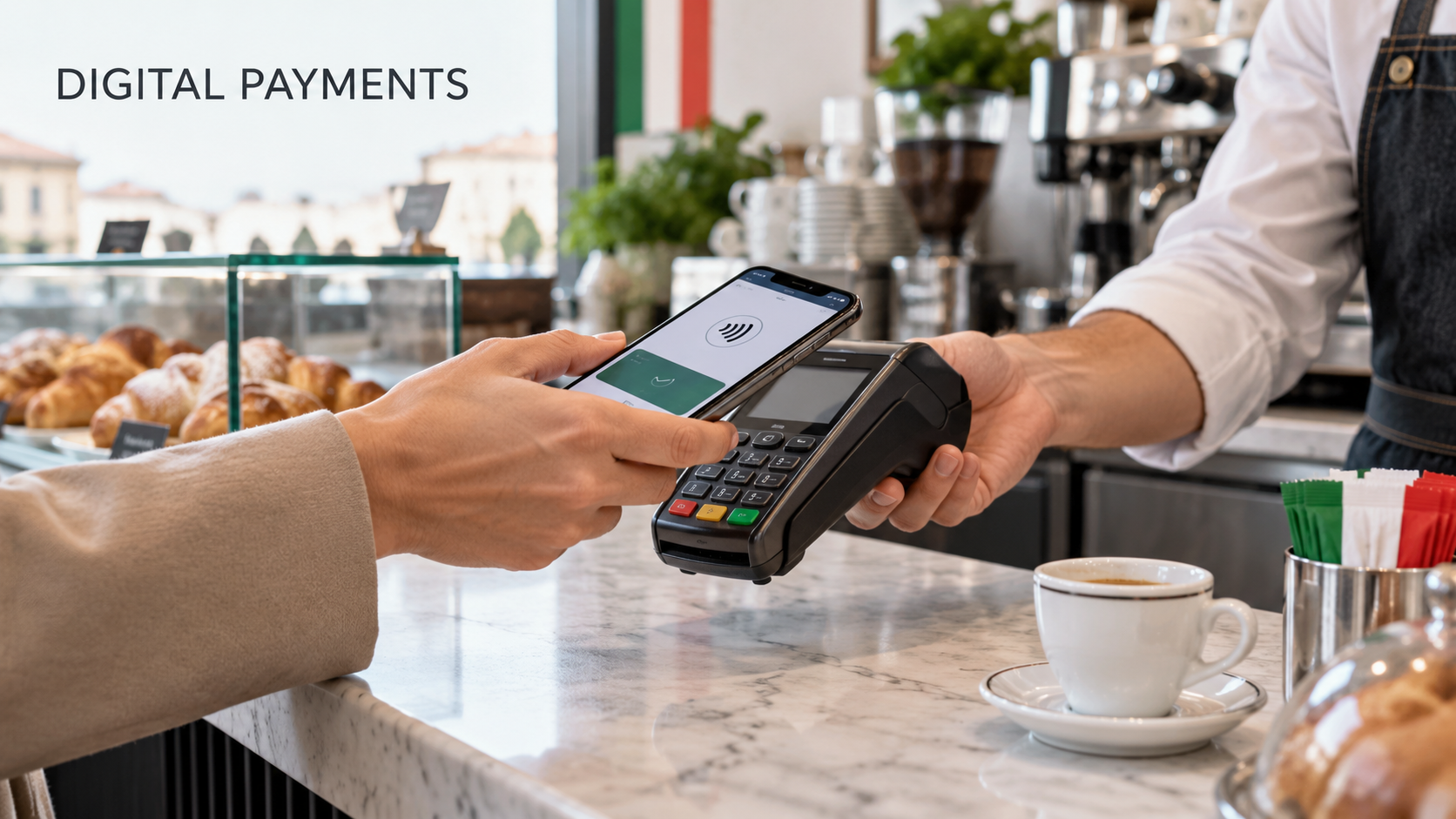
 Italy’s relationship with money is changing. Cash remains deeply rooted in everyday life, particularly for small purchases, but cards, smartphones and payment apps now occupy a much larger place in the Italian economy.
The earlier idea of an Italian e-wallet “boom” was broadly correct, but the digital-payment market has moved far beyond the handful of online services that originally drove adoption. Today, mobile wallets are used in supermarkets, restaurants, pharmacies, public transport systems, online shops and even small neighborhood businesses.
This is no longer primarily a story about online gaming. It is about how Italians pay for almost everything.
What Is an E-Wallet?
An electronic wallet, usually called a digital wallet or mobile wallet, allows users to store payment credentials on a smartphone, smartwatch or online account.
Depending on the service, a wallet may be connected to:
- A debit or credit card
- A prepaid card
- A bank account
- A dedicated balance held within the app
- A person’s telephone number or digital identity
Some wallets are designed mainly for contactless purchases in physical shops. Others specialize in online checkout, peer-to-peer transfers, bills or payments to public authorities.
Apple Pay and Google Wallet, for example, usually act as secure digital versions of cards issued by participating banks. Services such as PayPal, Satispay and BANCOMAT Pay operate differently and may offer additional functions, including sending money to friends or paying bills.
Why Digital Payments Are Growing in Italy
Several factors have accelerated the transition.
Contactless payments have become routine
Contactless card terminals are now common throughout Italy. A customer can generally pay by tapping a card, smartphone or smartwatch on the terminal without handing the payment instrument to the merchant.
Once consumers became familiar with tapping a card, paying with a phone became a relatively small behavioral change.
Smartphones have replaced the physical wallet for some purchases
A mobile wallet can hold more than payment cards. Depending on the platform, users may also store tickets, loyalty cards, boarding passes and other credentials.
This convenience has made the smartphone a practical payment tool rather than merely an alternative for technology enthusiasts.
E-commerce continues to influence payment habits
Italians increasingly purchase travel, clothing, food deliveries, subscriptions and household products online. Digital wallets can simplify checkout because the customer does not need to enter card information for every transaction.
Banca d’Italia reports that cashless payments are increasing in Italy, supported partly by e-commerce. Cards remain the leading alternative to cash, while mobile payments at physical points of sale and electronic solutions for online purchases are also growing.
More small businesses can accept mobile payments
Traditional payment acceptance required a dedicated terminal and a merchant agreement. Businesses now have more options, including compact card readers, QR-code payments and software-based systems that can turn a compatible smartphone into a contactless terminal.
Apple introduced Tap to Pay on iPhone in Italy in 2024, allowing participating payment platforms to offer contactless acceptance through an iPhone without a separate card reader.
Government services have moved online
Italy’s digital public-service infrastructure has also helped normalize app-based payments. Residents can use services such as pagoPA to pay taxes, fines, school charges and other amounts owed to participating public bodies.
The IO app brings together public-service messages, payments and selected administrative functions. These systems are not conventional commercial wallets, but they reinforce the expectation that payments and government services should be accessible from a phone.
The Main Digital Wallets Used in Italy
The market includes international technology platforms, bank-supported services and Italian payment companies.
Apple Pay
Apple Pay allows customers to add eligible credit, debit and prepaid cards to Apple Wallet. It can be used in shops accepting contactless payments, as well as on participating websites and apps.
Availability depends on the card issuer. Travelers and residents should therefore check whether their particular bank and card are supported rather than assuming that every card will work.
Google Wallet
Google Wallet provides a similar service on compatible Android devices. Users can add eligible payment cards and make contactless purchases where the service and card are supported.
Google maintains a country-specific list of supported payment methods in Italy.
PayPal
PayPal remains widely recognized for online payments. Customers can connect a bank account or card and make purchases without giving those details directly to every merchant.
PayPal is particularly relevant to e-commerce, subscriptions and international transactions, although currency conversion and certain transaction types may involve additional costs.
Satispay
Satispay is one of the most visible Italian-founded payment services. It can be used for purchases at participating physical and online merchants, person-to-person payments and various services within the app.
Unlike wallets that simply reproduce a payment card on a phone, Satispay operates through its own payment network and account-based system. Its acceptance is extensive but not universal, so customers should look for the Satispay sign or check participating businesses in the app.
BANCOMAT Pay
BANCOMAT Pay is linked to Italy’s familiar BANCOMAT payment ecosystem. Depending on the participating bank, customers can access it through their bank’s mobile application or the BANCOMAT app.
The service supports functions such as payments to participating merchants, online purchases and transfers between individuals. Availability and individual features depend on the user’s bank.
Bank and fintech applications
Italian banks and fintech companies also provide their own apps for card management, transfers and digital payments. Some integrate with Apple Pay, Google Wallet or BANCOMAT Pay, while others offer proprietary payment tools.
The result is not a single national e-wallet market but an interconnected collection of card networks, bank applications, international wallets and independent payment services.
Cash Has Not Disappeared
It would be misleading to describe Italy as a cashless country.
According to Banca d’Italia’s report based on the ECB’s 2024 consumer survey, cash remained the main payment method at physical points of sale in Italy, especially for purchases of up to €50. At the same time, its share was gradually declining, while cards and mobile payments were increasing.
The situation varies noticeably by location and type of business. Digital payments are generally easy to use in cities, supermarkets, hotels, chain stores and major tourist destinations. Cash may still be more convenient at markets, kiosks, rural businesses and very small establishments.
Anyone traveling in Italy should carry more than one way to pay. A wallet containing some euros and a physical card remains useful even when most purchases are made by phone.
Are Italian Businesses Required to Accept Electronic Payments?
Italian merchants and professionals are generally required to make electronic payment available, although the detailed rules, exceptions and enforcement mechanisms have evolved over time.
That does not mean every business must accept every wallet. A shop that accepts card payments may support Apple Pay or Google Wallet through its contactless terminal but not accept Satispay or BANCOMAT Pay as separate services.
Consumers should also distinguish between the right to use an electronic payment method and the assumption that a specific branded app must be accepted.
How Secure Are Digital Wallets?
Digital wallets can be safer than repeatedly entering or sharing a physical card number, but no payment method is completely risk-free.
Many mobile wallets use tokenization. Instead of providing the merchant with the card’s original number, the system uses a device-specific or transaction-specific credential. Payments may also require a fingerprint, facial recognition, passcode or another form of authentication.
European Strong Customer Authentication rules have added further verification requirements to many electronic transactions.
Banca d’Italia reported that fraudulent payments represented a very small share of the overall value transacted in the second half of 2025. It also found that payments protected by Strong Customer Authentication showed substantially lower fraud rates than transactions without it. However, fraud involving manipulation of the payer—convincing someone to authorize a payment voluntarily—remains a significant problem.
Common Digital-Payment Scams in Italy
Technology can secure the transaction, but it cannot always prevent a customer from being deceived.
Common risks include:
- Text messages pretending to come from a bank
- False warnings that an account has been blocked
- Requests to move money to a supposedly “safe” account
- Fake payment links and QR codes
- Fraudulent online shops
- Marketplace buyers who ask sellers to enter card details
- Telephone calls requesting verification codes
- Messages impersonating relatives who claim to need urgent money
A genuine bank should not ask a customer to disclose a complete password, card PIN or one-time security code during an unsolicited call.
Before approving a transfer, check the recipient’s name and IBAN carefully. EU rules for instant payments introduced verification of the beneficiary’s name against the account information to help identify errors and fraud.
Instant Bank Transfers Are Changing the Market
Digital wallets are not the only reason payments are becoming faster.
EU rules require eligible payment providers to make instant euro transfers more widely available. These transfers can arrive within approximately ten seconds, including during evenings, weekends and holidays. Charges for an instant euro transfer cannot be higher than those applied to an equivalent standard transfer.
This makes bank transfers more competitive for person-to-person payments and certain purchases. It also reduces one of the traditional advantages held by independent wallet apps: the ability to move money immediately.
Speed, however, increases the need for caution. An instant transfer may be difficult to recover once the money reaches the recipient.
What About the Digital Euro?
The digital euro is frequently confused with existing electronic wallets and cryptocurrencies, but it would be different from both.
It is a proposed digital form of central-bank money issued by the Eurosystem. If introduced, it could be used for shop purchases, online payments and transfers between individuals. It would complement cash rather than formally replace banknotes and coins.
The digital euro is not yet available to consumers. The European Central Bank is continuing its technical work while the legislative process proceeds. The ECB says the Eurosystem could be ready for a possible first issuance during 2029, assuming the required EU legislation is adopted.
Consumers should be suspicious of any website, investment scheme or salesperson claiming to sell official digital euros today.
Advice for Visitors to Italy
Travelers can normally use international cards and major mobile wallets in Italy, but a few precautions make payments easier:
- Notify the card issuer if required before international travel.
- Carry a second card from a different network.
- Keep a modest amount of cash for small purchases and emergencies.
- Check whether the card charges foreign transaction fees.
- Choose euros rather than home-currency conversion when a terminal offers both options, after reviewing your issuer’s charges.
- Keep a physical card available in case a phone loses power or connectivity.
- Do not rely on a single payment app.
- Use a passcode and biometric protection on the phone.
A mobile wallet does not eliminate the fees attached to the underlying card. Foreign transaction charges and exchange-rate markups may still apply.
Advice for People Living in Italy
Residents choosing a wallet should look beyond promotional bonuses. Important considerations include:
- Support from their bank and card issuer
- Acceptance among local merchants
- Fees for transfers or withdrawals
- Purchase and refund procedures
- Ability to block the service quickly
- Customer-support availability
- Privacy and data-use policies
- Compatibility with public-service payments
- Support for online and international purchases
Using two complementary systems can be practical. One might serve as a contactless version of a bank card, while another is used for sending money to friends, paying small businesses or settling public charges.
Italy’s Payment Transformation Is Bigger Than E-Wallets
The original e-wallet boom has developed into something broader: a gradual modernization of Italy’s entire payment environment.
Cash remains important, but consumers now expect to move easily between physical cards, mobile wallets, online accounts, QR codes and instant transfers. Banks, fintech companies, merchants and public institutions are all participating in that transition.
The most significant change is therefore not the success of one particular app. It is the disappearance of the boundary between online and offline payments. A phone can now pay for an espresso, settle a public-service charge, send money to a friend and complete an international online purchase.
Digital payment in Italy is no longer a niche trend. It has become part of everyday economic life.
External Sources
- Banca d’Italia: Payment attitudes of consumers in Italy
- Banca d’Italia: Report on fraudulent payment transactions
- Council of the European Union: Instant-payments regulation
- European Central Bank: Progress on the digital euro
- pagoPA official website
- IO public-services app