

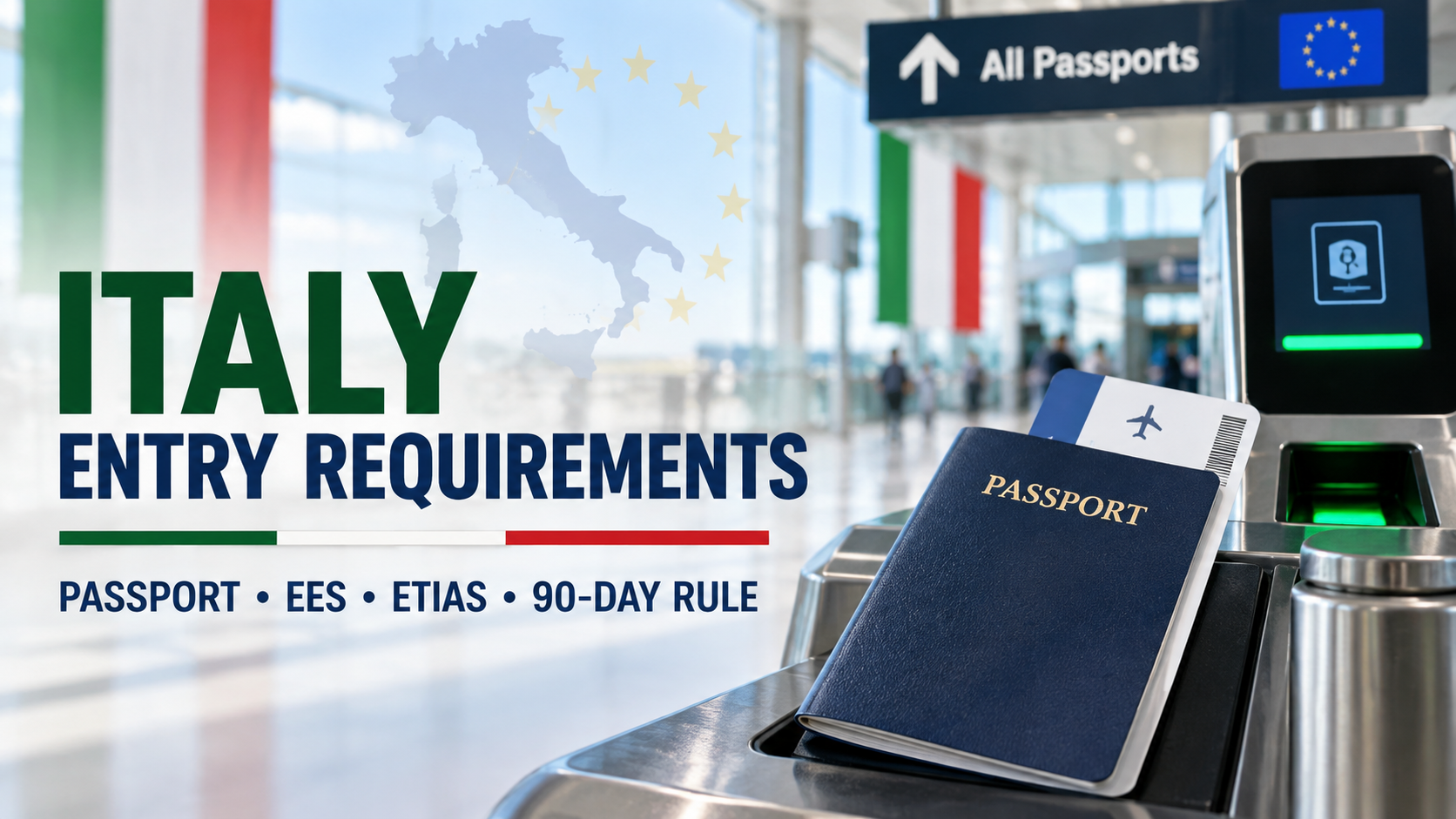
 American citizens can travel to Italy without obtaining a traditional visa for short vacations or business trips. However, travelers must meet passport requirements, respect the Schengen Area’s 90-day limit and complete the European border procedures in effect at the time of travel.
The Entry/Exit System, known as EES, is already being used to record travelers electronically. ETIAS, a separate online travel authorization, is not yet required as of September 20, 2026. Because the ETIAS timetable has changed repeatedly, travelers should verify the official European Union website shortly before departure.
Quick Entry Checklist for U.S. Citizens
For an ordinary vacation in Italy, a U.S. citizen should have:
• A valid U.S. passport book
• A passport issued within the previous 10 years
• At least three months of passport validity after the intended departure from the Schengen Area
• Enough unused passport pages for any stamps that may still be required
• A return or onward ticket
• Proof of accommodation
• Evidence of sufficient funds for the trip
• Compliance with the limit of 90 days in any rolling 180-day period
• ETIAS authorization once the system becomes mandatory
Travel insurance is not normally an entry requirement for visa-free U.S. tourists, but medical and trip insurance is strongly recommended. Medicare and many American health plans provide little or no coverage outside the United States.
Do U.S. Citizens Need a Visa for Italy?
U.S. citizens do not normally need a visa when visiting Italy for tourism or business for no more than 90 days in any 180-day period.
Visa-free entry does not cover every activity. A traveler who intends to work, study for an extended period, establish residence or remain longer than 90 days will generally need the appropriate Italian national visa before traveling.
Buying a house in Italy does not automatically give an American the right to remain beyond the 90-day limit. Property owners are subject to the same immigration rules unless they hold a suitable visa or residence permit.
Passport Requirements for Italy
Your U.S. passport must generally:
• Be valid for at least three months beyond the date you plan to leave the Schengen Area
• Have been issued within the previous 10 years
• Be in good physical condition
• Match the name used on your airline reservation
Although the formal minimum is three months beyond departure, the U.S. Department of State recommends having at least six months of remaining validity. Airlines can also apply document checks before allowing a passenger to board.
A passport card is not valid for air travel to Italy. Travelers need a passport book.
If a passport has been reported lost or stolen, it should not be used even if it is later recovered. Border databases may still identify it as invalid, potentially leading to denied boarding or refusal of entry.
What Is the 90-Day Rule?
The visa-free allowance is 90 days during any rolling 180-day period. This rule applies to the entire Schengen Area, not separately to Italy.
Days spent in France, Spain, Germany, Greece, Portugal, Austria, Switzerland and other Schengen countries count toward the same 90-day total. Traveling from Italy to another Schengen country does not restart the clock.
Both the arrival day and departure day normally count as days spent in the Schengen Area. Even arriving shortly before midnight generally uses one full calendar day.
For example, if an American spends 30 days in Italy, 20 days in France and 40 days in Spain within the same relevant 180-day period, the traveler has reached the 90-day limit.
The calculation is always made by looking back over the previous 180 days from each day of presence. It is therefore not based on a calendar year, and the allowance does not automatically reset on January 1 or after a brief trip outside the Schengen Area.
Travelers planning several European trips should use the official European Commission short-stay calculator and keep their own record of entry and exit dates.
Can You Leave Italy and Immediately Return?
Leaving Italy for a few days does not automatically provide another 90 days. A weekend in the United Kingdom, Ireland, Morocco or another non-Schengen destination may reduce the number of days currently inside the Schengen Area, but it does not erase the days already used.
A traveler who has spent 90 consecutive days in the Schengen Area will generally need to remain outside it for another 90 days before having a completely new 90-day allowance.
Overstaying can result in fines, removal, complications during future trips or a temporary ban from entering countries in the Schengen Area.
What Is EES?
The Entry/Exit System is the European Union’s digital border-management system for non-EU citizens making short visits. It applies to American travelers even though they are exempt from obtaining a short-stay visa.
EES records information such as:
• Passport details
• Date and location of entry
• Date and location of exit
• A facial image
• Fingerprints, when required
• Any refusal of entry
The system is designed to replace most manual passport stamping and automatically identify travelers who exceed their authorized stay.
At the first EES registration, an American traveler may be asked to present the passport, look into a camera and provide fingerprints. Children under 12 are generally not fingerprinted, although a facial image may still be collected.
Later crossings should be quicker because the traveler’s record can be retrieved and verified. However, temporary delays are possible, particularly at busy airports, ports and land borders. Travelers should allow extra time for immigration procedures.
There is no separate EES application to complete before leaving home, and there is no EES application fee. Registration takes place as part of the border-control process.
EES and the 90-Day Limit
EES does not create a new immigration rule. The 90-days-in-180 rule already existed. The important difference is that entries and exits can now be recorded and calculated electronically rather than relying mainly on passport stamps.
Travelers should not assume that an undetected overstay is possible because a passport was not stamped. The electronic record may show exactly when and where the person entered and left the Schengen Area.
What Is ETIAS?
ETIAS stands for European Travel Information and Authorisation System. Once it becomes mandatory, visa-exempt travelers from the United States will normally need an approved ETIAS authorization before traveling to Italy or another participating European country.
ETIAS is not a visa. It is an electronic travel authorization comparable in purpose, though not identical, to the U.S. ESTA system.
Applicants will complete an online form containing passport, personal, travel and security information. The authorization will be electronically linked to the passport used in the application.
Is ETIAS Required Now?
As of September 20, 2026, ETIAS is not yet in operation and American visitors cannot submit a legitimate ETIAS application.
The European Union has indicated that ETIAS will follow the implementation of EES, but travelers should rely on the official ETIAS website for the confirmed start date. There will also be transitional arrangements before full enforcement.
Websites claiming that travelers must already purchase ETIAS approval should be treated cautiously. Some commercial sites collect unnecessary fees or give misleading information. When applications officially open, travelers should use the European Union’s official website or official mobile application.
How Much Will ETIAS Cost?
The announced ETIAS application fee is €20. Applicants under 18 or over 70 will generally be exempt from paying the fee, although they will still need to obtain the authorization once ETIAS becomes mandatory.
Certain qualifying family members of EU citizens may also be exempt from the fee.
How Long Will ETIAS Be Valid?
An approved ETIAS authorization is expected to remain valid for up to three years or until the associated passport expires, whichever happens first.
A traveler who renews or replaces a passport will normally need a new ETIAS authorization because the approval is electronically connected to a specific passport.
Most applications are expected to be processed quickly, but additional review can take longer. Travelers should apply well before departure once applications officially open.
ETIAS Does Not Guarantee Admission
An approved ETIAS authorization will allow a traveler to present themselves at the border, but it will not guarantee entry. The final decision remains with the border authorities.
An immigration officer may request:
• Proof of accommodation
• A return or onward ticket
• Evidence of sufficient financial resources
• An explanation of the purpose of the visit
• Supporting documents for a business trip or invitation
A traveler can still be refused entry if the entry conditions are not satisfied.
EES and ETIAS: What Is the Difference?
EES records when a traveler enters and leaves Europe and collects border-related biometric information. It is completed during the border process.
ETIAS screens visa-exempt travelers before their journey. It will require an online application and approval before departure once it becomes mandatory.
In simple terms, ETIAS is the pre-travel authorization, while EES is the entry-and-exit record created at the border.
Traveling to Italy With Children
Every child, including an infant, must have an individual valid passport.
When a minor travels with only one parent, with another relative or without either parent, carrying a notarized consent letter can help prevent questions from airlines or border authorities. The letter should identify the child, accompanying adult, absent parent or parents, travel dates and destinations.
Parents should also carry copies of relevant birth, custody or guardianship documents when family names differ or legal circumstances could raise questions.
Dual U.S.-Italian Citizens
A person who is both an American and an Italian citizen should travel with both passports.
Dual citizens should generally use the Italian passport when entering or leaving Italy and the European Union. Italian and other EU citizens are not subject to ETIAS or the EES short-stay procedure in the same way as travelers entering solely as U.S. citizens.
The U.S. passport should be used when entering and leaving the United States.
Staying in Italy for More Than 90 Days
Americans who plan to live in Italy, retire there, accept employment, undertake long-term study or remain beyond the visa-free period should investigate the appropriate Italian visa before departure.
Depending on the circumstances, possibilities may include an elective residence visa, work visa, student visa, family visa, investor visa or digital nomad visa. After arriving with a qualifying long-stay visa, the traveler may also need to apply for a permesso di soggiorno, or residence permit.
Entering as a tourist and deciding to remain is not a reliable substitute for obtaining the correct visa. Many Italian long-stay visas must be requested through the Italian consulate with jurisdiction over the applicant’s legal residence before traveling.
Final Pre-Departure Check
Entry systems and implementation dates can change. Before flying to Italy, travelers should:
• Check passport validity
• Calculate all recent days spent in the Schengen Area
• Confirm whether ETIAS has officially started
• Use only the official EU application channel
• Keep accommodation and return-travel details accessible
• Allow additional time for EES processing
• Review airline requirements and official government travel information
A short document check before departure can prevent denied boarding, border delays and accidental violations of the 90-day rule.
External Sources
U.S. Department of State: Italy Travel Information
European Union: Entry/Exit System
European Commission: Schengen Border-Crossing Information
Italian Ministry of Foreign Affairs: Visa Information