

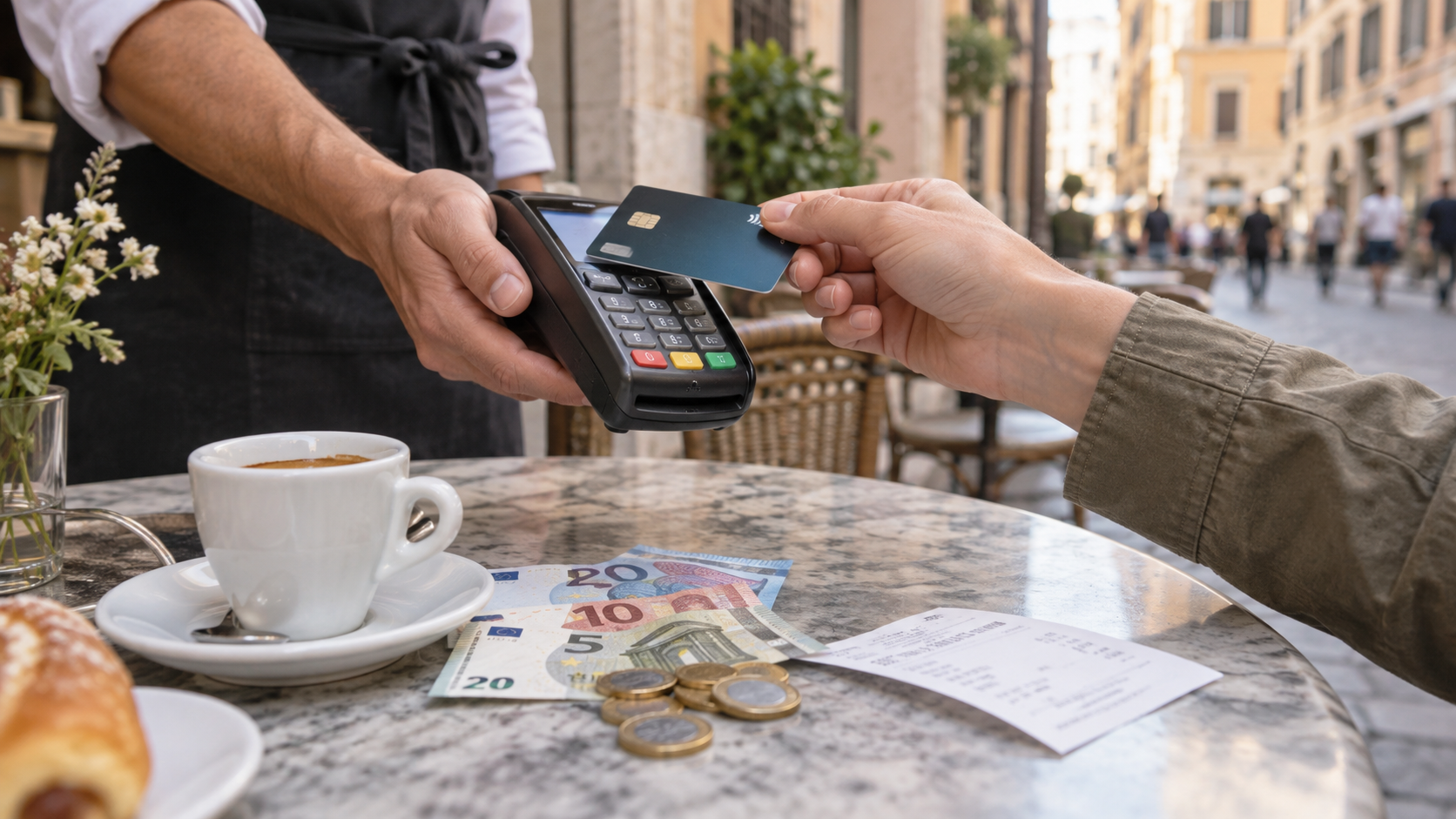
 Italy uses the euro, but knowing when to pay by card, when to carry cash and which extra charges to expect can save American travelers money and embarrassment. Credit cards and contactless payments are now widely accepted, yet cash remains useful for small purchases, rural businesses, local markets and occasional tourist taxes.
This guide explains how money works in Italy, including credit cards, ATMs, currency conversion, tipping, restaurant charges and the local accommodation taxes that can appear on your hotel bill.
Cash or Card in Italy?
For most visitors, the best strategy is to use a combination of cards and cash.
Visa and Mastercard are accepted by most hotels, restaurants, supermarkets, train stations, museums and established stores. Contactless cards, Apple Pay and Google Pay are also common, especially in cities.
However, it is still sensible to carry approximately €50 to €100 in cash, preferably in €5, €10 and €20 notes. Cash can be useful for:
• Small cafés and neighborhood bars
• Outdoor markets and street vendors
• Public restrooms
• Small tips
• Rural shops and family-run businesses
• Taxi rides when the card terminal is unavailable
• Accommodation taxes collected separately
Avoid carrying large amounts of cash or displaying a wallet filled with banknotes in crowded stations and tourist areas.
Are Credit Cards Widely Accepted in Italy?
Credit cards are widely accepted, but Visa and Mastercard generally provide the most reliable coverage. American Express is accepted by many upscale hotels, restaurants and stores, but considerably fewer small businesses take it.
Most Italian terminals accept chip-and-PIN and contactless transactions. A U.S. chip-and-signature card will usually work at staffed businesses, although an unattended machine may require a PIN.
This can be important at:
• Automatic ticket machines
• Gas stations after business hours
• Parking garages
• Highway toll machines
• Self-service kiosks
Before leaving the United States, confirm that you know the PIN for your debit card. If your credit card has a PIN, keep it separate from the card rather than writing it on the card itself.
It is also worth carrying two cards issued by different banks. Keep the backup card in a separate location in case your main card is lost, blocked or retained by an ATM.
Visitors planning to use Italian trains can also consult our Italy travel guides for advice on tickets, transportation and planning an itinerary.
Check Foreign Transaction Fees Before Traveling
Some U.S. credit and debit cards add a foreign transaction fee, commonly calculated as a percentage of each purchase. Other travel-oriented cards have no foreign transaction fee.
Check your card’s conditions before departure and compare:
• Foreign transaction fees
• International ATM withdrawal fees
• Daily cash-withdrawal limits
• Exchange-rate policies
• Emergency replacement services
• Travel benefits and insurance
Paying with a card that has no foreign transaction fee is usually more convenient and economical than exchanging large amounts of dollars before the trip.
Although Italy uses the euro, your bank converts each purchase into U.S. dollars. The final amount may differ slightly from the amount initially shown in your banking app because the transaction can be processed at a later exchange rate.
Always Choose Euros, Not U.S. Dollars
A card terminal or ATM may ask whether you want the transaction charged in euros or U.S. dollars. Always select euros.
Choosing dollars activates dynamic currency conversion, often called DCC. The machine or merchant performs the conversion using its own exchange rate and may add a substantial markup.
The apparently helpful question might appear as:
“Pay in USD or EUR?”
“Accept conversion?”
“Guaranteed exchange rate?”
“Continue with conversion?”
Select EUR, decline the conversion and allow your own bank or card network to calculate the exchange rate.
Declining conversion does not cancel the purchase or withdrawal. It simply means that the transaction remains in euros.
The European Union provides additional information about card payments and currency-conversion charges.
Using ATMs in Italy
An ATM is called a bancomat in Italian, although Bancomat is also the name of an Italian payment network. ATMs are readily available in cities, airports, train stations and most towns.
Whenever possible, use an ATM attached to a recognized bank branch. Bank-operated machines are generally preferable to independent ATMs placed inside souvenir stores, convenience shops and heavily touristed areas.
Look for established Italian banks such as:
• Intesa Sanpaolo
• UniCredit
• Banco BPM
• BPER Banca
• Banca Monte dei Paschi di Siena
• Crédit Agricole Italia
Before confirming a withdrawal, read the entire screen. The ATM should display any local fee and may offer its own currency conversion. Decline the conversion and request the transaction in euros.
Your U.S. bank may impose a separate international withdrawal fee in addition to any charge made by the Italian ATM. Withdrawing a reasonable amount once or twice is usually less expensive than making numerous small withdrawals.
Use normal security precautions: cover the keypad, avoid accepting help from strangers and inspect the card slot if anything looks unusual. If possible, use an ATM during banking hours so that assistance is available if the machine retains your card.
Should You Exchange Dollars Before Going to Italy?
There is usually no need to purchase a large quantity of euros before traveling. You may want to arrive with €50 to €100 for transportation, refreshments and minor expenses, but an Italian bank ATM will often provide a better exchange rate than airport currency-exchange counters.
Avoid changing money at locations advertising “zero commission” without checking the exchange rate. A poor rate may cost more than an openly stated commission.
Hotels may exchange dollars for guests, but their rates are rarely the most favorable. Banks and post offices may provide currency-exchange services, although the process can be slower and may require identification.
How Much Cash Should You Carry Each Day?
For a typical day of sightseeing, €40 to €100 in cash is usually sufficient when you also have a working card. Couples or families may want slightly more, particularly when visiting small towns.
Keep larger bills out of sight and place small notes and coins where they are easy to reach. Trying to pay for a €2 espresso with a €100 note is likely to be inconvenient for both you and the café.
Italy uses euro coins in values of €1 and €2, as well as smaller cent coins. Keep a few €1 and €2 coins for public restrooms, luggage lockers, parking meters and other small expenses.
Do You Tip in Italy?
Tipping in Italy is appreciated but is neither obligatory nor expected at the same level as in the United States. Italian restaurant employees do not normally depend on customer tips in the same way many American servers do.
A large automatic tip of 15% to 25% is therefore unnecessary.
At a café, you can leave a few coins or round up the bill. At an informal restaurant, rounding up or leaving a few euros is appropriate when the service has been good. At an upscale restaurant, a tip of approximately 5% to 10% can be generous for excellent service, but it is not compulsory.
Before tipping, check the menu and bill for two common terms.
Coperto means a per-person cover charge. It may pay for bread, table settings and the use of the table. It is not a tip.
Servizio incluso means that a service charge has already been included. An additional tip is optional.
If neither appears, you may still tip according to your experience, but you should not feel obligated to reproduce American tipping percentages.
Tipping Taxis, Hotels and Tour Guides
Italian taxi drivers do not normally expect a percentage-based tip. Rounding a €18.50 fare to €20 is a friendly gesture, particularly if the driver helped with luggage.
At hotels, you might give a porter €1 or €2 per bag and leave a few euros for housekeeping. These tips are optional and should reflect the service received.
For a private tour guide, a larger tip may be appropriate when the guide provides an exceptional and personalized experience. For a group tour, a few euros per person is generally sufficient.
Always check whether gratuities were already included in the tour price.
Restaurant Bills: Coperto, Service and Bread
Restaurant charges sometimes surprise American visitors. Italian menus are expected to disclose prices and additional charges, so look for a note about coperto or servizio before ordering.
The coperto is normally charged per person, including children occupying a seat. It is common in much of Italy, although local rules differ.
Bread may be included in the coperto or charged separately as pane. If you are uncertain, ask:
“Il coperto è incluso?” — Is the cover charge included?
“C’è un costo per il servizio?” — Is there a service charge?
Restaurants may allow a group to split the total across several cards, but separately itemizing what each person consumed is less common. Ask before the bill is processed if you need separate payments.
What Is the Tourist Tax in Italy?
Many Italian municipalities impose an accommodation tax, generally called imposta di soggiorno or contributo di soggiorno. This is a local tax rather than a single national charge, so the amount and rules differ from one destination to another.
The tax may depend on:
• The city or municipality
• Hotel category or star rating
• Type of accommodation
• Number of guests
• Number of nights
• Time of year
• The guest’s age
• Local exemptions
Hotels, bed-and-breakfasts, vacation rentals, agriturismi and other registered accommodations may be required to collect it.
The tax is commonly calculated per person, per night, sometimes only up to a maximum number of nights. Children below a locally established age may be exempt. Other exemptions may apply to residents, caregivers, patients receiving medical treatment or people with disabilities, but documentation may be required.
Is the Tourist Tax Included in the Hotel Price?
Sometimes it is included in the amount collected by the booking platform, but often it is payable separately at the accommodation. Your reservation confirmation should explain whether the tax has already been collected.
A property may request payment:
• During online check-in
• When you arrive
• At checkout
• Through a secure payment link
• In cash or by card, depending on the property
Ask for a receipt whenever you pay the tax. A legitimate accommodation should be able to explain the amount, the number of taxable nights and any applicable exemptions.
Do not assume that two nearby towns charge the same amount. Rates can change, so check the accommodation’s current information or the municipality’s official website shortly before traveling.
Venice’s Access Fee Is Different
Venice’s access fee for certain day visitors is separate from the accommodation tax paid by overnight guests. The city applies the access-fee system only on designated dates and under specific conditions.
Travelers staying overnight in registered accommodation within the Municipality of Venice are generally exempt from paying the day-visitor access fee because they already pay the accommodation tax. However, they may still need to obtain or carry proof of exemption.
The dates, fees and procedures can change. Check the official Venice Access Fee portal before your visit rather than relying on older travel articles or social-media posts.
VAT and Displayed Prices
Italy’s value-added tax is called IVA. For ordinary consumer purchases, IVA is normally incorporated into the displayed price rather than added at the register in the American manner.
If an item is marked €25, you will usually pay €25, not €25 plus sales tax.
Some non-EU residents may qualify for a VAT refund on eligible goods purchased from participating retailers when the required minimum and export conditions are met. This generally applies to physical goods taken out of the European Union, not to hotels, restaurant meals or transportation.
Ask the retailer about tax-free shopping before paying, keep the required documents and allow extra time at your final EU departure point.
Ask for a Receipt
The Italian word for a receipt is scontrino. Restaurants may issue a ricevuta or detailed bill.
Keep receipts for expensive purchases, tourist taxes, deposits and ATM withdrawals. At restaurants, review the bill before paying, especially in busy tourist areas. Check the number of guests, items ordered, coperto and any service charge.
If a total seems incorrect, politely ask:
“Posso controllare il conto, per favore?” — May I check the bill, please?
Most errors are easily resolved when raised calmly before payment.
A Simple Money Plan for American Travelers
Before leaving the United States:
• Bring a Visa or Mastercard with no foreign transaction fee
• Carry a second card as a backup
• Confirm your debit-card PIN
• Check international ATM fees and daily limits
• Save your bank’s international contact number
• Keep a small starting supply of euros
After arriving in Italy:
• Pay by card in euros
• Decline dynamic currency conversion
• Use ATMs attached to established banks
• Carry small euro notes and coins
• Tip modestly and only when appropriate
• Check for coperto and servizio incluso
• Verify whether your tourist tax has already been paid
• Request receipts for taxes and important purchases
Italy is no longer a predominantly cash-only destination. A card can cover most travel expenses, but a modest cash reserve remains useful. With the right cards, a basic understanding of Italian tipping customs and careful attention to conversion offers and local taxes, managing money in Italy should be straightforward.
External Sources
European Union: Payments, Transfers and Card Charges
Official Venice Access Fee Portal
Comune di Venezia Online Services and Accommodation Tax