 Naples can look like several different cities on screen: the divided world of Lila and Lenù, the restless adolescence of Paolo Sorrentino’s cinema, or the sea beyond the walls in Mare Fuori. Walking through it reveals how close some of those worlds are—and how much filmmaking rearranges them.
This Naples film and television itinerary connects accessible streets, squares, and waterfront walks. It also separates actual filming locations from story settings and reconstructed sets, so you can plan around places you can realistically see.
For a broader introduction, start with our Naples travel guide.
Affiliate disclosure: Italia Mia may earn a commission from bookings made through affiliate links, at no additional cost to you.
Naples screen locations at a glance
| Film or series | Place | What you can visit |
|---|---|---|
| My Brilliant Friend | Lungomare Caracciolo | A real filming location on a public waterfront |
| My Brilliant Friend | Rione Luzzatti | The neighborhood associated with the story; the period neighborhood was rebuilt near Caserta |
| The Hand of God | Galleria Umberto I and Piazza del Plebiscito | Public spaces used in the film |
| Naples in Veils | Piazza del Gesù Nuovo and Toledo station | Actual locations; normal transport rules apply in the station |
| Naples in Veils | Palazzo Mannajuolo | A real building used for filming; confirm permission before entering |
| Mare Fuori | Molo San Vincenzo | A naval-base filming location with restricted access |
| Il Postino | Marina Corricella, Procida | A separate island excursion to real filming locations |
Sources: Italy for Movies’ location guides and the Campania Film Commission, linked below.
My Brilliant Friend: the neighborhood and the set are different places
Elena Ferrante’s Naples makes geography personal. A street, a shop, or a journey toward the sea can mark a change in what Lila and Lenù believe is possible.
However, the television neighborhood is not somewhere you can simply find intact in Naples. The production recreated the period Rione Luzzatti near Caserta, in the former Saint-Gobain industrial area at Marcianise. Visiting today’s Rione Luzzatti is a neighborhood visit, rather than a walk through that set.
For a more straightforward screen stop, choose Lungomare Caracciolo, used when Elena discovers the sea with her father. The production also used Palazzo Gravina, on Via Monteoliveto, for school scenes. It is a university building, so treat it as a working institution: admire the exterior and ask about access rather than assuming its courtyard is a tourist attraction.
These locations offer two very different experiences: an easy waterfront walk and a glimpse of the architecture used to create the girls’ educational world.
Source: Italy for Movies — My Brilliant Friend.
The Hand of God: a compact Sorrentino walk
Paolo Sorrentino’s The Hand of God turns Naples into a landscape of family, longing, football, and the discovery of cinema.
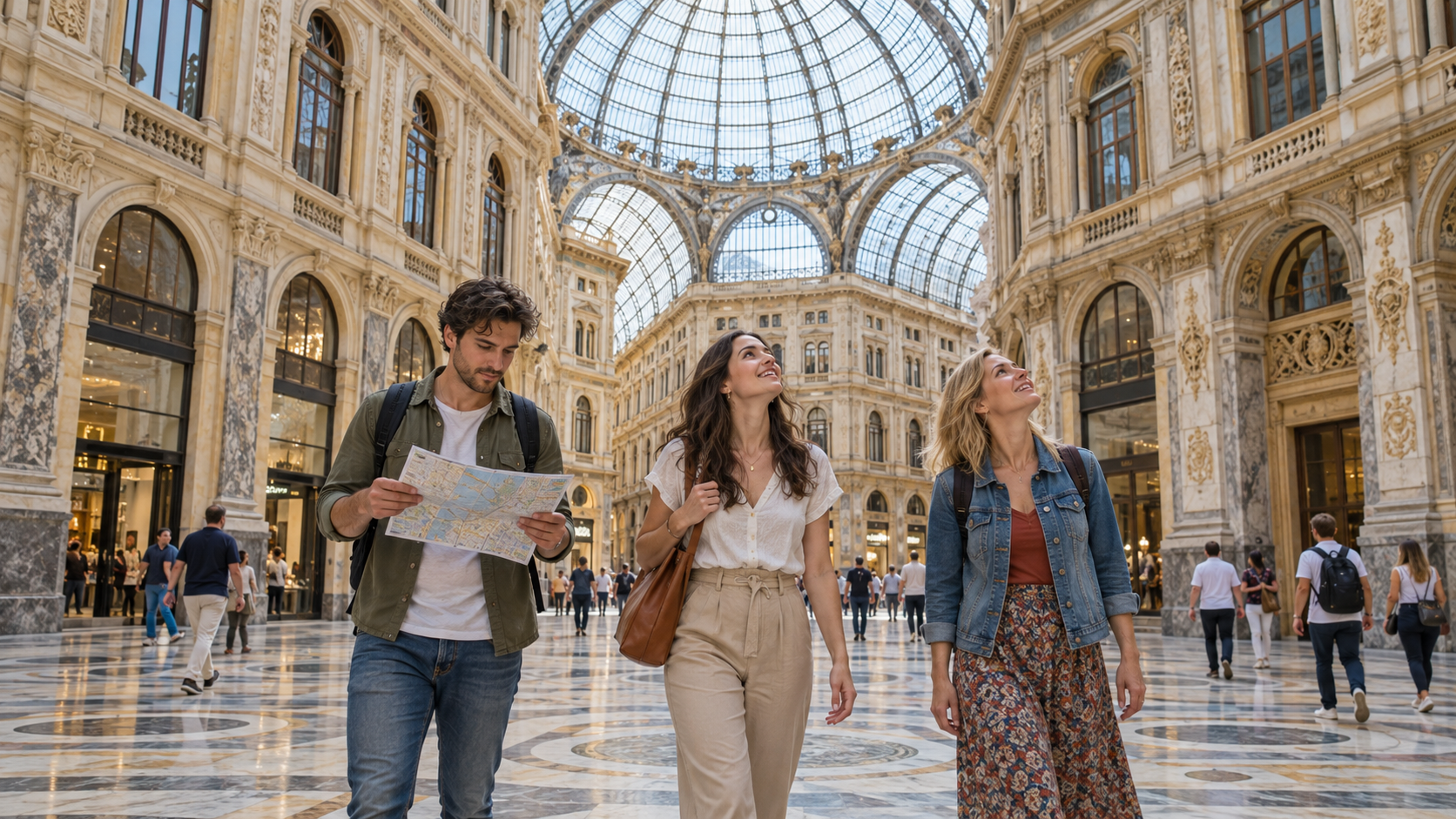
Galleria Umberto I is an especially rewarding stop because it appears repeatedly in the film. Walk beneath its glass roof, look up at the crossing of the arcades, then allow yourself a few minutes to watch people passing through.
Nearby, Piazza del Plebiscito appears in an early nighttime sequence. The film recreates its 1980s appearance, including parked cars, so its present-day atmosphere will feel different.
There is another useful filmmaking lesson here: the courtyard of Palazzo Zapata, on adjacent Piazza Trieste e Trento, and an interior at Villa del Cardinale in Torre del Greco were combined into one screen sequence. The editing makes them neighbors; a real itinerary cannot.
Keep this part of the walk centered on the public square and gallery rather than pursuing private interiors.
Source: Italy for Movies — The Hand of God.
Naples in Veils: squares, a station, and a remarkable staircase
Ferzan Özpetek’s Naples in Veils, or Napoli velata, offers a route through recognizable public places and more intimate architectural spaces.
Start at Piazza del Gesù Nuovo, whose church façade and central obelisk appear in the film. Continue toward Toledo metro station, another filming location. Visit as a passenger, keeping circulation routes clear.
In Chiaia, Palazzo Mannajuolo supplies the striking elliptical staircase seen at the opening. It is a residential building: confirm permission to enter and photograph, and accept that access may be refused.
The National Archaeological Museum of Naples, often called MANN, provides another actual location, including the film’s use of the Gabinetto Segreto. A museum visit needs its own time and ticket; check which rooms are accessible before booking.
Sources: Italy for Movies — Naples in Veils and the official MANN website.
Mare Fuori: understand the access limits before booking
The sea-facing institution in Mare Fuori is a constructed screen environment at the naval base on Molo San Vincenzo. It is not an ordinary visitor attraction or the real juvenile institution simply opened for filming.
The Campania Film Commission identifies the location as closed to general public access. Special openings have taken place, but an old event announcement does not establish that you can enter on your travel dates.
A tour advertised with the show’s name may therefore cover exterior locations elsewhere in Naples without entering its best-known set. Before paying, request the precise itinerary and ask whether naval-base access is explicitly included and authorized.
For an independent visit, enjoy the city’s public waterfront and keep the production site off your walking route unless a current, authorized visit is confirmed.
Sources: Campania Film Commission — Molo San Vincenzo and Mare Fuori production information.
A practical one-day Naples film itinerary
This is a suggested walking order, with generous pauses rather than a race between screenshots. Allow a full day for lunch, photographs, and browsing. Add a second morning if you want a substantial museum visit.
Morning: historic center and Via Toledo
Begin at Piazza del Gesù Nuovo, then walk toward Via Monteoliveto and Palazzo Gravina. Continue toward Via Toledo, using the station as a transport stop if it fits your plans.
Wear shoes suitable for uneven paving, and resist the temptation to add every nearby church and museum. A screen itinerary works best when you have time to notice the streets between its named stops.
Midday: Galleria Umberto I and Piazza del Plebiscito
Continue south along Via Toledo to Galleria Umberto I, then head to Piazza Trieste e Trento and Piazza del Plebiscito.
Make this your lunch break. Choose somewhere with a clearly displayed menu and check whether the price differs between counter service and sitting at a table.
Afternoon: Chiaia and the waterfront
Head through Via Chiaia toward Via Filangieri for Palazzo Mannajuolo, subject to whatever access the building permits. Then continue toward Piazza dei Martiri, Piazza Vittoria, and Lungomare Caracciolo.
Finish with a relaxed waterfront walk. This leaves room to enjoy Naples as a living city: children playing, people meeting after work, and conversations that have nothing to do with a production schedule.
For a shorter day, omit the museum. For less walking, divide the route into historic-center and waterfront sections on different days.
Optional second day: Il Postino on Procida
Procida deserves a separate day, with ferry travel built around your actual departure and return times.
At Marina Corricella, you can recognize the waterfront setting associated with Beatrice’s inn in Il Postino. Via San Rocco and Piazza dei Martiri provide further filming connections, including the building used as the post office. Cala di Pozzo Vecchio, often called the Postman’s Beach, is another location on the island.
The important distinction is that the film combines different islands. Pollara and Neruda’s screen house are on Salina in Sicily, rather than Procida.
Build the day around Corricella first, then decide whether you have time and energy for the beach. Steps and gradients make an island map look easier than the walk can feel.
Check Caremar’s Naples–Procida timetable for your date, departure terminal, and return sailing. Leave a comfortable margin before the last suitable boat.
Source: Italia.it — Il Postino itinerary through Procida and Salina.
Where to stay and which experiences to book
For this itinerary, I would compare three areas:
- Toledo and the lower historic center: useful for beginning the city walk.
- Chiaia: convenient for its afternoon section and a slower evening.
- Santa Lucia and the waterfront: worth considering if the seafront is your priority.
Compare exact addresses and recent reviews, especially comments about noise, stairs, and lift access. You can compare Naples stays through Expedia or check alternatives on Trip.com, searching for Naples and your dates.
The paid experiences most likely to add value are a small-group film walk with named locations, a Ferrante literary tour that explains the difference between novels and adaptation, or a guided archaeological museum visit. Ask about group size, language, walking distance, admissions, and cancellation terms.
A guide earns their place by explaining why a filmmaker chose a street, how a scene was assembled, or what has changed since filming. For this itinerary, that context is more useful than a long list of photo stops.
External Sources
- Italy for Movies: My Brilliant Friend locations
- Italy for Movies: The Hand of God locations
- Italy for Movies: Naples in Veils locations
- Campania Film Commission: Molo San Vincenzo
- Italia.it: Il Postino locations in Procida and Salina
- National Archaeological Museum of Naples
- Caremar: Naples–Procida services