Traveling by train is one of the easiest, fastest and most practical ways to see Italy. High-speed services connect Rome, Florence, Bologna, Milan, Turin, Venice and Naples, while regional trains reach hundreds of smaller cities, coastal towns and rural communities.
For many itineraries, the train is more convenient than renting a car. Stations are generally located close to historic centers, travelers avoid motorway tolls and restricted-traffic zones, and there is no need to find expensive city parking.
The system can initially seem confusing, however. Italy has different railway operators, several categories of trains, flexible and nonrefundable fares, assigned seats and ticket-validation rules that vary according to the type of ticket.
This guide explains how train travel in Italy works, including the differences between Trenitalia and Italo, where to buy tickets, when reservations are required, how regional tickets are validated, what to do with luggage and how to prepare for connections and strikes.
Why Travel Around Italy by Train?
Trains are especially effective when an itinerary includes several major cities. Rome, Florence, Bologna, Milan and Naples are connected by frequent high-speed services, allowing travelers to move from one city center to another without airport transfers or security lines.
Rail travel offers several advantages:
• Major stations are usually in or near city centers.
• High-speed trains provide reserved seats, air conditioning, electrical outlets and generally Wi-Fi.
• Travelers avoid fuel expenses, motorway tolls and city-center parking.
• There is no risk of accidentally entering a ZTL restricted-traffic zone.
• Travel time can be used to rest, read, work or enjoy the scenery.
• Multi-city itineraries are relatively easy to organize.
A car remains useful for rural Tuscany, inland Sicily, parts of Puglia, mountain areas and villages with limited public transportation. Many successful Italian vacations combine trains between major cities with a rental car for a few days in the countryside. Read our Driving in Italy guide before deciding which option suits your itinerary.
Understanding Italy’s Main Types of Trains
Italian passenger trains fall into several broad categories.
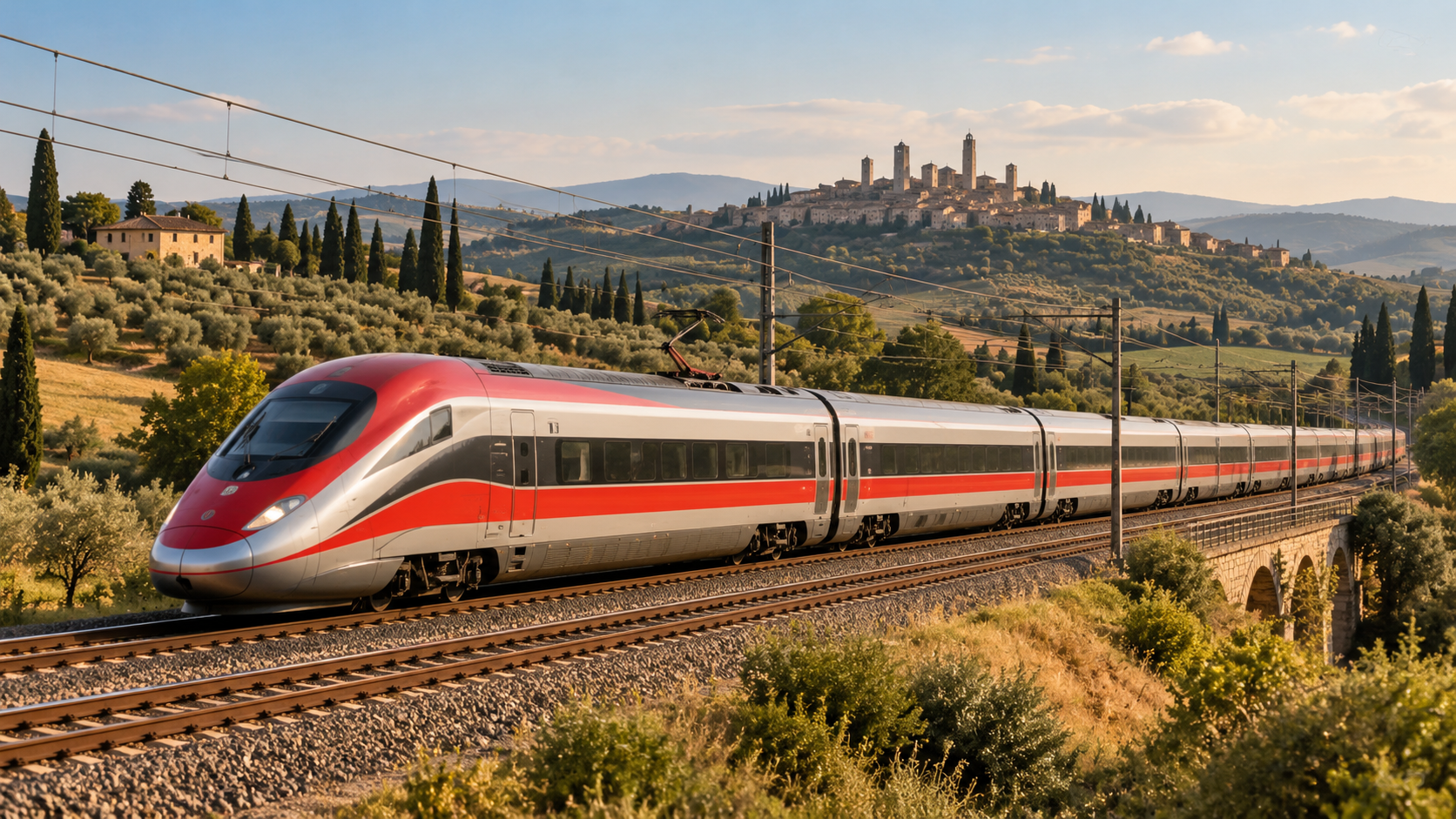
High-speed trains operate along Italy’s busiest intercity routes. Trenitalia runs Frecciarossa services, while Italo competes on many of the same lines. These trains require reservations, and the ticket includes a specific departure and assigned seat.
Intercity trains are slower than high-speed trains but serve additional destinations. They are useful when a city is not directly connected to the high-speed network or when the lower fare is more important than saving time.
Intercity Notte trains operate overnight. Depending on the service, passengers may choose ordinary seats, couchettes or private sleeping compartments.
Regional trains, identified as Regionale or Regionale Veloce, make more frequent stops and connect large cities with smaller destinations. They are essential for reaching places such as Lucca, Assisi, the Cinque Terre, Lake Como and many coastal communities.
Some regional networks are operated by companies other than Trenitalia. Trenord, for example, operates many services in Lombardy. Local ticket and validation rules can differ, so check the operator shown in the journey results.
Trenitalia or Italo: Which Is Better?
Trenitalia is Italy’s principal passenger railway operator. Its network includes Frecciarossa high-speed trains, Intercity services, overnight trains and an extensive regional system.
Italo is a private company specializing in high-speed travel. It serves many important routes linking cities such as Turin, Milan, Venice, Bologna, Florence, Rome, Naples, Salerno and Bari, but it does not operate a nationwide regional network.
Where both companies serve the same route, compare:
• Departure and arrival times
• The stations used
• Total travel time
• Fare restrictions
• Change and refund policies
• Service class
• Luggage conditions
• The price of selecting a particular seat
Neither operator is automatically better for every journey. The best choice is often simply the train with the most convenient schedule, station and fare.
Trenitalia and Italo tickets are not interchangeable. A Trenitalia ticket cannot normally be used on an Italo train, and an Italo ticket cannot be used on Trenitalia.
Where to Buy Italian Train Tickets
The safest places to buy tickets are the official Trenitalia and Italo websites, their official mobile apps, station ticket offices and authorized ticket machines.
Third-party platforms may sell valid tickets, but changes, refunds and customer assistance may have to be handled through the company that sold the ticket. Booking directly with the railway operator usually makes managing the reservation easier.
When using a station ticket machine, check the logo carefully and avoid accepting unsolicited assistance from strangers. Large stations sometimes attract people who offer to operate the machine and then request money.
Before paying, verify:
• The correct date
• Departure time
• Departure and arrival stations
• Train number
• Passenger names when required
• Fare conditions
• Carriage and seat information
Italian cities may have several stations. In Rome, Roma Termini and Roma Tiburtina are different stations. Milan has Milano Centrale, Milano Porta Garibaldi and Milano Rogoredo. Venice has Venezia Mestre on the mainland and Venezia Santa Lucia in the historic city.
When Should You Book?
High-speed and Intercity fares usually become more expensive as the departure date approaches. Promotional fares can offer worthwhile savings but normally impose stricter rules for changes and refunds.
Book early when traveling:
• On Friday or Sunday afternoons
• Near Italian public holidays
• During Easter, Christmas or New Year
• In July and August
• On popular routes at convenient times
• With a group that wants to sit together
Regional fares are generally fixed by distance, so buying several weeks ahead rarely produces the same savings. Regional tickets can often be purchased close to departure, although it remains sensible to buy before reaching the platform.
Seat Reservations on Italian Trains
Reservations are mandatory on Frecciarossa, Italo and most Intercity services. The reservation is normally included when purchasing the ticket, and the ticket shows the train, carriage and assigned seat.
Some fares include the ability to select a particular seat, while others assign one automatically or charge an additional seat-selection fee.
Regional trains generally do not offer seat reservations. Passengers board with a valid ticket and take an available seat. Regional trains can become crowded during commuting hours, holiday weekends and peak periods in destinations such as the Cinque Terre.
A rail pass does not eliminate reservation requirements. Travelers using Eurail or Interrail must still purchase reservations for many Italian high-speed and long-distance trains. Compare the combined cost of the pass and reservations with ordinary advance-purchase tickets before buying a pass.
Do Italian Train Tickets Need to Be Validated?
Validation is one of the most misunderstood parts of traveling by train in Italy. The answer depends on the ticket.
High-Speed and Intercity Tickets
Frecciarossa, Italo and most Intercity tickets are issued for a specific train, date and departure time. They include a reservation and do not need to be stamped in a station machine.
Board the train shown on the ticket and sit in the assigned carriage and seat. A ticket for a different train is not automatically valid, even when the destination is the same.
Trenitalia Digital Regional Tickets
Trenitalia’s current Digital Regional Ticket is automatically validated at the scheduled departure time of the selected train. The previous requirement to perform a separate online check-in has been removed.
Before the scheduled departure, travelers can generally change the selected time through the Trenitalia website or app, subject to the ticket’s conditions. After automatic validation, the ticket is valid for the selected service.
During inspection, show the digital ticket with its active dynamic display. Because the ticket is personal, staff may also request identification.
Rules can change, so travelers should always follow the instructions displayed on the ticket rather than relying on old travel articles or videos.
Paper Regional Tickets
Traditional paper regional tickets that are not issued for a specific train generally need to be validated before boarding. Insert the ticket into one of the station’s validation machines so it receives a date-and-time mark.
If the machine is not working, photograph it if possible and speak to railway staff immediately after boarding rather than waiting for an inspection.
Never assume that a blank paper ticket is ready for travel. Read the printed instructions carefully.
Luggage on Italian Trains
Italian trains normally allow passengers to bring luggage without checking it or paying a separate baggage fee. Travelers are responsible for carrying, storing and supervising their belongings.
Small bags can usually be placed under the seat or on the overhead rack. Larger suitcases may fit in racks near the carriage entrance or in dedicated luggage areas.
Practical precautions include:
• Travel with luggage you can lift without assistance.
• Keep passports, money, medication and electronics with you.
• Do not leave valuables inside a suitcase stored near the carriage doors.
• Keep aisles and emergency exits clear.
• Attach your name and contact information to each bag.
• Begin collecting luggage before arriving at your stop, particularly on a crowded regional train.
Operator, train and service-class restrictions can vary. Check the conditions attached to your ticket if traveling with unusually large luggage, bicycles, sporting equipment or several suitcases.
Changing Trains and Making Connections
A Trenitalia itinerary may combine Frecciarossa, Intercity and regional trains. Always verify the train number and destination on the station departure board because the final destination shown may be beyond your own stop.
A ten-minute connection may be technically possible but stressful for a first-time visitor. When possible, allow approximately 20 to 30 minutes at a large station, particularly when carrying luggage, traveling with children or dealing with reduced mobility.
Allow considerably more time when the connection requires changing stations. A ticket arriving at Milano Centrale, for example, does not create an automatic connection with a departure from Milano Porta Garibaldi.
If separate tickets are purchased for consecutive journeys, protection after a missed connection may be weaker than when the entire itinerary is issued as one booking. Leave a larger margin between independently booked trains.
Understanding Italian Station Boards
The word Partenze means departures, while Arrivi means arrivals.
Station boards normally display:
• Scheduled departure time
• Train number
• Final destination
• Intermediate stops
• Platform, marked binario
• Delay, marked ritardo
The platform may not appear until shortly before departure. Do not panic if it is initially blank, but remain close enough to reach the platform once announced.
Large stations can be busy, so pay attention to the train number rather than relying only on the destination. Different trains may leave for the same city within a short period.
What Happens During a Rail Strike?
Rail strikes in Italy are usually announced in advance, but the exact effect on an individual train may remain unclear until close to departure.
Trenitalia provides a list of guaranteed services for many strikes. Essential regional services are generally protected during designated commuter periods, currently from 6:00 to 9:00 and from 18:00 to 21:00 on weekdays and Saturdays. Some long-distance trains are also guaranteed.
Before traveling during a strike:
• Check the official Trenitalia or Italo website.
• Look up the train by number, not only by route.
• Review the operator’s list of guaranteed trains.
• Enable notifications in the operator’s app.
• Arrive with an alternative route in mind.
• Do not assume every train will be canceled.
A national railway strike does not necessarily affect every operator in the same way. Conversely, a strike involving station or infrastructure personnel may disrupt multiple companies.
Delays, Cancellations and Passenger Rights
If a train is substantially delayed or canceled, consult the operator before buying a replacement ticket independently. Depending on the circumstances, passengers may be entitled to rerouting, refunds or compensation.
Keep the original ticket, booking confirmation and receipts for necessary expenses. Claims are normally submitted to the operator that issued the ticket.
European passenger protections establish minimum rights, but the outcome depends on the delay, journey and circumstances. Promotional credits and statutory compensation are not always the same thing.
Getting to and From the Station
Do not plan only the train journey. Consider how you will reach the departure station and continue from the arrival station.
In major cities, metro systems, trams and buses frequently connect with the principal railway station. Licensed taxi stands are normally located outside the station. Travelers carrying luggage should allow extra time for elevators, underground passages and crowded platforms.
For an early departure, confirm whether local transportation operates early enough. A hotel near the station may be practical for a one-night stop, but check the exact location and neighborhood rather than relying only on the phrase “near the station.”
Regional Trains and Smaller Destinations
Regional trains are essential for travelers who want to move beyond the principal art cities. They serve many destinations that high-speed trains bypass and can make car-free itineraries possible.
They are particularly useful for:
• Florence to Lucca, Pisa or Arezzo
• Milan to towns around Lake Como
• Naples to Caserta or Salerno
• Venice to Padua, Vicenza or Treviso
• Bologna to Modena, Parma or Ravenna
• Local journeys along parts of the Ligurian coast
Regional trains are slower and may use older rolling stock, but they provide a closer view of everyday Italy. Read Italy Without a Car for destinations that work especially well with public transportation.
Common Mistakes to Avoid
The most frequent mistakes are easy to prevent:
• Arriving at the wrong station
• Boarding the wrong operator’s train
• Using a ticket for a different departure
• Forgetting to validate a paper regional ticket
• Relying on outdated digital check-in instructions
• Assuming a rail pass includes every reservation
• Choosing the cheapest promotional fare without reading its restrictions
• Planning an extremely short connection
• Leaving luggage unattended near the carriage doors
• Waiting until the train stops before gathering bags
• Following unofficial advice instead of the instructions on the ticket
A Simple Strategy for First-Time Visitors
For a straightforward journey, use this process:
- Search both Trenitalia and Italo when traveling between major cities.
- Compare the actual stations, travel time and fare conditions.
- Book high-speed journeys early when the schedule matters.
- Purchase regional tickets closer to travel if flexibility is important.
- Follow the validation instructions printed or displayed on the ticket.
- Arrive approximately 20 minutes early at an unfamiliar station.
- Check the train number, platform and final destination.
- Keep tickets and identification accessible during the journey.
Once the distinction between reserved long-distance trains and flexible regional services becomes clear, Italy’s rail network is relatively easy to use. For city-to-city travel, it is often the simplest way to experience more of the country without turning the vacation into a series of drives and parking searches.
External Sources
Trenitalia Digital Regional Ticket
Trenitalia information about rail strikes
European Commission rail-passenger rights