
Italy presents a fascinating contradiction when it comes to LGBTQ rights.
On the one hand, Italian society has changed dramatically. Same-sex relationships are widely accepted by the public, Pride celebrations attract hundreds of thousands of people, LGBTQ characters and themes are commonplace in popular culture, and a clear majority of Italians now support legal recognition of same-sex couples.
On the other hand, Italy remains one of Western Europe’s least advanced countries in terms of LGBTQ legal equality.
Same-sex couples can enter into civil unions, but they still cannot marry under Italian law. Joint adoption by same-sex couples is not generally available. Access to assisted reproduction remains restricted. Transgender people can obtain legal gender recognition, but Italy does not have a self-identification system. Comprehensive protection against hate crimes based specifically on sexual orientation and gender identity remains a major unresolved issue.
The result is a country in which social acceptance has moved considerably faster than legislation.
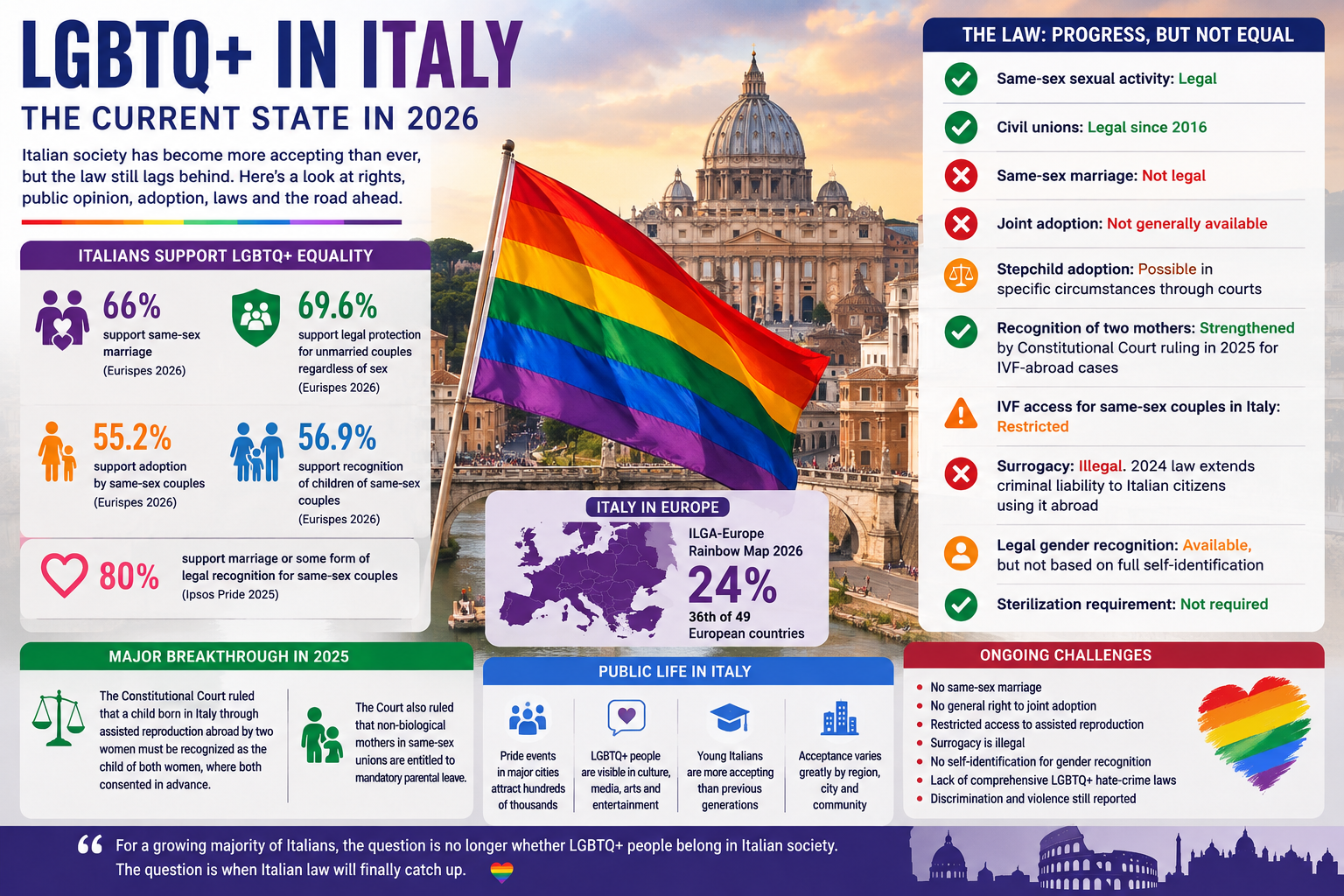
The latest ILGA-Europe Rainbow Map, published in 2026, gives Italy a score of just 24%, placing it 36th out of 49 European countries. Italy actually dropped one position compared with the previous ranking.
That ranking should not be interpreted as meaning that Italian society is only 24% accepting of LGBTQ people. The Rainbow Map measures laws and policies, not public attitudes. This distinction is crucial to understanding modern Italy.
How accepting are Italians?
Public opinion tells a considerably more positive story than the country’s legal ranking.
According to the 2026 Eurispes Italy Report, 66% of Italians support marriage between people of the same sex. Some 69.6% support legal protection for unmarried couples regardless of sex. 55.2% support adoption by same-sex couples, while 56.9% support legal recognition of children of same-sex couples.
The figures have changed substantially over the past decade.
Support for same-sex marriage has become increasingly mainstream, particularly among younger Italians and people living in larger cities. The 2025 Eurispes survey found support at 66.8%, virtually identical to the 2026 figure.
An even more striking result comes from the 2025 Ipsos LGBT+ Pride survey. In Italy, 80% supported marriage or some form of legal recognition for same-sex couples, placing Italy well above the international average in the survey. Support for same-sex couples having the same adoption rights as heterosexual couples stood at 59%.
The difference between the 80% Ipsos figure and the 66% Eurispes figure is not necessarily contradictory. The surveys ask slightly different questions and use different methodologies. The broad conclusion, however, is unmistakable:
A substantial majority of Italians support legal recognition of same-sex relationships.
Support becomes more complicated when the question involves children, reproductive technology or transgender rights.
For example, the 2026 Eurispes survey found that only 49.2% supported recognition of gender identities outside the male/female binary, compared with 51.1% in 2025.
This illustrates an important characteristic of Italian public opinion: acceptance of gay and lesbian couples is considerably more advanced than acceptance of every issue associated with the broader LGBTQ+ movement.
The 2016 Civil Unions Law
The most important legislative breakthrough in modern Italian LGBTQ history came in 2016, when Parliament approved Law No. 76, commonly known as the Legge Cirinnà.
The law established civil unions between two adults of the same sex and provided extensive legal rights and obligations broadly comparable to marriage.
The legislation followed years of political debate and activism. Senator Monica Cirinnà was one of the most prominent political figures behind the legislation and served as parliamentary rapporteur on the civil-unions bills.
Italia Mia has previously covered this turning point in its article on Italy’s civil unions and their limitations.
Civil unions provide important protections involving inheritance, property, social security, healthcare decisions and family responsibilities.
But they were deliberately created as a legal institution separate from marriage.
That distinction remains at the center of Italy’s LGBTQ debate.
Civil union versus marriage
An Italian same-sex couple can legally form a civil union, but cannot marry another person of the same sex under Italian domestic law.
Italy also generally treats same-sex marriages celebrated abroad through the legal framework applicable to same-sex unions rather than converting them into Italian marriages.
For many LGBTQ activists, this creates a symbolic and practical inequality: heterosexual couples have marriage, while same-sex couples have a separate institution.
For supporters of the existing system, civil unions represent a compromise that recognizes same-sex couples while preserving the traditional legal definition of marriage.
The political debate has remained unresolved.
Adoption: the biggest remaining legal gap
Perhaps the most controversial area is adoption.
Same-sex couples do not have a general right to jointly adopt children in Italy.
This is one of the principal reasons Italy’s Rainbow Map score remains low.
ILGA-Europe specifically recommends that Italy introduce full equality in family rights, including marriage equality, joint adoption and automatic recognition of co-parents.
The situation is nevertheless more complicated than simply saying “gay people cannot adopt.”
Italian courts have, under certain circumstances, permitted stepchild adoption through the existing legal framework. This can allow one partner in a same-sex couple to adopt the biological child of the other partner.
The process, however, has historically required judicial proceedings and does not provide the same straightforward route available to married heterosexual couples.
This means that the legal position of a child can depend on the circumstances of the child’s birth and on judicial proceedings rather than automatically following from the parents’ relationship.
That distinction is enormously important for families.
A major breakthrough for lesbian mothers in 2025
The most significant LGBTQ family-rights development in recent years came from the Italian Constitutional Court in 2025.
In Judgment No. 68/2025, the Court ruled that a child born in Italy following medically assisted reproduction legally carried out abroad by two women must be recognized as the child of both women, where both had consented in advance to the reproductive procedure and assumed parental responsibility.
The Court found the previous exclusion of the non-biological mother unconstitutional, referring to constitutional protections concerning equality, personal identity and the rights of children.
This was a landmark decision.
It means that, in the circumstances covered by the ruling, the non-biological mother does not have to depend on a subsequent adoption procedure simply to have her parental status recognized.
The case is particularly significant because it originated in Lucca, Tuscany, making it an important Italian example of how local court cases can eventually produce nationwide constitutional change.
The ruling also reflects an important change in the constitutional discussion: the Court explicitly stated that homosexual orientation does not, in itself, make a couple unsuitable to assume parental responsibility.
But IVF remains restricted
The 2025 ruling did not make Italy’s reproductive system fully equal.
It dealt with recognition of children born following legally performed assisted reproduction abroad. It did not establish a general right for same-sex couples to access assisted reproduction in Italy.
The Constitutional Court also ruled in 2025 that the exclusion of single women from assisted reproductive technology was not unconstitutional under the existing law.
Consequently, lesbian couples who want to have children may still face significant legal and practical barriers within Italy.
Parental leave for non-biological mothers
Another important Constitutional Court decision followed in 2025.
The Court ruled that a non-biological mother in a same-sex civil union is entitled to the mandatory parental leave that had previously been framed in terms applicable to fathers.
The Court emphasized that a child’s need to establish a relationship with both parents does not depend on the parents’ sexual orientation.
This is another example of the Italian judiciary gradually filling gaps left by Parliament.
It also demonstrates an increasingly important feature of Italian LGBTQ law: some of the most significant advances are now coming from the courts rather than from new legislation.
Surrogacy and the 2024 law
The situation is considerably more restrictive for gay male couples.
Italy already prohibited surrogacy domestically. In 2024, Parliament passed Law No. 169/2024, extending Italian criminal jurisdiction to surrogacy carried out abroad by Italian citizens.
The law entered into force on December 3, 2024.
The measure has been particularly controversial because surrogacy can be one of the principal routes to biological parenthood for male same-sex couples.
Supporters argue that the law is necessary to prevent exploitation of women and the commercialization of reproduction.
Opponents argue that the measure disproportionately affects same-sex couples and can create serious legal problems for children born abroad.
The issue is therefore much broader than LGBTQ rights alone. It involves reproductive ethics, children’s rights, international law and the definition of parenthood.
Transgender rights in Italy
The legal position of transgender people is another area where Italy has made progress but remains behind many European countries.
Italy introduced a legal framework for gender recognition with Law No. 164 of 1982, making Italy an early European country to establish a legal procedure for changing legal sex.
Over time, courts have removed some of the more restrictive requirements. Compulsory sterilization is no longer required.
Nevertheless, Italy does not currently have a comprehensive self-identification system comparable to countries such as Spain, Portugal, Belgium or Denmark.
ILGA-Europe’s 2026 analysis shows that Italy has a functioning legal framework for gender recognition and does not require sterilization, but it does not meet several of the criteria associated with modern self-determination-based systems.
This remains one of the areas where activists are calling for substantial reform.
ILGA-Europe recommends that Italy move toward legal gender recognition based on self-determination, depathologization and accessibility for people of all ages.
LGBTQ discrimination and hate crimes
Italy’s greatest weakness may be the gap between general anti-discrimination principles and specific legal protections.
LGBTQ people are protected by general constitutional and European legal principles, and discrimination can be challenged through various legal mechanisms.
However, Italy still lacks the kind of comprehensive national hate-crime and hate-speech framework specifically covering sexual orientation, gender identity and sex characteristics that exists in some other European countries.
This is one of the reasons Italy performs poorly in the ILGA-Europe assessment.
The European Union Agency for Fundamental Rights provides another perspective.
Its large 2024 LGBTIQ survey found that in Italy:
- 38% of respondents felt discriminated against in at least one area of everyday life during the previous year.
- 21% experienced discrimination at work or while looking for work.
- 51% reported harassment during the previous year.
- 10% had experienced an attack during the previous five years.
- 68% said they had experienced bullying, ridicule, teasing, insults or threats at school because they were LGBTIQ.
- Only 4% believed that the national government was effectively combating LGBTIQ prejudice and intolerance.
These figures need to be interpreted carefully because they come from an LGBTIQ survey rather than the general population. Nevertheless, they provide an important picture of the experiences of LGBTQ people themselves.
Under-reporting remains a problem
Official crime statistics do not necessarily reveal the full scale of anti-LGBTQ violence.
Many victims do not report incidents because of fear, shame, distrust of authorities, family pressure or concerns about being forced to disclose their sexual orientation or gender identity.
The OSCE’s ODIHR specifically warns that hate crimes against LGBTI people are significantly under-reported and that unwillingness or fear to reveal one’s identity contributes to the problem.
For Italy in 2024, ODIHR received reports of anti-LGBTI incidents from civil-society organizations, including Gay Center/Gay Helpline and Trans Europe and Central Asia. Some reported incidents involved violence against transgender people, while others involved attacks on gay men.
ILGA-Europe’s review of 2025 also documented homophobic and transphobic violence in a number of Italian cities, including assaults, family abuse and organized schemes targeting gay men through dating applications.
The existence of these incidents should not be interpreted as evidence that Italy is universally hostile to LGBTQ people. Rather, it demonstrates that legal and social progress has not eliminated prejudice or violence.
Schools and LGBTQ issues
Education has become one of the most politically sensitive LGBTQ issues in Italy.
The debate concerns sex education, relationships, gender identity, bullying and whether schools should discuss LGBTQ families and identities.
The current political climate has become more restrictive.
According to ILGA-Europe’s review of 2025, Parliament adopted legislation requiring schools to obtain written parental consent for certain sexuality and relationships education activities, with families also to be informed in advance about programme content and teaching materials. The measure was transmitted to the Senate for further consideration.
At the same time, research cited by ILGA-Europe indicates that nine out of ten young people surveyed support comprehensive sexuality education, while approximately 80% of parents surveyed support it.
This creates another interesting contrast between Italian public opinion and political debate.
Pride in Italy
Pride has become one of the most visible expressions of LGBTQ life in contemporary Italy.
Large Pride events take place in cities including Rome, Milan, Turin, Bologna, Naples, Florence, Palermo and many other communities.
Milan and Rome have particularly prominent LGBTQ communities, but Pride has also become an increasingly national phenomenon.
The movement is not merely about celebrations. Italian Pride events have traditionally combined celebration with demands for marriage equality, adoption rights, anti-discrimination legislation, transgender rights and recognition of LGBTQ families.
In 2025, LGBTQ organizations organized a major national demonstration in Rome around the International Day Against Homophobia, Biphobia and Transphobia. ILGA-Europe described it as part of a renewed national mobilization of the Italian LGBTQ movement.
The history of this movement is extensive. Italia Mia’s history of gay life in Italy traces the development of Italian LGBTQ activism from earlier periods of marginalization through the emergence of organized gay rights movements in the twentieth century.
Important LGBTQ figures in Italy
Italian LGBTQ history contains a remarkable collection of activists, politicians, artists and cultural figures.
Monica Cirinnà
Monica Cirinnà is perhaps the most recognizable political name associated with modern Italian LGBTQ legislation.
As a Democratic Party senator, she was closely associated with the legislation that eventually became the 2016 civil-unions law. The legislation is commonly known as the Legge Cirinnà. Her parliamentary record confirms her central role as rapporteur on numerous bills that were incorporated into the 2016 legislation.
Alessandro Zan
Alessandro Zan, a Democratic Party politician and longtime LGBTQ-rights advocate, has become another important figure.
He is particularly associated with attempts to strengthen Italian legislation against homophobia, transphobia and discrimination.
The proposed legislation popularly known as the Zan bill became one of Italy’s most divisive political debates in 2021. The bill ultimately failed to become law, but Alessandro Zan remains one of the most prominent parliamentary advocates for LGBTQ equality.
Vladimir Luxuria
Vladimir Luxuria became one of Italy’s most prominent transgender public figures.
A former activist and politician, she entered Parliament and subsequently became a familiar television personality. Her visibility helped bring transgender issues into mainstream Italian public discussion.
Her career is significant not simply because she became a political figure, but because she demonstrated how LGBTQ identities could move from activist circles into the center of Italian popular culture.
Marilena Grassadonia
Marilena Grassadonia is another important contemporary activist and political figure, particularly associated with the rights of rainbow families.
She has been a prominent advocate for recognition of same-sex parents and children.
The 2025 Constitutional Court decision recognizing the parental status of both mothers following assisted reproduction abroad was welcomed by Grassadonia and other LGBTQ advocates as a major step forward.
Gianni Versace and Franco Zeffirelli
Italy’s LGBTQ history cannot be separated from its extraordinary cultural influence.
Fashion designer Gianni Versace became one of the most internationally famous gay Italians, transforming Italian fashion while becoming an important cultural symbol.
Film and opera director Franco Zeffirelli was another internationally famous gay Italian whose career crossed cinema, theatre and opera.
Italia Mia’s earlier article on Italian gay life and the development of civil unions discusses Versace, Zeffirelli and other important figures in the evolution of Italian LGBTQ culture.
The Catholic Church and Italian LGBTQ politics
No discussion of LGBTQ issues in Italy can ignore the influence of the Catholic Church.
Italy is not governed by Catholic law, and Italian Catholics are far from politically uniform. Many Catholics support LGBTQ people and same-sex relationships, while others maintain traditional positions on marriage, sexuality and parenthood.
Nevertheless, the institutional influence of the Catholic Church has historically affected political debates about family, marriage, reproductive technology and education.
The Vatican’s physical presence in Rome makes this relationship particularly visible.
At the same time, Italian society has become increasingly secular and socially liberal in several areas.
This helps explain why public opinion can be considerably more progressive than some political and institutional positions.
Giorgia Meloni and the current political climate
The government led by Prime Minister Giorgia Meloni represents a more conservative approach to family policy and LGBTQ issues than many previous center-left governments.
The government has emphasized the traditional family, biological parenthood and opposition to surrogacy.
Critics argue that some of its policies disproportionately affect LGBTQ families. Supporters argue that the government is defending children’s rights, women’s protection and traditional family structures rather than targeting LGBTQ people.
The political conflict has become particularly visible over:
- same-sex parents on birth certificates;
- surrogacy;
- assisted reproduction;
- gender identity;
- sexuality education in schools;
- Pride and public demonstrations;
- the legal definition of family.
The important point is that Italy’s political landscape is not simply divided between a pro-LGBTQ left and an anti-LGBTQ right. Public attitudes, political parties, courts, municipalities, Catholic organizations and civil-society groups frequently take more nuanced positions.
The courts versus Parliament
One of the defining characteristics of LGBTQ rights in Italy today is the increasingly important role of the judiciary.
When Parliament has been unable or unwilling to reform legislation, Italian courts have sometimes intervened.
The 2025 Constitutional Court rulings concerning lesbian mothers and parental leave are good examples.
In its decision on dual motherhood, the Constitutional Court explicitly stated that the sexual orientation of the couple does not itself imply parental unfitness.
The Court therefore moved Italian law forward without Parliament passing a new comprehensive LGBTQ family law.
This judicial route has produced important victories, but it also creates uncertainty because rights can develop through individual cases rather than through one clear legislative framework.
What Italy still does not have
Despite considerable progress, Italy still lacks several rights that are now established in much of Western Europe.
The major unresolved issues include:
Same-sex marriage: Not legal under Italian domestic law.
Joint adoption: Same-sex couples do not have a general statutory right to adopt jointly.
Automatic co-parent recognition: Improved significantly for children born to two women through qualifying assisted reproduction abroad following the 2025 Constitutional Court ruling, but not universally applicable to all LGBTQ families.
Equal access to assisted reproduction: Same-sex couples do not have the same access available to heterosexual couples within Italy.
Surrogacy: Prohibited in Italy, with the 2024 law extending criminal liability to Italian citizens who commit the offense abroad.
Self-identification for gender recognition: Not currently available in the comprehensive form used by several European countries.
Comprehensive LGBTQ hate-crime legislation: Still a major area of concern.
Comprehensive protection from discrimination: Italy has important protections, but ILGA-Europe considers the national framework incomplete.
These gaps explain the country’s low Rainbow Map ranking despite relatively high levels of public acceptance.
Italy compared with the rest of Europe
Italy’s position becomes clearer when viewed internationally.
The 2026 ILGA-Europe Rainbow Map ranks:
- Spain — 89%
- Malta — 88%
- Iceland — 86%
- Belgium — 85%
- Denmark — 85%
- Finland — 70%
- Germany — 70%
- Norway — 69%
- Sweden — 68%
- Luxembourg — 68%
- Greece — 68%
- Portugal — 67%
- Netherlands — 64%
- Ireland — 61%
- France — 60%
- Austria — 55%
- Slovenia — 54%
- Montenegro — 53%
- Croatia — 51%
- Switzerland — 50%
- Estonia — 46%
- United Kingdom — 44%
… - Italy — 24%.
Italy therefore sits well behind Spain, France, Germany, Portugal and the Netherlands.
Perhaps more surprising is the comparison with Greece, which has made substantial recent advances in LGBTQ family rights and scores 68% in the 2026 ranking.
This helps explain why Italian activists frequently describe the country as lagging behind much of Western Europe.
But Italy is not uniformly conservative
It would nevertheless be misleading to describe Italy simply as an anti-LGBTQ country.
There is enormous regional and generational variation.
Large metropolitan areas such as Milan, Rome, Bologna, Turin and Florence generally have highly visible LGBTQ communities, Pride organizations, cultural events, nightlife and LGBTQ-friendly businesses.
Smaller towns and more socially conservative areas can present a very different environment.
Young Italians are also generally more comfortable with LGBTQ identities than older generations.
The result is a country where an openly gay couple may feel completely unremarkable in one neighborhood and noticeably different in another.
The same variation exists politically.
A municipality may recognize a same-sex family or support Pride activities while the national government challenges or restricts the same type of recognition.
A society ahead of its laws?
Perhaps the most accurate description of LGBTQ Italy in 2026 is that Italian society has moved ahead of Italian legislation.
The statistics are striking.
Around two-thirds of Italians support same-sex marriage. Around 70% support legal protection for unmarried couples regardless of sex. More than half support adoption by same-sex couples. And 80% in the 2025 Ipsos survey supported legal recognition of same-sex relationships.
Yet the legal framework remains incomplete.
At the same time, discrimination and violence have not disappeared. The FRA survey found substantial levels of harassment and discrimination among LGBTQ respondents, while ODIHR continues to receive reports of anti-LGBTI hate incidents.
This creates a complicated picture:
Italy is socially more accepting than its laws suggest, but less socially tolerant than its public-opinion numbers sometimes imply.
Both statements can be true at the same time.
The future of LGBTQ rights in Italy
The next major battles are likely to concern marriage equality, adoption, parental recognition, assisted reproduction, transgender self-determination and hate-crime legislation.
The 2025 Constitutional Court decisions demonstrate that the legal system is already moving toward greater recognition of LGBTQ families in specific circumstances.
But court decisions cannot substitute indefinitely for comprehensive legislation.
ILGA-Europe’s recommendations for Italy are straightforward: full equality in family rights, including marriage and joint adoption; stronger protections for intersex children; and a modern legal gender-recognition system based on self-determination.
Whether Parliament eventually embraces those reforms remains uncertain.
For now, Italy occupies an unusual position in Europe.
It is a country where gay and lesbian relationships are broadly accepted by the majority of the population, LGBTQ culture is highly visible, Pride is firmly established and same-sex couples have substantial legal protections through civil unions — yet full equality under the law remains out of reach.
The story of LGBTQ Italy in 2026 is therefore neither one of complete progress nor one of widespread repression.
It is a story of rapid social change, cautious legislation, political conflict and increasingly assertive courts.
And perhaps the clearest sign of how far Italy has travelled is that the central question is no longer whether LGBTQ people belong in Italian society.
For a growing majority of Italians, the answer is clearly yes.
The unresolved question is when Italian law will fully catch up with that social reality.
Key LGBTQ facts about Italy in 2026
| Issue | Current situation |
|---|---|
| Same-sex sexual activity | Legal |
| Same-sex civil unions | Legal since 2016 |
| Same-sex marriage | Not legally available in Italy |
| Joint adoption by same-sex couples | Not generally available |
| Stepchild adoption | Possible in specific circumstances through the courts |
| Recognition of two mothers | Strengthened by Constitutional Court ruling in 2025 for qualifying IVF-abroad cases |
| Same-sex couples’ access to IVF in Italy | Restricted |
| Surrogacy | Illegal; 2024 law extends criminal liability to Italian citizens using it abroad |
| Legal gender recognition | Available, but not based on full self-identification |
| Sterilization requirement | Not required |
| Public support for same-sex marriage | 66% in Eurispes 2026 |
| Support for same-sex adoption | 55.2% in Eurispes 2026 |
| Support for recognition of same-sex couples’ children | 56.9% in Eurispes 2026 |
| Support for same-sex marriage/legal recognition | 80% in Ipsos Italy, 2025 |
| ILGA-Europe Rainbow Map 2026 | 24%, 36th of 49 European countries |
Internal Italia Mia links
External Links
- ILGA-Europe Rainbow Map 2026 — European LGBTQ legal-rights rankings.
- ILGA-Europe: Italy 2026 — Detailed assessment of Italy’s laws and policies.
- Eurispes Italy Report 2026 — Latest Italian public-opinion figures.
- Ipsos LGBT+ Pride Report 2025 — International and Italian LGBTQ public-opinion data.
- Italian Constitutional Court — Judgment 68/2025 — Recognition of children of two women following assisted reproduction abroad.
- Italian Constitutional Court — Judgment 115/2025 — Parental leave for non-biological mothers.
- Italian Senate — Law 76/2016 Civil Unions — Parliamentary record of the civil-unions legislation.
- European Union Agency for Fundamental Rights — LGBTIQ Survey — Survey of discrimination and experiences of LGBTIQ people.
- OSCE/ODIHR — Italy Hate Crime Data — Officially reported hate-crime information.
- Gazzetta Ufficiale — Law 169/2024 — Law concerning surrogacy committed abroad by Italian citizens.