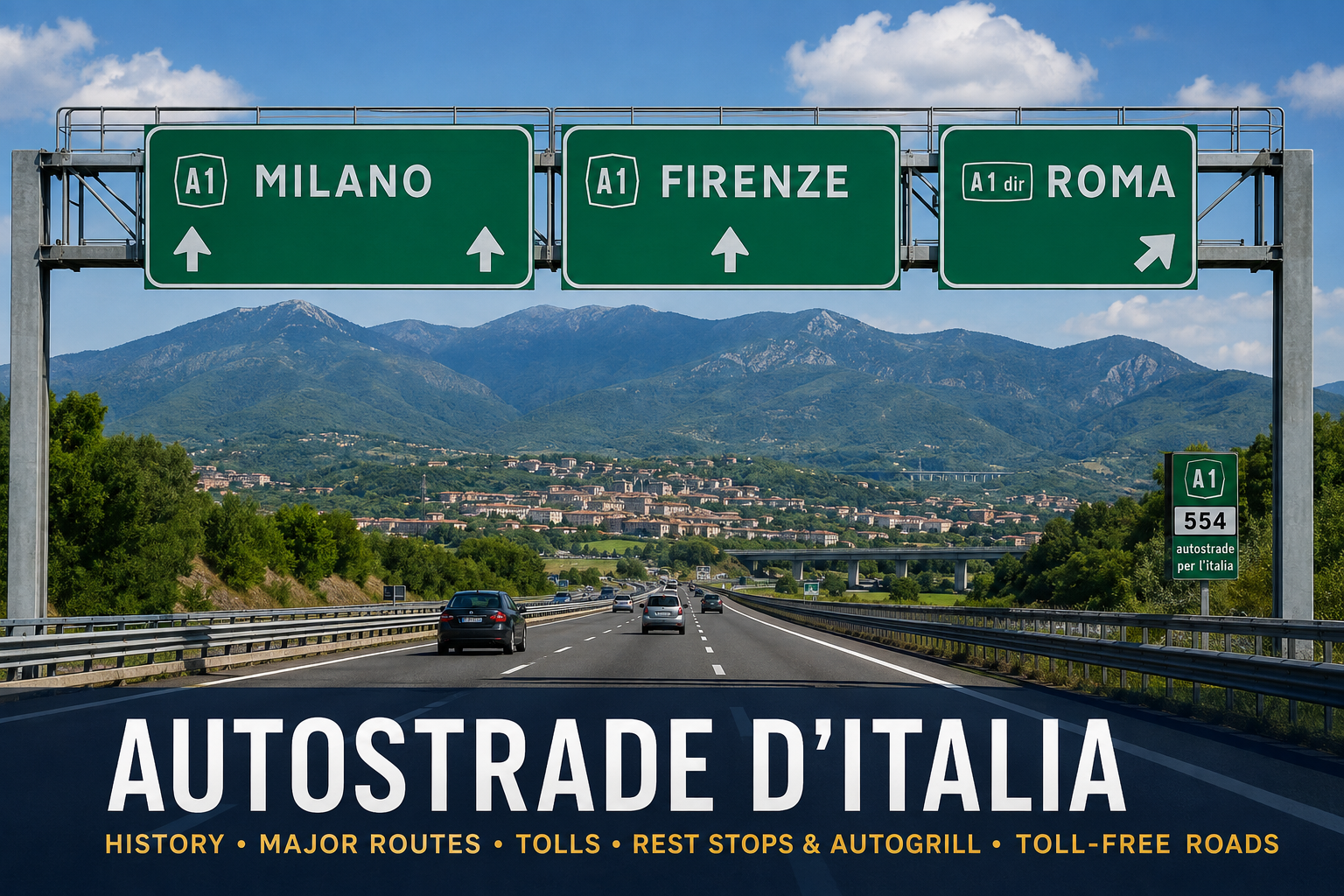
For anyone driving in Italy, the autostrade are both a great convenience and one of the country’s more confusing aspects. Italy has an extensive motorway system connecting the Alps with Sicily and the Adriatic with the Tyrrhenian coast. The fastest way to travel between many Italian cities is usually the autostrada, but that speed comes at a price: most motorways require a toll.
The Italian motorway network is also unusual because it is not operated by a single company. Different sections are managed by different concessionaires, while ANAS, the state road company, operates important toll-free motorway routes. This means that the driving experience, toll system and even the quality and characteristics of roads can vary considerably from one part of the country to another.
For visitors renting a car, understanding how Italian motorways work can make driving considerably easier—and can prevent unpleasant surprises at toll booths.
A brief history of the Italian motorway
Italy has one of the longest motorway traditions in the world.
The story began in the 1920s, well before the modern motorway networks of most European countries. On September 21, 1924, King Victor Emmanuel III inaugurated the first section of the Milano-Laghi, connecting Milan with Varese. The initial section ran between Lainate and Gallarate.
The project was developed by engineer Piero Puricelli, and this pioneering road is generally recognized as the world’s first motorway. It was designed specifically for motor vehicles rather than as an upgraded ordinary road.
The concept was revolutionary. Instead of forcing motorists to pass through towns and villages, a motorway provided a relatively direct route between major population centers.
During the Fascist period, additional motorways were constructed, including routes around Milan and other northern Italian cities. But it was after World War II that Italy’s motorway system became one of the country’s most important infrastructure projects.
The birth of Autostrada del Sole
The decisive moment came in the 1950s.
In 1950, the state-owned IRI established Società Autostrade Concessioni e Costruzioni S.p.A., partly to contribute to Italy’s postwar reconstruction.
In 1956, an agreement between ANAS and Autostrade provided for the construction and management of the future Autostrada del Sole, the A1.
The objective was extraordinarily ambitious: connect Milan in northern Italy with Naples in the south.
The A1 was progressively completed and the entire Milan-Naples route was inaugurated in 1964. It became one of the great symbols of Italy’s economic transformation during the miracolo economico, the postwar economic boom.
The road fundamentally changed the country. Journeys that had previously required considerably more time became easier, commerce expanded and tourism became more accessible.
The motorway also helped strengthen the economic and social links between northern, central and southern Italy.
Autostrade per l’Italia today
One important distinction is between Italian motorways in general and Autostrade per l’Italia, the company.
Autostrade per l’Italia, commonly abbreviated as ASPI, is one of Europe’s largest motorway concessionaires. Its network currently covers approximately 3,000 kilometers across 15 Italian regions. The company operates the roads under concession agreements rather than owning every kilometer of motorway outright.
Its network includes some of Italy’s most important motorways, including large sections of the A1, A7, A8, A9, A10, A11 and A12.
But the entire Italian motorway system is considerably larger than the ASPI network.
Other concessionaires manage substantial sections of motorways, including routes in Piedmont, Lombardy, Veneto, Liguria, Emilia-Romagna and southern Italy. ANAS also operates major routes.
This explains why motorists sometimes notice differences in tolling, road design, maintenance, service areas and traffic-management systems from one motorway to another.
Italy’s major motorway routes
The Italian motorway numbering system uses the letter A followed by a number. Some routes also have names that are much more familiar to Italians than their numerical designation.
Here are the most important routes for travelers.
A1 – Autostrada del Sole
Milan – Bologna – Florence – Rome – Naples
The A1 is the backbone of the Italian motorway system.
At roughly 760 kilometers, it connects Italy’s largest metropolitan areas and provides the principal north-south road connection through the center of the peninsula.
Major cities and areas served include:
- Milan
- Piacenza
- Parma
- Reggio Emilia
- Modena
- Bologna
- Florence
- Arezzo
- Orvieto
- Rome
- Frosinone
- Naples
For tourists, the A1 is particularly important when traveling between Milan, Florence, Rome and Naples.
The route also demonstrates one of the defining characteristics of Italian motorways: dramatic changes in terrain.
The northern section crosses the relatively flat Po Valley, while the route south of Bologna climbs through the Apennines before descending toward Tuscany, Lazio and Campania.
A4 – Torino–Trieste
Turin – Milan – Brescia – Verona – Vicenza – Padua – Venice – Trieste
The A4 is one of the busiest motorway corridors in Italy.
It connects the industrial heartland of northern Italy with the Veneto region and the northeastern border.
For tourists, the route is especially useful for traveling between:
- Turin and Milan
- Milan and Lake Garda
- Milan and Verona
- Verona and Venice
- Venice and Trieste
The A4 is also an important international corridor connecting Italy with France, Switzerland, Austria and Slovenia through connecting roads.
Unlike the A1, the A4 is divided among several concessionaires. The official Autostrade per l’Italia network list identifies different operators along the route.
A7 – Milan–Genoa
Milan – Genoa
The A7 is one of the principal routes from Lombardy to Liguria.
It crosses the Apennines and is famous for its curves, tunnels and spectacular mountain scenery.
It is also one of the most important roads for reaching the Ligurian coast from Milan.
Traffic can be particularly heavy during summer weekends, when large numbers of northern Italians head toward Liguria’s beaches.
A8 – Milan–Varese
Known as the Autostrada dei Laghi, the A8 is historically significant because it forms part of the world’s first motorway system.
It connects Milan with Varese and provides access toward the Italian-Swiss border.
The broader Milan-Lakes motorway system also includes the A9 toward Como.
A9 – Lainate–Como
The A9 provides the principal motorway connection between Milan and Como and continues toward the Swiss border.
For travelers visiting Lake Como, this is one of the most useful motorway routes.
However, reaching the smaller towns around the lake requires leaving the motorway and using local roads, which can be narrow, winding and considerably slower.
A10 – Genoa–Ventimiglia
The A10 runs along the Ligurian coast toward the French border.
It is one of Italy’s most spectacular motorways, with extensive tunnels and viaducts.
The landscape is extraordinary—but the road can also be challenging.
Traffic congestion is common around Genoa, particularly during holiday periods, and the combination of mountains, tunnels, bridges and dense development makes the Ligurian motorway system particularly complex.
A11 – Florence–Pisa
The A11 connects Florence with Prato, Pistoia, Lucca and Pisa.
It is particularly useful for travelers visiting Tuscany.
From Florence, the motorway provides relatively straightforward access toward western Tuscany and the coast.
For travelers heading toward Lucca, Pisa, Viareggio or the Versilia coast, the A11 can save considerable time compared with ordinary roads.
A12 – Genoa–Rome
The A12 follows much of Italy’s Tyrrhenian side, although it is operated by several concessionaires and is not one completely continuous concession.
Important destinations along or near the route include:
- Genoa
- Rapallo
- La Spezia
- Massa
- Viareggio
- Pisa
- Livorno
- Cecina
- Grosseto
- Civitavecchia
- Rome
For travelers exploring Tuscany’s coast, this is one of the most important motorway corridors.
A14 – Autostrada Adriatica
Bologna – Ancona – Pescara – Bari – Taranto
The A14 is the principal motorway along Italy’s Adriatic side.
It serves a remarkable variety of destinations, including:
- Rimini
- Pesaro
- Ancona
- Pescara
- Termoli
- Foggia
- Bari
- Brindisi
- Taranto
The motorway is particularly busy in summer because it connects large northern cities with Adriatic beach resorts.
It is also one of the principal routes for reaching Puglia from northern and central Italy.
A2 – Autostrada del Mediterraneo
The A2 runs from Salerno toward Reggio Calabria through the Italian south.
Unlike the A1 and many other major motorways, the A2 is operated by ANAS and is toll-free.
This is an important distinction for travelers: not every road designated as an autostrada requires payment.
A3 – Napoli–Salerno
The A3 connects Naples with Salerno and is an important regional motorway.
The road is particularly useful for accessing the Amalfi Coast, Pompeii, Herculaneum and the Sorrento area, although motorists must leave the motorway for the final portions of these journeys.
The motorway itself is toll-free.
How Italian motorway tolls work
The Italian toll system can seem complicated to foreign visitors, but the basic principle is straightforward.
On many Italian motorways, you take a ticket when entering and pay when exiting.
Your toll is calculated primarily according to:
- The distance traveled
- The vehicle class
- The motorway characteristics
- The concessionaire or concessionaires involved
Autostrade per l’Italia explains that its toll rates are based partly on the characteristics of the motorway. Mountain sections generally cost more because they require substantially more infrastructure, including tunnels and viaducts.
How much does an autostrada cost?
There is no single national price per kilometer.
For Autostrade per l’Italia, the published January 2026 rates for the standard Class A vehicle—including VAT—are:
- Flat terrain: €0.07869 per km
- Mountain terrain: €0.09315 per km
These are basic unit rates and should not be interpreted as a simple final price for every journey, because the actual toll calculation depends on the specific route, concessionaires and rounding rules.
A long journey across Italy can therefore cost a significant amount in tolls.
For a tourist renting a car, it is worth calculating tolls when comparing driving with trains or other transportation.
Why mountain motorways cost more
This is one of the more interesting features of Italian tolls.
A kilometer of motorway through the Po Valley is considerably easier and cheaper to construct than a kilometer crossing the Apennines or Alps.
Mountain motorways can require:
- Long tunnels
- Major viaducts
- Retaining structures
- Complex drainage
- Emergency infrastructure
- Additional maintenance
- Sophisticated monitoring systems
This is particularly obvious on roads such as the A7, A10 and sections of the A1.
Consequently, two journeys of similar distance can have different toll costs.
The toll booth system
Traditionally, Italy used a ticket-based system.
When entering a motorway, the driver takes a ticket at the entrance station.
When leaving, the ticket is inserted into a payment machine or handed to an attendant. The system calculates the amount due based on where the vehicle entered and exited.
Drivers should never lose the ticket.
Without the entry ticket, the system may not know where the journey began, potentially resulting in a charge based on the longest applicable route.
If this happens, there are procedures for correcting the situation, but it is far easier to keep the ticket safely in the car.
Paying the Italian motorway toll
There are several ways to pay.
Cash
Cash is still accepted at many toll stations.
However, don’t assume that every lane is cash-only or that every lane accepts every payment method.
Look for the appropriate symbols above the lane.
Credit and debit cards
Credit and debit cards can be used at many toll stations.
This is generally convenient for international visitors, although foreign card transactions can occasionally encounter authorization problems.
Electronic toll collection
Electronic toll collection has transformed motorway travel in Italy.
The best-known system is Telepass, introduced in 1990 by the Autostrade Group. Autostrade describes it as the world’s first large-scale dynamic toll-payment system.
Instead of stopping at a conventional toll booth, the vehicle passes through a designated electronic lane and the toll is charged automatically.
For frequent motorway users, this can save considerable time.
Don’t enter the Telepass lane by accident
This is one of the most important tips for foreign drivers.
The yellow Telepass lanes are intended for vehicles equipped with compatible electronic toll-payment devices.
If you are driving a rental car without such a device, do not enter a lane reserved exclusively for electronic payment.
Instead, choose a lane that accepts cards or cash.
Some toll plazas have mixed-payment lanes, so always check the symbols.
Are Italian autostrade free?
Yes—but this requires some explanation.
Italy has both toll motorways and toll-free motorways.
The most important toll-free motorway sections include roads operated by ANAS, but there are also individual motorway sections where no toll is collected.
Among the major toll-free routes are:
A2 – Salerno–Reggio Calabria
The A2 is one of the most important free motorway routes in Italy.
It provides the main high-speed road connection through Calabria and links the region with Campania and the rest of mainland Italy.
A3 – Naples–Salerno
This important Campania motorway is also toll-free.
Some raccordi and tangenziali
Italy has numerous raccordi autostradali, or motorway connectors, and tangenziali, bypass roads that function partly like motorways.
Many are toll-free.
This can be extremely useful for local travel.
For example, a traveler may use a toll-free ring road to bypass a city even when the motorway connecting the city to another region is tolled.
Toll-free doesn’t necessarily mean slower
This is an important point for tourists.
A toll-free road isn’t automatically an inferior road.
ANAS operates several major, high-capacity routes that can function much like conventional motorways.
The A2 is the clearest example.
However, free roads may have more variable characteristics, including lower speed limits, more junctions, construction zones or sections with different standards.
The decision between a tolled motorway and a toll-free alternative therefore depends on the journey.
The SS roads: Italy’s other major highways
Another important alternative to the autostrada is the Strada Statale, abbreviated SS.
State roads are generally identified with blue signs and can be major highways connecting cities, towns and regions.
Some SS roads are extremely modern and fast. Others can be winding mountain roads or urban routes.
For example, Italy’s famous SS1 Via Aurelia follows much of the western side of the peninsula, while roads such as the SS16 Adriatica provide an alternative to parts of the A14.
These roads can be useful when:
- You want to avoid tolls
- You aren’t in a hurry
- You want to see smaller towns
- You are traveling along the coast
- You want a more scenic route
Italy’s official tourism website specifically identifies state roads as an alternative to toll motorways.
The biggest difference between motorway and ordinary roads
The biggest practical difference isn’t simply speed.
It is access.
Autostrade are controlled-access roads. You normally enter through designated junctions and cannot simply stop along the road.
Ordinary roads pass through towns and cities, have traffic lights, pedestrian crossings and local intersections.
This makes ordinary roads much slower but potentially much more interesting for tourists.
A journey that takes two hours on the autostrada might take three or four hours on local roads—but it may also pass through medieval villages, vineyards, beaches and landscapes that you would never see from the motorway.
When should tourists use the autostrada?
For long-distance travel, the motorway is usually the best option.
Use it when:
- Traveling between major Italian cities
- You have limited time
- You need to cover several hundred kilometers
- You are traveling with children
- You are driving a rental car between airports and destinations
- Weather conditions make slower mountain roads less attractive
For example, driving from Milan to Florence entirely on local roads would be unnecessarily time-consuming for most travelers.
But if you are spending several days exploring Tuscany, leaving the A1 and taking local roads can be part of the experience.
When should you avoid the motorway?
Avoiding toll roads can make sense when:
- You are not in a hurry
- You want to reduce driving costs
- The alternative road is reasonably fast
- You want scenic views
- You are exploring a particular region
- The motorway is heavily congested
A good Italian road trip often combines both.
Use the autostrada to cover the large distances, then switch to ordinary roads for exploring.
Italy’s motorways vary considerably by region
One of the fascinating aspects of driving in Italy is that the motorway experience changes dramatically from north to south.
Northern Italy
Northern motorways generally serve densely populated and highly industrialized areas.
The A4 around Milan, Brescia, Verona and Padua can carry enormous volumes of traffic.
The road network is extensive, but congestion can be severe.
The Alps
Motorways crossing the Alpine regions involve numerous tunnels, viaducts and steep terrain.
Weather becomes an important factor, particularly in winter.
Snow, ice and restrictions can affect travel.
The Apennines
The Apennine crossings are particularly noticeable on the A1 between Bologna and Florence.
The modern motorway has significantly improved travel through the mountains, but the landscape remains challenging.
Long tunnels and high viaducts are common.
Liguria
Liguria has perhaps one of Italy’s most dramatic motorway environments.
The A10, A7 and A12 involve extensive engineering because the mountains rise almost directly from the sea.
The result is a landscape of tunnels and viaducts that can feel very different from the broad, flat motorways of Emilia-Romagna.
Central Italy
Tuscany, Umbria and Lazio combine motorways with an enormous network of state and regional roads.
The A1 is the principal north-south artery, while roads such as the A11, A12 and A24 provide important regional connections.
Southern Italy
Southern Italy has several major toll-free or differently managed routes.
The A2 is particularly important because of its role in connecting Campania with Calabria.
The road network has improved considerably over the decades, although distances, terrain and local road conditions can still make journeys slower than visitors expect.
Autostrade and Italian road-trip culture
The motorway has played a much larger role in Italian life than simply providing a way to get from one city to another.
The Autostrada del Sole became a symbol of the modern Italian nation.
It connected regions that had historically been separated by geography and poor transportation links.
Families could travel south for holidays. Southern workers could more easily travel north in search of employment. Businesses could transport goods across the country.
Tourism was transformed.
The motorway also changed Italy’s physical landscape.
Hotels, restaurants, petrol stations and service areas developed around motorway junctions. Towns that had previously been important stopping points on ordinary roads sometimes lost traffic, while new commercial centers developed around motorway exits.
Motorway service areas
Italian autostrade are generally well supplied with service areas, known as aree di servizio.
They typically offer:
- Fuel
- Toilets
- Food
- Coffee
- Snacks
- Shops
- Parking
- Sometimes restaurants and additional services
Autostrade per l’Italia currently reports 215 service areas on its network.
For long-distance journeys, these stops are an important part of the Italian motorway experience.
And, as with everything else on the autostrada, prices can be higher than in towns.
Autogrill: the Italian motorway institution
For generations of Italians, the word Autogrill has meant much more than a place to stop for coffee.
It has become almost synonymous with the motorway rest stop itself. On a long Italian road trip, an Autogrill is where you stop for an espresso, use the bathroom, buy a panino, stretch your legs, fill up with fuel or simply take a break from driving.
The story of Autogrill is closely intertwined with the history of Italy’s motorways and the country’s postwar economic transformation.
From Pavesi biscuits to the modern Autogrill
The origins go back to the late 1940s.
In 1947, Mario Pavesi, a businessman from Lombardy and producer of the famous Pavesini biscuits, opened a small shop near the Novara toll station on the Milan-Turin motorway. It originally sold products from his family’s biscuit factory but already included tables, seating and an outdoor pergola where motorists could relax.
As automobile ownership increased during Italy’s economic boom, the small outlet evolved into a genuine restaurant and rest area.
Other companies followed, most notably Motta and Alemagna, creating a new form of motorway hospitality. By the 1950s and 1960s, motorway service areas had become an increasingly important part of Italian travel culture.
The spectacular bridge Autogrills
The most remarkable period in Autogrill’s history was arguably the late 1950s and 1960s.
Instead of building ordinary roadside restaurants, architects created extraordinary structures that actually crossed the motorway.
The first European bridge-style Autogrill opened at Fiorenzuola d’Arda, between Parma and Piacenza, in 1959. Designed by architect Angelo Bianchetti, the steel-and-glass structure stretched approximately 70 meters and crossed the motorway more than five meters above the traffic.
It became known as the “Transatlantico”, reflecting its futuristic appearance.
More than a dozen bridge-style Autogrills were subsequently constructed between 1959 and 1971. They became architectural symbols of Italy’s optimism, modernity and fascination with the automobile.
One of the most famous was the Cantagallo service area on the A1 between Bologna and Florence. When it opened in 1961, it was described as the largest in Europe and contained not only a restaurant but also a market, pastry shop, hairdresser and florist.
The motorway was becoming a destination in itself.
Villoresi: a symbol of Italian modernism
Another extraordinary example is Villoresi Ovest, on the A8 Milano-Laghi.
Opened in 1958 and designed by Bianchetti, its circular structure, extensive glass walls and futuristic tripod form represented the optimism of Italy’s economic miracle.
Today, the historic building has been renovated and operates as Autogrill 1958, preserving its architectural identity while providing contemporary food and beverage services.
For anyone interested in Italian architecture, design and industrial history, these motorway restaurants are worth considering as destinations in their own right.
The birth of Autogrill as a company
The name Autogrill eventually became the umbrella brand for the motorway foodservice business.
In 1977, the Italian state holding company IRI merged the motorway restaurant operations of Pavesi, Motta and Alemagna into the new Autogrill S.p.A. The three names initially continued to appear alongside the Autogrill brand before the company gradually consolidated its identity.
During the 1980s, Autogrill expanded its offering.
The Ciao self-service restaurant concept was introduced in 1981, while the famous Camogli sandwich was launched the same year. Later came other brands and concepts, including Spizzico.
The idea was no longer simply to provide motorists with food. Autogrill increasingly offered a complete travel-shopping experience.
What you can expect at an Autogrill today
Modern motorway service areas are considerably more sophisticated than the original postwar cafés.
Depending on the location, an Autogrill or motorway service area may include:
- Coffee bars
- Restaurants
- Self-service restaurants
- Sandwich counters
- Pizza
- Pastries and desserts
- Convenience stores
- Italian food products
- Souvenirs
- Toilets
- Baby-changing facilities
- Outdoor seating
- Fuel stations
- Electric-vehicle charging
- Parking for cars and trucks
- Accessibility facilities
Larger locations may contain several different food concepts under the same roof.
Autogrill’s current Italian locations include historic sites such as Villoresi Ovest, Fiorenzuola d’Arda, Cantagallo and Scaligera, as well as modern service areas with multiple restaurants and food brands.
Are Autogrills expensive?
One criticism frequently made by travelers is that food and drinks at motorway service areas can cost more than they do in ordinary cafés and restaurants.
That is not surprising: motorway locations have higher operating costs and serve a captive traveling clientele.
A simple espresso may still be reasonably priced, while a full meal, bottled drinks, snacks and convenience-store purchases can add up quickly.
For budget-conscious travelers, a good strategy is to use Autogrill primarily for coffee, a bathroom break and a quick snack, while eating larger meals in towns along the route.
Nevertheless, Autogrill can be extremely convenient when you need to keep moving.
Don’t confuse Autogrill with every motorway rest stop
This is an important distinction.
Autogrill is a company and brand; “area di servizio” is the generic Italian term for a motorway service area.
Not every Italian motorway rest area is an Autogrill.
Different concessionaires and operators have contracts with different foodservice companies. You may therefore encounter other brands, independent restaurants, fuel-station services and combinations of businesses.
In everyday Italian conversation, however, someone may say “Ci fermiamo all’Autogrill” even when the destination is technically another type of motorway service area.
The brand has become so culturally established that the name is often used almost generically.
Rest stops without restaurants
Not every useful motorway stop is a major commercial service area.
Italy also has smaller aree di sosta, designed primarily for taking a break.
These may provide:
- Parking
- Toilets
- Picnic tables
- Green space
- Vending machines
- Basic traveler facilities
They are particularly useful if you simply need to stop driving for a few minutes.
For long journeys, drivers should not wait until they are exhausted before stopping. Italian motorway driving can involve sustained high speeds, heavy traffic, tunnels and complex interchanges. A short break can make a substantial difference in concentration.
Fuel stations and motorway stops
Many major service areas combine food, parking and fuel.
Historically, the traditional motorway stop was therefore a single location where a driver could refuel the car, have lunch, buy groceries and take a bathroom break.
Today, the increasing number of electric vehicles is changing the traditional model.
Some motorway service areas now include electric-vehicle charging stations, although availability and charging speeds vary considerably between locations.
If you are driving an electric car across Italy, it is important to plan charging stops rather than assuming that every Autogrill or service station will have a suitable fast charger.
Truck stops and long-distance driving
Italy’s motorway rest areas are also essential for professional drivers.
Larger service areas provide dedicated truck parking and facilities designed for people spending many hours on the road.
On major freight corridors such as the A1, A4 and A14, service areas can become particularly busy with trucks.
This is another reason why drivers should not assume that every motorway stop will have unlimited parking during peak periods.
The culture of the Italian motorway coffee break
There is also a cultural side to the Autogrill experience.
For Italians, stopping for an espresso during a long drive is almost a ritual.
You walk inside, order a coffee at the bar, perhaps buy a cornetto or sandwich, use the bathroom and return to the car.
The entire stop may take only ten or fifteen minutes.
The traditional Italian motorway bar was never intended to be a leisurely restaurant experience in the same way as a café in a city center. Its purpose was to make travel easier while maintaining a connection with familiar Italian food and coffee culture.
For foreign visitors, however, an Autogrill can be an interesting cultural experience in itself.
What to try at an Italian Autogrill
If this is your first Italian road trip, some of the classic motorway foods worth trying include:
Espresso – The essential Italian motorway stop.
Cappuccino – More appropriate in the morning than after a heavy meal.
Cornetto – The Italian breakfast pastry, usually available plain or filled with cream, chocolate or jam.
Panini – One of the defining foods of Italian road travel.
Camogli – One of Autogrill’s historic signature sandwiches, launched in 1981.
Pizza or focaccia – Availability varies by location.
Regional products – Larger service areas increasingly offer local specialties and packaged Italian foods.
The quality varies from location to location, so don’t assume that every Autogrill offers exactly the same experience.
Famous Autogrills worth seeing
Some motorway stops are sufficiently distinctive that they have become architectural landmarks.
Fiorenzuola d’Arda – A1
The historic bridge restaurant at Fiorenzuola d’Arda is arguably the most famous.
It was inaugurated in 1959 and is regarded as the first bridge-style Autogrill in Europe. Its position spanning the A1 makes it one of the great surviving monuments of Italian motorway architecture.
Villoresi Ovest – A8
The futuristic 1958 building on the A8 is another landmark of Italian modernism.
It has been renovated while retaining the character of Bianchetti’s original design.
Cantagallo – A1
Located between Bologna and Florence, Cantagallo is another historic bridge-style structure.
Its imposing position above the motorway makes it particularly memorable when traveling through the Apennines.
Scaligera – A4
The Scaligera service area at Soave, along the A4 Turin-Trieste motorway, is another example of the distinctive bridge-style motorway architecture associated with Italy’s golden age of highway construction.
A motorway tradition that became part of Italian identity
The importance of Autogrill goes far beyond food.
The company emerged at precisely the moment when Italy was becoming a modern mass-motorized society.
The Fiat 500 and 600 put millions of Italians on the road. The Autostrada del Sole connected northern and southern Italy. Families began taking holidays by car. And the Autogrill provided the places where these travelers could stop, eat, shop and rest.
The spectacular architecture of the 1950s and 1960s reflected the optimism of that period.
Today, the buildings and businesses have changed, but the basic idea remains remarkably similar.
Drive. Stop. Have a coffee. Eat something. Continue the journey.
For many Italians, that simple ritual is an inseparable part of traveling on the autostrada.
A practical tip: plan your stops
When driving long distances in Italy, don’t choose your rest stop only when you are already tired.
Before starting a long journey, identify one or two potential aree di servizio along the route.
This is particularly useful on busy summer weekends, when popular stops can become crowded.
And remember that the service area itself may be several kilometers from the next motorway exit. If you need a full meal, a hotel or a supermarket rather than a quick break, leaving the motorway may offer more choices and potentially lower prices.
For the classic Italian road trip, however, there is something uniquely appropriate about pulling into an Autogrill, ordering an espresso and watching thousands of kilometers of Italian motorway traffic pass outside.
It is not simply a rest stop.
It is part of the experience of driving through Italy.
Speed limits on Italian motorways
The general maximum speed limit on Italian motorways is 130 km/h, subject to road conditions, weather, vehicle type and posted restrictions.
In bad weather, lower limits may apply.
Roadworks can also reduce the limit substantially.
Drivers should pay close attention to variable-message signs and temporary restrictions.
The presence of a motorway does not mean that 130 km/h is always permitted.
Safety and the Italian motorway
Italian motorways have extensive safety infrastructure, including cameras, variable-message signs, emergency telephones and traffic-management systems.
Autostrade per l’Italia reports approximately 4,000 cameras and 1,922 variable-message signs on its network.
One of the most important systems for drivers is Tutor, which monitors average speed over designated sections rather than simply measuring speed at one point.
This means that slowing down just before a camera does not necessarily solve the problem.
The safest approach is simply to respect the posted speed limit throughout the journey.
The future of Italy’s autostrade
Italy’s motorway network is now approximately a century old.
The challenge today is very different from the challenge faced by Puricelli in the 1920s.
The country no longer needs simply to build roads. It must maintain and modernize a vast infrastructure of tunnels, bridges, viaducts, pavements and safety systems.
This is particularly important because Italy’s motorway network contains an unusually high concentration of bridges, viaducts and tunnels compared with many other European countries.
The future is therefore likely to involve:
- Tunnel modernization
- Bridge and viaduct maintenance
- Digital traffic management
- Electronic toll collection
- Intelligent transport systems
- Electric-vehicle infrastructure
- Noise reduction
- Improved road safety
- Greater use of real-time traffic information
For motorists, this should gradually produce a more technologically sophisticated motorway experience.
Tips for foreigners driving on Italian autostrade
If you are visiting Italy by rental car, remember these basic rules:
Keep your motorway entry ticket.
You will normally need it when leaving.
Check the payment symbols before entering a toll lane.
Don’t accidentally enter a lane reserved for electronic payment.
Keep a credit card available.
It is often the easiest payment method.
Don’t assume every motorway is operated by Autostrade per l’Italia.
There are multiple concessionaires.
Check tolls before a long journey.
The cost can be significant.
Consider toll-free alternatives.
For shorter journeys, the saving can be worthwhile.
Don’t judge distances only by kilometers.
A 100-kilometer mountain journey can take considerably longer than 100 kilometers across the Po Valley.
Watch the weather.
Mountain motorways can experience snow, fog, heavy rain and strong winds.
Don’t rely entirely on navigation apps.
Always pay attention to road signs and temporary restrictions.
Autostrada or scenic road?
For visitors, the best answer is often: both.
Italy’s motorways are efficient transportation corridors. They make it possible to travel from Milan to Rome, Florence to Pisa or Bologna to Venice relatively quickly.
But the real Italy often begins when you leave the motorway.
A road trip through Tuscany, Sicily, Puglia, Umbria, Liguria or the Italian Lakes can be much more rewarding when you allow yourself time to use secondary roads.
The motorway gets you there.
The smaller roads allow you to discover the country.
The Italian motorway system at a glance
| Route | Main connection | Toll? |
|---|---|---|
| A1 | Milan–Bologna–Florence–Rome–Naples | Yes |
| A2 | Salerno–Reggio Calabria | No |
| A3 | Naples–Salerno | No |
| A4 | Turin–Milan–Venice–Trieste | Yes, depending on section |
| A7 | Milan–Genoa | Yes |
| A8 | Milan–Varese | Yes |
| A9 | Milan–Como | Yes |
| A10 | Genoa–Ventimiglia | Yes |
| A11 | Florence–Pisa | Yes |
| A12 | Genoa–Rome corridor | Yes, depending on section |
| A14 | Bologna–Ancona–Pescara–Bari–Taranto | Yes |
Because Italy’s motorway network is divided among different concessionaires, travelers should always check the specific route rather than assuming that a motorway number automatically determines the toll.
Final thoughts
Italy’s autostrade are much more than a collection of highways. They are part of the country’s modern history.
From the pioneering Milano-Laghi motorway of 1924 to the enormous A1 network and today’s sophisticated electronic tolling systems, Italian motorways have helped transform the geography and economy of the country.
For visitors, they offer an efficient way to cover enormous distances—but they also require some preparation.
Understand the toll system, know which roads are free, choose the correct toll lane, and remember that different sections may be managed by different concessionaires.
Most importantly, don’t feel that you have to choose between the motorway and the scenic route.
The best Italian road trip often uses the autostrada when distance matters and the smaller roads when Italy itself is the destination.
Internal Links
For more information about driving, road travel and exploring Italy by car, see these related Italia Mia guides:
- Driving in Italy: A Complete Guide to Italian Roads, Drivers, Traffic, and Survival Tips — Practical information about Italian roads, motorway driving, speed cameras, ZTL zones, parking and driving customs.
- Driving in Italy Compared to the USA and Other Countries — A useful comparison of Italian roads, traffic laws and driving habits with those in the United States and elsewhere.
- The Best Driving Routes in Italy: Scenic Roads, Hidden Gems, and Culinary Delights — Covers some of Italy’s most attractive road-trip routes, including Tuscany, the Amalfi Coast, the Dolomites and the Italian Riviera.
- Tips for Enjoying an Unforgettable Road Trip in Italy — Practical advice on planning an Italian road trip, choosing a vehicle and selecting destinations.
- What Visitors Need to Know Before Driving in Italy — Additional advice for visitors unfamiliar with Italian driving conditions and road rules.
- Italy for First-Time Visitors: The Complete Guide to Your First Italian Vacation — A broader guide to transportation, renting a car, itineraries and traveling around Italy.
- Ultimate Italy Travel Guide 2026 — Comprehensive information for planning an Italian vacation, including transportation and road-trip ideas.
- Region of Tuscany: A Complete Travel Guide — Particularly useful for travelers using the A1 and A11 or exploring Tuscany by car.
- How to Get from Milan to Lake Como — Includes information about the A9 and alternative roads around Lake Como.
- Peccioli Tuscany: Medieval Village, Contemporary Art and Hidden Gems — An example of how Italy’s motorway network can be used as a starting point for exploring smaller Tuscan destinations.
External Links
- Autostrade per l’Italia – Official Website
- Autostrade per l’Italia – Network and Motorway Routes
- Autostrade per l’Italia – How Tolls Are Calculated
- Autostrade per l’Italia – History and Company Information
- Italia.it – Getting Around Italy