
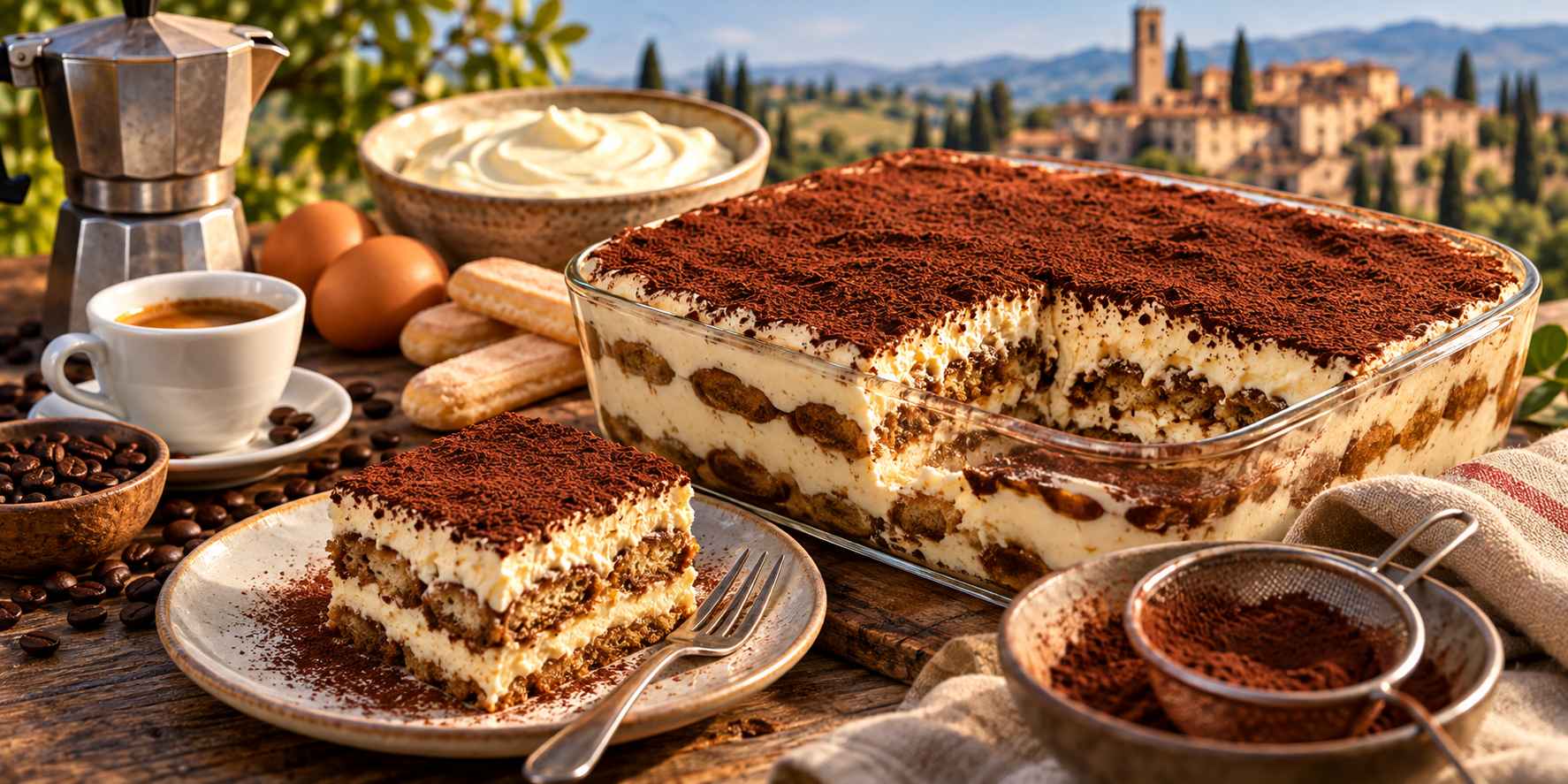
Few Italian desserts have achieved the international fame of tiramisù. From small family kitchens in Italy to elegant restaurants in New York, Paris, Tokyo and Sydney, the combination of coffee-soaked savoiardi, mascarpone cream and cocoa has become almost synonymous with Italian cuisine.
It is a remarkably simple dessert. There is no complicated pastry, no elaborate decoration and traditionally no baking. Yet the balance between bitter coffee, sweet mascarpone cream, soft biscuits and slightly bitter cocoa is extraordinarily effective.
Tiramisù is also a relatively young Italian classic. Unlike panettone, cassata, cannoli or many other Italian sweets whose origins go back centuries, the modern tiramisù emerged only in the second half of the 20th century.
And its history is not entirely straightforward.
Several places in northeastern Italy have claimed to be its birthplace, while the precise evolution from earlier coffee-and-cream desserts remains the subject of culinary debate. Nevertheless, the Treviso version associated with the restaurant Le Beccherie has the strongest documentary and institutional claim to the modern dessert we know today. The Italian Academy of Cuisine deposited the Treviso recipe with a notarial deed in 2010.
For anyone interested in Italian food, tiramisù is more than a dessert. It is a fascinating example of how a relatively recent recipe can become part of a country’s culinary identity in just a few decades.
What does “tiramisù” mean?
The Italian word tiramisù literally means something close to “pick me up” or “lift me up.”
The expression is derived from the Venetian dialect tiramesù, referring to the supposedly restorative qualities of the dessert’s combination of eggs, sugar, mascarpone and coffee.
The name makes perfect sense. Tiramisù contains coffee and sugar, while its rich mascarpone and egg cream makes it an intensely satisfying dessert.
The original dialect spelling was tiramesù, although tiramisù became the standard Italian form and eventually the internationally recognized name.
The story begins before tiramisù
Although tiramisù itself is a modern invention, its ingredients and basic concept are much older.
Italian cooks had long combined:
- eggs and sugar
- mascarpone or other fresh cheeses
- coffee
- sweet biscuits or sponge cake
- cocoa or chocolate
- sometimes liqueurs
The Italian Academy of Cuisine has documented several earlier Treviso-area preparations that resemble tiramisù. These included coffee desserts using mascarpone, eggs, sugar, sponge cake, biscuits, chocolate and sometimes liqueur.
One particularly interesting predecessor was the Coppa Imperiale served at the Al Fogher restaurant in Treviso in 1956. It included black coffee, mascarpone, sugar and egg yolks, but used sponge cake instead of savoiardi and grated chocolate rather than cocoa.
This is important because it demonstrates that the idea did not appear from nowhere.
The modern tiramisù was the result of combining and refining culinary traditions that already existed in the region.
Treviso and the birth of modern tiramisù
The central figure in the accepted Treviso story is Roberto “Loli” Linguanotto, a pastry chef who worked at the restaurant Le Beccherie in Treviso.
According to the historical account preserved by the restaurant and the Italian Academy of Cuisine, experiments took place around 1970–1971, involving Linguanotto and Alba Campeol, a member of the family associated with Le Beccherie.
The inspiration is often connected to a traditional preparation called sbatudin: egg yolks beaten with sugar, a simple and energy-rich preparation familiar in rural Veneto.
The idea was to transform this basic preparation into a restaurant dessert by combining it with mascarpone and coffee-soaked biscuits.
The result was tiramisù.
The restaurant itself dates to 1939, and its history is closely connected with the Campeol family. The dessert was officially placed on the Le Beccherie menu in 1972, although the development of the recipe is generally dated to the period immediately preceding that date.
Why Le Beccherie matters
The importance of Le Beccherie is not simply that the restaurant claims to have invented tiramisù.
The restaurant’s version is supported by a chain of historical evidence:
1970: the dessert’s creation is traditionally associated with Roberto Linguanotto and Le Beccherie.
1972: Tiramesù appears on the restaurant’s menu.
1981: gastronomer Giuseppe Maffioli published one of the first important written accounts attributing the dessert to Le Beccherie in his magazine Vin Veneto.
1983: Maffioli included the recipe in his book La cucina trevigiana, identifying it with Le Beccherie.
2010: the Treviso delegation of the Italian Academy of Cuisine deposited the traditional recipe through a notarial deed.
This makes Treviso’s claim considerably stronger than many of the stories that have appeared over the years.
The Friuli-Venezia Giulia connection
There is, however, another important part of the story.
Friuli-Venezia Giulia also has a strong claim to the early history of tiramisù.
The most frequently mentioned examples include the Albergo Roma in Tolmezzo and the Trattoria Al Vetturino in Pieris/San Canzian d’Isonzo, where related desserts appeared before or around the period in which the Treviso tiramisù was being developed.
The Italian culinary tradition therefore does not fit neatly into the idea that one person suddenly invented an entirely new dessert.
Earlier versions existed.
What distinguishes the Treviso story is the combination of ingredients and technique that produced the modern layered dessert and its subsequent documentation and enormous popularity.
The Italian Academy of Cuisine itself has acknowledged the existence of several precursors. Its research describes coffee-based desserts in the Treviso area before the emergence of the recognizable tiramisù.
In other words, the safest historical conclusion is that the modern tiramisù was born from an existing family of Italian coffee-and-cream desserts, with Le Beccherie in Treviso establishing the version that became internationally famous.
The six ingredients of traditional tiramisù
One of the most appealing characteristics of the classic recipe is its simplicity.
The traditional Treviso formulation contains just six essential ingredients:
- Savoiardi
- Egg yolks
- Mascarpone
- Sugar
- Coffee
- Unsweetened cocoa powder
Notably absent from the original formulation are:
- whipped cream
- whipped egg whites
- chocolate chips
- vanilla
- fruit
- Nutella
- Marsala or other liqueurs
The Le Beccherie version is particularly distinctive because the cream is made from egg yolks, sugar and mascarpone alone. No whipped cream or egg whites are required.
The original Le Beccherie recipe
There are slightly different transcriptions of the historical recipe, particularly concerning quantities because the original restaurant preparation was designed for professional service.
The version documented by the Italian Academy of Cuisine uses six egg yolks, sugar, mascarpone, coffee, savoiardi and cocoa. Other published versions reproduce a larger restaurant-scale formula using 12 yolks and 1 kilogram of mascarpone.
For a practical home preparation, the following proportions are easier to manage.
Ingredients for approximately 6–8 servings
- 6 fresh egg yolks
- 250 g sugar
- 500 g mascarpone
- approximately 300–500 ml strong unsweetened coffee
- approximately 30 savoiardi
- unsweetened cocoa powder
The precise amount of coffee and savoiardi depends on the size of the dish.
Importantly, traditional tiramisù does not require alcohol. The absence of liqueur is one of the characteristics that helped make the Treviso version so widely accessible.
How to make the traditional tiramisù
1. Prepare the coffee
Make strong coffee, traditionally using a moka pot, and allow it to cool.
The coffee should be intense but not sweetened.
Do not use hot coffee to soak the savoiardi. Hot liquid can make them collapse too quickly.
2. Prepare the mascarpone cream
Separate the egg yolks from the whites.
Beat the yolks together with the sugar until the mixture becomes pale, thick and creamy.
Add the mascarpone and incorporate it gently until you obtain a smooth, dense cream.
The classic Treviso recipe relies entirely on the yolks and mascarpone for the cream’s characteristic richness and texture.
3. Soak the savoiardi
Dip each savoiardo briefly into the cooled coffee.
This is one of the most important steps.
Do not soak the biscuits for too long.
A good tiramisù should have soft biscuits, but they should still retain enough structure to provide a slight contrast with the cream.
The Italian Academy of Cuisine specifically emphasizes avoiding excessive soaking.
4. Create the first layer
Arrange the coffee-soaked savoiardi in the bottom of your serving dish.
Traditionally, the original Le Beccherie tiramisù was prepared in a round form and served in triangular portions.
Today, rectangular dishes are more common in homes and restaurants.
5. Add the cream
Spread approximately half of the mascarpone cream over the savoiardi.
Smooth the surface gently.
6. Add the second layer
Repeat the process with another layer of coffee-dipped savoiardi.
Cover them with the remaining mascarpone cream.
7. Refrigerate
Place the tiramisù in the refrigerator for several hours.
A minimum of about two hours is commonly recommended, but allowing it to rest longer gives the layers time to settle and the flavors to integrate. The modern Le Beccherie preparation also emphasizes several hours of refrigeration.
8. Add the cocoa
Dust the surface generously with unsweetened cocoa powder immediately before serving.
Adding the cocoa at the last moment helps preserve its aroma, color and slightly bitter flavor.
The secret is balance
Tiramisù looks simple, but making an excellent one requires attention to proportion.
The dessert works because each ingredient performs a specific role.
Coffee supplies bitterness and aroma.
Sugar softens the bitterness and provides sweetness.
Mascarpone supplies fat, creaminess and richness.
Egg yolks give the cream structure and additional richness.
Savoiardi provide the absorbent sponge-like layer.
Cocoa contributes a dry, bitter, aromatic finish.
Remove any one of these elements and the balance changes dramatically.
This is why a tiramisù overloaded with chocolate, alcohol or whipped cream can be delicious but should technically be considered a variation, rather than the classic Treviso preparation.
Raw eggs and food safety
Traditional tiramisù uses raw egg yolks, which is historically authentic but requires care.
For modern home preparation, particularly when serving children, older adults, pregnant people or anyone with increased vulnerability to foodborne illness, using pasteurized eggs or pasteurized egg yolks is a sensible alternative.
Pasteurization changes the technique but does not require abandoning the basic structure of tiramisù.
The traditional recipe should therefore be understood as a historical culinary formula rather than a requirement to use unpasteurized eggs regardless of circumstances.
Should tiramisù contain alcohol?
This is one of the most controversial questions surrounding the dessert.
Many modern recipes contain:
- Marsala
- rum
- coffee liqueur
- Amaretto
- Grand Marnier
- brandy
These can produce excellent results.
But the classic Le Beccherie recipe does not contain alcohol.
This distinction is important because many people assume that Marsala is an essential ingredient in authentic tiramisù.
It is not.
Marsala is a popular variation.
Indeed, the absence of alcohol was one of the features that helped the original version appeal to a broad audience.
The great tiramisù variations
Once tiramisù became popular throughout Italy, cooks began modifying it.
Today there are hundreds of variations.
Some are subtle and remain recognizably tiramisù. Others use the name for desserts that have only a distant relationship to the original.
Tiramisù with Marsala
Probably one of the most traditional variations.
A small quantity of Marsala is added to the egg-and-mascarpone cream or sometimes incorporated into the coffee.
Marsala provides additional sweetness, complexity and a gentle fortified-wine aroma.
It is particularly appropriate for diners who prefer a richer, more adult flavor.
Tiramisù with rum
Rum is another popular addition.
It creates a warmer, more aromatic dessert and works especially well with strong coffee and dark cocoa.
The flavor, however, is quite different from the clean coffee-and-mascarpone profile of the Treviso original.
Tiramisù with whipped egg whites
Some recipes fold whipped egg whites into the mascarpone mixture.
This produces a lighter, airier cream.
The result can be excellent, but it is not the traditional Le Beccherie formulation, which relies on yolks, sugar and mascarpone.
Tiramisù with whipped cream
Adding whipped cream creates an even softer and lighter dessert.
It is particularly common in commercial and home recipes.
Again, this is a variation rather than part of the original six-ingredient formula.
Chocolate tiramisù
Some versions replace part of the cocoa with melted chocolate or add chocolate shavings between the layers.
Chocolate intensifies the dessert but can overwhelm the delicate bitterness of the coffee.
For that reason, traditional tiramisù often benefits from restraint.
Strawberry tiramisù
Strawberry tiramisù is one of the most popular fruit versions.
Coffee is generally replaced by strawberry juice, puree or syrup, while fresh strawberries are incorporated into the layers.
It becomes lighter and more summery while maintaining the basic architecture of biscuit, cream and layers.
Mixed-berry tiramisù
Fruit versions have become particularly popular outside Italy.
Italia Mia has also explored a tiramisù with mixed berries, which demonstrates how the basic dessert can be transformed with fresh and frozen berries while retaining its characteristic layered structure.
Lemon tiramisù
Lemon tiramisù replaces coffee with lemon syrup or lemon juice and introduces lemon zest into the cream.
It is especially appropriate during warm weather.
A good version balances acidity against the richness of mascarpone rather than making the dessert excessively sweet.
Pistachio tiramisù
Pistachio cream or finely ground pistachios can be incorporated into the mascarpone layer.
This has become particularly fashionable in Italy, reflecting the extraordinary popularity of pistachio in contemporary Italian pastry.
For more on Italy’s broader dessert tradition, see Italia Mia’s A Short Guide to Italian Desserts.
Nutella tiramisù
Nutella tiramisù is an unmistakably modern interpretation.
Hazelnut-chocolate spread is added to the cream or layered between the savoiardi.
It is extremely popular, particularly with children, but its sweetness can easily overwhelm the coffee and cocoa.
Pandoro tiramisù
A distinctly Italian Christmas variation replaces the savoiardi with slices of pandoro.
This creates an especially rich dessert and is an excellent way of using leftover pandoro after Christmas.
Panettone tiramisù
The same principle works with panettone.
Slices of panettone replace the savoiardi and can be combined with coffee and mascarpone cream.
The fruit and citrus notes of panettone create a completely different flavor profile.
Amaretto tiramisù
Amaretti biscuits can replace some or all of the savoiardi.
The almond flavor works surprisingly well with coffee and mascarpone.
This is particularly attractive for people who enjoy the characteristic bitter-almond flavor of traditional amaretti.
Deconstructed tiramisù
Modern Italian chefs sometimes separate the components.
Instead of neat layers, the plate may contain:
- mascarpone cream
- coffee gel
- biscuit crumble
- cocoa
- espresso foam
The diner then combines the elements while eating.
It is technically more sophisticated, but the basic concept remains the same.
Le Beccherie itself has experimented with alternative presentations, including a deconstructed version served in a glass, although the traditional version remains central to its identity.
Tiramisu in a glass
The individual glass version has become one of the most popular contemporary presentations.
Rather than cutting a large dessert into portions, the cook builds individual layers in small glasses.
The advantages are obvious:
- attractive presentation
- easy portion control
- no cutting
- ideal for dinner parties
- easy preparation in advance
It is also an excellent format for variations involving fruit or chocolate.
Pavesini versus savoiardi
Another Italian debate concerns the biscuit.
The traditional recipe uses savoiardi, the elongated, dry sponge biscuits known in English as ladyfingers.
Some Italian cooks prefer Pavesini, which are smaller, lighter and thinner.
Pavesini absorb coffee quickly and create a lighter texture.
Savoiardi, however, remain the traditional choice for classic tiramisù.
Coffee: espresso or moka?
The coffee should be strong and unsweetened.
A moka pot is particularly appropriate because it produces coffee with enough intensity without necessarily being as concentrated as a commercial espresso.
The important point is not to introduce sweetness into the coffee.
The bitterness of coffee is an essential part of tiramisù’s flavor structure.
For visitors learning about Italian food culture, coffee itself is worth understanding. In Italy, ordering un caffè normally means an espresso, while cappuccino is traditionally associated more strongly with breakfast. Italia Mia’s guide to Italy for first-time visitors includes a useful introduction to Italian coffee culture.
Why cocoa is so important
The final dusting of cocoa powder may look decorative, but it serves a much more important culinary purpose.
Cocoa introduces:
- bitterness
- aroma
- dryness
- roasted flavors
- visual contrast
It prevents the final bite from becoming overwhelmingly creamy and sweet.
This is why unsweetened cocoa is preferable.
A thick layer of sweetened drinking chocolate produces a completely different result.
Why tiramisù became so successful
Tiramisù had several advantages that helped it spread rapidly.
First, it required no baking.
Second, its ingredients were relatively accessible.
Third, it could be prepared in advance.
Fourth, the recipe could easily be increased to serve large groups.
And finally, the flavor combination was immediately appealing.
Coffee and sugar were already deeply established in Italian food culture, while mascarpone provided the rich creamy component.
The dessert was also remarkably adaptable.
It could be served in a restaurant, prepared for Sunday lunch, made in a large family dish or presented as an elegant individual dessert.
The Italian Academy of Cuisine specifically notes that the simplicity of assembling the ingredients, together with the possibility of creating variations, contributed to the dessert’s international diffusion.
From Treviso to the world
Once the dessert became established in Veneto, it spread rapidly through Italy.
Restaurants began offering their own versions.
Italian emigrants carried the recipe abroad.
Italian restaurants around the world adopted it.
Eventually, tiramisù became one of the most recognizable Italian food names internationally.
Today you can find tiramisù in restaurants from Tokyo to Buenos Aires, often in forms that would surprise the cooks of Treviso.
There are tiramisù cakes, tiramisù ice creams, tiramisù cheesecakes, tiramisù cocktails and even tiramisù-flavored packaged products.
The basic combination has become a global flavor profile.
Tiramisù and Italian identity
Tiramisù is particularly interesting because it illustrates something important about Italian cuisine.
Not every Italian classic needs to be ancient.
Italian culinary tradition is constantly evolving.
A recipe can become “traditional” surprisingly quickly when it becomes associated with a particular region, family, restaurant and cultural story.
Tiramisù demonstrates how this happens.
The dessert is now strongly associated with Treviso and Veneto, even though its ingredients have much older histories and similar preparations existed elsewhere.
The story also illustrates the difference between historical origin and culinary identity.
Even if earlier desserts helped inspire tiramisù, the Treviso version ultimately became the form that captured the public imagination.
Tiramisù and Italian desserts
Tiramisù belongs to a much larger family of Italian dolci.
Italy’s desserts vary enormously from region to region.
Northern Italy is known for rich dairy-based desserts and pastries, while central and southern regions offer specialties built around almonds, citrus, ricotta, chocolate, fruit and pastry.
For a broader exploration, see Italia Mia’s Italian desserts guide, which covers everything from cannoli and sfogliatelle to panettone, cassata and gelato.
And if you are interested in another globally famous Italian dessert, the history of Italian gelato provides a fascinating comparison between an older frozen-dessert tradition and the much younger tiramisù.
How to make better tiramisù at home
A few simple rules make an enormous difference.
Use good mascarpone.
The mascarpone should be fresh, thick and creamy.
Use strong coffee.
Weak coffee disappears beneath the mascarpone.
Do not sweeten the coffee.
The sugar already comes from the cream.
Do not drown the savoiardi.
They should absorb coffee without becoming mush.
Do not overwork the mascarpone.
Mix it until smooth but avoid creating an excessively loose cream.
Use unsweetened cocoa.
The bitterness provides an important counterpoint.
Let the dessert rest.
Tiramisù generally improves after several hours in the refrigerator.
Dust with cocoa just before serving.
This preserves its aroma and appearance.
Is the original tiramisù better than the variations?
That is ultimately a matter of taste.
The original has an elegance that comes from restraint.
There are only six ingredients, and each has a job.
Modern versions can be spectacular, but they often move away from the essential character of the dessert.
A pistachio tiramisù may be delicious.
A strawberry tiramisù may be perfect in summer.
A chocolate and hazelnut version may be irresistible.
But if you want to understand what made tiramisù famous, start with the original.
Coffee.
Mascarpone.
Egg yolks.
Sugar.
Savoiardi.
Cocoa.
Nothing more is necessary.
Recommended Books About Tiramisù and Italian Desserts
If you would like to explore tiramisù and traditional Italian desserts in greater depth, these books are useful additions to an Italian cookbook collection.
Tiramisù: Tradizione e innovazione nelle ricette dei grandi maestri
A specialized book devoted to tiramisù, exploring both traditional preparations and modern interpretations by pastry professionals.
Tiramisu Recipes from Italian Friends and Family
A collection centered on home-style tiramisù recipes and the many ways Italian families have interpreted the dessert.
Italian Cooking School: Desserts
Part of Phaidon’s Italian Cooking School series, with accessible recipes covering classic Italian sweets and desserts.
Giuseppe’s Italian Bakes: 60 Classic Cakes, Desserts and Savoury Bakes
Giuseppe Dell’Anno explores traditional Italian baking and desserts through approachable recipes suitable for home cooks.
Dolce: 80 Authentic Italian Sweet Treats, Cakes and Desserts
A broader collection for readers interested in discovering the diversity of Italian cakes, pastries and desserts beyond tiramisù.
Dolcissimo: Delicious Sweet Dishes from Italy
A useful introduction to Italy’s rich dessert tradition and a natural companion for readers interested in classic Italian sweets.
As an Amazon Associate, Italia Mia may earn from qualifying purchases.
The enduring appeal of tiramisù
More than half a century after its appearance in Treviso, tiramisù remains one of Italy’s most recognizable culinary creations.
Its success is not difficult to understand.
It is creamy without being a custard, sweet without being cloying, bitter without being harsh, soft without completely losing texture.
It is sophisticated enough for a restaurant and simple enough for a home kitchen.
Most importantly, it demonstrates the Italian talent for turning a handful of ordinary ingredients into something memorable.
The story of tiramisù is therefore not merely the story of a recipe.
It is the story of Treviso, coffee culture, Italian pastry, family traditions, culinary experimentation and the extraordinary ability of Italian food to travel.
Whether served in a restaurant in Veneto, prepared by an Italian grandmother on Sunday or made in a kitchen thousands of miles from Italy, a good tiramisù still delivers exactly what its name promises:
it picks you up.
Internal Links
- A Short Guide to Italian Desserts — A broader guide to Italy’s cakes, pastries, cookies, chocolate and frozen desserts.
- Tiramisù with Mixed Berries — A creative fruit-based interpretation of the classic.
- The History of Italian Gelato — Explore another of Italy’s most internationally famous desserts.
- Italy for First-Time Visitors — Includes useful information about Italian coffee culture and eating habits.
External Links
- Le Beccherie — official history of Tiramisù
- Le Beccherie — original Tiramisù recipe
- Italian Academy of Cuisine — Veneto traditional recipes
- Italian Academy of Cuisine — historical research on Tiramisù
- La Cucina Italiana — original Le Beccherie recipe